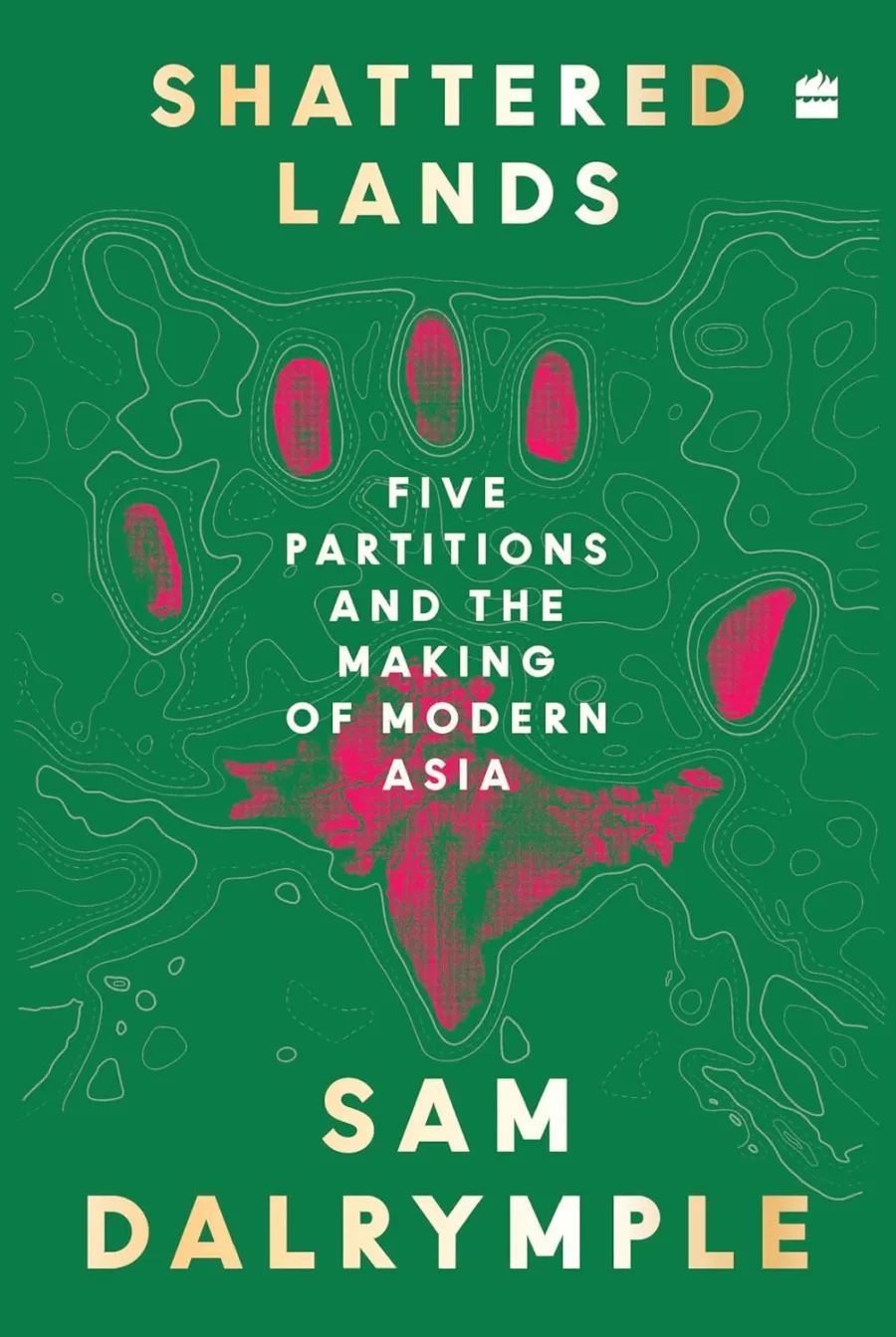
Shattered Lands : Five Partitions and the Making of Modern Asia
Hardcover
• 563 Pages
• ₹ 799.00
• English
• 9789369894628
No ratings yet
| Publisher | Fourth Estate India |
|---|---|
| ISBN13 | 9789369894628 |
| ASIN/SKU | 9369894624 |
| Book Format | Hardcover |
| Language | English |
| Pages | 563 |
| List Price | ₹ 799.00 |
| Publishing Date | 19/06/2025 |
| Weight | 450 g |
| Book Code | BD00070193 |
Buy this Book
Amazon Stores
Ebook Stores
Other Stores
Discover Shattered Lands : Five Partitions and the Making of Modern Asia by Sam Dalrymple. This book is published by Fourth Estate India in Hardcover format, ISBN 9789369894628, ASIN 9369894624, under History, Colonialism and Imperialism History, Indian History.
Book Description
A history of modern South Asia told through five partitions that reshaped it.
As recently as 1928, a vast swathe of Asia--India, Pakistan, Bangladesh, Burma, Nepal, Bhutan, Yemen, Oman, the UAE, Qatar, Bahrain and Kuwait--were bound together under a single imperial banner, an entity known officially as the 'Indian Empire', or more simply as the Raj.
It was the British Empire's crown jewel, a vast dominion stretching from the Red Sea to the jungles of Southeast Asia, home to a quarter of the world's population and encompassing the largest Hindu, Muslim, Sikh and Zoroastrian communities on the planet. Its people used the Indian rupee, were issued passports stamped 'Indian Empire', and were guarded by armies garrisoned forts from the Bab el-Mandab to the Himalayas.
And then, in the space of just fifty years, the Indian Empire shattered. Five partitions tore it apart, carving out new nations, redrawing maps, and leaving behind a legacy of war, exile and division.
Shattered Lands, for the first time, presents the whole story of how the Indian Empire was unmade. How a single, sprawling dominion became twelve modern nations. How maps were redrawn in boardrooms and on battlefields, by politicians in London and revolutionaries in Delhi, by kings in remote palaces and soldiers in trenches.
Its legacies include civil wars in Burma and Sri Lanka, ongoing insurgencies in Kashmir, Baluchistan, Northeast India, and the Rohingya genocide. It is a history of ambition and betrayal, of forgotten wars and unlikely alliances, of borders carved with ink and fire. And, above all, it is the story of how the map of modern Asia was made.
Sam Dalrymple's stunning narrative is based on deep archival research, previously untranslated private memoirs, and interviews in English, Hindi, Urdu, Bengali, Punjabi, Konyak, Arabic and Burmese. From portraits of the key political players to accounts of those swept up in these wars and mass migrations, Shattered Lands is vivid, compelling, thought-provoking history at its best.
As recently as 1928, a vast swathe of Asia--India, Pakistan, Bangladesh, Burma, Nepal, Bhutan, Yemen, Oman, the UAE, Qatar, Bahrain and Kuwait--were bound together under a single imperial banner, an entity known officially as the 'Indian Empire', or more simply as the Raj.
It was the British Empire's crown jewel, a vast dominion stretching from the Red Sea to the jungles of Southeast Asia, home to a quarter of the world's population and encompassing the largest Hindu, Muslim, Sikh and Zoroastrian communities on the planet. Its people used the Indian rupee, were issued passports stamped 'Indian Empire', and were guarded by armies garrisoned forts from the Bab el-Mandab to the Himalayas.
And then, in the space of just fifty years, the Indian Empire shattered. Five partitions tore it apart, carving out new nations, redrawing maps, and leaving behind a legacy of war, exile and division.
Shattered Lands, for the first time, presents the whole story of how the Indian Empire was unmade. How a single, sprawling dominion became twelve modern nations. How maps were redrawn in boardrooms and on battlefields, by politicians in London and revolutionaries in Delhi, by kings in remote palaces and soldiers in trenches.
Its legacies include civil wars in Burma and Sri Lanka, ongoing insurgencies in Kashmir, Baluchistan, Northeast India, and the Rohingya genocide. It is a history of ambition and betrayal, of forgotten wars and unlikely alliances, of borders carved with ink and fire. And, above all, it is the story of how the map of modern Asia was made.
Sam Dalrymple's stunning narrative is based on deep archival research, previously untranslated private memoirs, and interviews in English, Hindi, Urdu, Bengali, Punjabi, Konyak, Arabic and Burmese. From portraits of the key political players to accounts of those swept up in these wars and mass migrations, Shattered Lands is vivid, compelling, thought-provoking history at its best.
Author Biography
Sam Dalrymple is a Delhi-raised Scottish historian and award-winning film-maker. He graduated from Oxford University as a Persian and Sanskrit scholar, and also studied at the University of Isfahan and Ferdowsi University of Mashhad in Iran. He has worked across South and Central Asia, including stints with Turquoise Mountain in Kabul, and with the Aga Khan Trust for Culture in Hunza and Lahore. In 2018, he co-founded Project Dastaan, a peace-building initiative that reconnects refugees displaced by the 1947 Partition of India. His debut film, Child of Empire, premiered at the Sundance Film Festival in 2022, and his animated series, Lost Migrations, sold out at the British Film Institute the same year. His writing has appeared in the New York Times and The Spectator, and his work has been featured in TIME, The New Yorker and The Economist. He is a columnist for Architectural Digest and, in 2025, Travel & Leisure named him ‘Champion of the Travel Narrative'. He was a guest editor for the Indian art journal MARG for their volume ‘Beyond the Mughal Arch: Temples in Early Modern Hindustan'. He runs the history Substack page @travelsofsamwise. Shattered Lands is his first book.
Editorial Reviews
Editorial Reviews will be added soon…
Book Summary
Sam Dalrymple’s Shattered Lands: Five Partitions and the Making of Modern Asia is an ambitious work of modern Asian history that examines how the political map of the region was repeatedly broken apart by partition, displacement, nationalism, colonialism, and the collapse of old empires. Rather than treating the 1947 Partition of British India as an isolated historical event, Dalrymple places it within a much wider Asian story. The book asks how borders were created, why communities that had lived together for generations became divided, and how the consequences of those divisions continue to shape South Asia and the wider Asian world. For readers searching for a Shattered Lands book summary, the central idea is that Partition was not one singular rupture but part of a broader twentieth-century history in which political boundaries repeatedly transformed communities, identities, and nations.
The title, Shattered Lands, captures the emotional and geographical character of Dalrymple’s subject. A partition is more than a line drawn across a map. It can divide families, villages, religious communities, trade routes, cultural regions, and memories. Dalrymple is particularly interested in what happens to people when political borders suddenly become more important than the older networks that connected them. His approach moves beyond the familiar stories of political leaders and constitutional negotiations and focuses attention on the human consequences of dividing territories. Migration, violence, uncertainty, loss, and the struggle to rebuild life after displacement become essential parts of the historical narrative.
One of the most important features of the book is its comparative structure. Instead of examining only India and Pakistan, Dalrymple identifies five major partitions that helped shape modern Asia. The result is a wider historical framework in which the division of British India can be compared with other instances of political fragmentation. This approach encourages readers to see Partition not simply as an Indian tragedy but as one expression of a larger twentieth-century crisis involving the collapse of empires and the rise of competing ideas of the nation-state.
The first major background to this history is the decline of imperial systems. For centuries, much of Asia had been governed through empires whose borders did not necessarily correspond to modern ideas of nationhood. People could belong simultaneously to a particular locality, language community, religious tradition, dynasty, profession, or imperial system without thinking of themselves as citizens of a nation in the modern sense. Colonialism changed this political landscape. European powers increasingly organized territories through censuses, administrative divisions, legal categories, maps, and centralized institutions. Identities that had previously overlapped could become more rigid when governments began classifying populations according to religion, ethnicity, language, or other categories.
British India provides one of the clearest examples of this transformation. The subcontinent contained extraordinary linguistic, religious, cultural, and regional diversity, but its communities were also deeply interconnected. Hindus, Muslims, Sikhs, Christians, Jains, Buddhists, and others lived in many of the same cities and regions. People traded with one another, worked together, shared artistic traditions, participated in local customs, and maintained complex social relationships. Yet the political crisis of the late colonial period increasingly encouraged the idea that religious communities represented distinct political interests. The demand for Pakistan eventually became one of the defining forces behind the end of British rule.
Dalrymple’s broader argument makes it impossible to understand the 1947 Partition simply as the inevitable result of ancient religious conflict. The violence of Partition did not emerge because Hindus and Muslims had always been enemies. Political circumstances, colonial administrative practices, competing nationalisms, fears about political representation, elite negotiations, economic anxieties, and the rapid collapse of British authority all contributed to the catastrophe. The rushed transfer of power meant that the new boundary between India and Pakistan was announced only after independence, leaving millions of people uncertain about which side of the border they would belong to.
The human consequences were enormous. Around fifteen million people crossed the newly created borders, while hundreds of thousands—and possibly more than a million—people died in the violence that accompanied the migration. Entire communities were uprooted. Families were separated, homes abandoned, property lost, and memories of places that had existed for generations suddenly became memories of another country. Refugees who had previously thought of themselves as residents of a particular town or village were forced to redefine themselves according to new national identities. Dalrymple’s history is especially powerful when it demonstrates that the map could change much faster than people’s emotional attachments to the places they called home.
The Sikh experience is particularly important in understanding the brutality of Partition. Punjab was divided between India and Pakistan, despite the region’s deep intercommunal connections. Sikhs, Hindus, and Muslims were caught in an extraordinary cycle of fear and violence. Families fled in opposite directions, trains became associated with massacres, and villages that had contained multiple communities were emptied. The partition of Punjab demonstrates the terrible irony of modern borders: a line intended to separate political communities could produce some of the most violent forced migrations in modern history.
Bengal presents a different but equally important story. The division of Bengal separated communities and disrupted cultural and economic relationships that had developed over centuries. Unlike Punjab, where mass migration occurred with extraordinary speed, the consequences in Bengal unfolded over a longer period. Migration continued for years, and the border remained a source of tension. Dalrymple’s broader framework helps reveal that Partition did not have one universal pattern. Different regions experienced different combinations of violence, migration, political anxiety, and adaptation.
This regional diversity matters because popular accounts of Partition sometimes reduce the event to a single story. Shattered Lands instead suggests that there were many Partitions within Partition. The experience of a refugee from Lahore was not identical to that of someone displaced from Bengal. A person leaving a city could have a different experience from a family escaping a rural village. Women often experienced displacement and violence differently from men, while children carried memories of Partition into later generations. By bringing attention to these different experiences, the book encourages a more human understanding of historical catastrophe.
The wider Asian comparisons deepen this argument. Partition in the Indian subcontinent occurred within a period when other Asian regions were also experiencing dramatic political fragmentation. The end of colonial rule, the retreat of European empires, civil wars, ethnic nationalism, religious politics, and Cold War rivalries all contributed to the creation of new borders. In some cases, old imperial territories were divided into new states; in others, political movements attempted to consolidate territories around particular ethnic, religious, or linguistic identities.
The comparison with Korea is especially revealing. The division of Korea into North and South created a border that did not simply separate two political administrations; it eventually became one of the most militarized frontiers in the world. Families were separated, millions were displaced or killed during the Korean War, and the division became institutionalized through decades of ideological conflict. The Korean case demonstrates how a temporary political arrangement can become a permanent geopolitical reality.
The division of Vietnam provides another example of how the Cold War intensified territorial fragmentation. Vietnam was divided into North and South, with the boundary becoming the center of a devastating conflict. Although the historical circumstances differed from those of India and Pakistan, the comparison highlights the way external powers could influence the creation and maintenance of political divisions within Asian societies. Borders were no longer simply products of local political movements; they could also become instruments of global ideological competition.
The partition of Palestine is another major part of the broader twentieth-century story of borders, displacement, and competing national claims. Here too, the creation and attempted creation of political boundaries involved communities with deeply rooted connections to the same territory. The resulting conflict produced mass displacement and continuing political disputes. The comparison with South Asia reinforces Dalrymple’s central concern: when competing national projects claim the same land, the drawing of borders can create new forms of insecurity rather than simply resolving old conflicts.
The final case within Dalrymple’s framework extends the discussion into another part of Asia and further demonstrates how the twentieth century repeatedly transformed complex, multiethnic territories into states organized around narrower national identities. The common thread among these histories is not that all partitions were identical. They were not. Rather, the comparison shows that partition repeatedly appeared as a political solution to apparently insoluble problems—and that the human consequences could be much more complicated than the architects of those solutions anticipated.
One of the book’s most significant insights is that borders often appear neat on maps but chaotic in human life. A cartographer can draw a line across a territory in a relatively short period. People, however, cannot instantly redraw their memories, friendships, marriages, family histories, religious practices, or economic networks. A new international boundary may classify someone as a foreigner in the place where their grandparents were born. A market that once served an entire region can suddenly become divided between two countries. A pilgrimage route can be interrupted. A language community can become split across borders.
This is why migration occupies such an important place in the story. Refugees are not simply statistics. They are people who must reconstruct ordinary life after losing the physical foundations of their previous existence. They need homes, employment, schools, food, legal documents, and social networks. Many also carry trauma. The refugee experience can therefore continue long after the political crisis officially ends. Children and grandchildren may inherit stories of lost homes and abandoned ancestral places even when they themselves were born decades after Partition.
Memory is consequently another major theme. Partition created memories that were simultaneously personal and political. For some families, the past became a story of heroic survival. For others, it became a source of grief, guilt, anger, or silence. Many survivors avoided discussing what they had experienced, while others passed stories to younger generations. Dalrymple’s historical approach is valuable because it treats memory as an important part of understanding how political violence survives beyond the original event.
The book also challenges simplistic ideas about national identity. Modern nation-states often encourage people to think of themselves as belonging primarily to one national community. Yet the histories explored by Dalrymple show that identities are usually layered. A person can be Bengali and Indian, Punjabi and Pakistani, Kashmiri and something else, Muslim and South Asian, or connected simultaneously to a village, a language, a religion, and a family history. Partition forces these overlapping identities into political categories, sometimes violently.
The political leaders who shaped these transformations remain important, but Dalrymple’s approach shifts attention away from treating history solely as the product of famous individuals. Leaders such as Muhammad Ali Jinnah, Jawaharlal Nehru, Mahatma Gandhi, and others mattered enormously, but the outcome was also shaped by institutions, colonial policies, mass movements, local fears, ordinary decisions, and events that moved beyond the control of political elites. Partition became a process in which political decisions interacted with rapidly escalating violence and population movement.
Another important theme is the danger of rushed political transitions. The British withdrawal from India happened under enormous time pressure. The boundary-making process could not adequately account for the complexity of local communities, administrative structures, property ownership, transport, security, and population movements. Once violence began, institutions struggled to contain it. The lesson extends beyond South Asia: political borders imposed during moments of crisis can create consequences that last for generations.
For readers interested in modern Asian history, Shattered Lands is particularly valuable because it connects events that are often studied separately. The Partition of India, the division of Korea, Vietnam’s division, the Palestine question, and other territorial ruptures are frequently treated as independent historical subjects. Dalrymple instead places them within a shared twentieth-century context of imperial collapse, nationalism, migration, and border-making. This comparative method encourages readers to ask not only “What caused Partition in India?” but also “Why did partition become such a recurring political response across Asia?”
The book’s deeper message is ultimately about the human cost of dividing political space. Nations require borders, but borders are not neutral. They determine citizenship, movement, legal rights, political belonging, and access to resources. When borders are drawn through territories where populations are deeply mixed, the consequences can be traumatic. A political map may appear stable once a boundary is established, but the social world on either side may remain shaped by the violence and displacement that created it.
For readers searching for a Shattered Lands: Five Partitions and the Making of Modern Asia summary, the book can therefore be understood as a comparative history of how modern Asia was created through repeated acts of territorial division. Its central focus is not merely the drawing of borders but the transformation of human lives that followed. Dalrymple shows how imperial decline, nationalism, religious and ethnic politics, Cold War competition, and the creation of new nation-states repeatedly produced divided lands and displaced populations.
What makes the book especially compelling is its insistence that history should be understood through people as well as maps. The most important question is not simply where a border was drawn, but what happened to the people living there afterward. Who had to leave? Who was able to remain? Which homes were lost? Which memories survived? Which identities changed? And what happens when descendants continue to carry the consequences of a political decision made generations earlier?
Ultimately, Shattered Lands offers a powerful way of understanding modern Asia: not as a collection of countries that naturally emerged in their present form, but as a region profoundly reshaped by political decisions, imperial collapse, competing nationalisms, and forced migrations. Its story is one of broken landscapes but also of human resilience. People rebuilt cities, established new communities, created new identities, and carried fragments of their old worlds into their new homes. The borders remained, but the cultural connections did not disappear completely.
For anyone interested in the history of Partition, India and Pakistan, South Asian history, modern Asian geopolitics, nationalism, refugees, migration, or the long-term consequences of colonial rule, Shattered Lands provides a broad and deeply human framework. Its greatest contribution is to make the reader see partition not as a line on a map, but as a rupture in human relationships. The modern borders of Asia may look permanent today, but Dalrymple’s history reminds us that they were created through turbulent, often painful processes—and that the people who lived through those transformations continue to carry their consequences.
The title, Shattered Lands, captures the emotional and geographical character of Dalrymple’s subject. A partition is more than a line drawn across a map. It can divide families, villages, religious communities, trade routes, cultural regions, and memories. Dalrymple is particularly interested in what happens to people when political borders suddenly become more important than the older networks that connected them. His approach moves beyond the familiar stories of political leaders and constitutional negotiations and focuses attention on the human consequences of dividing territories. Migration, violence, uncertainty, loss, and the struggle to rebuild life after displacement become essential parts of the historical narrative.
One of the most important features of the book is its comparative structure. Instead of examining only India and Pakistan, Dalrymple identifies five major partitions that helped shape modern Asia. The result is a wider historical framework in which the division of British India can be compared with other instances of political fragmentation. This approach encourages readers to see Partition not simply as an Indian tragedy but as one expression of a larger twentieth-century crisis involving the collapse of empires and the rise of competing ideas of the nation-state.
The first major background to this history is the decline of imperial systems. For centuries, much of Asia had been governed through empires whose borders did not necessarily correspond to modern ideas of nationhood. People could belong simultaneously to a particular locality, language community, religious tradition, dynasty, profession, or imperial system without thinking of themselves as citizens of a nation in the modern sense. Colonialism changed this political landscape. European powers increasingly organized territories through censuses, administrative divisions, legal categories, maps, and centralized institutions. Identities that had previously overlapped could become more rigid when governments began classifying populations according to religion, ethnicity, language, or other categories.
British India provides one of the clearest examples of this transformation. The subcontinent contained extraordinary linguistic, religious, cultural, and regional diversity, but its communities were also deeply interconnected. Hindus, Muslims, Sikhs, Christians, Jains, Buddhists, and others lived in many of the same cities and regions. People traded with one another, worked together, shared artistic traditions, participated in local customs, and maintained complex social relationships. Yet the political crisis of the late colonial period increasingly encouraged the idea that religious communities represented distinct political interests. The demand for Pakistan eventually became one of the defining forces behind the end of British rule.
Dalrymple’s broader argument makes it impossible to understand the 1947 Partition simply as the inevitable result of ancient religious conflict. The violence of Partition did not emerge because Hindus and Muslims had always been enemies. Political circumstances, colonial administrative practices, competing nationalisms, fears about political representation, elite negotiations, economic anxieties, and the rapid collapse of British authority all contributed to the catastrophe. The rushed transfer of power meant that the new boundary between India and Pakistan was announced only after independence, leaving millions of people uncertain about which side of the border they would belong to.
The human consequences were enormous. Around fifteen million people crossed the newly created borders, while hundreds of thousands—and possibly more than a million—people died in the violence that accompanied the migration. Entire communities were uprooted. Families were separated, homes abandoned, property lost, and memories of places that had existed for generations suddenly became memories of another country. Refugees who had previously thought of themselves as residents of a particular town or village were forced to redefine themselves according to new national identities. Dalrymple’s history is especially powerful when it demonstrates that the map could change much faster than people’s emotional attachments to the places they called home.
The Sikh experience is particularly important in understanding the brutality of Partition. Punjab was divided between India and Pakistan, despite the region’s deep intercommunal connections. Sikhs, Hindus, and Muslims were caught in an extraordinary cycle of fear and violence. Families fled in opposite directions, trains became associated with massacres, and villages that had contained multiple communities were emptied. The partition of Punjab demonstrates the terrible irony of modern borders: a line intended to separate political communities could produce some of the most violent forced migrations in modern history.
Bengal presents a different but equally important story. The division of Bengal separated communities and disrupted cultural and economic relationships that had developed over centuries. Unlike Punjab, where mass migration occurred with extraordinary speed, the consequences in Bengal unfolded over a longer period. Migration continued for years, and the border remained a source of tension. Dalrymple’s broader framework helps reveal that Partition did not have one universal pattern. Different regions experienced different combinations of violence, migration, political anxiety, and adaptation.
This regional diversity matters because popular accounts of Partition sometimes reduce the event to a single story. Shattered Lands instead suggests that there were many Partitions within Partition. The experience of a refugee from Lahore was not identical to that of someone displaced from Bengal. A person leaving a city could have a different experience from a family escaping a rural village. Women often experienced displacement and violence differently from men, while children carried memories of Partition into later generations. By bringing attention to these different experiences, the book encourages a more human understanding of historical catastrophe.
The wider Asian comparisons deepen this argument. Partition in the Indian subcontinent occurred within a period when other Asian regions were also experiencing dramatic political fragmentation. The end of colonial rule, the retreat of European empires, civil wars, ethnic nationalism, religious politics, and Cold War rivalries all contributed to the creation of new borders. In some cases, old imperial territories were divided into new states; in others, political movements attempted to consolidate territories around particular ethnic, religious, or linguistic identities.
The comparison with Korea is especially revealing. The division of Korea into North and South created a border that did not simply separate two political administrations; it eventually became one of the most militarized frontiers in the world. Families were separated, millions were displaced or killed during the Korean War, and the division became institutionalized through decades of ideological conflict. The Korean case demonstrates how a temporary political arrangement can become a permanent geopolitical reality.
The division of Vietnam provides another example of how the Cold War intensified territorial fragmentation. Vietnam was divided into North and South, with the boundary becoming the center of a devastating conflict. Although the historical circumstances differed from those of India and Pakistan, the comparison highlights the way external powers could influence the creation and maintenance of political divisions within Asian societies. Borders were no longer simply products of local political movements; they could also become instruments of global ideological competition.
The partition of Palestine is another major part of the broader twentieth-century story of borders, displacement, and competing national claims. Here too, the creation and attempted creation of political boundaries involved communities with deeply rooted connections to the same territory. The resulting conflict produced mass displacement and continuing political disputes. The comparison with South Asia reinforces Dalrymple’s central concern: when competing national projects claim the same land, the drawing of borders can create new forms of insecurity rather than simply resolving old conflicts.
The final case within Dalrymple’s framework extends the discussion into another part of Asia and further demonstrates how the twentieth century repeatedly transformed complex, multiethnic territories into states organized around narrower national identities. The common thread among these histories is not that all partitions were identical. They were not. Rather, the comparison shows that partition repeatedly appeared as a political solution to apparently insoluble problems—and that the human consequences could be much more complicated than the architects of those solutions anticipated.
One of the book’s most significant insights is that borders often appear neat on maps but chaotic in human life. A cartographer can draw a line across a territory in a relatively short period. People, however, cannot instantly redraw their memories, friendships, marriages, family histories, religious practices, or economic networks. A new international boundary may classify someone as a foreigner in the place where their grandparents were born. A market that once served an entire region can suddenly become divided between two countries. A pilgrimage route can be interrupted. A language community can become split across borders.
This is why migration occupies such an important place in the story. Refugees are not simply statistics. They are people who must reconstruct ordinary life after losing the physical foundations of their previous existence. They need homes, employment, schools, food, legal documents, and social networks. Many also carry trauma. The refugee experience can therefore continue long after the political crisis officially ends. Children and grandchildren may inherit stories of lost homes and abandoned ancestral places even when they themselves were born decades after Partition.
Memory is consequently another major theme. Partition created memories that were simultaneously personal and political. For some families, the past became a story of heroic survival. For others, it became a source of grief, guilt, anger, or silence. Many survivors avoided discussing what they had experienced, while others passed stories to younger generations. Dalrymple’s historical approach is valuable because it treats memory as an important part of understanding how political violence survives beyond the original event.
The book also challenges simplistic ideas about national identity. Modern nation-states often encourage people to think of themselves as belonging primarily to one national community. Yet the histories explored by Dalrymple show that identities are usually layered. A person can be Bengali and Indian, Punjabi and Pakistani, Kashmiri and something else, Muslim and South Asian, or connected simultaneously to a village, a language, a religion, and a family history. Partition forces these overlapping identities into political categories, sometimes violently.
The political leaders who shaped these transformations remain important, but Dalrymple’s approach shifts attention away from treating history solely as the product of famous individuals. Leaders such as Muhammad Ali Jinnah, Jawaharlal Nehru, Mahatma Gandhi, and others mattered enormously, but the outcome was also shaped by institutions, colonial policies, mass movements, local fears, ordinary decisions, and events that moved beyond the control of political elites. Partition became a process in which political decisions interacted with rapidly escalating violence and population movement.
Another important theme is the danger of rushed political transitions. The British withdrawal from India happened under enormous time pressure. The boundary-making process could not adequately account for the complexity of local communities, administrative structures, property ownership, transport, security, and population movements. Once violence began, institutions struggled to contain it. The lesson extends beyond South Asia: political borders imposed during moments of crisis can create consequences that last for generations.
For readers interested in modern Asian history, Shattered Lands is particularly valuable because it connects events that are often studied separately. The Partition of India, the division of Korea, Vietnam’s division, the Palestine question, and other territorial ruptures are frequently treated as independent historical subjects. Dalrymple instead places them within a shared twentieth-century context of imperial collapse, nationalism, migration, and border-making. This comparative method encourages readers to ask not only “What caused Partition in India?” but also “Why did partition become such a recurring political response across Asia?”
The book’s deeper message is ultimately about the human cost of dividing political space. Nations require borders, but borders are not neutral. They determine citizenship, movement, legal rights, political belonging, and access to resources. When borders are drawn through territories where populations are deeply mixed, the consequences can be traumatic. A political map may appear stable once a boundary is established, but the social world on either side may remain shaped by the violence and displacement that created it.
For readers searching for a Shattered Lands: Five Partitions and the Making of Modern Asia summary, the book can therefore be understood as a comparative history of how modern Asia was created through repeated acts of territorial division. Its central focus is not merely the drawing of borders but the transformation of human lives that followed. Dalrymple shows how imperial decline, nationalism, religious and ethnic politics, Cold War competition, and the creation of new nation-states repeatedly produced divided lands and displaced populations.
What makes the book especially compelling is its insistence that history should be understood through people as well as maps. The most important question is not simply where a border was drawn, but what happened to the people living there afterward. Who had to leave? Who was able to remain? Which homes were lost? Which memories survived? Which identities changed? And what happens when descendants continue to carry the consequences of a political decision made generations earlier?
Ultimately, Shattered Lands offers a powerful way of understanding modern Asia: not as a collection of countries that naturally emerged in their present form, but as a region profoundly reshaped by political decisions, imperial collapse, competing nationalisms, and forced migrations. Its story is one of broken landscapes but also of human resilience. People rebuilt cities, established new communities, created new identities, and carried fragments of their old worlds into their new homes. The borders remained, but the cultural connections did not disappear completely.
For anyone interested in the history of Partition, India and Pakistan, South Asian history, modern Asian geopolitics, nationalism, refugees, migration, or the long-term consequences of colonial rule, Shattered Lands provides a broad and deeply human framework. Its greatest contribution is to make the reader see partition not as a line on a map, but as a rupture in human relationships. The modern borders of Asia may look permanent today, but Dalrymple’s history reminds us that they were created through turbulent, often painful processes—and that the people who lived through those transformations continue to carry their consequences.
Sample Chapters
Sample Chapters will be added soon…
Reader Reviews
No reviews yet.
Shattered Lands : Five Partitions and the Making of Modern Asia
Download Cover Image
Do you want to download the full cover image for Shattered Lands : Five Partitions and the Making of Modern Asia?