
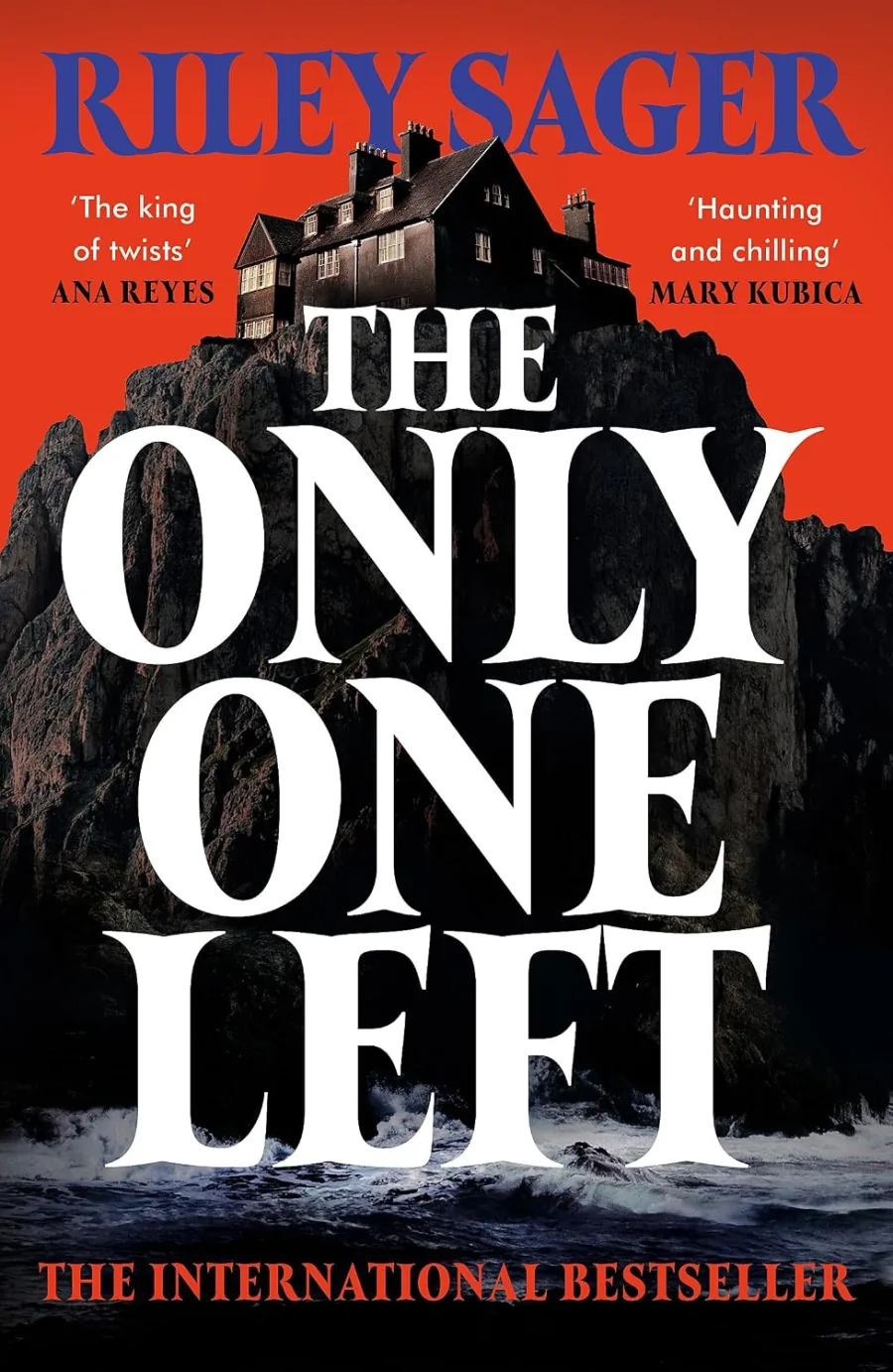
The Only One Left
Paperback
• 400 Pages
• ₹ 599.00
• English
• 9781399712378
No ratings yet
| Publisher | Hodder Paperback |
|---|---|
| ISBN13 | 9781399712378 |
| ASIN/SKU | 1399712373 |
| Book Format | Paperback |
| Language | English |
| Pages | 400 |
| List Price | ₹ 599.00 |
| Publishing Date | 28/12/2023 |
| Dimensions | 12.6 x 3.2 x 19.6 cm |
| Weight | 1 kg 50 g |
| Book Code | BD00070192 |
Buy this Book
Amazon Stores
Ebook Stores
Other Stores
Discover The Only One Left by Riley Sager. This book is published by Hodder Paperback in Paperback format, ISBN 9781399712378, ASIN 1399712373, under Literature and Fiction, Crime Fiction, Mysteries.
Book Description
Get the brand new, Agatha Christie-inspired suspense thriller from Riley Sager now - WITH A VENGEANCE
THE HEART-POUNDING GOTHIC THRILLER FROM THE INTERNATIONALLY BESTSELLING AUTHOR
Everyone believes that Lenora Hope is a mass murderer.
When the Hope family was massacred decades ago, she was the only one left after that tragic night.
Mute, paralysed and confined to a wheelchair, Lenora has never been able to tell her side of the story.
Until her new live-in caregiver Kit brings her a typewriter.
And with one working finger Lenora begins to type:
I want to tell you everything.
Real readers LOVE The Only One Left:
''Plot twists on plot twists! A story that keeps you guessing throughout'' ⭐⭐⭐⭐⭐
''Kept me guessing to the very end'' ⭐⭐⭐⭐⭐
''I literally couldn''t leave this story alone'' ⭐⭐⭐⭐⭐
''The tension throughout this book is so intense it is breath taking'' ⭐⭐⭐⭐⭐
''I devoured this in a single sitting'' ⭐⭐⭐⭐⭐
''Laden with an abundance of twists and turns that are truly mind-bending'' ⭐⭐⭐⭐⭐
''The ending though . . . didn''t see that one coming!'' ⭐⭐⭐⭐⭐
''Riley never fails to disappoint me, now to wait for the next book...'' ⭐⭐⭐⭐⭐
And your favourite authors love it too...
''A master storyteller'' ALEX MICHAELIDES
''Spine-chilling'' RUTH WARE
''Twisty'' SHARI LAPENA
''Addictive'' STEPHANIE WROBEL
''Propulsive'' ELLERY LLOYD
''Terrific'' KARIN SLAUGHTER
''Shocking'' LISA GARDNER
THE HEART-POUNDING GOTHIC THRILLER FROM THE INTERNATIONALLY BESTSELLING AUTHOR
Everyone believes that Lenora Hope is a mass murderer.
When the Hope family was massacred decades ago, she was the only one left after that tragic night.
Mute, paralysed and confined to a wheelchair, Lenora has never been able to tell her side of the story.
Until her new live-in caregiver Kit brings her a typewriter.
And with one working finger Lenora begins to type:
I want to tell you everything.
Real readers LOVE The Only One Left:
''Plot twists on plot twists! A story that keeps you guessing throughout'' ⭐⭐⭐⭐⭐
''Kept me guessing to the very end'' ⭐⭐⭐⭐⭐
''I literally couldn''t leave this story alone'' ⭐⭐⭐⭐⭐
''The tension throughout this book is so intense it is breath taking'' ⭐⭐⭐⭐⭐
''I devoured this in a single sitting'' ⭐⭐⭐⭐⭐
''Laden with an abundance of twists and turns that are truly mind-bending'' ⭐⭐⭐⭐⭐
''The ending though . . . didn''t see that one coming!'' ⭐⭐⭐⭐⭐
''Riley never fails to disappoint me, now to wait for the next book...'' ⭐⭐⭐⭐⭐
And your favourite authors love it too...
''A master storyteller'' ALEX MICHAELIDES
''Spine-chilling'' RUTH WARE
''Twisty'' SHARI LAPENA
''Addictive'' STEPHANIE WROBEL
''Propulsive'' ELLERY LLOYD
''Terrific'' KARIN SLAUGHTER
''Shocking'' LISA GARDNER
Author Biography
Riley Sager is the New York Times bestselling author of ten novels, most recently With a Vengeance, Middle of the Night and The Only One Left.
His novels have been published in 40 countries, with more than 4 million copies sold worldwide. The Unknown is his latest book.
A native of Pennsylvania, he now lives in Princeton, New Jersey.
His novels have been published in 40 countries, with more than 4 million copies sold worldwide. The Unknown is his latest book.
A native of Pennsylvania, he now lives in Princeton, New Jersey.
Editorial Reviews
Editorial Reviews will be added soon…
Book Summary
Riley Sager’s The Only One Left is a Gothic psychological thriller built around a decades-old family massacre, a crumbling mansion, a mysterious elderly woman, and a young caregiver determined to discover what really happened. Published in 2023, the novel combines murder mystery, Gothic horror, historical suspense, family secrets, unreliable testimony, and multiple reversals. Its central mystery concerns Lenora Hope, the sole surviving member of a wealthy Maine family whose parents and sister were brutally murdered in 1929. For decades, everyone has believed that seventeen-year-old Lenora committed the killings, but she was never convicted, and she has never publicly explained what happened. In 1983, a young home-health aide named Kit McDeere arrives at the isolated Hope’s End mansion to care for Lenora, who is now elderly, paralyzed, and unable to speak. When Lenora begins typing, “I want to tell you everything,” Kit finds herself drawn into a mystery that becomes increasingly dangerous.
The novel immediately creates an atmosphere of Gothic unease. Hope’s End is not merely the setting for the story; it is almost a character itself. Perched on a cliff above the Maine coast, the mansion is old, decaying, isolated, and filled with the remnants of a family whose history has become local legend. The house has the qualities readers expect from classic Gothic fiction: secrets behind closed doors, hidden rooms, unreliable memories, strange noises, family scandals, and a sense that the past has never really disappeared. The mansion’s physical deterioration mirrors the collapse of the Hope family itself. What was once a place of wealth and privilege has become a haunted monument to violence and unanswered questions.
The story begins with the infamous Hope family murders of 1929. Seventeen-year-old Lenora Hope was accused of killing her father, mother, and younger sister. The case became so notorious that a schoolyard rhyme about the murders survived for decades. The rhyme reduces a complicated tragedy to a few brutal lines, turning Lenora into a local monster before she has ever been given an opportunity to tell her side. The police could not prove that she committed the murders, but public opinion effectively convicted her anyway. She remained at Hope’s End, withdrew from public life, and eventually became the only living person who could potentially explain what happened that night.
More than fifty years later, Kit McDeere arrives at Hope’s End. Kit is not an entirely conventional heroine. She has her own troubled history and is trying to rebuild her life after a scandal involving her mother. Her past makes it difficult for her to find employment, which is one reason she accepts the unusual position caring for Lenora. The job seems straightforward at first, but the circumstances surrounding it are immediately strange. Lenora’s previous caregiver has left suddenly, and nobody gives Kit a completely satisfactory explanation. This detail establishes an important pattern in the novel: every answer seems to conceal another question.
Lenora is particularly intriguing because she cannot speak. After suffering a series of strokes, she is confined to a wheelchair and apparently unable to communicate verbally. Her only reliable means of communication is an old typewriter. Kit initially has to help her establish a way of communicating, but soon Lenora begins typing messages with a single functioning finger. The typewriter becomes one of the novel’s most important objects because it transforms Lenora from a silent figure into a storyteller. Through it, she can finally present her version of the events that destroyed her family. The publisher’s description emphasizes this turning point: Lenora tells Kit that she wants to reveal everything about the massacre.
Kit is naturally skeptical. After all, Lenora has spent decades being accused of murdering her own family. If she really was innocent, why did she never tell her story? Why did she remain in the house? Why has she allowed the public to believe she was a murderer? And why does her former caregiver seem to have fled under mysterious circumstances? These questions make Kit uncertain about whether she is helping an innocent victim or living with someone much more dangerous than she appears.
The novel’s central tension comes from this uncertainty. Lenora tells Kit that she did not commit the murders, but Kit has no reason to accept that statement automatically. A person who has lived with an accusation for more than fifty years could have become an expert at manipulating others. At the same time, Lenora’s physical vulnerability makes it difficult to imagine her as a threat. She is elderly, wheelchair-bound, and unable to speak. Sager uses this contradiction effectively: the person who appears least capable of violence may possess the most dangerous secrets.
As Lenora begins recounting the past, the narrative moves between 1983 and 1929. This structure allows the reader to experience the Hope family tragedy while simultaneously watching Kit investigate the present-day consequences. The historical sections gradually introduce the personalities, tensions, ambitions, and relationships within the Hope household. The family is far from the harmonious wealthy household suggested by its public image. Beneath the surface are resentments, secrets, romantic entanglements, financial concerns, and emotional wounds.
This is where the novel becomes more than a simple “Who killed the family?” mystery. Sager is interested in how families construct appearances. The Hope family looks respectable from outside, but the private reality is considerably darker. Wealth does not eliminate fear, jealousy, loneliness, or cruelty. In fact, the family’s social position gives its members more opportunities to conceal their problems. The mansion becomes a closed environment in which everyone knows something about someone else, but nobody knows the entire truth.
Kit gradually discovers that the official version of the 1929 massacre is incomplete. The story she has heard all her life is essentially a legend: Lenora Hope murdered her family, survived, and somehow escaped punishment. But the deeper she goes, the more unstable this version becomes. People who were connected to the family remember events differently. Certain details do not fit. Some information was never made public. And the people who might have known the truth are either dead, unavailable, or unwilling to speak.
The investigation becomes even more complicated when Kit starts examining the circumstances surrounding her predecessor’s disappearance. This gives the novel two mysteries running simultaneously. The first concerns the Hope family murders of 1929. The second concerns what is happening inside Hope’s End in 1983. The possibility that the old violence is somehow connected to new danger keeps the tension high. Kit begins to wonder whether she has entered a house where the past is not merely remembered but still active.
The novel also makes strong use of the true-crime phenomenon. The Hope murders have become part of popular culture, and people are fascinated by Lenora’s story. The case has effectively turned a real family tragedy into entertainment. Sager uses this fascination to ask uncomfortable questions about why people become obsessed with murder cases. What happens when a human tragedy becomes a story people repeat for amusement? What is lost when complicated people are reduced to the labels “victim” and “killer”? The official publisher description and reviews specifically identify true-crime obsession as one of the novel’s themes.
Kit’s relationship with Lenora is therefore complicated by the fact that Kit is not merely caring for an elderly patient. She is listening to a person who may be the last surviving witness to a notorious crime. Lenora’s story gives Kit something nobody else has ever possessed: access to the past from the perspective of someone who was actually there. But because Lenora controls the information, she also controls the pace at which the truth is revealed.
This makes Lenora an intriguing example of an unreliable narrator. She does not necessarily lie in obvious ways. Instead, she chooses what to reveal and what to withhold. Her story arrives in fragments, forcing Kit to interpret the gaps. The reader therefore has to ask whether Lenora is telling the truth, telling a carefully edited version of the truth, or manipulating Kit for reasons that remain hidden. Every revelation simultaneously answers one question and creates another.
Kit herself becomes increasingly vulnerable as she investigates. Hope’s End is isolated, and the people around her cannot necessarily be trusted. Her position as a caregiver means she has limited power. She is living in someone else’s house, surrounded by people with deeper connections to the Hope family than she possesses. Her curiosity therefore carries real risk. The more she learns, the more dangerous it becomes to continue asking questions.
The historical story eventually reveals that the family relationships were much more complicated than the public narrative suggests. Lenora’s sister Virginia, her parents, and the people connected to them all have roles in the unfolding tragedy. The identities of the people involved are not always what they initially appear to be, and Sager repeatedly uses mistaken assumptions to redirect the mystery. The novel’s title itself becomes ironic because the phrase “the only one left” appears to describe Lenora, but the deeper meaning of survival changes as the truth about the family emerges.
One of the book’s most significant twists involves Lenora’s identity and the identity of Virginia, her supposedly dead sister. Lenora’s narrative eventually reveals that the person the world believes to be Lenora Hope is not exactly who the public thinks she is. The distinction between Lenora and Virginia becomes essential to understanding the massacre and the decades of secrecy that followed. This is one of several revelations that force the reader to reinterpret earlier events rather than simply adding new information to an already understood story.
Another major twist concerns Kit’s own family. The investigation eventually reaches beyond Hope’s End and into Kit’s personal history, making the mystery much more intimate. Her father, Patrick, becomes involved in the revelations, and Kit discovers that the story she thought she knew about her own family is also incomplete. The novel thus establishes a parallel between Kit and Lenora: both women are living with narratives about their pasts that have been shaped by other people.
The ultimate truth is that the original massacre was far more complicated than the public story suggested. Virginia survived the attempted murder and was subsequently able to move again, despite allowing others to believe she was paralyzed. She ultimately becomes a crucial figure in the truth behind the Hope family’s destruction. Patrick also has a hidden connection to the tragedy, and his actions help explain why some of the secrets remained concealed for so long. The result is not a simple revelation of one murderer but a tangled story of family relationships, deception, attempted suicide, murder, protection, and mistaken identity.
The climax takes place as Hope’s End itself begins to collapse. This is a fitting conclusion because the physical destruction of the mansion mirrors the destruction of the lies that have surrounded the Hope family for decades. The house has protected secrets for more than half a century, but eventually its foundations can no longer hold. Kit, Virginia, and Patrick are caught in the crisis, and survival depends on escaping before the mansion falls into the sea. According to published plot summaries, Patrick and Lenora ultimately help Kit and Virginia escape before returning to the collapsing house.
The ending then provides another significant reversal. Virginia, who has spent decades allowing people to believe she is disabled and confined to a wheelchair, eventually leaves Kit’s home without warning. Months later, Kit receives a letter explaining that Virginia has been physically capable of moving since shortly after the original events. She has chosen to leave because she wants to experience the world she lost so many years earlier. She also reveals another important secret: Jessie is her granddaughter, the daughter of her long-lost son. Virginia invites Kit and Archie to join her in Paris, transforming the ending from one of pure horror into something unexpectedly bittersweet.
This final revelation changes the meaning of Virginia’s entire existence. For decades, she has lived behind an identity built from tragedy. Her apparent paralysis has isolated her, but it has also allowed her to remain hidden. Once the truth is revealed, she can finally abandon the role she has been playing. Her decision to travel represents a kind of liberation. The woman who seemed trapped inside Hope’s End turns out to have been waiting for the opportunity to leave it behind.
The conclusion also gives the novel a surprisingly emotional dimension. Beneath all the murders and twists is a story about people trapped by the past. Lenora, Virginia, Kit, and the other characters are all dealing with forms of grief and secrecy. Some are trying to protect themselves. Others are trying to protect someone they love. Some are simply unable to let go. Hope’s End represents the physical form of this emotional imprisonment. The house contains the past so completely that leaving it becomes almost impossible.
One of the novel’s strongest themes is the unreliability of appearances. Lenora appears helpless but knows far more than she reveals. Virginia appears permanently disabled but is not. Kit appears to be a simple caregiver but becomes an investigator. The respectable Hope family conceals deep dysfunction. The local legend appears to provide an obvious explanation for the murders but turns out to be profoundly misleading. Sager repeatedly asks the reader not to trust first impressions.
Another major theme is the power of storytelling. The Hope murders become famous because people create a narrative around them. Once that narrative is established, it becomes difficult to challenge. Lenora’s innocence does not matter much to people who prefer the story of a teenage girl murdering her family. The book therefore examines how legends can replace facts. The truth can be complicated, while a simple story is easier to remember and repeat.
The novel also explores the destructive effects of secrets. The characters keep secrets because they believe they are protecting themselves or others, but secrecy gradually creates larger problems. A lie that seems manageable for one day can become impossible to maintain for fifty years. Sager shows how the past becomes more powerful when people refuse to confront it. The eventual destruction of Hope’s End can be interpreted symbolically as the collapse of an entire structure built on silence.
For readers searching for The Only One Left spoilers, ending explained, plot summary, or a detailed review, the novel’s appeal lies largely in the way its revelations repeatedly change the meaning of earlier scenes. It is a Gothic whodunit, but it is also a story about identity, family, grief, obsession, and the ways people manipulate public narratives. The official publisher describes it as a Gothic chiller and a “dizzying Gothic whodunit,” while other reviews have highlighted its similarities to classic Gothic fiction and true-crime mysteries.
The novel’s Gothic influences are particularly noticeable in Hope’s End. The isolated mansion, family curse-like atmosphere, hidden history, decaying architecture, and uncertain narrator recall the tradition of Gothic suspense associated with writers such as Daphne du Maurier and Edgar Allan Poe. Yet Sager modernizes these elements through his interest in true crime and psychological mystery. The result is a story that feels both old-fashioned and contemporary. It has the atmosphere of a haunted-house novel but the investigative structure of a modern thriller.
Ultimately, The Only One Left is a story about the danger of believing you already know the truth. Lenora Hope has spent more than fifty years being defined by an accusation that may not be true. Kit arrives believing that the mystery is straightforward, only to discover that nearly every important fact has another side. The people she trusts have secrets, the people she suspects may be innocent, and the house itself seems to preserve memories that refuse to disappear.
For anyone interested in Gothic thrillers, psychological mysteries, murder investigations, family secrets, unreliable narrators, historical crime fiction, or twist-heavy suspense novels, The Only One Left offers an especially compelling combination. It begins with a seemingly simple question—did Lenora Hope murder her family?—but expands into a much larger exploration of identity, memory, deception, and survival. The ultimate lesson is that a story repeated often enough can become accepted as truth, even when the person at its center has never had the opportunity to speak.
In the end, the title The Only One Left carries several meanings. It initially refers to Lenora as the apparent sole survivor of the Hope family massacre. But as the layers of the story are removed, survival becomes more complicated. The people who appear to have died may not all be dead, the people who appear to be victims may have made their own choices, and the people believed to be innocent may have participated in hidden acts. Sager turns survival itself into a mystery.
That is ultimately what makes The Only One Left such an effective psychological and Gothic thriller. It is not simply a story about who killed whom. It is about the stories people construct to survive, the identities they create to hide from painful truths, and the extraordinary consequences of allowing secrets to remain buried for generations. Hope’s End may finally collapse, but its destruction also represents freedom: once the walls fall, the truth can finally emerge.
The novel immediately creates an atmosphere of Gothic unease. Hope’s End is not merely the setting for the story; it is almost a character itself. Perched on a cliff above the Maine coast, the mansion is old, decaying, isolated, and filled with the remnants of a family whose history has become local legend. The house has the qualities readers expect from classic Gothic fiction: secrets behind closed doors, hidden rooms, unreliable memories, strange noises, family scandals, and a sense that the past has never really disappeared. The mansion’s physical deterioration mirrors the collapse of the Hope family itself. What was once a place of wealth and privilege has become a haunted monument to violence and unanswered questions.
The story begins with the infamous Hope family murders of 1929. Seventeen-year-old Lenora Hope was accused of killing her father, mother, and younger sister. The case became so notorious that a schoolyard rhyme about the murders survived for decades. The rhyme reduces a complicated tragedy to a few brutal lines, turning Lenora into a local monster before she has ever been given an opportunity to tell her side. The police could not prove that she committed the murders, but public opinion effectively convicted her anyway. She remained at Hope’s End, withdrew from public life, and eventually became the only living person who could potentially explain what happened that night.
More than fifty years later, Kit McDeere arrives at Hope’s End. Kit is not an entirely conventional heroine. She has her own troubled history and is trying to rebuild her life after a scandal involving her mother. Her past makes it difficult for her to find employment, which is one reason she accepts the unusual position caring for Lenora. The job seems straightforward at first, but the circumstances surrounding it are immediately strange. Lenora’s previous caregiver has left suddenly, and nobody gives Kit a completely satisfactory explanation. This detail establishes an important pattern in the novel: every answer seems to conceal another question.
Lenora is particularly intriguing because she cannot speak. After suffering a series of strokes, she is confined to a wheelchair and apparently unable to communicate verbally. Her only reliable means of communication is an old typewriter. Kit initially has to help her establish a way of communicating, but soon Lenora begins typing messages with a single functioning finger. The typewriter becomes one of the novel’s most important objects because it transforms Lenora from a silent figure into a storyteller. Through it, she can finally present her version of the events that destroyed her family. The publisher’s description emphasizes this turning point: Lenora tells Kit that she wants to reveal everything about the massacre.
Kit is naturally skeptical. After all, Lenora has spent decades being accused of murdering her own family. If she really was innocent, why did she never tell her story? Why did she remain in the house? Why has she allowed the public to believe she was a murderer? And why does her former caregiver seem to have fled under mysterious circumstances? These questions make Kit uncertain about whether she is helping an innocent victim or living with someone much more dangerous than she appears.
The novel’s central tension comes from this uncertainty. Lenora tells Kit that she did not commit the murders, but Kit has no reason to accept that statement automatically. A person who has lived with an accusation for more than fifty years could have become an expert at manipulating others. At the same time, Lenora’s physical vulnerability makes it difficult to imagine her as a threat. She is elderly, wheelchair-bound, and unable to speak. Sager uses this contradiction effectively: the person who appears least capable of violence may possess the most dangerous secrets.
As Lenora begins recounting the past, the narrative moves between 1983 and 1929. This structure allows the reader to experience the Hope family tragedy while simultaneously watching Kit investigate the present-day consequences. The historical sections gradually introduce the personalities, tensions, ambitions, and relationships within the Hope household. The family is far from the harmonious wealthy household suggested by its public image. Beneath the surface are resentments, secrets, romantic entanglements, financial concerns, and emotional wounds.
This is where the novel becomes more than a simple “Who killed the family?” mystery. Sager is interested in how families construct appearances. The Hope family looks respectable from outside, but the private reality is considerably darker. Wealth does not eliminate fear, jealousy, loneliness, or cruelty. In fact, the family’s social position gives its members more opportunities to conceal their problems. The mansion becomes a closed environment in which everyone knows something about someone else, but nobody knows the entire truth.
Kit gradually discovers that the official version of the 1929 massacre is incomplete. The story she has heard all her life is essentially a legend: Lenora Hope murdered her family, survived, and somehow escaped punishment. But the deeper she goes, the more unstable this version becomes. People who were connected to the family remember events differently. Certain details do not fit. Some information was never made public. And the people who might have known the truth are either dead, unavailable, or unwilling to speak.
The investigation becomes even more complicated when Kit starts examining the circumstances surrounding her predecessor’s disappearance. This gives the novel two mysteries running simultaneously. The first concerns the Hope family murders of 1929. The second concerns what is happening inside Hope’s End in 1983. The possibility that the old violence is somehow connected to new danger keeps the tension high. Kit begins to wonder whether she has entered a house where the past is not merely remembered but still active.
The novel also makes strong use of the true-crime phenomenon. The Hope murders have become part of popular culture, and people are fascinated by Lenora’s story. The case has effectively turned a real family tragedy into entertainment. Sager uses this fascination to ask uncomfortable questions about why people become obsessed with murder cases. What happens when a human tragedy becomes a story people repeat for amusement? What is lost when complicated people are reduced to the labels “victim” and “killer”? The official publisher description and reviews specifically identify true-crime obsession as one of the novel’s themes.
Kit’s relationship with Lenora is therefore complicated by the fact that Kit is not merely caring for an elderly patient. She is listening to a person who may be the last surviving witness to a notorious crime. Lenora’s story gives Kit something nobody else has ever possessed: access to the past from the perspective of someone who was actually there. But because Lenora controls the information, she also controls the pace at which the truth is revealed.
This makes Lenora an intriguing example of an unreliable narrator. She does not necessarily lie in obvious ways. Instead, she chooses what to reveal and what to withhold. Her story arrives in fragments, forcing Kit to interpret the gaps. The reader therefore has to ask whether Lenora is telling the truth, telling a carefully edited version of the truth, or manipulating Kit for reasons that remain hidden. Every revelation simultaneously answers one question and creates another.
Kit herself becomes increasingly vulnerable as she investigates. Hope’s End is isolated, and the people around her cannot necessarily be trusted. Her position as a caregiver means she has limited power. She is living in someone else’s house, surrounded by people with deeper connections to the Hope family than she possesses. Her curiosity therefore carries real risk. The more she learns, the more dangerous it becomes to continue asking questions.
The historical story eventually reveals that the family relationships were much more complicated than the public narrative suggests. Lenora’s sister Virginia, her parents, and the people connected to them all have roles in the unfolding tragedy. The identities of the people involved are not always what they initially appear to be, and Sager repeatedly uses mistaken assumptions to redirect the mystery. The novel’s title itself becomes ironic because the phrase “the only one left” appears to describe Lenora, but the deeper meaning of survival changes as the truth about the family emerges.
One of the book’s most significant twists involves Lenora’s identity and the identity of Virginia, her supposedly dead sister. Lenora’s narrative eventually reveals that the person the world believes to be Lenora Hope is not exactly who the public thinks she is. The distinction between Lenora and Virginia becomes essential to understanding the massacre and the decades of secrecy that followed. This is one of several revelations that force the reader to reinterpret earlier events rather than simply adding new information to an already understood story.
Another major twist concerns Kit’s own family. The investigation eventually reaches beyond Hope’s End and into Kit’s personal history, making the mystery much more intimate. Her father, Patrick, becomes involved in the revelations, and Kit discovers that the story she thought she knew about her own family is also incomplete. The novel thus establishes a parallel between Kit and Lenora: both women are living with narratives about their pasts that have been shaped by other people.
The ultimate truth is that the original massacre was far more complicated than the public story suggested. Virginia survived the attempted murder and was subsequently able to move again, despite allowing others to believe she was paralyzed. She ultimately becomes a crucial figure in the truth behind the Hope family’s destruction. Patrick also has a hidden connection to the tragedy, and his actions help explain why some of the secrets remained concealed for so long. The result is not a simple revelation of one murderer but a tangled story of family relationships, deception, attempted suicide, murder, protection, and mistaken identity.
The climax takes place as Hope’s End itself begins to collapse. This is a fitting conclusion because the physical destruction of the mansion mirrors the destruction of the lies that have surrounded the Hope family for decades. The house has protected secrets for more than half a century, but eventually its foundations can no longer hold. Kit, Virginia, and Patrick are caught in the crisis, and survival depends on escaping before the mansion falls into the sea. According to published plot summaries, Patrick and Lenora ultimately help Kit and Virginia escape before returning to the collapsing house.
The ending then provides another significant reversal. Virginia, who has spent decades allowing people to believe she is disabled and confined to a wheelchair, eventually leaves Kit’s home without warning. Months later, Kit receives a letter explaining that Virginia has been physically capable of moving since shortly after the original events. She has chosen to leave because she wants to experience the world she lost so many years earlier. She also reveals another important secret: Jessie is her granddaughter, the daughter of her long-lost son. Virginia invites Kit and Archie to join her in Paris, transforming the ending from one of pure horror into something unexpectedly bittersweet.
This final revelation changes the meaning of Virginia’s entire existence. For decades, she has lived behind an identity built from tragedy. Her apparent paralysis has isolated her, but it has also allowed her to remain hidden. Once the truth is revealed, she can finally abandon the role she has been playing. Her decision to travel represents a kind of liberation. The woman who seemed trapped inside Hope’s End turns out to have been waiting for the opportunity to leave it behind.
The conclusion also gives the novel a surprisingly emotional dimension. Beneath all the murders and twists is a story about people trapped by the past. Lenora, Virginia, Kit, and the other characters are all dealing with forms of grief and secrecy. Some are trying to protect themselves. Others are trying to protect someone they love. Some are simply unable to let go. Hope’s End represents the physical form of this emotional imprisonment. The house contains the past so completely that leaving it becomes almost impossible.
One of the novel’s strongest themes is the unreliability of appearances. Lenora appears helpless but knows far more than she reveals. Virginia appears permanently disabled but is not. Kit appears to be a simple caregiver but becomes an investigator. The respectable Hope family conceals deep dysfunction. The local legend appears to provide an obvious explanation for the murders but turns out to be profoundly misleading. Sager repeatedly asks the reader not to trust first impressions.
Another major theme is the power of storytelling. The Hope murders become famous because people create a narrative around them. Once that narrative is established, it becomes difficult to challenge. Lenora’s innocence does not matter much to people who prefer the story of a teenage girl murdering her family. The book therefore examines how legends can replace facts. The truth can be complicated, while a simple story is easier to remember and repeat.
The novel also explores the destructive effects of secrets. The characters keep secrets because they believe they are protecting themselves or others, but secrecy gradually creates larger problems. A lie that seems manageable for one day can become impossible to maintain for fifty years. Sager shows how the past becomes more powerful when people refuse to confront it. The eventual destruction of Hope’s End can be interpreted symbolically as the collapse of an entire structure built on silence.
For readers searching for The Only One Left spoilers, ending explained, plot summary, or a detailed review, the novel’s appeal lies largely in the way its revelations repeatedly change the meaning of earlier scenes. It is a Gothic whodunit, but it is also a story about identity, family, grief, obsession, and the ways people manipulate public narratives. The official publisher describes it as a Gothic chiller and a “dizzying Gothic whodunit,” while other reviews have highlighted its similarities to classic Gothic fiction and true-crime mysteries.
The novel’s Gothic influences are particularly noticeable in Hope’s End. The isolated mansion, family curse-like atmosphere, hidden history, decaying architecture, and uncertain narrator recall the tradition of Gothic suspense associated with writers such as Daphne du Maurier and Edgar Allan Poe. Yet Sager modernizes these elements through his interest in true crime and psychological mystery. The result is a story that feels both old-fashioned and contemporary. It has the atmosphere of a haunted-house novel but the investigative structure of a modern thriller.
Ultimately, The Only One Left is a story about the danger of believing you already know the truth. Lenora Hope has spent more than fifty years being defined by an accusation that may not be true. Kit arrives believing that the mystery is straightforward, only to discover that nearly every important fact has another side. The people she trusts have secrets, the people she suspects may be innocent, and the house itself seems to preserve memories that refuse to disappear.
For anyone interested in Gothic thrillers, psychological mysteries, murder investigations, family secrets, unreliable narrators, historical crime fiction, or twist-heavy suspense novels, The Only One Left offers an especially compelling combination. It begins with a seemingly simple question—did Lenora Hope murder her family?—but expands into a much larger exploration of identity, memory, deception, and survival. The ultimate lesson is that a story repeated often enough can become accepted as truth, even when the person at its center has never had the opportunity to speak.
In the end, the title The Only One Left carries several meanings. It initially refers to Lenora as the apparent sole survivor of the Hope family massacre. But as the layers of the story are removed, survival becomes more complicated. The people who appear to have died may not all be dead, the people who appear to be victims may have made their own choices, and the people believed to be innocent may have participated in hidden acts. Sager turns survival itself into a mystery.
That is ultimately what makes The Only One Left such an effective psychological and Gothic thriller. It is not simply a story about who killed whom. It is about the stories people construct to survive, the identities they create to hide from painful truths, and the extraordinary consequences of allowing secrets to remain buried for generations. Hope’s End may finally collapse, but its destruction also represents freedom: once the walls fall, the truth can finally emerge.
Sample Chapters
Sample Chapters will be added soon…
Reader Reviews
No reviews yet.
The Only One Left
Download Cover Image
Do you want to download the full cover image for The Only One Left?