
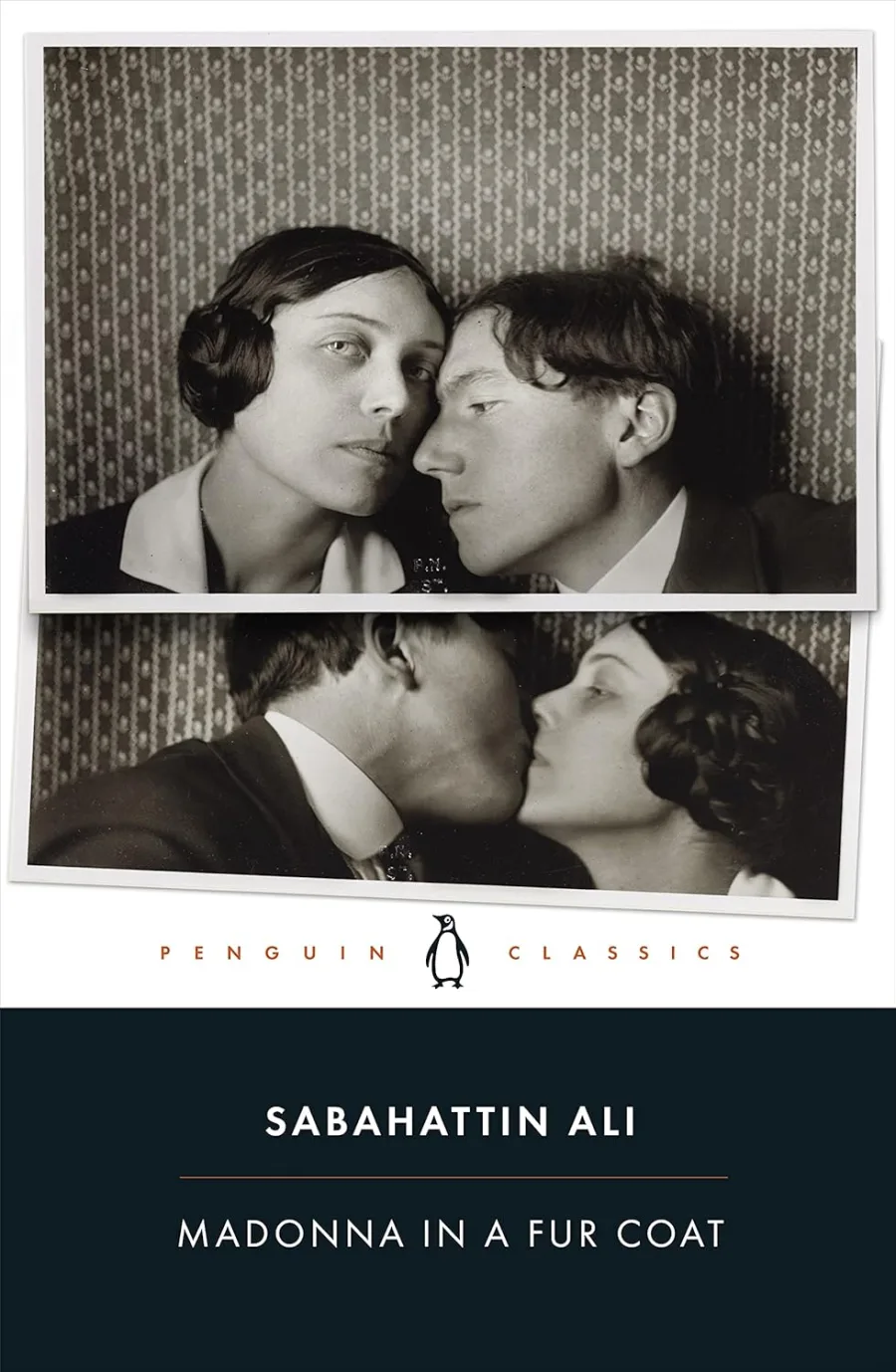
Madonna in a Fur Coat
Paperback
• 192 Pages
• ₹ 499.00
• English
• 9780241422267
No ratings yet
| Publisher | Penguin Classics |
|---|---|
| ISBN13 | 9780241422267 |
| ASIN/SKU | 0241422264 |
| Book Format | Paperback |
| Language | English |
| Pages | 192 |
| List Price | ₹ 499.00 |
| Publishing Date | 04/03/2021 |
| Dimensions | 12.9 x 1.1 x 19.7 cm |
| Weight | 146 g |
| Book Code | BD00070191 |
Buy this Book
Amazon Stores
Ebook Stores
Other Stores
Discover Madonna in a Fur Coat by Sabahattin Ali. This book is published by Penguin Classics in Paperback format, ISBN 9780241422267, ASIN 0241422264, under Literature and Fiction, Indian Writing, Classic Fiction.
Book Description
The bestselling Turkish classic of love and loss in a changing world
'A heart-breaker . . . it has the kind of indefinably powerful impact of The Great Gatsby' Observer
‘Deeply moving … transformative … a love story that I actually love’ Elif Shafak
'It is, perhaps, easier to dismiss a man whose face gives no indication of an inner life. And what a pity that is: a dash of curiosity is all it takes to stumble upon treasures we never expected.'
A shy young man leaves his home in rural Turkey to learn a trade in 1920s Berlin. The city's crowded streets, thriving arts scene, passionate politics and seedy cabarets provide the backdrop for a chance meeting with a woman, which will haunt him for the rest of his life. Emotionally powerful, intensely atmospheric and touchingly profound, Madonna in a Fur Coat is an unforgettable novel about new beginnings and the unfathomable nature of the human soul.
With an introduction by David Selim Sayers
‘You think you know yearning . . . you think you know the fleeting nature of happiness . . . you think you know unrequited love, you think you know lyrical writing . . . and then you read Madonna in a Fur Coat’ Jack Edwards
‘The surprise bestseller ... read, loved and wept over by men and women of all ages’ Guardian
'A heart-breaker . . . it has the kind of indefinably powerful impact of The Great Gatsby' Observer
‘Deeply moving … transformative … a love story that I actually love’ Elif Shafak
'It is, perhaps, easier to dismiss a man whose face gives no indication of an inner life. And what a pity that is: a dash of curiosity is all it takes to stumble upon treasures we never expected.'
A shy young man leaves his home in rural Turkey to learn a trade in 1920s Berlin. The city's crowded streets, thriving arts scene, passionate politics and seedy cabarets provide the backdrop for a chance meeting with a woman, which will haunt him for the rest of his life. Emotionally powerful, intensely atmospheric and touchingly profound, Madonna in a Fur Coat is an unforgettable novel about new beginnings and the unfathomable nature of the human soul.
With an introduction by David Selim Sayers
‘You think you know yearning . . . you think you know the fleeting nature of happiness . . . you think you know unrequited love, you think you know lyrical writing . . . and then you read Madonna in a Fur Coat’ Jack Edwards
‘The surprise bestseller ... read, loved and wept over by men and women of all ages’ Guardian
Author Biography
Sabahattin Ali (1907-1948)was born in the Ottoman town of Egridere (now Ardino in southern Bulgaria). A teacher, novelist, short-story writer and journalist, he owned and edited a popular weekly newspaper called Marko Pasa. He is admired for the determination with which he defended his political beliefs, which are anchored through his writing. Madonna in A Fur Coat, first published in 1943, is his best loved work and a touchstone of Turkish literary culture which continues to resonate profoundly with readers young and old today.
Editorial Reviews
A tale of young love and disenchantment, of missed opportunities and passion's elusive, flickering flame . . . reminiscent of Turgenev's First Love, with a hero every bit as gauche, and a twist every bit as bitter -- Toby Lichtig ― Financial Times
The magical novel about a Turkish man who falls in love with an artist in 1920s Berlin ... recreates a vanished era and dramatises a doomed relationship, and does so with verve, depth and poignancy. The result is a miniature masterpiece. -- Malcolm Forbes ― The National
A heart-breaker . . . it has the kind of indefinably powerful impact of The Great Gatsby -- Salley Vickers ― Observer
A poignant coming-of-age tale, drenched in disillusionment. The gap between hope and reality, art and ordinary life, has been explored in many other novels, but rarely with the unaffected simplicity of Madonna in a Fur Coat. -- William Armstrong ― Times Literary Supplement
Moving and memorable, full of yearning and melancholy ... reading it is like taking a literary minibreak -- Fiona Wilson ― The Times
A gorgeously melancholic romance . . . a cautionary tale certain to beguile -- Eileen Battersby ― Irish Times
The surprise bestseller ... read, loved and wept over by men and women of all ages ― Guardian
You think you know yearning . . . you think you know the fleeting nature of happiness . . . you think you know unrequited love, you think you know lyrical writing . . . and then you read Madonna in a Fur Coat -- Jack Edwards
The magical novel about a Turkish man who falls in love with an artist in 1920s Berlin ... recreates a vanished era and dramatises a doomed relationship, and does so with verve, depth and poignancy. The result is a miniature masterpiece. -- Malcolm Forbes ― The National
A heart-breaker . . . it has the kind of indefinably powerful impact of The Great Gatsby -- Salley Vickers ― Observer
A poignant coming-of-age tale, drenched in disillusionment. The gap between hope and reality, art and ordinary life, has been explored in many other novels, but rarely with the unaffected simplicity of Madonna in a Fur Coat. -- William Armstrong ― Times Literary Supplement
Moving and memorable, full of yearning and melancholy ... reading it is like taking a literary minibreak -- Fiona Wilson ― The Times
A gorgeously melancholic romance . . . a cautionary tale certain to beguile -- Eileen Battersby ― Irish Times
The surprise bestseller ... read, loved and wept over by men and women of all ages ― Guardian
You think you know yearning . . . you think you know the fleeting nature of happiness . . . you think you know unrequited love, you think you know lyrical writing . . . and then you read Madonna in a Fur Coat -- Jack Edwards
Book Summary
Sabahattin Ali’s Madonna in a Fur Coat is a deeply moving Turkish novel about love, loneliness, identity, emotional isolation, and the painful consequences of misunderstanding. First published in 1943, the novel initially appeared to be a relatively simple love story, but over time it became one of the most beloved works of modern Turkish literature. Its international reputation grew substantially after English translations introduced it to a wider readership. Set partly in 1930s Ankara and largely in 1920s Berlin, the novel follows Raif Efendi, an apparently insignificant and withdrawn Turkish clerk whose quiet exterior conceals an extraordinary emotional history. At the center of that history is Maria Puder, a fiercely independent German artist whose meeting with Raif transforms both their lives.
For readers searching for a Madonna in a Fur Coat summary, the novel is best understood as a story about the hidden lives people carry behind ordinary appearances. The narrator initially sees Raif as an unremarkable, almost invisible man. He works quietly, speaks little, tolerates disrespect, and appears to have almost no interest in the world around him. His colleagues consider him dull, and even his family treats him with little affection. Yet the narrator gradually realizes that this apparently insignificant man possesses a rich inner life. The contrast between Raif’s outward existence and his private emotional world is one of the novel’s central ideas. Ali asks readers to consider how easily society dismisses quiet people simply because their feelings are not visible.
The novel begins in Ankara, where an unnamed narrator is struggling with unemployment and financial difficulty. Eventually, through the assistance of a former acquaintance, he finds a low-level position at a lumber-trading company. There he works alongside Raif Efendi, a German translator who seems physically weak, emotionally distant, and almost completely resigned to his circumstances. The narrator initially has difficulty understanding why Raif continues living such a passive life. Raif does not seem to fight for recognition at work, and at home he appears to endure the contempt of his wife and children without protest. Yet his behavior creates a mystery: why does a man who seems so detached from life continue to live as though he is carrying some enormous private burden?
When Raif becomes seriously ill, the narrator visits him and begins to see another side of his personality. Raif reveals that his family does not truly understand him. Before dying, he asks the narrator to destroy a notebook hidden in his desk. This notebook contains the story of his younger life, and although Raif initially wants it burned, the narrator becomes determined to read it. The notebook transforms the structure of the novel. The quiet clerk of Ankara disappears, and the reader meets a much younger Raif, a sensitive and introspective young man whose life changes dramatically after he is sent to Berlin.
Young Raif comes from Havran in Turkey and is sent to Berlin by his father to learn the manufacture of soap. His family expects him to acquire useful knowledge and eventually return home to take responsibility for the family business. But Raif is not naturally suited to commercial life. He is shy, artistic, introspective, and much more interested in literature and painting than in business. Berlin, which should have been a place of education and professional preparation, becomes instead a place where Raif wanders through streets, museums, galleries, cafés, and parks while trying to understand himself. The city’s cultural energy offers him a freedom that he has never experienced at home. Penguin describes this period as a journey through the vibrant artistic and political atmosphere of interwar Berlin.
The decisive moment occurs when Raif visits an art exhibition and sees a portrait of a woman wearing a fur coat. He becomes fascinated by the painting. The woman’s expression seems to communicate something that he cannot put into words: loneliness, strength, sadness, independence, and emotional distance. Raif repeatedly returns to the exhibition because he feels that the portrait contains a mystery he desperately wants to understand. What makes this attraction significant is that he does not initially know the woman in the painting. He is drawn to an image before he knows the person behind it. The painting becomes a symbol of his own unspoken emotional life.
The woman in the portrait is Maria Puder, the artist herself. Maria is radically different from the women Raif has known. She is intelligent, independent, skeptical about romantic conventions, and unwilling to surrender her identity simply to fit social expectations. She works as an artist and performer and has developed a strong sense of self-reliance. When Raif encounters her in person, he is both fascinated and intimidated. Their first interactions are awkward because Raif is hesitant and inexperienced, while Maria is direct and confident.
Maria’s personality is crucial to the novel because she challenges traditional expectations about gender and romance. She refuses to behave according to the conventional role expected of a woman in a romantic relationship. She is suspicious of men who assume that affection gives them power over women. Raif, meanwhile, is unusually gentle, passive, and emotionally vulnerable. Their relationship therefore reverses many conventional romantic roles. Maria becomes the more assertive figure, while Raif is the one who waits, observes, listens, and feels deeply. Critics have noted that Ali uses their relationship to explore expectations placed on men and women and the boundaries between dominance, vulnerability, and intimacy.
Initially, Maria insists that she is not interested in falling in love with Raif. She has developed a philosophy of emotional independence because she fears dependence and disappointment. She believes that romantic relationships often become forms of possession, especially when one person begins to expect the other to behave according to traditional ideas about love. Raif, however, does not attempt to control her. His affection is quiet and patient. He accepts her independence and does not demand that she give him anything she is not ready to give. This makes their relationship unusual and allows Maria gradually to trust him.
Their connection begins more as friendship than conventional romance. They walk through Berlin together, talk about life, visit places of interest, and share long conversations. The relationship is intimate without immediately becoming physical. Raif finds in Maria someone who understands parts of him that nobody else has recognized. Maria, in turn, discovers that Raif’s apparent weakness is actually a form of emotional depth. He does not impress her through confidence, money, status, or masculinity. Instead, he gives her something more unusual: the freedom to be herself.
The New Year’s Eve sequence becomes an important emotional turning point. Raif and Maria spend the evening together, drinking, dancing, and enjoying one another’s company. Eventually, Raif accompanies Maria home when she is drunk. He cares for her rather than taking advantage of her vulnerability. Their intimacy deepens, but Maria becomes frightened by what she is beginning to feel. The next morning, their relationship is strained by an argument. Raif leaves, devastated and confused, and spends hours wandering through Berlin.
His wandering eventually takes him to Wannsee, a place associated with the tragic deaths of Heinrich von Kleist and Henriette Vogel. The location prompts Raif to think about love, despair, and the relationship between emotional intimacy and death. His thoughts reveal how deeply Maria has already changed him. He has moved from being a young man drifting through Berlin without purpose to someone whose entire emotional existence has become connected to another person.
When Raif returns to Maria, he discovers that she has become seriously ill and has been hospitalized. He rushes to see her and insists on being allowed inside. At the hospital, Maria finally recognizes the depth and sincerity of Raif’s feelings. Her defenses begin to collapse. She admits that she loves him, and their relationship becomes fully mutual. The emotional power of this moment lies in its simplicity. Maria has spent much of her life believing that dependence is dangerous, while Raif has spent his life believing that he is incapable of being truly understood. Their relationship temporarily resolves both fears.
They spend approximately a month together during Maria’s recovery. For Raif, this period represents a form of happiness he has never previously experienced. He has finally found a person with whom he can share his inner life. Maria is no longer merely the mysterious woman in the portrait. She has become a real person whom he knows intimately. The painting that first fascinated him therefore acquires a deeper meaning: he has discovered the human being behind the image.
But the happiness cannot last indefinitely. Raif receives news that his father has died, forcing him to return to Turkey. Maria plans to leave Berlin as well, intending to stay with her mother in Prague until Raif has established himself in Turkey. They agree that once Raif is settled, they will reunite. Their separation is therefore not supposed to be permanent. Both believe they have a future together.
Raif returns to Turkey and discovers that his family circumstances are more complicated than he expected. His relatives have taken control of much of the inheritance, leaving him with a less desirable portion of the family property. He eventually begins working with the land and tries to build a life while waiting for Maria. The letters she sends become his emotional connection to Berlin and to the future they imagined together. For Raif, these letters are not ordinary correspondence. They are proof that his most important relationship still exists.
Then the letters stop.
This silence becomes one of the novel’s most painful moments. Raif does not know what has happened. He waits, worries, and eventually concludes that Maria has abandoned him. His fear of betrayal becomes stronger than his willingness to trust. Instead of seeking the truth, he retreats into emotional isolation. This decision is central to the tragedy of the novel because Raif’s greatest weakness is not lack of love but his inability to believe that love can survive uncertainty.
Raif eventually marries a woman he does not truly love and settles into a life that feels emotionally empty. The furniture he accumulates is partly intended for the life he once imagined sharing with Maria. His marriage becomes another symbol of his internal separation from the world. He is physically surrounded by people but emotionally alone. His family sees only the quiet, passive man in front of them. Nobody understands that he has already experienced the most intense love of his life and believes he has lost it forever.
The tragedy becomes even greater when Raif encounters an old acquaintance from Berlin years later. She reveals that Maria died from an illness nine years earlier. She had also left behind a young daughter whose father was a Turkish man she refused to name. Raif immediately realizes that the child is his daughter. This revelation changes his understanding of the years he spent believing Maria had betrayed him. She had not abandoned him in the way he imagined. She had been carrying his child and had died before they could reunite. His greatest mistake was allowing silence to become proof of betrayal.
The discovery devastates Raif because he realizes that he has spent years punishing himself and Maria for something that was never her fault. His withdrawal from life was based on a misunderstanding. He had loved Maria deeply, but he had not trusted her enough to survive uncertainty. In this sense, the novel’s tragedy is not simply that two lovers were separated by circumstances. It is that communication failed at the moment when trust was most necessary.
The narrative then returns to the present. The narrator finishes reading Raif’s notebook and goes back to the house, but Raif has died. The narrator is left with a profound understanding of a man whom everyone else had considered insignificant. He now knows that the quiet clerk who seemed to have nothing to live for had once experienced an extraordinary love. The narrator’s discovery changes the way he sees ordinary people. He realizes that a person’s visible life may reveal almost nothing about the emotional world hidden inside.
This framing device is one of the novel’s greatest strengths. The reader begins by seeing Raif through the narrator’s limited perspective. He appears weak, dull, and insignificant. Only later does the notebook reveal the truth. The structure itself therefore embodies the novel’s central theme: appearances are deceptive. The person everyone ignores may possess the richest inner life in the room.
Maria Puder is equally important as a symbol of freedom and individuality. She refuses to allow society to define her entirely through gender or romance. Her relationship with Raif becomes meaningful precisely because neither person fits conventional expectations. Maria’s independence challenges Raif, while Raif’s vulnerability challenges Maria’s assumptions about men. Their love is therefore not simply sentimental. It becomes a space in which both characters can temporarily escape the roles society has assigned to them.
The novel also explores loneliness in a particularly subtle way. Raif is lonely before he meets Maria, but his loneliness does not disappear completely after their relationship begins. Instead, he becomes aware of what genuine connection feels like. This makes the eventual separation even more painful. Once someone has experienced being truly understood, ordinary social relationships can feel especially empty. Raif’s later isolation is therefore not simply the absence of company; it is the absence of meaningful recognition.
Another major theme is the danger of judging people by appearances. Raif’s family considers him weak because he does not behave aggressively. His colleagues underestimate him because he does not seek attention. The narrator initially assumes that his life is meaningless. Yet Raif has a capacity for love, sensitivity, artistic appreciation, and emotional depth that the people around him never recognize. Ali suggests that society often rewards visible confidence while overlooking quieter forms of strength.
The novel also offers a nuanced examination of masculinity. Raif is not a conventional masculine hero. He is shy, emotionally vulnerable, and unwilling to dominate Maria. Yet these qualities make him capable of an unusually respectful form of love. Maria, meanwhile, is assertive, independent, sexually self-aware, and unwilling to submit to traditional expectations. Their relationship demonstrates that intimacy does not require one person to dominate the other. Ali was writing in the early 1940s, yet the relationship remains strikingly modern in its questioning of conventional gender roles.
The setting of Berlin is also significant. Raif arrives from rural Turkey and encounters a European city filled with art, nightlife, literature, political energy, and social experimentation. Berlin becomes a temporary space of possibility. He can become someone different there. His Turkish identity remains important, but the city gives him permission to explore aspects of himself that his previous life had suppressed. The contrast between Berlin and later Turkey reinforces the tension between freedom and obligation that runs throughout the novel.
At the same time, Ali avoids presenting either place as entirely good or bad. Berlin offers Raif freedom but cannot protect him from loss. Turkey offers family and stability but also imposes expectations that leave him emotionally trapped. The real conflict exists inside Raif himself. He wants freedom but also wants belonging. He wants intimacy but fears vulnerability. He wants to trust Maria but becomes overwhelmed by uncertainty. This internal conflict makes him much more than a passive romantic hero.
For readers searching for a Madonna in a Fur Coat ending explained, the tragedy ultimately rests on a profound misunderstanding. Raif believes Maria has abandoned him because her letters stop arriving, but he later discovers that she had died and had left behind their daughter. His life after Berlin is therefore shaped by a false conclusion. He does not stop loving Maria; instead, he believes that the woman he loved betrayed him, and this belief causes him to withdraw from life. The final revelation forces him to confront how much happiness he lost because he could not know the truth.
The title itself refers to the portrait that first captures Raif’s imagination. The “Madonna” is Maria, but the phrase also carries symbolic meaning. She appears in the painting as both distant and deeply human, combining strength with vulnerability. For Raif, the portrait initially represents an impossible mystery. After meeting Maria, he discovers that the mystery is not simply the woman herself but the human soul. People cannot be fully understood from appearances. A painting can reveal something, but it can also conceal an entire life.
Ultimately, Madonna in a Fur Coat is a novel about the extraordinary emotional worlds hidden inside ordinary people. Its love story is heartbreaking, but its deeper subject is loneliness and the human need to be seen. Raif’s tragedy is that he finds someone who understands him completely, loses her through circumstances he cannot control, and then spends years believing that she rejected him. Maria’s tragedy is that she finds a man she finally trusts but dies before she can complete the life they planned together.
The novel remains powerful because its emotions are quiet rather than theatrical. There is no need for grand declarations to communicate the depth of Raif and Maria’s relationship. Much of the story is built from conversations, walks, letters, silences, paintings, memories, and missed opportunities. Ali shows how a single encounter can transform an entire life and how the absence of communication can destroy what love has created.
For anyone interested in Madonna in a Fur Coat book summary, analysis, themes, or ending explanation, the novel can be described as a melancholic romance wrapped inside a story about loneliness and hidden identity. It is a Turkish literary classic about a shy young man, a fiercely independent artist, and a relationship that challenges conventional ideas about love, masculinity, and emotional dependence. Its enduring appeal comes from the simple but profound question at its center: how much of another person can we truly know, and how much of our judgment depends on what they choose—or are able—to reveal?
In the end, Madonna in a Fur Coat suggests that every person contains a private world that may be invisible to everyone else. Raif’s colleagues see a dull clerk. His family sees a passive husband and father. The narrator initially sees a sickly, insignificant man. Only the notebook reveals the extraordinary life that existed beneath that surface. That is the novel’s most enduring lesson: people are often far more complicated, sensitive, wounded, and capable of love than their outward behavior suggests. A little curiosity can uncover an entire hidden universe.
The book’s reputation as a modern Turkish classic is therefore easy to understand. First published in 1943, it combines a simple narrative structure with unusually subtle emotional insight, and its themes of alienation, yearning, freedom, love, and misunderstanding remain remarkably contemporary.
For readers searching for a Madonna in a Fur Coat summary, the novel is best understood as a story about the hidden lives people carry behind ordinary appearances. The narrator initially sees Raif as an unremarkable, almost invisible man. He works quietly, speaks little, tolerates disrespect, and appears to have almost no interest in the world around him. His colleagues consider him dull, and even his family treats him with little affection. Yet the narrator gradually realizes that this apparently insignificant man possesses a rich inner life. The contrast between Raif’s outward existence and his private emotional world is one of the novel’s central ideas. Ali asks readers to consider how easily society dismisses quiet people simply because their feelings are not visible.
The novel begins in Ankara, where an unnamed narrator is struggling with unemployment and financial difficulty. Eventually, through the assistance of a former acquaintance, he finds a low-level position at a lumber-trading company. There he works alongside Raif Efendi, a German translator who seems physically weak, emotionally distant, and almost completely resigned to his circumstances. The narrator initially has difficulty understanding why Raif continues living such a passive life. Raif does not seem to fight for recognition at work, and at home he appears to endure the contempt of his wife and children without protest. Yet his behavior creates a mystery: why does a man who seems so detached from life continue to live as though he is carrying some enormous private burden?
When Raif becomes seriously ill, the narrator visits him and begins to see another side of his personality. Raif reveals that his family does not truly understand him. Before dying, he asks the narrator to destroy a notebook hidden in his desk. This notebook contains the story of his younger life, and although Raif initially wants it burned, the narrator becomes determined to read it. The notebook transforms the structure of the novel. The quiet clerk of Ankara disappears, and the reader meets a much younger Raif, a sensitive and introspective young man whose life changes dramatically after he is sent to Berlin.
Young Raif comes from Havran in Turkey and is sent to Berlin by his father to learn the manufacture of soap. His family expects him to acquire useful knowledge and eventually return home to take responsibility for the family business. But Raif is not naturally suited to commercial life. He is shy, artistic, introspective, and much more interested in literature and painting than in business. Berlin, which should have been a place of education and professional preparation, becomes instead a place where Raif wanders through streets, museums, galleries, cafés, and parks while trying to understand himself. The city’s cultural energy offers him a freedom that he has never experienced at home. Penguin describes this period as a journey through the vibrant artistic and political atmosphere of interwar Berlin.
The decisive moment occurs when Raif visits an art exhibition and sees a portrait of a woman wearing a fur coat. He becomes fascinated by the painting. The woman’s expression seems to communicate something that he cannot put into words: loneliness, strength, sadness, independence, and emotional distance. Raif repeatedly returns to the exhibition because he feels that the portrait contains a mystery he desperately wants to understand. What makes this attraction significant is that he does not initially know the woman in the painting. He is drawn to an image before he knows the person behind it. The painting becomes a symbol of his own unspoken emotional life.
The woman in the portrait is Maria Puder, the artist herself. Maria is radically different from the women Raif has known. She is intelligent, independent, skeptical about romantic conventions, and unwilling to surrender her identity simply to fit social expectations. She works as an artist and performer and has developed a strong sense of self-reliance. When Raif encounters her in person, he is both fascinated and intimidated. Their first interactions are awkward because Raif is hesitant and inexperienced, while Maria is direct and confident.
Maria’s personality is crucial to the novel because she challenges traditional expectations about gender and romance. She refuses to behave according to the conventional role expected of a woman in a romantic relationship. She is suspicious of men who assume that affection gives them power over women. Raif, meanwhile, is unusually gentle, passive, and emotionally vulnerable. Their relationship therefore reverses many conventional romantic roles. Maria becomes the more assertive figure, while Raif is the one who waits, observes, listens, and feels deeply. Critics have noted that Ali uses their relationship to explore expectations placed on men and women and the boundaries between dominance, vulnerability, and intimacy.
Initially, Maria insists that she is not interested in falling in love with Raif. She has developed a philosophy of emotional independence because she fears dependence and disappointment. She believes that romantic relationships often become forms of possession, especially when one person begins to expect the other to behave according to traditional ideas about love. Raif, however, does not attempt to control her. His affection is quiet and patient. He accepts her independence and does not demand that she give him anything she is not ready to give. This makes their relationship unusual and allows Maria gradually to trust him.
Their connection begins more as friendship than conventional romance. They walk through Berlin together, talk about life, visit places of interest, and share long conversations. The relationship is intimate without immediately becoming physical. Raif finds in Maria someone who understands parts of him that nobody else has recognized. Maria, in turn, discovers that Raif’s apparent weakness is actually a form of emotional depth. He does not impress her through confidence, money, status, or masculinity. Instead, he gives her something more unusual: the freedom to be herself.
The New Year’s Eve sequence becomes an important emotional turning point. Raif and Maria spend the evening together, drinking, dancing, and enjoying one another’s company. Eventually, Raif accompanies Maria home when she is drunk. He cares for her rather than taking advantage of her vulnerability. Their intimacy deepens, but Maria becomes frightened by what she is beginning to feel. The next morning, their relationship is strained by an argument. Raif leaves, devastated and confused, and spends hours wandering through Berlin.
His wandering eventually takes him to Wannsee, a place associated with the tragic deaths of Heinrich von Kleist and Henriette Vogel. The location prompts Raif to think about love, despair, and the relationship between emotional intimacy and death. His thoughts reveal how deeply Maria has already changed him. He has moved from being a young man drifting through Berlin without purpose to someone whose entire emotional existence has become connected to another person.
When Raif returns to Maria, he discovers that she has become seriously ill and has been hospitalized. He rushes to see her and insists on being allowed inside. At the hospital, Maria finally recognizes the depth and sincerity of Raif’s feelings. Her defenses begin to collapse. She admits that she loves him, and their relationship becomes fully mutual. The emotional power of this moment lies in its simplicity. Maria has spent much of her life believing that dependence is dangerous, while Raif has spent his life believing that he is incapable of being truly understood. Their relationship temporarily resolves both fears.
They spend approximately a month together during Maria’s recovery. For Raif, this period represents a form of happiness he has never previously experienced. He has finally found a person with whom he can share his inner life. Maria is no longer merely the mysterious woman in the portrait. She has become a real person whom he knows intimately. The painting that first fascinated him therefore acquires a deeper meaning: he has discovered the human being behind the image.
But the happiness cannot last indefinitely. Raif receives news that his father has died, forcing him to return to Turkey. Maria plans to leave Berlin as well, intending to stay with her mother in Prague until Raif has established himself in Turkey. They agree that once Raif is settled, they will reunite. Their separation is therefore not supposed to be permanent. Both believe they have a future together.
Raif returns to Turkey and discovers that his family circumstances are more complicated than he expected. His relatives have taken control of much of the inheritance, leaving him with a less desirable portion of the family property. He eventually begins working with the land and tries to build a life while waiting for Maria. The letters she sends become his emotional connection to Berlin and to the future they imagined together. For Raif, these letters are not ordinary correspondence. They are proof that his most important relationship still exists.
Then the letters stop.
This silence becomes one of the novel’s most painful moments. Raif does not know what has happened. He waits, worries, and eventually concludes that Maria has abandoned him. His fear of betrayal becomes stronger than his willingness to trust. Instead of seeking the truth, he retreats into emotional isolation. This decision is central to the tragedy of the novel because Raif’s greatest weakness is not lack of love but his inability to believe that love can survive uncertainty.
Raif eventually marries a woman he does not truly love and settles into a life that feels emotionally empty. The furniture he accumulates is partly intended for the life he once imagined sharing with Maria. His marriage becomes another symbol of his internal separation from the world. He is physically surrounded by people but emotionally alone. His family sees only the quiet, passive man in front of them. Nobody understands that he has already experienced the most intense love of his life and believes he has lost it forever.
The tragedy becomes even greater when Raif encounters an old acquaintance from Berlin years later. She reveals that Maria died from an illness nine years earlier. She had also left behind a young daughter whose father was a Turkish man she refused to name. Raif immediately realizes that the child is his daughter. This revelation changes his understanding of the years he spent believing Maria had betrayed him. She had not abandoned him in the way he imagined. She had been carrying his child and had died before they could reunite. His greatest mistake was allowing silence to become proof of betrayal.
The discovery devastates Raif because he realizes that he has spent years punishing himself and Maria for something that was never her fault. His withdrawal from life was based on a misunderstanding. He had loved Maria deeply, but he had not trusted her enough to survive uncertainty. In this sense, the novel’s tragedy is not simply that two lovers were separated by circumstances. It is that communication failed at the moment when trust was most necessary.
The narrative then returns to the present. The narrator finishes reading Raif’s notebook and goes back to the house, but Raif has died. The narrator is left with a profound understanding of a man whom everyone else had considered insignificant. He now knows that the quiet clerk who seemed to have nothing to live for had once experienced an extraordinary love. The narrator’s discovery changes the way he sees ordinary people. He realizes that a person’s visible life may reveal almost nothing about the emotional world hidden inside.
This framing device is one of the novel’s greatest strengths. The reader begins by seeing Raif through the narrator’s limited perspective. He appears weak, dull, and insignificant. Only later does the notebook reveal the truth. The structure itself therefore embodies the novel’s central theme: appearances are deceptive. The person everyone ignores may possess the richest inner life in the room.
Maria Puder is equally important as a symbol of freedom and individuality. She refuses to allow society to define her entirely through gender or romance. Her relationship with Raif becomes meaningful precisely because neither person fits conventional expectations. Maria’s independence challenges Raif, while Raif’s vulnerability challenges Maria’s assumptions about men. Their love is therefore not simply sentimental. It becomes a space in which both characters can temporarily escape the roles society has assigned to them.
The novel also explores loneliness in a particularly subtle way. Raif is lonely before he meets Maria, but his loneliness does not disappear completely after their relationship begins. Instead, he becomes aware of what genuine connection feels like. This makes the eventual separation even more painful. Once someone has experienced being truly understood, ordinary social relationships can feel especially empty. Raif’s later isolation is therefore not simply the absence of company; it is the absence of meaningful recognition.
Another major theme is the danger of judging people by appearances. Raif’s family considers him weak because he does not behave aggressively. His colleagues underestimate him because he does not seek attention. The narrator initially assumes that his life is meaningless. Yet Raif has a capacity for love, sensitivity, artistic appreciation, and emotional depth that the people around him never recognize. Ali suggests that society often rewards visible confidence while overlooking quieter forms of strength.
The novel also offers a nuanced examination of masculinity. Raif is not a conventional masculine hero. He is shy, emotionally vulnerable, and unwilling to dominate Maria. Yet these qualities make him capable of an unusually respectful form of love. Maria, meanwhile, is assertive, independent, sexually self-aware, and unwilling to submit to traditional expectations. Their relationship demonstrates that intimacy does not require one person to dominate the other. Ali was writing in the early 1940s, yet the relationship remains strikingly modern in its questioning of conventional gender roles.
The setting of Berlin is also significant. Raif arrives from rural Turkey and encounters a European city filled with art, nightlife, literature, political energy, and social experimentation. Berlin becomes a temporary space of possibility. He can become someone different there. His Turkish identity remains important, but the city gives him permission to explore aspects of himself that his previous life had suppressed. The contrast between Berlin and later Turkey reinforces the tension between freedom and obligation that runs throughout the novel.
At the same time, Ali avoids presenting either place as entirely good or bad. Berlin offers Raif freedom but cannot protect him from loss. Turkey offers family and stability but also imposes expectations that leave him emotionally trapped. The real conflict exists inside Raif himself. He wants freedom but also wants belonging. He wants intimacy but fears vulnerability. He wants to trust Maria but becomes overwhelmed by uncertainty. This internal conflict makes him much more than a passive romantic hero.
For readers searching for a Madonna in a Fur Coat ending explained, the tragedy ultimately rests on a profound misunderstanding. Raif believes Maria has abandoned him because her letters stop arriving, but he later discovers that she had died and had left behind their daughter. His life after Berlin is therefore shaped by a false conclusion. He does not stop loving Maria; instead, he believes that the woman he loved betrayed him, and this belief causes him to withdraw from life. The final revelation forces him to confront how much happiness he lost because he could not know the truth.
The title itself refers to the portrait that first captures Raif’s imagination. The “Madonna” is Maria, but the phrase also carries symbolic meaning. She appears in the painting as both distant and deeply human, combining strength with vulnerability. For Raif, the portrait initially represents an impossible mystery. After meeting Maria, he discovers that the mystery is not simply the woman herself but the human soul. People cannot be fully understood from appearances. A painting can reveal something, but it can also conceal an entire life.
Ultimately, Madonna in a Fur Coat is a novel about the extraordinary emotional worlds hidden inside ordinary people. Its love story is heartbreaking, but its deeper subject is loneliness and the human need to be seen. Raif’s tragedy is that he finds someone who understands him completely, loses her through circumstances he cannot control, and then spends years believing that she rejected him. Maria’s tragedy is that she finds a man she finally trusts but dies before she can complete the life they planned together.
The novel remains powerful because its emotions are quiet rather than theatrical. There is no need for grand declarations to communicate the depth of Raif and Maria’s relationship. Much of the story is built from conversations, walks, letters, silences, paintings, memories, and missed opportunities. Ali shows how a single encounter can transform an entire life and how the absence of communication can destroy what love has created.
For anyone interested in Madonna in a Fur Coat book summary, analysis, themes, or ending explanation, the novel can be described as a melancholic romance wrapped inside a story about loneliness and hidden identity. It is a Turkish literary classic about a shy young man, a fiercely independent artist, and a relationship that challenges conventional ideas about love, masculinity, and emotional dependence. Its enduring appeal comes from the simple but profound question at its center: how much of another person can we truly know, and how much of our judgment depends on what they choose—or are able—to reveal?
In the end, Madonna in a Fur Coat suggests that every person contains a private world that may be invisible to everyone else. Raif’s colleagues see a dull clerk. His family sees a passive husband and father. The narrator initially sees a sickly, insignificant man. Only the notebook reveals the extraordinary life that existed beneath that surface. That is the novel’s most enduring lesson: people are often far more complicated, sensitive, wounded, and capable of love than their outward behavior suggests. A little curiosity can uncover an entire hidden universe.
The book’s reputation as a modern Turkish classic is therefore easy to understand. First published in 1943, it combines a simple narrative structure with unusually subtle emotional insight, and its themes of alienation, yearning, freedom, love, and misunderstanding remain remarkably contemporary.
Sample Chapters
Sample Chapters will be added soon…
Reader Reviews
No reviews yet.
Madonna in a Fur Coat
Download Cover Image
Do you want to download the full cover image for Madonna in a Fur Coat?