
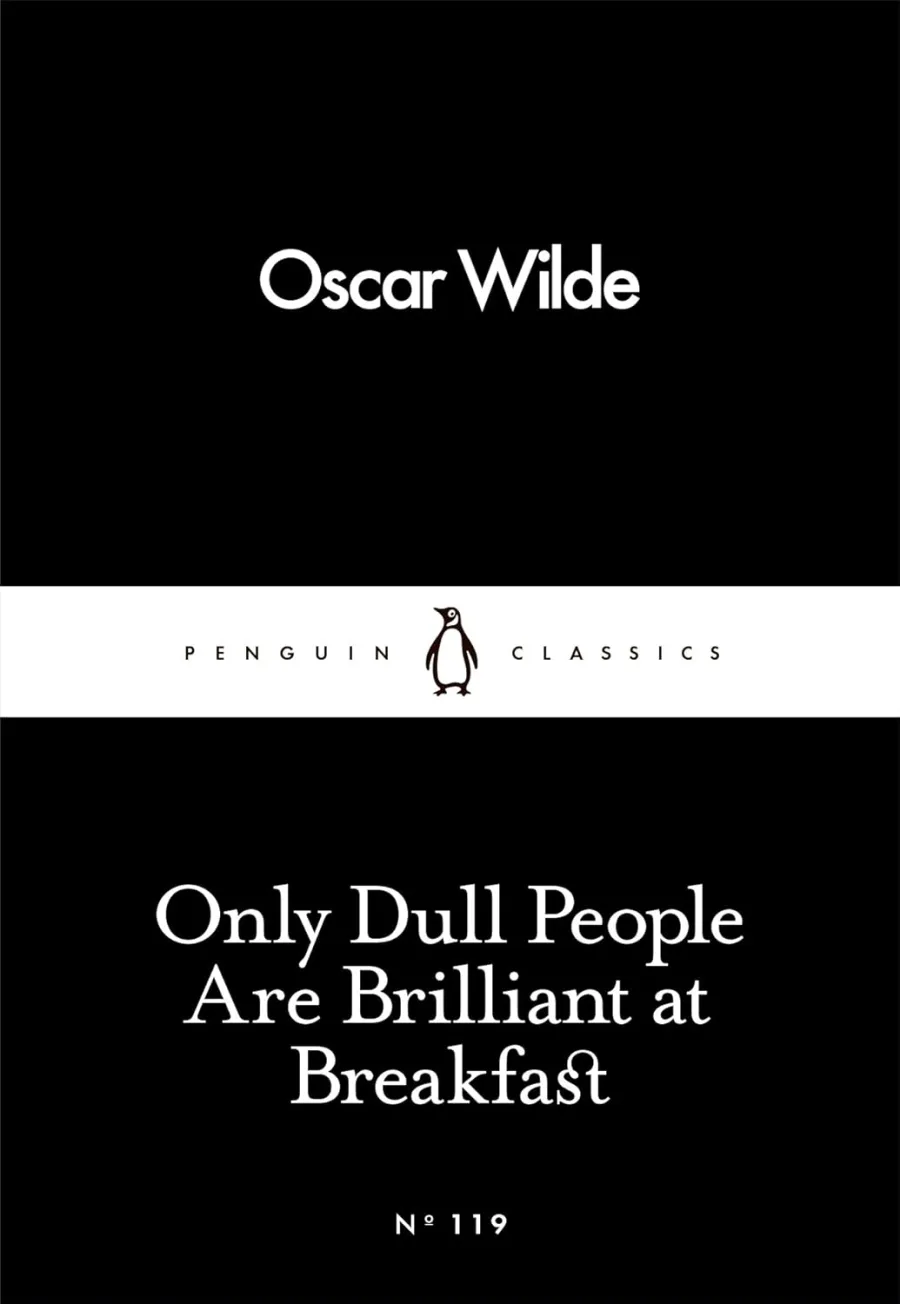
Only Dull People Are Brilliant at Breakfast by Oscar Wilde: Essays, Wit & Humour, Classic Literature
Paperback
• 65 Pages
• ₹ 199.00
• English
• 9780241251805
No ratings yet
| Publisher | Penguin Classics |
|---|---|
| ISBN13 | 9780241251805 |
| ASIN/SKU | 024125180X |
| Book Format | Paperback |
| Language | English |
| Pages | 65 |
| List Price | ₹ 199.00 |
| Publishing Date | 03/03/2016 |
| Dimensions | 11 x 0.5 x 16.1 cm |
| Weight | 55 g |
| Book Code | BD00070188 |
Buy this Book
Amazon Stores
Ebook Stores
Other Stores
Discover Only Dull People Are Brilliant at Breakfast by Oscar Wilde: Essays, Wit and Humour, Classic Literature by Oscar Wilde. This book is published by Penguin Classics in Paperback format, ISBN 9780241251805, ASIN 024125180X, under Literature and Fiction, English Literature, Essays.
Book Description
'It would be unfair to expect other people to be as remarkable as oneself'
Wilde's celebrated witticisms on the dangers of sincerity, duplicitous biographers, the stupidity of the English - and his own genius.
One of 46 new books in the bestselling Little Black Classics series, to celebrate the first ever Penguin Classic in 1946. Each book gives readers a taste of the Classics' huge range and diversity, with works from around the world and across the centuries - including fables, decadence, heartbreak, tall tales, satire, ghosts, battles and elephants.
Wilde's celebrated witticisms on the dangers of sincerity, duplicitous biographers, the stupidity of the English - and his own genius.
One of 46 new books in the bestselling Little Black Classics series, to celebrate the first ever Penguin Classic in 1946. Each book gives readers a taste of the Classics' huge range and diversity, with works from around the world and across the centuries - including fables, decadence, heartbreak, tall tales, satire, ghosts, battles and elephants.
Author Biography
Oscar Fingal O'Flahertie Wills Wilde was born in Dublin in 1854. He went to Trinity College, Dublin and then to Magdalen College, Oxford, where he began to propagandize the new Aesthetic (or 'Art for Art's Sake') Movement.Despite winning a first and the Newdigate Prize for Poetry, Wilde failed to obtain an Oxford scholarship, and was forced to earn a living by lecturing and writing for periodicals. After his marriage to Constance Lloyd in 1884, he tried to establish himself as a writer, but with little initial success. However, his three volumes of short fiction, The Happy Prince (1888), Lord Arthur Savile's Crime (1891) and A House of Pomegranates (1891), together with his only novel, The Picture of Dorian Gray (1891), gradually won him a reputation as a modern writer with an original talent, a reputation confirmed and enhanced by the phenomenal success of his Society Comedies - Lady Windermere's Fan, A Woman of No Importance, An Ideal Husband and The Importance of Being Earnest, all performed on the West End stage between 1892 and 1895.Success, however, was short-lived. In 1891 Wilde had met and fallen extravagantly in love with Lord Alfred Douglas. In 1895, when his success as a dramatist was at its height, Wilde brought an unsuccessful libel action against Douglas's father, the Marquess of Queensberry. Wilde lost the case and two trials later was sentenced to two years' imprisonment for acts of gross indecency. As a result of this experience he wrote The Ballad of Reading Gaol. He was released from prison in 1897 and went into an immediate self-imposed exile on the Continent. He died in Paris in ignominy in 1900.
Editorial Reviews
Editorial Reviews will be added soon…
Book Summary
Oscar Wilde’s Only Dull People Are Brilliant at Breakfast is a lively collection of essays, observations, conversations, aphorisms, and literary pieces that captures the extraordinary wit, elegance, irony, and social criticism for which Wilde remains famous. Rather than being a conventional book with one continuous plot, it brings together different aspects of Wilde’s writing and personality, offering readers a window into his ideas about art, society, fashion, morality, literature, beauty, conversation, and human behavior. For anyone searching for an Only Dull People Are Brilliant at Breakfast summary, the most important thing to understand is that the book is less about presenting a single argument than about experiencing Wilde’s distinctive way of looking at the world: playful on the surface, provocative underneath, and frequently designed to make readers question ideas they normally accept without thinking.
The title itself perfectly captures Wilde’s style. “Only dull people are brilliant at breakfast” is an intentionally paradoxical statement, the kind of witty reversal that makes Wilde’s writing so memorable. Breakfast is normally associated with ordinary routine, practicality, and everyday life. Wilde turns that assumption upside down by suggesting that being lively and interesting requires something more than conventional respectability. The title therefore functions as a miniature example of his larger literary method. He takes an ordinary observation, reverses it, exaggerates it, and transforms it into something memorable. His wit is rarely accidental. Beneath the joke there is often a challenge to conventional thinking.
Wilde’s essays and prose are especially interesting because he does not treat seriousness and humor as opposites. He can make a reader laugh while simultaneously exposing hypocrisy. He can appear to praise something while quietly mocking it. He can make an outrageous statement that sounds ridiculous at first and then leave the reader wondering whether there is actually some truth hidden inside it. This ability to combine entertainment with criticism is one of the defining characteristics of his writing.
A recurring theme throughout Wilde’s work is the importance of individual freedom. Victorian society placed enormous value on respectability, discipline, social position, conventional morality, and public reputation. Wilde was fascinated by the tension between what society demanded people appear to be and what they actually wanted to become. His writing repeatedly challenges the assumption that a respectable appearance automatically indicates a good or meaningful life.
Wilde’s fascination with appearance is closely connected to his philosophy of aestheticism. He believed that beauty and art had value in themselves and did not necessarily need to serve a moral, political, or practical purpose. This was a provocative position during an era when literature was often expected to teach lessons or reinforce respectable values. Wilde instead argued for the freedom of art and the importance of pleasure, imagination, style, and beauty.
This idea appears repeatedly in his observations about literature and artistic creation. Wilde distrusts the notion that every work of art must deliver an obvious moral. For him, art does not have to behave like a schoolteacher. It can simply be beautiful, strange, entertaining, disturbing, or emotionally powerful. This belief became central to the aesthetic movement with which he was associated.
Yet Wilde’s celebration of beauty does not mean that he was uninterested in society. In fact, his writing is filled with observations about social behavior. He examines the rituals of fashionable life, the importance people attach to appearances, and the absurdity of social conventions. His humor often works by showing how ridiculous people become when they take social rules too seriously.
One of Wilde’s greatest talents is his ability to expose hypocrisy without sounding like a conventional moralist. Instead of giving a long lecture about dishonesty, he might make a single witty observation that reveals the contradiction. His aphorisms often work this way. A sentence can appear to be merely clever, but it may contain a sharp criticism of marriage, wealth, class, morality, or social ambition.
This is why Wilde’s humor remains so quotable. His sentences are constructed to surprise. He frequently takes familiar expressions and gives them an unexpected meaning. Instead of saying directly that society is hypocritical, he creates a paradox that makes hypocrisy visible. Instead of explaining that people are inconsistent, he shows the inconsistency through an elegant contradiction.
The essays also demonstrate Wilde’s fascination with conversation. To Wilde, conversation is an art form. A brilliant conversation is not necessarily a factual exchange designed to communicate information efficiently. It can be playful, theatrical, provocative, and imaginative. People reveal themselves through the things they choose to say, the opinions they pretend to hold, and the ways they respond to one another.
This emphasis on conversation connects Wilde’s essays to his plays, particularly The Importance of Being Earnest, where dialogue becomes the primary source of comedy. Wilde understood that social conversation often contains an enormous amount of performance. People do not simply communicate; they create versions of themselves. They try to sound intelligent, respectable, fashionable, mysterious, or sophisticated. Wilde’s wit exposes the performance.
The collection is also deeply concerned with the relationship between truth and exaggeration. Wilde often speaks in deliberately exaggerated terms. He might make an absolute statement that no reasonable person could literally accept. Yet the exaggeration creates a comic effect while encouraging the reader to reconsider the opposite assumption. His paradoxes are therefore intellectual games, but they are games with consequences.
For example, when Wilde praises something conventionally considered foolish or criticizes something considered respectable, he forces readers to examine their own assumptions. Why do we believe that seriousness is automatically valuable? Why do we assume that practicality is superior to imagination? Why should social respectability determine personal worth? Wilde’s humor opens these questions without turning the prose into a dry philosophical argument.
The theme of boredom is particularly relevant to the title. Wilde regarded dullness as a kind of social failure. A person may be respectable, successful, and conventional while still being profoundly uninteresting. By contrast, an unconventional person may be intellectually alive precisely because they refuse to accept every rule without question. Wilde’s preference for wit and individuality reflects his broader admiration for people who create their own identities.
This individualism is one reason Wilde’s writing continues to appeal to modern readers. His world was socially different from ours, but his observations about self-presentation remain surprisingly recognizable. People still curate their appearances. They still worry about status. They still use conversation to impress others. They still judge people according to fashionable standards. They still confuse social approval with personal happiness.
Wilde is particularly sharp when discussing marriage and romantic relationships. He often treats conventional marriage with skepticism because he sees how frequently it is influenced by money, social expectations, family pressure, and appearances. His jokes about marriage are rarely simply anti-romantic. Instead, they expose the gap between society’s idealized image of marriage and the complicated reality of human relationships.
His approach to love is similarly ironic. Wilde understands that romantic love is often surrounded by clichés and fantasies. People imagine that love will transform their lives, yet social expectations can quickly turn romance into another form of routine. His humor comes from recognizing this contradiction. He can celebrate love while simultaneously mocking the sentimental language people use to describe it.
Money and class are equally important targets. Wilde grew up in a society in which wealth and social position heavily influenced opportunities and relationships. His writing frequently explores the strange behavior produced by class consciousness. People may pretend that they value character, but they often care deeply about money, titles, clothes, addresses, and social connections.
Fashion becomes another form of social language. Wilde understood that clothing communicates identity before a person has said a word. His fascination with style was not merely superficial. Fashion represented the human desire to construct an identity. A person can use clothes, manners, speech, and possessions to create an image that may have little relationship to their private self.
This concern with appearance also connects Wilde to the modern idea of celebrity. Wilde was himself a highly visible public figure. He cultivated a distinctive image and became famous for his appearance, personality, and conversational brilliance. He understood that public identity could become a performance. His writing reflects both fascination with and skepticism toward that performance.
At the same time, the book should not be read as a simple collection of jokes. Wilde’s wit often contains sadness. His fascination with beauty and pleasure exists alongside an awareness of suffering, hypocrisy, loneliness, and social cruelty. The contrast between the lightness of his language and the seriousness of some of his underlying ideas gives his writing much of its lasting power.
This becomes particularly apparent when considering Wilde’s later life. His public success eventually collapsed after his prosecution and imprisonment for “gross indecency,” followed by social ostracism and financial ruin. Although not every piece collected under this title directly addresses these events, knowledge of Wilde’s biography inevitably adds another layer to his writing. The man who mocked social respectability would eventually experience the destructive power of the society whose conventions he challenged.
Wilde’s essays therefore acquire an almost tragic dimension when read against his life. His celebration of individuality was not merely theoretical. He lived in ways that Victorian society considered unacceptable, and he paid an enormous personal price. His wit, which once made him fashionable, became powerless against legal and social persecution. This history helps explain why his observations about reputation, morality, and public judgment remain so powerful.
Another important quality of the collection is its accessibility. Wilde can discuss sophisticated ideas without making the prose unnecessarily complicated. His sentences are often short, polished, and memorable. Even when the ideas are intellectually challenging, the language remains conversational. This makes the book particularly suitable for readers who want to explore classic literature without encountering excessively difficult prose.
For readers searching for the meaning of Only Dull People Are Brilliant at Breakfast, the title can be interpreted as an example of Wilde’s philosophy of paradox. He deliberately challenges the assumption that being “brilliant” in a conventional setting is necessarily admirable. Breakfast represents routine and social normality, while brilliance represents wit and individuality. By placing the two together ironically, Wilde creates a joke about the expectations of civilized behavior.
The book’s greatest pleasure comes from the constant unpredictability of Wilde’s observations. A paragraph may begin with an apparently ordinary topic and suddenly move toward an unexpected conclusion. He does not want readers to remain comfortable. His writing works best when it surprises them.
This is also why Wilde should not always be interpreted literally. His aphorisms are often deliberately extreme. If a reader treats every sentence as a literal philosophical proposition, much of the humor disappears. Wilde wants readers to appreciate the tension between the statement and the reality it describes. The contradiction is often the point.
His wit also depends heavily on inversion. He frequently turns moral assumptions upside down: the supposedly respectable person may be ridiculous, the supposedly immoral person may be more honest, the conventional person may be dull, and the unconventional person may possess greater vitality. These reversals allow Wilde to challenge social hierarchies without writing a traditional political manifesto.
A major strength of the collection is therefore its ability to make readers question certainty. Wilde rarely says, “This is the correct way to think.” Instead, he offers a clever alternative and lets the reader struggle with the implications. His writing encourages intellectual flexibility. If an idea seems obvious, Wilde wants us to ask whether it is actually true or merely familiar.
For anyone interested in Oscar Wilde’s wit and humor, this collection also provides a useful introduction to the themes that appear throughout his larger body of work. His fascination with beauty can be seen in The Picture of Dorian Gray. His social satire becomes especially prominent in The Importance of Being Earnest. His interest in morality, hypocrisy, and suffering emerges powerfully in The Happy Prince and De Profundis. His distinctive voice runs through all of them.
The collection can also be understood as a portrait of Wilde himself. His writing reflects a man who loved conversation, beauty, contradiction, theatricality, intelligence, and pleasure. He was fascinated by the gap between appearance and reality and deeply skeptical of people who claimed moral superiority. His prose is therefore inseparable from his personality. Reading Wilde often feels like listening to an extraordinarily clever person improvise observations about the world.
Yet beneath the wit lies a serious belief in the importance of living consciously. Wilde does not want human beings to become machines governed entirely by routine and convention. He values imagination because it allows people to imagine lives different from the ones society has prepared for them. He values art because it creates experiences that cannot be reduced to practical usefulness. And he values wit because it keeps the mind alive.
This is perhaps the most humane message beneath the humor. A life devoted entirely to respectability can become empty. A person can follow every rule and still fail to understand themselves. Wilde’s celebration of individuality is therefore ultimately a defense of human complexity. People should not be reduced to their social roles, occupations, appearances, or reputations.
For readers searching for an Only Dull People Are Brilliant at Breakfast review, the collection is best approached not as a traditional narrative but as a treasury of Wildean ideas. It is ideal for readers who enjoy literary essays, classic humor, paradoxes, social satire, philosophical observations, and memorable quotations. Its greatest appeal lies in the pleasure of encountering sentences that make familiar ideas suddenly look strange.
Ultimately, Only Dull People Are Brilliant at Breakfast demonstrates why Oscar Wilde remains one of the most recognizable voices in English literature. His language is elegant but rarely obedient; his humor is light but often deeply critical; and his paradoxes are entertaining precisely because they contain uncomfortable truths. He understood that laughter can be a form of criticism and that a joke can sometimes reveal more about society than a serious lecture.
The enduring lesson of Wilde’s wit is not simply that dullness is undesirable. It is that life becomes richer when people remain curious, imaginative, independent, and willing to question convention. Wilde invites readers to look beyond the obvious, distrust easy judgments, and recognize the absurdity hidden inside ordinary social behavior. His essays and observations remain enjoyable because they do not merely tell us what to think. They make us look again.
In that sense, Only Dull People Are Brilliant at Breakfast is a fitting introduction to Wilde’s literary world. It presents the qualities that have kept his work alive for generations: dazzling wit, elegant language, social satire, paradox, aesthetic sensitivity, and an unwavering fascination with human contradiction. Beneath all the cleverness is a simple but lasting idea: a truly interesting life begins when we stop accepting every convention as unquestionable truth.
The title itself perfectly captures Wilde’s style. “Only dull people are brilliant at breakfast” is an intentionally paradoxical statement, the kind of witty reversal that makes Wilde’s writing so memorable. Breakfast is normally associated with ordinary routine, practicality, and everyday life. Wilde turns that assumption upside down by suggesting that being lively and interesting requires something more than conventional respectability. The title therefore functions as a miniature example of his larger literary method. He takes an ordinary observation, reverses it, exaggerates it, and transforms it into something memorable. His wit is rarely accidental. Beneath the joke there is often a challenge to conventional thinking.
Wilde’s essays and prose are especially interesting because he does not treat seriousness and humor as opposites. He can make a reader laugh while simultaneously exposing hypocrisy. He can appear to praise something while quietly mocking it. He can make an outrageous statement that sounds ridiculous at first and then leave the reader wondering whether there is actually some truth hidden inside it. This ability to combine entertainment with criticism is one of the defining characteristics of his writing.
A recurring theme throughout Wilde’s work is the importance of individual freedom. Victorian society placed enormous value on respectability, discipline, social position, conventional morality, and public reputation. Wilde was fascinated by the tension between what society demanded people appear to be and what they actually wanted to become. His writing repeatedly challenges the assumption that a respectable appearance automatically indicates a good or meaningful life.
Wilde’s fascination with appearance is closely connected to his philosophy of aestheticism. He believed that beauty and art had value in themselves and did not necessarily need to serve a moral, political, or practical purpose. This was a provocative position during an era when literature was often expected to teach lessons or reinforce respectable values. Wilde instead argued for the freedom of art and the importance of pleasure, imagination, style, and beauty.
This idea appears repeatedly in his observations about literature and artistic creation. Wilde distrusts the notion that every work of art must deliver an obvious moral. For him, art does not have to behave like a schoolteacher. It can simply be beautiful, strange, entertaining, disturbing, or emotionally powerful. This belief became central to the aesthetic movement with which he was associated.
Yet Wilde’s celebration of beauty does not mean that he was uninterested in society. In fact, his writing is filled with observations about social behavior. He examines the rituals of fashionable life, the importance people attach to appearances, and the absurdity of social conventions. His humor often works by showing how ridiculous people become when they take social rules too seriously.
One of Wilde’s greatest talents is his ability to expose hypocrisy without sounding like a conventional moralist. Instead of giving a long lecture about dishonesty, he might make a single witty observation that reveals the contradiction. His aphorisms often work this way. A sentence can appear to be merely clever, but it may contain a sharp criticism of marriage, wealth, class, morality, or social ambition.
This is why Wilde’s humor remains so quotable. His sentences are constructed to surprise. He frequently takes familiar expressions and gives them an unexpected meaning. Instead of saying directly that society is hypocritical, he creates a paradox that makes hypocrisy visible. Instead of explaining that people are inconsistent, he shows the inconsistency through an elegant contradiction.
The essays also demonstrate Wilde’s fascination with conversation. To Wilde, conversation is an art form. A brilliant conversation is not necessarily a factual exchange designed to communicate information efficiently. It can be playful, theatrical, provocative, and imaginative. People reveal themselves through the things they choose to say, the opinions they pretend to hold, and the ways they respond to one another.
This emphasis on conversation connects Wilde’s essays to his plays, particularly The Importance of Being Earnest, where dialogue becomes the primary source of comedy. Wilde understood that social conversation often contains an enormous amount of performance. People do not simply communicate; they create versions of themselves. They try to sound intelligent, respectable, fashionable, mysterious, or sophisticated. Wilde’s wit exposes the performance.
The collection is also deeply concerned with the relationship between truth and exaggeration. Wilde often speaks in deliberately exaggerated terms. He might make an absolute statement that no reasonable person could literally accept. Yet the exaggeration creates a comic effect while encouraging the reader to reconsider the opposite assumption. His paradoxes are therefore intellectual games, but they are games with consequences.
For example, when Wilde praises something conventionally considered foolish or criticizes something considered respectable, he forces readers to examine their own assumptions. Why do we believe that seriousness is automatically valuable? Why do we assume that practicality is superior to imagination? Why should social respectability determine personal worth? Wilde’s humor opens these questions without turning the prose into a dry philosophical argument.
The theme of boredom is particularly relevant to the title. Wilde regarded dullness as a kind of social failure. A person may be respectable, successful, and conventional while still being profoundly uninteresting. By contrast, an unconventional person may be intellectually alive precisely because they refuse to accept every rule without question. Wilde’s preference for wit and individuality reflects his broader admiration for people who create their own identities.
This individualism is one reason Wilde’s writing continues to appeal to modern readers. His world was socially different from ours, but his observations about self-presentation remain surprisingly recognizable. People still curate their appearances. They still worry about status. They still use conversation to impress others. They still judge people according to fashionable standards. They still confuse social approval with personal happiness.
Wilde is particularly sharp when discussing marriage and romantic relationships. He often treats conventional marriage with skepticism because he sees how frequently it is influenced by money, social expectations, family pressure, and appearances. His jokes about marriage are rarely simply anti-romantic. Instead, they expose the gap between society’s idealized image of marriage and the complicated reality of human relationships.
His approach to love is similarly ironic. Wilde understands that romantic love is often surrounded by clichés and fantasies. People imagine that love will transform their lives, yet social expectations can quickly turn romance into another form of routine. His humor comes from recognizing this contradiction. He can celebrate love while simultaneously mocking the sentimental language people use to describe it.
Money and class are equally important targets. Wilde grew up in a society in which wealth and social position heavily influenced opportunities and relationships. His writing frequently explores the strange behavior produced by class consciousness. People may pretend that they value character, but they often care deeply about money, titles, clothes, addresses, and social connections.
Fashion becomes another form of social language. Wilde understood that clothing communicates identity before a person has said a word. His fascination with style was not merely superficial. Fashion represented the human desire to construct an identity. A person can use clothes, manners, speech, and possessions to create an image that may have little relationship to their private self.
This concern with appearance also connects Wilde to the modern idea of celebrity. Wilde was himself a highly visible public figure. He cultivated a distinctive image and became famous for his appearance, personality, and conversational brilliance. He understood that public identity could become a performance. His writing reflects both fascination with and skepticism toward that performance.
At the same time, the book should not be read as a simple collection of jokes. Wilde’s wit often contains sadness. His fascination with beauty and pleasure exists alongside an awareness of suffering, hypocrisy, loneliness, and social cruelty. The contrast between the lightness of his language and the seriousness of some of his underlying ideas gives his writing much of its lasting power.
This becomes particularly apparent when considering Wilde’s later life. His public success eventually collapsed after his prosecution and imprisonment for “gross indecency,” followed by social ostracism and financial ruin. Although not every piece collected under this title directly addresses these events, knowledge of Wilde’s biography inevitably adds another layer to his writing. The man who mocked social respectability would eventually experience the destructive power of the society whose conventions he challenged.
Wilde’s essays therefore acquire an almost tragic dimension when read against his life. His celebration of individuality was not merely theoretical. He lived in ways that Victorian society considered unacceptable, and he paid an enormous personal price. His wit, which once made him fashionable, became powerless against legal and social persecution. This history helps explain why his observations about reputation, morality, and public judgment remain so powerful.
Another important quality of the collection is its accessibility. Wilde can discuss sophisticated ideas without making the prose unnecessarily complicated. His sentences are often short, polished, and memorable. Even when the ideas are intellectually challenging, the language remains conversational. This makes the book particularly suitable for readers who want to explore classic literature without encountering excessively difficult prose.
For readers searching for the meaning of Only Dull People Are Brilliant at Breakfast, the title can be interpreted as an example of Wilde’s philosophy of paradox. He deliberately challenges the assumption that being “brilliant” in a conventional setting is necessarily admirable. Breakfast represents routine and social normality, while brilliance represents wit and individuality. By placing the two together ironically, Wilde creates a joke about the expectations of civilized behavior.
The book’s greatest pleasure comes from the constant unpredictability of Wilde’s observations. A paragraph may begin with an apparently ordinary topic and suddenly move toward an unexpected conclusion. He does not want readers to remain comfortable. His writing works best when it surprises them.
This is also why Wilde should not always be interpreted literally. His aphorisms are often deliberately extreme. If a reader treats every sentence as a literal philosophical proposition, much of the humor disappears. Wilde wants readers to appreciate the tension between the statement and the reality it describes. The contradiction is often the point.
His wit also depends heavily on inversion. He frequently turns moral assumptions upside down: the supposedly respectable person may be ridiculous, the supposedly immoral person may be more honest, the conventional person may be dull, and the unconventional person may possess greater vitality. These reversals allow Wilde to challenge social hierarchies without writing a traditional political manifesto.
A major strength of the collection is therefore its ability to make readers question certainty. Wilde rarely says, “This is the correct way to think.” Instead, he offers a clever alternative and lets the reader struggle with the implications. His writing encourages intellectual flexibility. If an idea seems obvious, Wilde wants us to ask whether it is actually true or merely familiar.
For anyone interested in Oscar Wilde’s wit and humor, this collection also provides a useful introduction to the themes that appear throughout his larger body of work. His fascination with beauty can be seen in The Picture of Dorian Gray. His social satire becomes especially prominent in The Importance of Being Earnest. His interest in morality, hypocrisy, and suffering emerges powerfully in The Happy Prince and De Profundis. His distinctive voice runs through all of them.
The collection can also be understood as a portrait of Wilde himself. His writing reflects a man who loved conversation, beauty, contradiction, theatricality, intelligence, and pleasure. He was fascinated by the gap between appearance and reality and deeply skeptical of people who claimed moral superiority. His prose is therefore inseparable from his personality. Reading Wilde often feels like listening to an extraordinarily clever person improvise observations about the world.
Yet beneath the wit lies a serious belief in the importance of living consciously. Wilde does not want human beings to become machines governed entirely by routine and convention. He values imagination because it allows people to imagine lives different from the ones society has prepared for them. He values art because it creates experiences that cannot be reduced to practical usefulness. And he values wit because it keeps the mind alive.
This is perhaps the most humane message beneath the humor. A life devoted entirely to respectability can become empty. A person can follow every rule and still fail to understand themselves. Wilde’s celebration of individuality is therefore ultimately a defense of human complexity. People should not be reduced to their social roles, occupations, appearances, or reputations.
For readers searching for an Only Dull People Are Brilliant at Breakfast review, the collection is best approached not as a traditional narrative but as a treasury of Wildean ideas. It is ideal for readers who enjoy literary essays, classic humor, paradoxes, social satire, philosophical observations, and memorable quotations. Its greatest appeal lies in the pleasure of encountering sentences that make familiar ideas suddenly look strange.
Ultimately, Only Dull People Are Brilliant at Breakfast demonstrates why Oscar Wilde remains one of the most recognizable voices in English literature. His language is elegant but rarely obedient; his humor is light but often deeply critical; and his paradoxes are entertaining precisely because they contain uncomfortable truths. He understood that laughter can be a form of criticism and that a joke can sometimes reveal more about society than a serious lecture.
The enduring lesson of Wilde’s wit is not simply that dullness is undesirable. It is that life becomes richer when people remain curious, imaginative, independent, and willing to question convention. Wilde invites readers to look beyond the obvious, distrust easy judgments, and recognize the absurdity hidden inside ordinary social behavior. His essays and observations remain enjoyable because they do not merely tell us what to think. They make us look again.
In that sense, Only Dull People Are Brilliant at Breakfast is a fitting introduction to Wilde’s literary world. It presents the qualities that have kept his work alive for generations: dazzling wit, elegant language, social satire, paradox, aesthetic sensitivity, and an unwavering fascination with human contradiction. Beneath all the cleverness is a simple but lasting idea: a truly interesting life begins when we stop accepting every convention as unquestionable truth.
Sample Chapters
Sample Chapters will be added soon…
Reader Reviews
No reviews yet.
Only Dull People Are Brilliant at Breakfast by Oscar Wilde: Essays, Wit & Humour, Classic Literature
Download Cover Image
Do you want to download the full cover image for Only Dull People Are Brilliant at Breakfast by Oscar Wilde: Essays, Wit & Humour, Classic Literature?