
A Court of Splintered Harmony: The Sixth Book In the Globally Bestselling, Fantasy Romance Series
Paperback
• 352 Pages
• ₹ 999.00
• English
• 9781037200083
No ratings yet
| Publisher | Bloomsbury Publishing |
|---|---|
| ISBN13 | 9781037200083 |
| ASIN/SKU | 103720008X |
| Book Format | Paperback |
| Language | English |
| Pages | 352 |
| List Price | ₹ 999.00 |
| Publishing Date | 27/09/2026 |
| Dimensions | 23.4 x 15.3 x 23.4 cm |
| Weight | 505 g |
| Book Code | BD00070185 |
Buy this Book
Amazon Stores
Ebook Stores
Other Stores
Discover A Court of Splintered Harmony: The Sixth Book In the Globally Bestselling, Fantasy Romance Series by Sarah J. Maas. This book is published by Bloomsbury Publishing in Paperback format, ISBN 9781037200083, ASIN 103720008X, under Science Fiction and Fantasy, Romantic Fantasy, Epic Fantasy.
Book Description
Sarah J. Maas, the #1 bestselling author of the Court of Thorns and Roses series, returns to the courts of Prythian.
Romance, danger and intrigue await in the breathtaking sixth book in the #1 bestselling A Court of Thorns and Roses (ACOTAR) series.
What was broken will be remade.
Deep in the heart of the continent, Koschei the Deathless is stirring. Though he has been bound to a mountain lake for millennia, the insidious threat of his return now spreads across the Fae territories, attracting powerful allies determined to reclaim what was once theirs: the human lands.
The Night Court will not stand idly by while innocents are attacked. But with Prythian still recovering from the devastating Hybern War, uniting the Fae is proving more difficult by the day.
Worse still, those who rule and protect the Night Court are reeling from betrayals and devastating revelations. The rifts dividing them seem impossible to overcome.
To defeat Koschei's growing shadow, they must find their way back to one another and resurrect old alliances. To survive, they must repair the fractured bonds around them before it is too late.
Perfect for fans of fantasy romance, romantasy, fae courts, enemies-to-lovers romance, magical worlds, epic adventures and Sarah J. Maas's bestselling ACOTAR series.
The full Court of Thorns and Roses series includes:
1) A Court of Thorns and Roses
2) A Court of Mist and Fury
3) A Court of Wings and Ruin
4) A Court of Frost and Starlight
5) A Court of Silver Flames
6) A Court of Splintered Harmony
7) A Court of Forgotten Melody
Also available from Sarah J. Maas:
The bestselling Crescent City series, beginning with House of Earth and Blood, and the internationally bestselling Throne of Glass series, starting with Throne of Glass.
Romance, danger and intrigue await in the breathtaking sixth book in the #1 bestselling A Court of Thorns and Roses (ACOTAR) series.
What was broken will be remade.
Deep in the heart of the continent, Koschei the Deathless is stirring. Though he has been bound to a mountain lake for millennia, the insidious threat of his return now spreads across the Fae territories, attracting powerful allies determined to reclaim what was once theirs: the human lands.
The Night Court will not stand idly by while innocents are attacked. But with Prythian still recovering from the devastating Hybern War, uniting the Fae is proving more difficult by the day.
Worse still, those who rule and protect the Night Court are reeling from betrayals and devastating revelations. The rifts dividing them seem impossible to overcome.
To defeat Koschei's growing shadow, they must find their way back to one another and resurrect old alliances. To survive, they must repair the fractured bonds around them before it is too late.
Perfect for fans of fantasy romance, romantasy, fae courts, enemies-to-lovers romance, magical worlds, epic adventures and Sarah J. Maas's bestselling ACOTAR series.
The full Court of Thorns and Roses series includes:
1) A Court of Thorns and Roses
2) A Court of Mist and Fury
3) A Court of Wings and Ruin
4) A Court of Frost and Starlight
5) A Court of Silver Flames
6) A Court of Splintered Harmony
7) A Court of Forgotten Melody
Also available from Sarah J. Maas:
The bestselling Crescent City series, beginning with House of Earth and Blood, and the internationally bestselling Throne of Glass series, starting with Throne of Glass.
Author Biography
Sarah J. Maas is the #1 bestselling author of the Court of Thorns and Roses, Throne of Glass, and Crescent City series. Her books have sold more than seventy-five million copies and are published in forty languages.
sarahjmaas.com
facebook.com/theworldofsarahjmaas
instagram.com/sarahjmaas
sarahjmaas.com
facebook.com/theworldofsarahjmaas
instagram.com/sarahjmaas
Editorial Reviews
"A deliciously badass rivals-to-lovers romance that nearly singed my fingers. Intensely emotional, wildly sexy, and absolutely unputdownable." - Sarah MacLean on A Court of Silver Flames "Deeply sexy and spectacularly propulsive." - Christina Lauren on A Court of Silver Flames
Book Summary
A Court of Splintered Harmony is the sixth novel in Sarah J. Maas’s A Court of Thorns and Roses (ACOTAR) series. It is scheduled for publication on October 27, 2026, so a complete chapter-by-chapter plot is not yet publicly available. The summary below is therefore based on the publisher’s official synopsis and currently available bibliographic information, rather than invented details about the unreleased story.
A Court of Splintered Harmony returns readers to the magical world of Prythian in what promises to be another sweeping fantasy romance filled with danger, political tension, ancient magic, fractured alliances, and complicated relationships. Written by Sarah J. Maas, the novel is the sixth main installment in the internationally bestselling A Court of Thorns and Roses series and follows A Court of Silver Flames. The official description makes its central idea clear: after enormous destruction and upheaval, the world cannot simply return to normal. Something has been broken, and rebuilding it will require more than defeating a single enemy. The characters must repair relationships, political alliances, and the trust that has been damaged by war and betrayal.
The story takes place in the aftermath of the devastating Hybern War, an event that dramatically altered the political and emotional landscape of Prythian. Although the war is over, peace has not produced complete stability. The various courts and territories are still attempting to recover, and old divisions remain beneath the surface. The Night Court, despite its immense power and its determination to protect vulnerable people, faces a difficult new reality. The central challenge is no longer simply surviving a war. It is creating a future in which the different peoples of Prythian can actually live together without allowing old rivalries and fears to destroy the fragile peace.
At the heart of the new threat is Koschei the Deathless, an ancient and dangerous figure whose presence has been building throughout the broader ACOTAR mythology. According to the official synopsis, Koschei has been bound to a mountain lake for thousands of years, but his influence is beginning to spread again. His awakening creates the possibility of another major conflict, one that could threaten not only individual courts but the balance of the entire continent. His growing power attracts allies who want to reclaim the human lands, meaning that the danger is both supernatural and political.
This makes the novel particularly interesting because its conflict appears to operate on two levels. On the surface, there is an ancient magical threat that must be confronted. Beneath that, there is a political problem involving territory, power, loyalty, and competing claims to land. The characters cannot simply defeat an enemy through physical strength. They must also determine whom they can trust and how different communities can work together.
The official phrase “What was broken will be remade” captures the novel’s larger theme. Rather than presenting recovery as something automatic, Maas appears to be exploring what it means to rebuild after enormous trauma. A kingdom can repair damaged buildings relatively quickly, but repairing trust between people is far more difficult. Friendships may have changed. Alliances may have collapsed. Secrets may have been exposed. People who once fought together may now question each other’s motives.
This theme of broken trust is especially important because the rulers and protectors of the Night Court are described as dealing with recent betrayals and revealed truths. The official synopsis says that the resulting divisions appear almost impossible to overcome. This suggests that the novel’s emotional stakes will be just as important as its magical ones. The characters must decide whether their shared history is strong enough to overcome anger, disappointment, and suspicion.
The Night Court remains central to the larger story because it has repeatedly positioned itself as a protector of those who are vulnerable. In this installment, that protective responsibility becomes even more complicated. Innocent people are under threat, but protecting them requires political cooperation. The Night Court cannot simply remain isolated and defend its own territory. It must persuade others to unite against a threat that could eventually affect everyone.
The idea of unity is therefore one of the most important themes in A Court of Splintered Harmony. The title itself suggests something that has been fractured into pieces. Harmony implies cooperation, balance, and shared purpose, while “splintered” suggests division and damage. Put together, the title points toward a story about trying to restore something that has been broken without pretending that the damage never happened.
This is a natural continuation of the larger ACOTAR series. From the beginning, Maas has used fantasy conflicts to explore personal transformation and relationships. Feyre’s journey, the formation of the Night Court, the struggles of its inner circle, and the aftermath of war have all demonstrated that battles do not end simply because an enemy has been defeated. Characters continue to carry emotional consequences long after physical danger has passed.
The sixth book appears to broaden that idea from individual trauma to collective healing. Prythian itself has been damaged by war. Different courts have competing interests, and the political structure remains unstable. Rebuilding therefore requires the characters to think beyond their immediate relationships and consider the future of an entire continent.
The threat posed by Koschei also gives the novel an especially mythic quality. Koschei is connected to ancient folklore, and his presence introduces a different kind of danger from the military conflict of the Hybern War. An ancient deathless being represents something that cannot simply be defeated through conventional means. His imprisonment for millennia suggests a history that reaches far beyond the events experienced by Feyre and her companions.
The fact that Koschei has been bound rather than destroyed is also significant. A prison can contain a threat without eliminating it. His return therefore suggests that old dangers can remain dormant until circumstances allow them to emerge again. This fits perfectly with the novel’s broader interest in unresolved problems. What appears to have been settled may not actually be settled at all.
The human lands are another important element of the official synopsis. Powerful forces seeking to reclaim them are being drawn toward the conflict, meaning that the division between the magical and human worlds remains politically important. The fate of these lands could become a major source of conflict because questions of territory are rarely just questions of geography. They involve identity, history, ownership, fear, and power.
The book is also explicitly described as a fantasy romance, meaning that emotional and romantic relationships remain a major part of the reading experience. Maas’s ACOTAR books have traditionally combined epic fantasy with intense romantic relationships, and this installment is positioned within that same tradition. However, because the novel has not yet been released, it would be misleading to invent a detailed account of which characters form new relationships or how specific romances conclude.
What can be said with confidence is that relationships will be tested by the larger crisis. When characters face betrayal, war, political disagreements, and supernatural danger, personal relationships inevitably become more complicated. Trust becomes particularly important. A character may love someone while questioning whether that person’s decisions can be trusted. Friends may remain loyal while disagreeing about how to respond to danger. Political alliances may depend upon personal relationships that are themselves under strain.
This combination of romance and political fantasy is one of the defining characteristics of the ACOTAR series. The characters are rarely able to separate private emotions from public responsibilities. A personal choice can have political consequences, while a political decision can cause profound emotional damage. This creates the dramatic tension that has made the series so popular.
For readers looking for an A Court of Splintered Harmony summary, the safest way to understand the story at this stage is as a post-war rebuilding narrative that gradually develops into a confrontation with an ancient supernatural threat. Prythian is wounded. Its alliances are unstable. Koschei is beginning to stir. Powerful forces are moving toward the human lands. And the Night Court must find a way to bring divided people together before their internal conflicts prevent them from confronting the larger danger.
The phrase “splintered harmony” is particularly appropriate because the problem is not simply that the characters disagree. Their disagreements are rooted in experiences that have changed them. War has forced them to make difficult choices, and those choices can create consequences that cannot be erased. Even when characters have good intentions, they may hurt one another. Even when they have fought on the same side, they may no longer see the world in exactly the same way.
This gives the story an opportunity to explore a mature question: How do people rebuild trust after discovering that the people they depended upon have secrets? Trust is easy when everyone believes they understand one another. It becomes much harder when hidden truths emerge. The official synopsis specifically emphasizes betrayals and revealed truths, indicating that these issues will be central to the story.
The novel’s title can also be interpreted on a personal level. Harmony does not necessarily mean that everyone agrees. True harmony can mean that different people with different personalities and histories find a way to coexist. In that sense, restoring harmony may require accepting differences rather than eliminating them. The characters do not need to become identical; they need to learn how to work together despite their differences.
The story therefore appears to move beyond the simple fantasy question of “Who will win?” toward the more complicated question of what kind of world the characters want to build after the battle is over. Defeating Koschei will be important, but victory alone will not solve Prythian’s deeper political and emotional problems. The characters must also decide what comes next.
This is particularly relevant to the series because so many of its central characters have already undergone enormous personal transformations. They are no longer the people they were at the beginning of the saga. Their identities have been shaped by love, loss, war, sacrifice, power, and survival. The sixth book therefore arrives at a point where the question of the future becomes increasingly important.
For readers wondering where A Court of Splintered Harmony fits in the ACOTAR reading order, it is officially listed as Book 6, following A Court of Silver Flames. The series order is A Court of Thorns and Roses, A Court of Mist and Fury, A Court of Wings and Ruin, A Court of Frost and Starlight, A Court of Silver Flames, and then A Court of Splintered Harmony. Bloomsbury also lists a seventh book, A Court of Forgotten Melody, as part of the series.
The publication date currently listed by Bloomsbury and Sarah J. Maas’s official website is October 27, 2026, making this a forthcoming novel rather than a book with a publicly available full plot at the present time. The currently listed edition is 352 pages, although editions and pagination can vary.
Ultimately, A Court of Splintered Harmony appears to continue the ACOTAR series by shifting attention toward the difficult work of rebuilding after war while introducing a dangerous new stage in the conflict with Koschei. Its central ideas—healing, trust, unity, betrayal, political cooperation, ancient magic, and romantic loyalty—fit naturally into the larger world Sarah J. Maas has created.
For anyone searching for an A Court of Splintered Harmony book summary, ACOTAR Book 6 explanation, plot overview, themes, or reading order, the essential premise is this: Prythian has survived one devastating war, but survival has not restored peace. Koschei the Deathless is stirring, powerful forces are threatening the human lands, and the Night Court is struggling with internal divisions caused by betrayal and painful revelations. To face the new enemy, the characters must repair relationships and alliances that have been fractured.
The most intriguing promise of the novel is therefore contained in its title. The story is not simply about defeating darkness; it is about putting broken pieces back together. The characters must discover whether trust can survive betrayal, whether old alliances can be rebuilt, and whether a divided world can find common purpose again. What has been broken may indeed be remade—but the process of rebuilding may prove just as difficult and dangerous as the war that broke it in the first place.
A Court of Splintered Harmony returns readers to the magical world of Prythian in what promises to be another sweeping fantasy romance filled with danger, political tension, ancient magic, fractured alliances, and complicated relationships. Written by Sarah J. Maas, the novel is the sixth main installment in the internationally bestselling A Court of Thorns and Roses series and follows A Court of Silver Flames. The official description makes its central idea clear: after enormous destruction and upheaval, the world cannot simply return to normal. Something has been broken, and rebuilding it will require more than defeating a single enemy. The characters must repair relationships, political alliances, and the trust that has been damaged by war and betrayal.
The story takes place in the aftermath of the devastating Hybern War, an event that dramatically altered the political and emotional landscape of Prythian. Although the war is over, peace has not produced complete stability. The various courts and territories are still attempting to recover, and old divisions remain beneath the surface. The Night Court, despite its immense power and its determination to protect vulnerable people, faces a difficult new reality. The central challenge is no longer simply surviving a war. It is creating a future in which the different peoples of Prythian can actually live together without allowing old rivalries and fears to destroy the fragile peace.
At the heart of the new threat is Koschei the Deathless, an ancient and dangerous figure whose presence has been building throughout the broader ACOTAR mythology. According to the official synopsis, Koschei has been bound to a mountain lake for thousands of years, but his influence is beginning to spread again. His awakening creates the possibility of another major conflict, one that could threaten not only individual courts but the balance of the entire continent. His growing power attracts allies who want to reclaim the human lands, meaning that the danger is both supernatural and political.
This makes the novel particularly interesting because its conflict appears to operate on two levels. On the surface, there is an ancient magical threat that must be confronted. Beneath that, there is a political problem involving territory, power, loyalty, and competing claims to land. The characters cannot simply defeat an enemy through physical strength. They must also determine whom they can trust and how different communities can work together.
The official phrase “What was broken will be remade” captures the novel’s larger theme. Rather than presenting recovery as something automatic, Maas appears to be exploring what it means to rebuild after enormous trauma. A kingdom can repair damaged buildings relatively quickly, but repairing trust between people is far more difficult. Friendships may have changed. Alliances may have collapsed. Secrets may have been exposed. People who once fought together may now question each other’s motives.
This theme of broken trust is especially important because the rulers and protectors of the Night Court are described as dealing with recent betrayals and revealed truths. The official synopsis says that the resulting divisions appear almost impossible to overcome. This suggests that the novel’s emotional stakes will be just as important as its magical ones. The characters must decide whether their shared history is strong enough to overcome anger, disappointment, and suspicion.
The Night Court remains central to the larger story because it has repeatedly positioned itself as a protector of those who are vulnerable. In this installment, that protective responsibility becomes even more complicated. Innocent people are under threat, but protecting them requires political cooperation. The Night Court cannot simply remain isolated and defend its own territory. It must persuade others to unite against a threat that could eventually affect everyone.
The idea of unity is therefore one of the most important themes in A Court of Splintered Harmony. The title itself suggests something that has been fractured into pieces. Harmony implies cooperation, balance, and shared purpose, while “splintered” suggests division and damage. Put together, the title points toward a story about trying to restore something that has been broken without pretending that the damage never happened.
This is a natural continuation of the larger ACOTAR series. From the beginning, Maas has used fantasy conflicts to explore personal transformation and relationships. Feyre’s journey, the formation of the Night Court, the struggles of its inner circle, and the aftermath of war have all demonstrated that battles do not end simply because an enemy has been defeated. Characters continue to carry emotional consequences long after physical danger has passed.
The sixth book appears to broaden that idea from individual trauma to collective healing. Prythian itself has been damaged by war. Different courts have competing interests, and the political structure remains unstable. Rebuilding therefore requires the characters to think beyond their immediate relationships and consider the future of an entire continent.
The threat posed by Koschei also gives the novel an especially mythic quality. Koschei is connected to ancient folklore, and his presence introduces a different kind of danger from the military conflict of the Hybern War. An ancient deathless being represents something that cannot simply be defeated through conventional means. His imprisonment for millennia suggests a history that reaches far beyond the events experienced by Feyre and her companions.
The fact that Koschei has been bound rather than destroyed is also significant. A prison can contain a threat without eliminating it. His return therefore suggests that old dangers can remain dormant until circumstances allow them to emerge again. This fits perfectly with the novel’s broader interest in unresolved problems. What appears to have been settled may not actually be settled at all.
The human lands are another important element of the official synopsis. Powerful forces seeking to reclaim them are being drawn toward the conflict, meaning that the division between the magical and human worlds remains politically important. The fate of these lands could become a major source of conflict because questions of territory are rarely just questions of geography. They involve identity, history, ownership, fear, and power.
The book is also explicitly described as a fantasy romance, meaning that emotional and romantic relationships remain a major part of the reading experience. Maas’s ACOTAR books have traditionally combined epic fantasy with intense romantic relationships, and this installment is positioned within that same tradition. However, because the novel has not yet been released, it would be misleading to invent a detailed account of which characters form new relationships or how specific romances conclude.
What can be said with confidence is that relationships will be tested by the larger crisis. When characters face betrayal, war, political disagreements, and supernatural danger, personal relationships inevitably become more complicated. Trust becomes particularly important. A character may love someone while questioning whether that person’s decisions can be trusted. Friends may remain loyal while disagreeing about how to respond to danger. Political alliances may depend upon personal relationships that are themselves under strain.
This combination of romance and political fantasy is one of the defining characteristics of the ACOTAR series. The characters are rarely able to separate private emotions from public responsibilities. A personal choice can have political consequences, while a political decision can cause profound emotional damage. This creates the dramatic tension that has made the series so popular.
For readers looking for an A Court of Splintered Harmony summary, the safest way to understand the story at this stage is as a post-war rebuilding narrative that gradually develops into a confrontation with an ancient supernatural threat. Prythian is wounded. Its alliances are unstable. Koschei is beginning to stir. Powerful forces are moving toward the human lands. And the Night Court must find a way to bring divided people together before their internal conflicts prevent them from confronting the larger danger.
The phrase “splintered harmony” is particularly appropriate because the problem is not simply that the characters disagree. Their disagreements are rooted in experiences that have changed them. War has forced them to make difficult choices, and those choices can create consequences that cannot be erased. Even when characters have good intentions, they may hurt one another. Even when they have fought on the same side, they may no longer see the world in exactly the same way.
This gives the story an opportunity to explore a mature question: How do people rebuild trust after discovering that the people they depended upon have secrets? Trust is easy when everyone believes they understand one another. It becomes much harder when hidden truths emerge. The official synopsis specifically emphasizes betrayals and revealed truths, indicating that these issues will be central to the story.
The novel’s title can also be interpreted on a personal level. Harmony does not necessarily mean that everyone agrees. True harmony can mean that different people with different personalities and histories find a way to coexist. In that sense, restoring harmony may require accepting differences rather than eliminating them. The characters do not need to become identical; they need to learn how to work together despite their differences.
The story therefore appears to move beyond the simple fantasy question of “Who will win?” toward the more complicated question of what kind of world the characters want to build after the battle is over. Defeating Koschei will be important, but victory alone will not solve Prythian’s deeper political and emotional problems. The characters must also decide what comes next.
This is particularly relevant to the series because so many of its central characters have already undergone enormous personal transformations. They are no longer the people they were at the beginning of the saga. Their identities have been shaped by love, loss, war, sacrifice, power, and survival. The sixth book therefore arrives at a point where the question of the future becomes increasingly important.
For readers wondering where A Court of Splintered Harmony fits in the ACOTAR reading order, it is officially listed as Book 6, following A Court of Silver Flames. The series order is A Court of Thorns and Roses, A Court of Mist and Fury, A Court of Wings and Ruin, A Court of Frost and Starlight, A Court of Silver Flames, and then A Court of Splintered Harmony. Bloomsbury also lists a seventh book, A Court of Forgotten Melody, as part of the series.
The publication date currently listed by Bloomsbury and Sarah J. Maas’s official website is October 27, 2026, making this a forthcoming novel rather than a book with a publicly available full plot at the present time. The currently listed edition is 352 pages, although editions and pagination can vary.
Ultimately, A Court of Splintered Harmony appears to continue the ACOTAR series by shifting attention toward the difficult work of rebuilding after war while introducing a dangerous new stage in the conflict with Koschei. Its central ideas—healing, trust, unity, betrayal, political cooperation, ancient magic, and romantic loyalty—fit naturally into the larger world Sarah J. Maas has created.
For anyone searching for an A Court of Splintered Harmony book summary, ACOTAR Book 6 explanation, plot overview, themes, or reading order, the essential premise is this: Prythian has survived one devastating war, but survival has not restored peace. Koschei the Deathless is stirring, powerful forces are threatening the human lands, and the Night Court is struggling with internal divisions caused by betrayal and painful revelations. To face the new enemy, the characters must repair relationships and alliances that have been fractured.
The most intriguing promise of the novel is therefore contained in its title. The story is not simply about defeating darkness; it is about putting broken pieces back together. The characters must discover whether trust can survive betrayal, whether old alliances can be rebuilt, and whether a divided world can find common purpose again. What has been broken may indeed be remade—but the process of rebuilding may prove just as difficult and dangerous as the war that broke it in the first place.
Sample Chapters
Sample Chapters will be added soon…
Reader Reviews
No reviews yet.
A Court of Splintered Harmony: The Sixth Book In the Globally Bestselling, Fantasy Romance Series
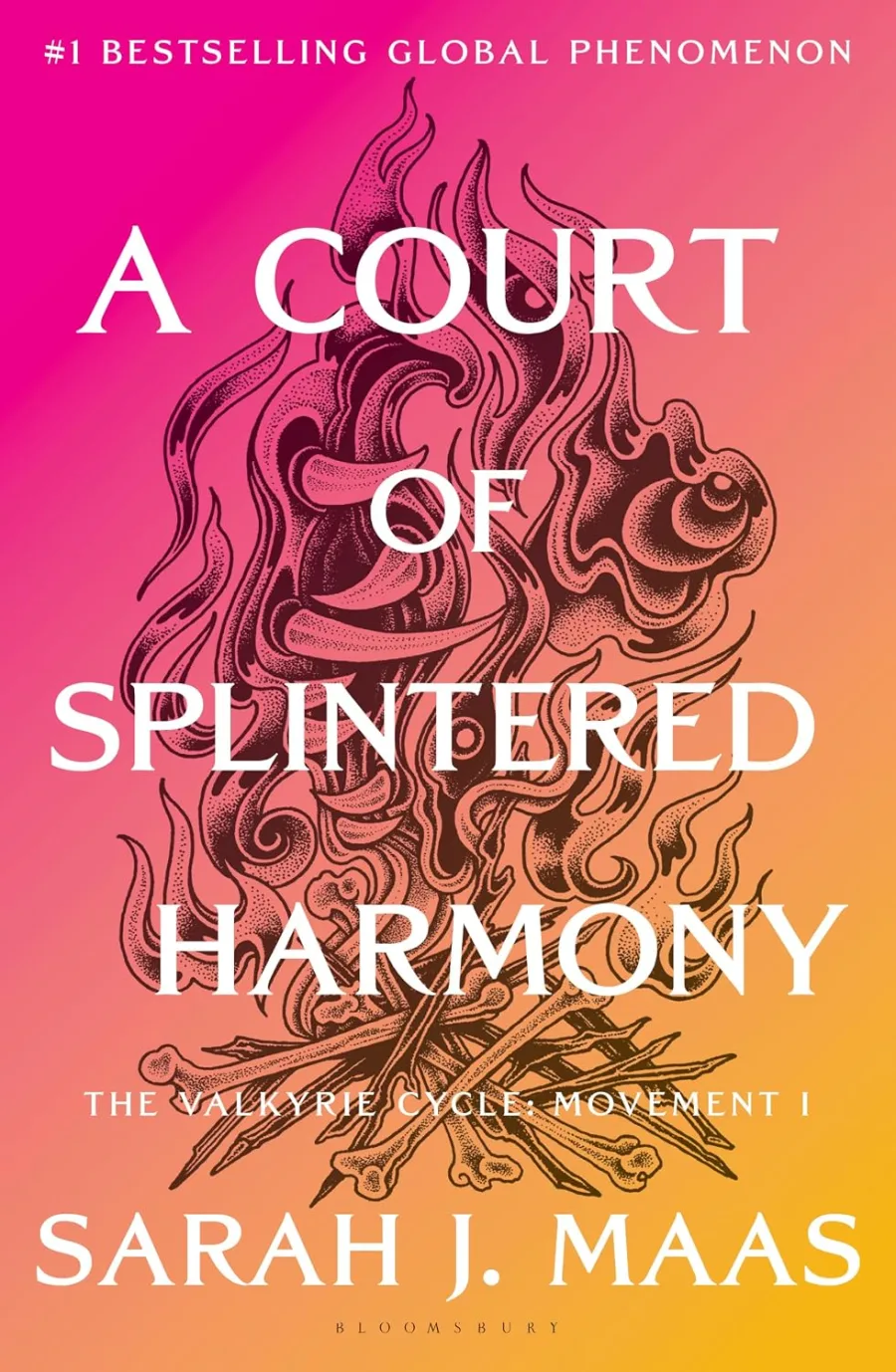
Download Cover Image
Do you want to download the full cover image for A Court of Splintered Harmony: The Sixth Book In the Globally Bestselling, Fantasy Romance Series?