
The Hidden Hindu: Science-Fiction Meets Indian Mythology in a Nail Biting Thriller Set In 2020
Paperback
• 256 Pages
• ₹ 250.00
• English
• 9780571348176
No ratings yet
| Publisher | Penguin eBury Press |
|---|---|
| ISBN13 | 9780571348176 |
| ASIN/SKU | 0143455699 |
| Book Format | Paperback |
| Language | English |
| Pages | 256 |
| List Price | ₹ 250.00 |
| Publishing Date | 15/02/2022 |
| Dimensions | 20.3 x 25.4 x 4.7 cm |
| Weight | 190 g |
| Book Code | BD00070184 |
Buy this Book
Amazon Stores
Ebook Stores
Other Stores
Discover The Hidden Hindu: Science-Fiction Meets Indian Mythology in a Nail Biting Thriller Set In 2020 by Akshat Gupta. This book is published by Penguin eBury Press in Paperback format, ISBN 9780571348176, ASIN 0143455699, under Literature and Fiction, Historical Fiction, Science Fiction Adventures.
Book Description
Prithvi, a twenty-one-year-old, is searching for a mysterious middle-aged aghori (Shiva devotee), Om Shastri, who was traced more than 200 years ago before he was captured and transported to a high-tech facility on an isolated Indian island. When the aghori was drugged and hypnotized for interrogation by a team of specialists, he claimed to have witnessed all four yugas (the epochs in Hinduism) and even participated in both Ramayana and Mahabharata. Om's revelations of his incredible past that defied the nature of mortality left everyone baffled. The team also discovers that Om had been in search of the other immortals from every yuga. These bizarre secrets could shake up the ancient beliefs of the present and alter the course of the future. So who is Om Shastri? Why was he captured? Board the boat of Om Shastri's secrets, Prithvi's pursuit and adventures of other enigmatic immortals of Hindu mythology in this exciting and revealing journey.
Author Biography
Akshat has the credit of successfully running a restaurant chain. Nevertheless, his penchant for writing grew with the passage of time. The Hidden Hindu is the product of sheer dedication and research for continuous two years. He is working on the second and third parts of this fiction trilogy which is a blend of Hindu mythology and Indian history. Akshat is currently working on few scripts for known production houses in Mumbai.
Editorial Reviews
Editorial Reviews will be added soon…
Book Summary
The Hidden Hindu by Akshat Gupta is a fast-paced Indian mythological thriller that brings together ancient Hindu mythology, modern science, immortality, secret identities, espionage, and science fiction. Set primarily around events connected with 2020, the novel revolves around a mysterious Aghori named Om Shastri, whose extraordinary claims challenge everything the investigators believe about history, mortality, and mythology. The publisher describes the book as a meeting point between science fiction and Indian mythology, centered on twenty-one-year-old Prithvi's search for Om Shastri.
At the heart of the story is a fascinating question: What if the immortals described in ancient Indian traditions were not merely legends?
The novel takes this question seriously and builds an elaborate mystery around it.
The Mysterious Om Shastri
The story introduces a mysterious middle-aged Aghori named Om Shastri, a Shiva devotee whose appearance and behavior immediately attract attention.
He is not an ordinary ascetic.
His past appears to stretch back far beyond the normal limits of human life.
According to the premise of the novel, Om Shastri had been traced more than two centuries earlier before eventually being captured and transported to a technologically advanced facility on an isolated Indian island. There, a team of specialists attempts to discover who he really is and how he could possibly possess knowledge of events separated from him by thousands of years.
The investigators initially assume that Om is either delusional, deliberately deceptive, or hiding some extraordinary secret.
Then he begins speaking.
And what he says changes everything.
A Man Who Remembers Ancient Ages
Under interrogation and hypnosis, Om Shastri claims to have lived through the four yugas described in Hindu cosmology.
He speaks about ancient periods of Indian history as though he personally experienced them.
Even more astonishingly, he claims to have participated in events associated with both the Ramayana and the Mahabharata.
The investigators are understandably skeptical.
How could a modern man possibly have witnessed events separated by thousands of years?
Yet Om's answers are not vague stories.
He provides names, identities, historical details, and connections that appear impossible for an ordinary person to know.
The mystery therefore changes from Is this man telling the truth? to If he is telling the truth, what exactly is he?
The novel uses this uncertainty to create much of its suspense.
Prithvi's Search
Running parallel to the mystery surrounding Om Shastri is the story of Prithvi, a twenty-one-year-old man searching for him.
Prithvi's connection to Om is not immediately obvious.
His pursuit gives the novel an additional layer of mystery because readers gradually discover that events in the present are connected to secrets from the past—and perhaps even to events that have not yet happened.
The publisher's description presents Prithvi's search as one of the central threads of the novel, alongside the mysterious immortals connected with different yugas.
The story therefore moves between investigation, revelation, mythology, and pursuit.
Science Meets Mythology
One of the novel's most distinctive features is its combination of two worlds that are normally treated separately.
On one side is modern science.
The investigators use sophisticated technology, psychological techniques, medical expertise, and surveillance to understand Om.
On the other side is ancient mythology.
Om speaks of yugas, immortals, legendary warriors, sages, and ancient knowledge.
The novel deliberately places these worlds in conflict.
The scientists want evidence.
The mythological explanations seem impossible.
Yet the deeper the investigation goes, the harder it becomes to dismiss Om's claims.
This tension gives the novel its science-fiction quality.
It does not simply retell ancient mythology.
Instead, it asks what ancient mythology might look like if it were interpreted through the lens of modern technology.
The Four Yugas
The idea of the four yugas is central to Om's revelations.
Rather than treating the ancient ages as distant stories, the novel imagines a character who has actually experienced them.
This creates a sense of enormous historical scale.
For Om, events that modern people regard as mythology are memories.
Figures remembered as legendary characters were, in his experience, real people.
Wars described in ancient texts were not simply stories.
They were part of a living past.
This dramatically changes the meaning of history.
The novel's mystery therefore extends far beyond the identity of one man.
It becomes a mystery about the nature of time itself.
The Immortals
As the investigation continues, the existence of other immortals becomes an increasingly important part of the story.
The concept draws on the Hindu tradition of Chiranjivis, extraordinary beings believed to remain alive across the ages.
The publisher specifically describes Om's search for other immortals connected to different yugas.
These immortals give the story a much larger mythology.
Om is no longer an isolated anomaly.
He appears to be part of a hidden world that has existed for thousands of years.
The question then becomes:
Why are these immortals still alive, and what are they waiting for?
Om Shastri's Hidden Identity
One of the most important revelations is that Om Shastri is not simply an unusually old man.
His true identity is connected to the ancient concept of Mrityunjay, one who has conquered death.
The story presents him as someone whose existence is linked to the legendary knowledge of Mrit Sanjeevani, a mysterious means of overcoming death.
His many identities across the ages help explain how he could have survived without being recognized.
He repeatedly changes names and identities, allowing him to disappear into history.
This idea gives the character a tragic dimension.
Immortality may appear to be an extraordinary gift.
But living for thousands of years also means watching civilizations disappear, friendships end, and generations pass.
Om's immortality therefore carries a heavy emotional price.
The Secret Facility
Much of the suspense develops inside the isolated high-tech facility where Om is interrogated.
The setting itself symbolizes the novel's central contrast.
Ancient knowledge is being examined through modern technology.
The investigators believe they can understand Om through science.
They use drugs and hypnosis to access his memories.
But the deeper they go, the more their scientific assumptions are challenged.
Om's mind becomes a doorway into ancient history.
The facility therefore becomes more than a prison.
It becomes a place where modern humanity confronts mysteries it does not yet possess the tools to explain.
Dr Shahista
Dr Shahista, a psychiatrist and hypnotism expert, plays an important role in the investigation.
She initially approaches Om scientifically.
Her goal is to understand his psychological state and determine whether his claims have any rational explanation.
But as she listens to him, her attitude begins to change.
She becomes increasingly uncomfortable with the methods being used against him.
Instead of seeing Om merely as a subject to be interrogated, she begins recognizing him as a human being who may be suffering.
Her compassion introduces an important moral question:
Even if someone possesses extraordinary knowledge, does that give others the right to violate him in the name of discovery?
The more Om reveals, the more difficult it becomes to treat him simply as a scientific specimen.
The Ancient Names
One of the novel's most intriguing elements is Om's association with multiple legendary identities.
He claims connections with figures such as Vidur, Sushen, and Chanakya, among others.
These revelations blur the boundary between mythology and history.
The investigators begin wondering whether the identities they have studied in textbooks and scriptures might have been connected to a single immortal being.
This is where the novel's imagination becomes particularly ambitious.
It takes familiar names from Indian cultural memory and places them inside a completely new narrative framework.
The result is not a traditional mythological retelling.
It is a mystery about identity.
The Search for the Other Immortals
Om's story reveals that he has been searching for other immortals.
This search becomes increasingly important.
Why does he need them?
What connects them?
Why have they remained hidden?
And why does someone else appear determined to find them?
The answers gradually reveal a much larger conflict.
The immortals are not merely mysterious survivors of ancient history.
They are connected to knowledge that could have enormous consequences in the modern world.
Nagendra and the Darker Conspiracy
Another important figure is Nagendra, whose connection with Om forms one of the novel's major conflicts.
Nagendra is associated with the pursuit of ancient knowledge and the secret behind immortality.
His motivations are far darker than simple curiosity.
Where Om represents the burden of preserving ancient knowledge, Nagendra is driven by the desire to obtain and use it.
This creates a classic conflict between knowledge as responsibility and knowledge as power.
Ancient wisdom can heal.
But it can also become dangerous when placed in the hands of someone motivated by domination.
The Mrit Sanjeevani Mystery
The concept of Mrit Sanjeevani provides one of the novel's most fascinating speculative ideas.
It is connected with the possibility of overcoming death.
Modern science has always struggled with the limits of mortality.
The novel therefore takes an ancient Indian concept and imagines what would happen if such knowledge were real.
Who would control it?
Could death actually be defeated?
Would immortality be a blessing?
Or would it create a struggle for power unlike anything the modern world has seen?
These questions make the novel feel like science fiction even when it is drawing heavily on mythology.
Violence and Betrayal
As the mystery develops, the story becomes increasingly dangerous.
The investigators discover that they are dealing with people who will kill to obtain ancient knowledge.
Alliances become uncertain.
Characters who appear trustworthy may have hidden motives.
The facility itself becomes a battleground.
The story therefore moves from psychological mystery toward full-scale thriller.
The search for truth has consequences.
Learning the wrong secret can be fatal.
The Immortals as Human Beings
One of the novel's interesting ideas is that immortality does not make someone emotionally invulnerable.
The immortals experience pain, fear, loneliness, attachment, and loss.
They may possess extraordinary abilities, but they remain shaped by human emotions.
Om's long existence is therefore not simply a celebration of power.
It is also a story of endurance.
Imagine watching thousands of years pass while remaining alive.
Friends die.
Kingdoms disappear.
Languages change.
Civilizations rise and collapse.
People you love become distant memories.
Immortality becomes a form of exile.
The Conflict Between Knowledge and Power
The novel repeatedly asks what people do when they discover something powerful.
The investigators want knowledge.
Nagendra wants ancient secrets.
Om wants to protect certain truths.
Prithvi wants answers.
These motivations overlap but are not identical.
The story suggests that knowledge itself is neither good nor evil.
What matters is the intention of the person who possesses it.
Ancient knowledge in the hands of a responsible person can preserve life.
In the hands of someone seeking domination, it can become destructive.
Prithvi's Importance
Prithvi represents the younger generation confronting mysteries inherited from the ancient world.
He begins by searching for answers about Om.
But his journey gradually becomes much larger.
He discovers that the person he is seeking is connected to a history far greater than he imagined.
His search becomes a bridge between generations.
He belongs to the modern world, yet he is drawn into a conflict that began thousands of years ago.
This gives the novel a strong sense of continuity between India's mythological past and its imagined future.
The Final Revelations
As the story approaches its climax, the secrets surrounding Om, Nagendra, and the immortals begin to converge.
The investigation reveals that Om's memories are not meaningless fantasies.
They are connected to an ancient reality.
The people around him are also connected to a much older conflict.
The high-tech facility, which initially appears to represent modern scientific control, becomes vulnerable to forces that modern technology cannot easily contain.
The conflict between the immortals and their enemies finally erupts into violence.
The first book ends with major questions still unresolved, setting up the subsequent novels in the trilogy.
The publisher's later descriptions confirm that the larger series continues the search for a hidden verse and explores the identities of Om, Nagendra, and the other immortals.
Mythology Reimagined
Perhaps the greatest strength of The Hidden Hindu is its willingness to reinterpret familiar mythology.
It does not ask readers to choose between science and mythology.
Instead, it imagines a universe in which both can coexist.
Ancient sages can possess knowledge that resembles advanced science.
Immortality can be treated as a biological mystery.
Mythological figures can become characters in a modern thriller.
Ancient battles can have consequences in the present.
This imaginative combination gives the novel its distinctive identity.
The Meaning of Immortality
At a deeper level, the novel asks whether living forever is truly desirable.
Modern culture often treats immortality as the ultimate achievement.
But Om's existence suggests otherwise.
Immortality means carrying memories that no ordinary human being could survive.
It means repeatedly losing people.
It means living through history rather than simply reading about it.
It means hiding one's true identity for centuries.
The ability to survive death therefore becomes both a gift and a burden.
Om's story suggests that mortality may be painful, but it is also what gives human relationships urgency and meaning.
Conclusion
The Hidden Hindu is ultimately an ambitious blend of Indian mythology, science fiction, mystery, and thriller.
The story begins with a simple question: Who is Om Shastri?
But the answer leads into much larger questions.
Who were the immortals?
What are the four yugas really hiding?
Can death be conquered?
What happened during the ancient ages?
Why has Om spent centuries changing identities?
Why is he searching for other immortals?
And who wants to control the knowledge they possess?
The novel's central character, Om Shastri, is fascinating precisely because he is both extraordinary and deeply human. He has apparently survived across enormous stretches of time, yet immortality has not made him free. Instead, it has burdened him with memories, secrets, loneliness, and responsibility.
Prithvi's search gives the story its modern perspective, while the investigation surrounding Om provides the scientific and psychological framework. The ancient immortals provide the mythology, and the conspiracy surrounding their secrets supplies the thriller element.
What makes the novel especially engaging is the way it refuses to keep mythology safely in the past.
It brings ancient Indian legends into the modern world and asks what might happen if those legends were literally true.
The result is a story where an Aghori can be older than empires, an ancient secret can become a modern weapon, and mythology can suddenly become evidence.
Ultimately, The Hidden Hindu is about the dangerous meeting point between ancient wisdom and modern ambition. It suggests that some knowledge is so powerful that possessing it can become a responsibility rather than a privilege.
And behind all the mythology and mystery lies a deeply human question:
If you could defeat death, would living forever truly be a blessing—or would immortality become the greatest burden of all?
That question gives The Hidden Hindu its emotional depth beneath its fast-moving thriller plot and makes Om Shastri's mysterious journey much more than a tale of ancient immortals.
At the heart of the story is a fascinating question: What if the immortals described in ancient Indian traditions were not merely legends?
The novel takes this question seriously and builds an elaborate mystery around it.
The Mysterious Om Shastri
The story introduces a mysterious middle-aged Aghori named Om Shastri, a Shiva devotee whose appearance and behavior immediately attract attention.
He is not an ordinary ascetic.
His past appears to stretch back far beyond the normal limits of human life.
According to the premise of the novel, Om Shastri had been traced more than two centuries earlier before eventually being captured and transported to a technologically advanced facility on an isolated Indian island. There, a team of specialists attempts to discover who he really is and how he could possibly possess knowledge of events separated from him by thousands of years.
The investigators initially assume that Om is either delusional, deliberately deceptive, or hiding some extraordinary secret.
Then he begins speaking.
And what he says changes everything.
A Man Who Remembers Ancient Ages
Under interrogation and hypnosis, Om Shastri claims to have lived through the four yugas described in Hindu cosmology.
He speaks about ancient periods of Indian history as though he personally experienced them.
Even more astonishingly, he claims to have participated in events associated with both the Ramayana and the Mahabharata.
The investigators are understandably skeptical.
How could a modern man possibly have witnessed events separated by thousands of years?
Yet Om's answers are not vague stories.
He provides names, identities, historical details, and connections that appear impossible for an ordinary person to know.
The mystery therefore changes from Is this man telling the truth? to If he is telling the truth, what exactly is he?
The novel uses this uncertainty to create much of its suspense.
Prithvi's Search
Running parallel to the mystery surrounding Om Shastri is the story of Prithvi, a twenty-one-year-old man searching for him.
Prithvi's connection to Om is not immediately obvious.
His pursuit gives the novel an additional layer of mystery because readers gradually discover that events in the present are connected to secrets from the past—and perhaps even to events that have not yet happened.
The publisher's description presents Prithvi's search as one of the central threads of the novel, alongside the mysterious immortals connected with different yugas.
The story therefore moves between investigation, revelation, mythology, and pursuit.
Science Meets Mythology
One of the novel's most distinctive features is its combination of two worlds that are normally treated separately.
On one side is modern science.
The investigators use sophisticated technology, psychological techniques, medical expertise, and surveillance to understand Om.
On the other side is ancient mythology.
Om speaks of yugas, immortals, legendary warriors, sages, and ancient knowledge.
The novel deliberately places these worlds in conflict.
The scientists want evidence.
The mythological explanations seem impossible.
Yet the deeper the investigation goes, the harder it becomes to dismiss Om's claims.
This tension gives the novel its science-fiction quality.
It does not simply retell ancient mythology.
Instead, it asks what ancient mythology might look like if it were interpreted through the lens of modern technology.
The Four Yugas
The idea of the four yugas is central to Om's revelations.
Rather than treating the ancient ages as distant stories, the novel imagines a character who has actually experienced them.
This creates a sense of enormous historical scale.
For Om, events that modern people regard as mythology are memories.
Figures remembered as legendary characters were, in his experience, real people.
Wars described in ancient texts were not simply stories.
They were part of a living past.
This dramatically changes the meaning of history.
The novel's mystery therefore extends far beyond the identity of one man.
It becomes a mystery about the nature of time itself.
The Immortals
As the investigation continues, the existence of other immortals becomes an increasingly important part of the story.
The concept draws on the Hindu tradition of Chiranjivis, extraordinary beings believed to remain alive across the ages.
The publisher specifically describes Om's search for other immortals connected to different yugas.
These immortals give the story a much larger mythology.
Om is no longer an isolated anomaly.
He appears to be part of a hidden world that has existed for thousands of years.
The question then becomes:
Why are these immortals still alive, and what are they waiting for?
Om Shastri's Hidden Identity
One of the most important revelations is that Om Shastri is not simply an unusually old man.
His true identity is connected to the ancient concept of Mrityunjay, one who has conquered death.
The story presents him as someone whose existence is linked to the legendary knowledge of Mrit Sanjeevani, a mysterious means of overcoming death.
His many identities across the ages help explain how he could have survived without being recognized.
He repeatedly changes names and identities, allowing him to disappear into history.
This idea gives the character a tragic dimension.
Immortality may appear to be an extraordinary gift.
But living for thousands of years also means watching civilizations disappear, friendships end, and generations pass.
Om's immortality therefore carries a heavy emotional price.
The Secret Facility
Much of the suspense develops inside the isolated high-tech facility where Om is interrogated.
The setting itself symbolizes the novel's central contrast.
Ancient knowledge is being examined through modern technology.
The investigators believe they can understand Om through science.
They use drugs and hypnosis to access his memories.
But the deeper they go, the more their scientific assumptions are challenged.
Om's mind becomes a doorway into ancient history.
The facility therefore becomes more than a prison.
It becomes a place where modern humanity confronts mysteries it does not yet possess the tools to explain.
Dr Shahista
Dr Shahista, a psychiatrist and hypnotism expert, plays an important role in the investigation.
She initially approaches Om scientifically.
Her goal is to understand his psychological state and determine whether his claims have any rational explanation.
But as she listens to him, her attitude begins to change.
She becomes increasingly uncomfortable with the methods being used against him.
Instead of seeing Om merely as a subject to be interrogated, she begins recognizing him as a human being who may be suffering.
Her compassion introduces an important moral question:
Even if someone possesses extraordinary knowledge, does that give others the right to violate him in the name of discovery?
The more Om reveals, the more difficult it becomes to treat him simply as a scientific specimen.
The Ancient Names
One of the novel's most intriguing elements is Om's association with multiple legendary identities.
He claims connections with figures such as Vidur, Sushen, and Chanakya, among others.
These revelations blur the boundary between mythology and history.
The investigators begin wondering whether the identities they have studied in textbooks and scriptures might have been connected to a single immortal being.
This is where the novel's imagination becomes particularly ambitious.
It takes familiar names from Indian cultural memory and places them inside a completely new narrative framework.
The result is not a traditional mythological retelling.
It is a mystery about identity.
The Search for the Other Immortals
Om's story reveals that he has been searching for other immortals.
This search becomes increasingly important.
Why does he need them?
What connects them?
Why have they remained hidden?
And why does someone else appear determined to find them?
The answers gradually reveal a much larger conflict.
The immortals are not merely mysterious survivors of ancient history.
They are connected to knowledge that could have enormous consequences in the modern world.
Nagendra and the Darker Conspiracy
Another important figure is Nagendra, whose connection with Om forms one of the novel's major conflicts.
Nagendra is associated with the pursuit of ancient knowledge and the secret behind immortality.
His motivations are far darker than simple curiosity.
Where Om represents the burden of preserving ancient knowledge, Nagendra is driven by the desire to obtain and use it.
This creates a classic conflict between knowledge as responsibility and knowledge as power.
Ancient wisdom can heal.
But it can also become dangerous when placed in the hands of someone motivated by domination.
The Mrit Sanjeevani Mystery
The concept of Mrit Sanjeevani provides one of the novel's most fascinating speculative ideas.
It is connected with the possibility of overcoming death.
Modern science has always struggled with the limits of mortality.
The novel therefore takes an ancient Indian concept and imagines what would happen if such knowledge were real.
Who would control it?
Could death actually be defeated?
Would immortality be a blessing?
Or would it create a struggle for power unlike anything the modern world has seen?
These questions make the novel feel like science fiction even when it is drawing heavily on mythology.
Violence and Betrayal
As the mystery develops, the story becomes increasingly dangerous.
The investigators discover that they are dealing with people who will kill to obtain ancient knowledge.
Alliances become uncertain.
Characters who appear trustworthy may have hidden motives.
The facility itself becomes a battleground.
The story therefore moves from psychological mystery toward full-scale thriller.
The search for truth has consequences.
Learning the wrong secret can be fatal.
The Immortals as Human Beings
One of the novel's interesting ideas is that immortality does not make someone emotionally invulnerable.
The immortals experience pain, fear, loneliness, attachment, and loss.
They may possess extraordinary abilities, but they remain shaped by human emotions.
Om's long existence is therefore not simply a celebration of power.
It is also a story of endurance.
Imagine watching thousands of years pass while remaining alive.
Friends die.
Kingdoms disappear.
Languages change.
Civilizations rise and collapse.
People you love become distant memories.
Immortality becomes a form of exile.
The Conflict Between Knowledge and Power
The novel repeatedly asks what people do when they discover something powerful.
The investigators want knowledge.
Nagendra wants ancient secrets.
Om wants to protect certain truths.
Prithvi wants answers.
These motivations overlap but are not identical.
The story suggests that knowledge itself is neither good nor evil.
What matters is the intention of the person who possesses it.
Ancient knowledge in the hands of a responsible person can preserve life.
In the hands of someone seeking domination, it can become destructive.
Prithvi's Importance
Prithvi represents the younger generation confronting mysteries inherited from the ancient world.
He begins by searching for answers about Om.
But his journey gradually becomes much larger.
He discovers that the person he is seeking is connected to a history far greater than he imagined.
His search becomes a bridge between generations.
He belongs to the modern world, yet he is drawn into a conflict that began thousands of years ago.
This gives the novel a strong sense of continuity between India's mythological past and its imagined future.
The Final Revelations
As the story approaches its climax, the secrets surrounding Om, Nagendra, and the immortals begin to converge.
The investigation reveals that Om's memories are not meaningless fantasies.
They are connected to an ancient reality.
The people around him are also connected to a much older conflict.
The high-tech facility, which initially appears to represent modern scientific control, becomes vulnerable to forces that modern technology cannot easily contain.
The conflict between the immortals and their enemies finally erupts into violence.
The first book ends with major questions still unresolved, setting up the subsequent novels in the trilogy.
The publisher's later descriptions confirm that the larger series continues the search for a hidden verse and explores the identities of Om, Nagendra, and the other immortals.
Mythology Reimagined
Perhaps the greatest strength of The Hidden Hindu is its willingness to reinterpret familiar mythology.
It does not ask readers to choose between science and mythology.
Instead, it imagines a universe in which both can coexist.
Ancient sages can possess knowledge that resembles advanced science.
Immortality can be treated as a biological mystery.
Mythological figures can become characters in a modern thriller.
Ancient battles can have consequences in the present.
This imaginative combination gives the novel its distinctive identity.
The Meaning of Immortality
At a deeper level, the novel asks whether living forever is truly desirable.
Modern culture often treats immortality as the ultimate achievement.
But Om's existence suggests otherwise.
Immortality means carrying memories that no ordinary human being could survive.
It means repeatedly losing people.
It means living through history rather than simply reading about it.
It means hiding one's true identity for centuries.
The ability to survive death therefore becomes both a gift and a burden.
Om's story suggests that mortality may be painful, but it is also what gives human relationships urgency and meaning.
Conclusion
The Hidden Hindu is ultimately an ambitious blend of Indian mythology, science fiction, mystery, and thriller.
The story begins with a simple question: Who is Om Shastri?
But the answer leads into much larger questions.
Who were the immortals?
What are the four yugas really hiding?
Can death be conquered?
What happened during the ancient ages?
Why has Om spent centuries changing identities?
Why is he searching for other immortals?
And who wants to control the knowledge they possess?
The novel's central character, Om Shastri, is fascinating precisely because he is both extraordinary and deeply human. He has apparently survived across enormous stretches of time, yet immortality has not made him free. Instead, it has burdened him with memories, secrets, loneliness, and responsibility.
Prithvi's search gives the story its modern perspective, while the investigation surrounding Om provides the scientific and psychological framework. The ancient immortals provide the mythology, and the conspiracy surrounding their secrets supplies the thriller element.
What makes the novel especially engaging is the way it refuses to keep mythology safely in the past.
It brings ancient Indian legends into the modern world and asks what might happen if those legends were literally true.
The result is a story where an Aghori can be older than empires, an ancient secret can become a modern weapon, and mythology can suddenly become evidence.
Ultimately, The Hidden Hindu is about the dangerous meeting point between ancient wisdom and modern ambition. It suggests that some knowledge is so powerful that possessing it can become a responsibility rather than a privilege.
And behind all the mythology and mystery lies a deeply human question:
If you could defeat death, would living forever truly be a blessing—or would immortality become the greatest burden of all?
That question gives The Hidden Hindu its emotional depth beneath its fast-moving thriller plot and makes Om Shastri's mysterious journey much more than a tale of ancient immortals.
Sample Chapters
Sample Chapters will be added soon…
Reader Reviews
No reviews yet.
The Hidden Hindu: Science-Fiction Meets Indian Mythology in a Nail Biting Thriller Set In 2020
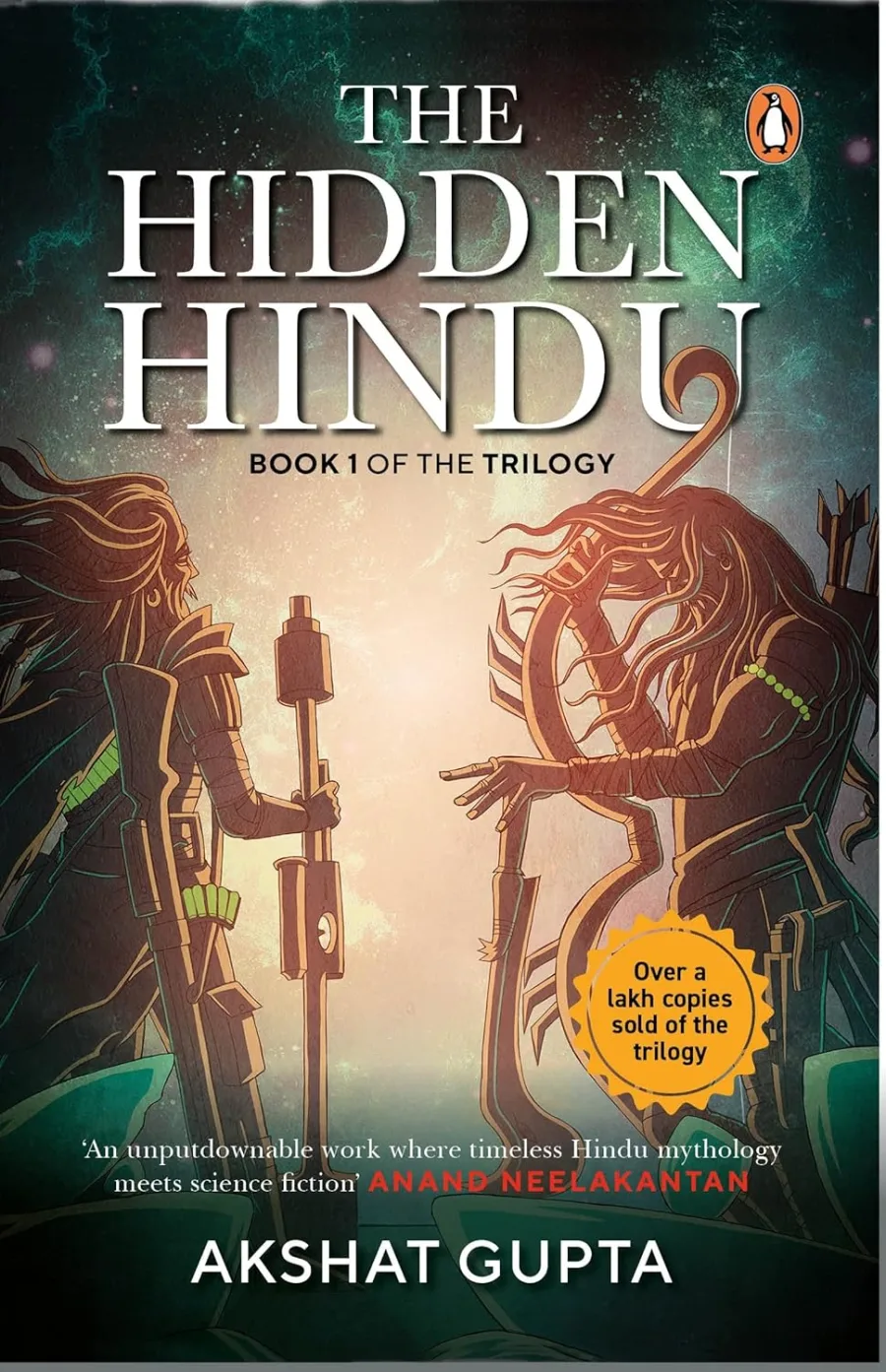
Download Cover Image
Do you want to download the full cover image for The Hidden Hindu: Science-Fiction Meets Indian Mythology in a Nail Biting Thriller Set In 2020?