
The Hidden Hindu
Paperback
• 256 Pages
• ₹ 250.00
• English
• 9780571348176
No ratings yet
| Publisher | Penguin eBury Press |
|---|---|
| ISBN13 | 9780571348176 |
| ASIN/SKU | 0143455699 |
| Book Format | Paperback |
| Language | English |
| Pages | 256 |
| List Price | ₹ 250.00 |
| Publishing Date | 15/02/2022 |
| Dimensions | 20.3 x 25.4 x 4.7 cm |
| Weight | 190 g |
| Book Code | BD00070184 |
Buy this Book
Amazon Stores
Ebook Stores
Other Stores
Discover The Hidden Hindu by Akshat Gupta. This book is published by Penguin eBury Press in Paperback format, ISBN 9780571348176, ASIN 0143455699, under Literature and Fiction, Historical Fiction, Science Fiction Adventures.
Book Description
Prithvi, a twenty-one-year-old, is searching for a mysterious middle-aged aghori (Shiva devotee), Om Shastri, who was traced more than 200 years ago before he was captured and transported to a high-tech facility on an isolated Indian island. When the aghori was drugged and hypnotized for interrogation by a team of specialists, he claimed to have witnessed all four yugas (the epochs in Hinduism) and even participated in both Ramayana and Mahabharata. Om's revelations of his incredible past that defied the nature of mortality left everyone baffled. The team also discovers that Om had been in search of the other immortals from every yuga. These bizarre secrets could shake up the ancient beliefs of the present and alter the course of the future. So who is Om Shastri? Why was he captured? Board the boat of Om Shastri's secrets, Prithvi's pursuit and adventures of other enigmatic immortals of Hindu mythology in this exciting and revealing journey.
Author Biography
Akshat has the credit of successfully running a restaurant chain. Nevertheless, his penchant for writing grew with the passage of time. The Hidden Hindu is the product of sheer dedication and research for continuous two years. He is working on the second and third parts of this fiction trilogy which is a blend of Hindu mythology and Indian history. Akshat is currently working on few scripts for known production houses in Mumbai.
Editorial Reviews
Editorial Reviews will be added soon…
Book Summary
The Hidden Hindu by Akshat Gupta is a fast-paced mythological thriller that blends ancient Indian mythology, mystery, immortality, modern science, and a race against time. At the heart of the novel is a fascinating question: what if some of the most powerful beings described in Indian mythology were not merely characters from ancient stories, but living beings who had survived into the modern world? Gupta builds his story around this possibility and uses it to create a suspenseful narrative in which the past refuses to remain buried.
The novel begins by introducing Om Shastri, an apparently ordinary but deeply mysterious man who is brought to a secret medical facility after being found under unusual circumstances. What makes Om extraordinary is not simply his physical condition but his strange behavior and the ancient identity he claims to possess. During questioning, he speaks several languages, including languages that are believed to be extremely old, and gives answers that seem impossible for a contemporary person to know. His knowledge of history, mythology, and ancient events makes the investigators increasingly suspicious. Yet the greatest mystery is his claim that he is an immortal being who has lived for thousands of years.
The medical and investigative team initially approaches Om as a psychological or scientific puzzle. If he is telling the truth, however, their assumptions about human history would have to be reconsidered. Om's statements suggest that mythology and history may overlap in ways that modern people have forgotten. He speaks about ancient personalities and events with the familiarity of someone who has personally witnessed them. As the investigation progresses, the distinction between myth and reality begins to disappear.
One of the novel's strongest elements is this gradual unveiling of Om's identity. Gupta does not immediately explain everything. Instead, the story allows mystery to accumulate. Every revelation produces another question. Why is Om immortal? How long has he lived? What has he witnessed? Why has he remained hidden? And most importantly, why has he suddenly appeared in the modern world?
The story introduces a number of characters who become connected to this mystery, including investigative and scientific figures trying to understand Om's extraordinary claims. Prithvi, a young man with his own connection to the mysterious events, becomes an important part of the unfolding narrative. The relationship between the characters is driven not simply by friendship or conflict but by the need to uncover the truth before it becomes too late.
Om's story takes the reader into the world of Indian mythology, particularly the idea of the Chiranjivis—immortal or exceptionally long-lived beings who are traditionally believed to continue existing in the world. The novel creatively uses this ancient concept as the foundation of its fantasy. Instead of treating immortality as a distant religious idea, Gupta imagines what it might mean for such beings to actually walk among modern humans.
This creates an intriguing contrast between two worlds. On one side is modern science, with its laboratories, medical examinations, technology, and rational investigation. On the other is ancient mythology, filled with extraordinary beings, curses, divine events, wars, spiritual powers, and secrets passed through generations. The novel brings these worlds together without completely explaining either one. The tension between scientific skepticism and mythological possibility becomes one of its central sources of suspense.
As Om's history begins to emerge, the reader encounters some of the most recognizable figures from Indian mythology. The novel draws especially upon stories surrounding figures such as Ashwatthama, one of the most controversial and tragic characters associated with the Mahabharata. Ashwatthama's immortality is traditionally connected with a curse, and Gupta uses this idea to explore the emotional burden of living beyond the normal limits of human life.
Here mythology becomes more than spectacle. Immortality is not presented simply as a superpower. It can also be a punishment. To live for centuries means watching civilizations rise and disappear, witnessing loved ones die, carrying memories that nobody else can understand, and living with the consequences of decisions made in a distant past. The novel therefore gives its immortal characters an emotional dimension. Their extraordinary longevity separates them from ordinary humanity.
The Mahabharata becomes particularly important because it provides a bridge between the ancient and modern worlds. The epic is not treated merely as an old story but as a living reservoir of mysteries. Characters associated with the epic become part of the novel's contemporary investigation, and the consequences of their ancient lives continue to influence events in the present.
Another major theme is the relationship between knowledge and power. The characters are not searching for information simply because they are curious. Ancient knowledge can have enormous consequences when combined with modern technology. Gupta repeatedly creates situations in which discovering the truth is only the beginning of the problem. Once powerful knowledge becomes available, the question becomes who will control it and what they will do with it.
This is where the thriller element becomes particularly strong. The story gradually expands from a mysterious individual in a medical facility into a much larger conflict. Hidden organizations, ancient secrets, dangerous individuals, and extraordinary abilities begin to intersect. The characters find themselves caught in circumstances where the survival of individuals may be connected to much greater consequences.
Prithvi's journey provides an important human perspective within this larger mythology. Unlike Om, who carries the weight of thousands of years, Prithvi belongs to the modern world. His involvement allows the reader to experience the mystery through someone who must gradually accept that the world is far stranger than he believed. His journey is therefore one of discovery as well as danger.
The novel also explores the idea that history may be incomplete. Human civilization tends to organize the past into neat categories—myth, legend, history, religion, archaeology, and science. But Gupta imagines a world in which these categories overlap. Ancient events may contain historical truths, legends may preserve memories of extraordinary individuals, and myths may have been shaped by experiences that later generations no longer understood.
This idea gives the novel much of its imaginative energy. A familiar mythological figure can suddenly become a contemporary character, and an ancient story can become relevant to a modern crisis. Readers who already know Indian mythology may find pleasure in recognizing familiar names and stories, while readers less familiar with them are introduced to a larger mythological universe through the thriller's narrative.
The title, The Hidden Hindu, itself reflects this combination of mystery and identity. The word “hidden” suggests something deliberately concealed, something that exists close to the surface but remains invisible to ordinary perception. The “Hindu” element points toward the cultural and mythological world from which the novel draws its central ideas. The book does not simply retell mythology; it reimagines mythological concepts within a contemporary fictional framework.
Gupta's storytelling style is cinematic. Scenes move quickly, revelations arrive at regular intervals, and the narrative frequently ends sections with unanswered questions. This makes the book accessible and highly readable. Instead of presenting mythology as a long academic explanation, the novel turns it into an active mystery. Readers learn about the ancient world because the characters need to understand it in order to survive.
The novel also raises questions about the meaning of immortality. Humans traditionally dream of living forever because death represents the ultimate unknown. Yet The Hidden Hindu complicates that dream. Immortality can offer extraordinary knowledge and experience, but it can also create profound loneliness. An immortal person cannot simply return to the innocence of ordinary life. Every new generation may appear temporary, while memories from the past become increasingly heavy.
This theme gives Om's character an unusual emotional depth. His secret is fascinating, but his existence is also tragic. A person who has lived through thousands of years carries an unimaginable accumulation of experiences. The novel encourages readers to consider whether endless life would actually be a blessing. If death gives human life urgency and meaning, what happens when that boundary disappears?
At the same time, the story is concerned with the consequences of the past. The ancient characters cannot simply escape what happened centuries ago. Their actions continue to shape the present. This creates one of the book's most important ideas: time may move forward, but unresolved consequences can survive across generations.
The novel's mythological imagination is also supported by its exploration of secret knowledge. Ancient India is presented as a civilization containing mysteries that modern people may not fully understand. Gupta uses this idea as fiction rather than as a conventional historical argument, creating a world where forgotten knowledge can suddenly become relevant again. The result is a story that encourages readers to look at mythology with curiosity rather than treating it merely as a collection of old tales.
As the narrative develops, the stakes become increasingly serious. What begins as an investigation into one unusual man eventually becomes connected with a much larger threat. The characters must understand the past in order to deal with the present. Ancient identities are revealed, hidden motives become clearer, and the boundaries between protector and threat become increasingly complicated.
One of the novel's greatest strengths is its ability to make mythology feel immediate. Figures who normally exist in scriptures, legends, and cultural memory are placed in laboratories, cities, conversations, investigations, and conflicts recognizable to modern readers. This creates a sense that two timelines are operating simultaneously: the ancient world beneath the surface and the modern world visible above it.
Yet the novel deliberately leaves certain questions open. It is not designed as a definitive explanation of Indian mythology. Instead, it uses mythology as a creative foundation for a fictional adventure. Some elements are altered, expanded, or interpreted for dramatic purposes. Readers should therefore approach the book primarily as mythological fiction rather than as a historical or theological account.
Ultimately, The Hidden Hindu is a story about secrets that refuse to die. Its characters carry ancient identities, ancient wounds, ancient knowledge, and ancient responsibilities into a world transformed by technology and modern civilization. The novel asks what might happen if humanity suddenly discovered that the stories it had classified as mythology were connected to living realities.
The deeper appeal of the book lies in the meeting of wonder and suspense. It invites readers to imagine a world in which the Mahabharata is not simply remembered but somehow still present, where immortals walk quietly among ordinary people, and where forgotten knowledge can become dangerously relevant. At the same time, it keeps the human emotions of fear, loneliness, loyalty, curiosity, guilt, and the desire for truth at the center of the adventure.
In the end, The Hidden Hindu offers a contemporary way of entering the vast imaginative world of Indian mythology. Akshat Gupta combines ancient legends with modern investigation, science-fiction-like possibilities, supernatural mystery, and thriller pacing. The result is a novel in which the past is never truly past. Ancient actions have modern consequences, immortality carries a price, knowledge can become dangerous, and the greatest mysteries may be hidden not in distant worlds but within stories humanity has been telling for thousands of years.
The novel begins by introducing Om Shastri, an apparently ordinary but deeply mysterious man who is brought to a secret medical facility after being found under unusual circumstances. What makes Om extraordinary is not simply his physical condition but his strange behavior and the ancient identity he claims to possess. During questioning, he speaks several languages, including languages that are believed to be extremely old, and gives answers that seem impossible for a contemporary person to know. His knowledge of history, mythology, and ancient events makes the investigators increasingly suspicious. Yet the greatest mystery is his claim that he is an immortal being who has lived for thousands of years.
The medical and investigative team initially approaches Om as a psychological or scientific puzzle. If he is telling the truth, however, their assumptions about human history would have to be reconsidered. Om's statements suggest that mythology and history may overlap in ways that modern people have forgotten. He speaks about ancient personalities and events with the familiarity of someone who has personally witnessed them. As the investigation progresses, the distinction between myth and reality begins to disappear.
One of the novel's strongest elements is this gradual unveiling of Om's identity. Gupta does not immediately explain everything. Instead, the story allows mystery to accumulate. Every revelation produces another question. Why is Om immortal? How long has he lived? What has he witnessed? Why has he remained hidden? And most importantly, why has he suddenly appeared in the modern world?
The story introduces a number of characters who become connected to this mystery, including investigative and scientific figures trying to understand Om's extraordinary claims. Prithvi, a young man with his own connection to the mysterious events, becomes an important part of the unfolding narrative. The relationship between the characters is driven not simply by friendship or conflict but by the need to uncover the truth before it becomes too late.
Om's story takes the reader into the world of Indian mythology, particularly the idea of the Chiranjivis—immortal or exceptionally long-lived beings who are traditionally believed to continue existing in the world. The novel creatively uses this ancient concept as the foundation of its fantasy. Instead of treating immortality as a distant religious idea, Gupta imagines what it might mean for such beings to actually walk among modern humans.
This creates an intriguing contrast between two worlds. On one side is modern science, with its laboratories, medical examinations, technology, and rational investigation. On the other is ancient mythology, filled with extraordinary beings, curses, divine events, wars, spiritual powers, and secrets passed through generations. The novel brings these worlds together without completely explaining either one. The tension between scientific skepticism and mythological possibility becomes one of its central sources of suspense.
As Om's history begins to emerge, the reader encounters some of the most recognizable figures from Indian mythology. The novel draws especially upon stories surrounding figures such as Ashwatthama, one of the most controversial and tragic characters associated with the Mahabharata. Ashwatthama's immortality is traditionally connected with a curse, and Gupta uses this idea to explore the emotional burden of living beyond the normal limits of human life.
Here mythology becomes more than spectacle. Immortality is not presented simply as a superpower. It can also be a punishment. To live for centuries means watching civilizations rise and disappear, witnessing loved ones die, carrying memories that nobody else can understand, and living with the consequences of decisions made in a distant past. The novel therefore gives its immortal characters an emotional dimension. Their extraordinary longevity separates them from ordinary humanity.
The Mahabharata becomes particularly important because it provides a bridge between the ancient and modern worlds. The epic is not treated merely as an old story but as a living reservoir of mysteries. Characters associated with the epic become part of the novel's contemporary investigation, and the consequences of their ancient lives continue to influence events in the present.
Another major theme is the relationship between knowledge and power. The characters are not searching for information simply because they are curious. Ancient knowledge can have enormous consequences when combined with modern technology. Gupta repeatedly creates situations in which discovering the truth is only the beginning of the problem. Once powerful knowledge becomes available, the question becomes who will control it and what they will do with it.
This is where the thriller element becomes particularly strong. The story gradually expands from a mysterious individual in a medical facility into a much larger conflict. Hidden organizations, ancient secrets, dangerous individuals, and extraordinary abilities begin to intersect. The characters find themselves caught in circumstances where the survival of individuals may be connected to much greater consequences.
Prithvi's journey provides an important human perspective within this larger mythology. Unlike Om, who carries the weight of thousands of years, Prithvi belongs to the modern world. His involvement allows the reader to experience the mystery through someone who must gradually accept that the world is far stranger than he believed. His journey is therefore one of discovery as well as danger.
The novel also explores the idea that history may be incomplete. Human civilization tends to organize the past into neat categories—myth, legend, history, religion, archaeology, and science. But Gupta imagines a world in which these categories overlap. Ancient events may contain historical truths, legends may preserve memories of extraordinary individuals, and myths may have been shaped by experiences that later generations no longer understood.
This idea gives the novel much of its imaginative energy. A familiar mythological figure can suddenly become a contemporary character, and an ancient story can become relevant to a modern crisis. Readers who already know Indian mythology may find pleasure in recognizing familiar names and stories, while readers less familiar with them are introduced to a larger mythological universe through the thriller's narrative.
The title, The Hidden Hindu, itself reflects this combination of mystery and identity. The word “hidden” suggests something deliberately concealed, something that exists close to the surface but remains invisible to ordinary perception. The “Hindu” element points toward the cultural and mythological world from which the novel draws its central ideas. The book does not simply retell mythology; it reimagines mythological concepts within a contemporary fictional framework.
Gupta's storytelling style is cinematic. Scenes move quickly, revelations arrive at regular intervals, and the narrative frequently ends sections with unanswered questions. This makes the book accessible and highly readable. Instead of presenting mythology as a long academic explanation, the novel turns it into an active mystery. Readers learn about the ancient world because the characters need to understand it in order to survive.
The novel also raises questions about the meaning of immortality. Humans traditionally dream of living forever because death represents the ultimate unknown. Yet The Hidden Hindu complicates that dream. Immortality can offer extraordinary knowledge and experience, but it can also create profound loneliness. An immortal person cannot simply return to the innocence of ordinary life. Every new generation may appear temporary, while memories from the past become increasingly heavy.
This theme gives Om's character an unusual emotional depth. His secret is fascinating, but his existence is also tragic. A person who has lived through thousands of years carries an unimaginable accumulation of experiences. The novel encourages readers to consider whether endless life would actually be a blessing. If death gives human life urgency and meaning, what happens when that boundary disappears?
At the same time, the story is concerned with the consequences of the past. The ancient characters cannot simply escape what happened centuries ago. Their actions continue to shape the present. This creates one of the book's most important ideas: time may move forward, but unresolved consequences can survive across generations.
The novel's mythological imagination is also supported by its exploration of secret knowledge. Ancient India is presented as a civilization containing mysteries that modern people may not fully understand. Gupta uses this idea as fiction rather than as a conventional historical argument, creating a world where forgotten knowledge can suddenly become relevant again. The result is a story that encourages readers to look at mythology with curiosity rather than treating it merely as a collection of old tales.
As the narrative develops, the stakes become increasingly serious. What begins as an investigation into one unusual man eventually becomes connected with a much larger threat. The characters must understand the past in order to deal with the present. Ancient identities are revealed, hidden motives become clearer, and the boundaries between protector and threat become increasingly complicated.
One of the novel's greatest strengths is its ability to make mythology feel immediate. Figures who normally exist in scriptures, legends, and cultural memory are placed in laboratories, cities, conversations, investigations, and conflicts recognizable to modern readers. This creates a sense that two timelines are operating simultaneously: the ancient world beneath the surface and the modern world visible above it.
Yet the novel deliberately leaves certain questions open. It is not designed as a definitive explanation of Indian mythology. Instead, it uses mythology as a creative foundation for a fictional adventure. Some elements are altered, expanded, or interpreted for dramatic purposes. Readers should therefore approach the book primarily as mythological fiction rather than as a historical or theological account.
Ultimately, The Hidden Hindu is a story about secrets that refuse to die. Its characters carry ancient identities, ancient wounds, ancient knowledge, and ancient responsibilities into a world transformed by technology and modern civilization. The novel asks what might happen if humanity suddenly discovered that the stories it had classified as mythology were connected to living realities.
The deeper appeal of the book lies in the meeting of wonder and suspense. It invites readers to imagine a world in which the Mahabharata is not simply remembered but somehow still present, where immortals walk quietly among ordinary people, and where forgotten knowledge can become dangerously relevant. At the same time, it keeps the human emotions of fear, loneliness, loyalty, curiosity, guilt, and the desire for truth at the center of the adventure.
In the end, The Hidden Hindu offers a contemporary way of entering the vast imaginative world of Indian mythology. Akshat Gupta combines ancient legends with modern investigation, science-fiction-like possibilities, supernatural mystery, and thriller pacing. The result is a novel in which the past is never truly past. Ancient actions have modern consequences, immortality carries a price, knowledge can become dangerous, and the greatest mysteries may be hidden not in distant worlds but within stories humanity has been telling for thousands of years.
Sample Chapters
Sample Chapters will be added soon…
Reader Reviews
No reviews yet.
The Hidden Hindu
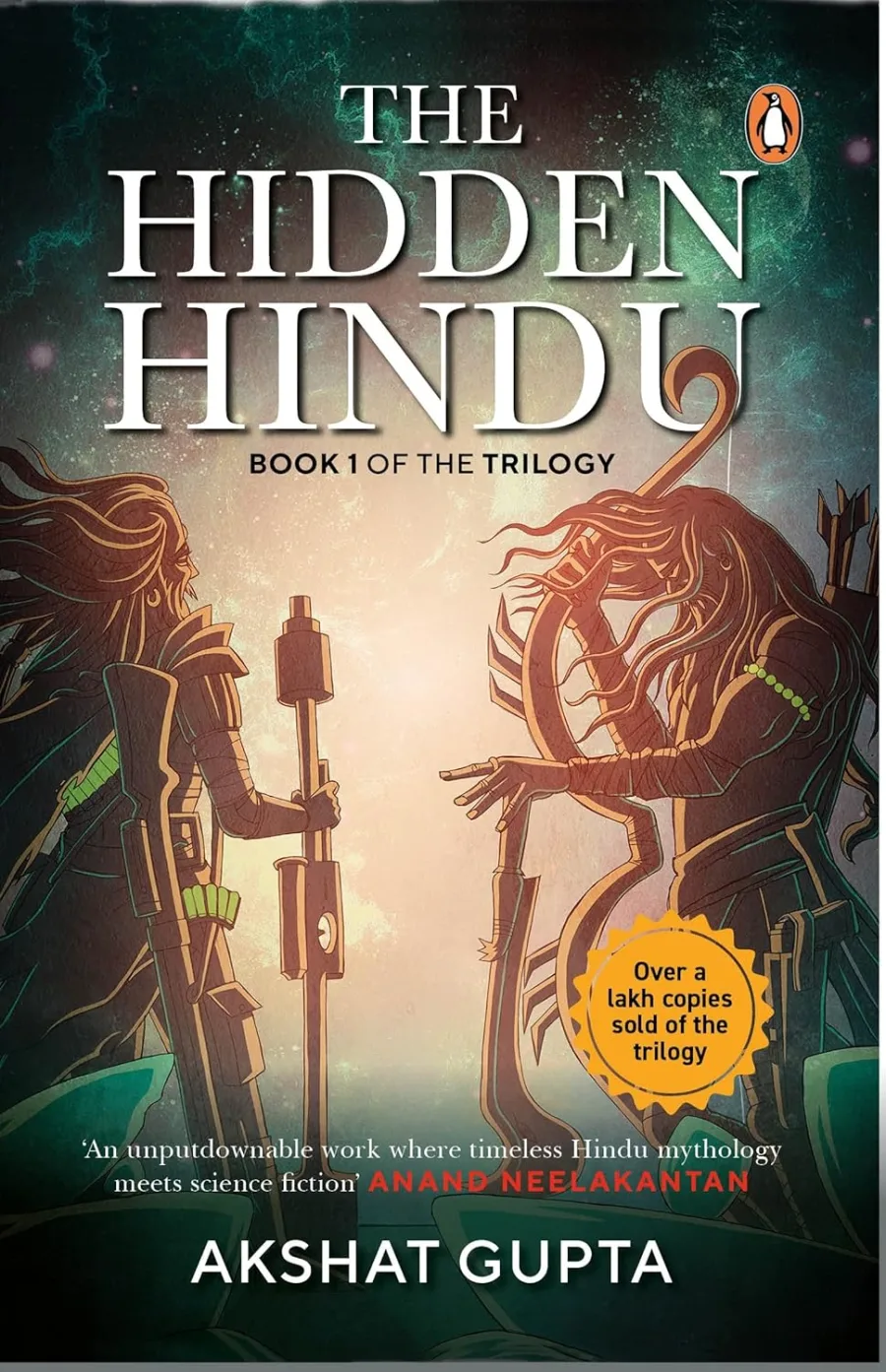
Download Cover Image
Do you want to download the full cover image for The Hidden Hindu?