
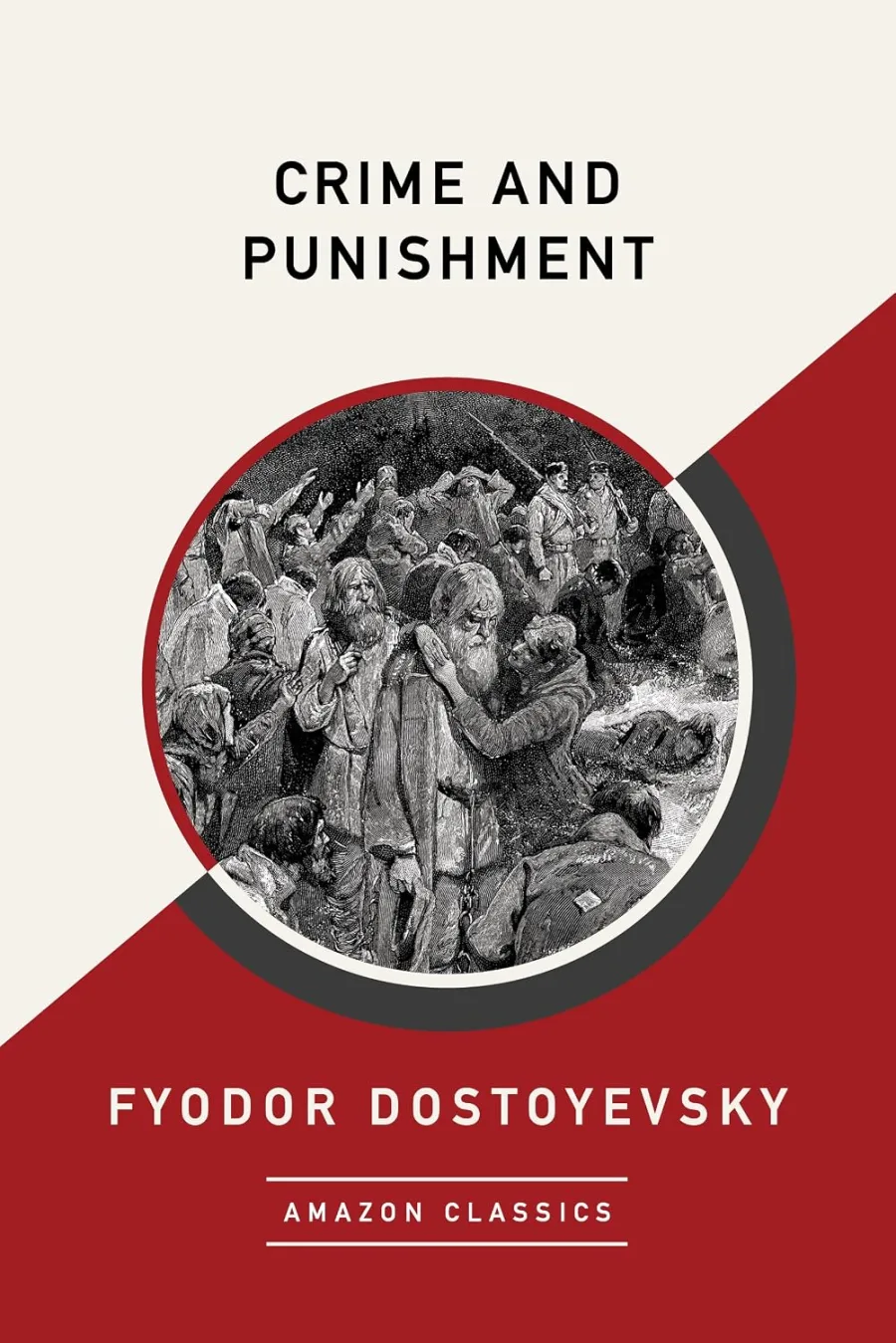
Crime and Punishment (AmazonClassics Edition)
eBook
• 330 Pages
• ₹ 399.00
• English
• 9781542099301
No ratings yet
| Publisher | AmazonClassics |
|---|---|
| ISBN13 | 9781542099301 |
| ASIN/SKU | B074W9WW4S |
| Book Format | eBook |
| Language | English |
| Pages | 330 |
| List Price | ₹ 399.00 |
| Publishing Date | 10/10/2017 |
| Book Code | BD00070182 |
Buy this Book
Amazon Stores
Ebook Stores
Other Stores
Discover Crime and Punishment (AmazonClassics Edition) by Fyodor Dostoyevsky. This book is published by AmazonClassics in eBook format, ISBN 9781542099301, ASIN B074W9WW4S, under Literature and Fiction, Classic Fiction, Crime, Thriller and Mystery.
Book Description
Living in a squalid room in St. Petersburg, the indigent but proud Rodion Raskolnikov believes he is above society. Obsessed with the idea of breaking the law, Raskolnikov resolves to kill an old pawnbroker for her cash.
Although the murder and robbery are bungled, Raskolnikov manages to escape without being seen. And with nothing to prove his guilt and a mendacious confessor in police custody, Raskolnikov seems to have committed the perfect crime. But in Fyodor Dostoyevsky’s world of moral transgressions, with its reason and its consequences, Raskolnikov’s plan has a devastating hitch: the feverish delirium of his own conscience.
AmazonClassics brings you timeless works from the masters of storytelling. Ideal for anyone who wants to read a great work for the first time or rediscover an old favorite, these new editions open the door to literature’s most unforgettable characters and beloved worlds.
Although the murder and robbery are bungled, Raskolnikov manages to escape without being seen. And with nothing to prove his guilt and a mendacious confessor in police custody, Raskolnikov seems to have committed the perfect crime. But in Fyodor Dostoyevsky’s world of moral transgressions, with its reason and its consequences, Raskolnikov’s plan has a devastating hitch: the feverish delirium of his own conscience.
AmazonClassics brings you timeless works from the masters of storytelling. Ideal for anyone who wants to read a great work for the first time or rediscover an old favorite, these new editions open the door to literature’s most unforgettable characters and beloved worlds.
Author Biography
Born in Moscow, Fyodor Mikhailovich Dostoyevsky (1821–1881) was a Russian novelist, short-story writer, translator, essayist, journalist, and philosopher, regarded today as one of the most significant writers of the Golden Age of Russian Literature.
Raised with an appreciation for books, Dostoyevsky developed a desire to write at an early age. His first novel, Poor Folk, gained him entry into literary circles, but his interest in the banned books of tsarist Russia landed the young author in a Siberian prison camp for four years. It helped to instill in Dostoyevsky themes of desperation, suicide, poverty, manipulation, crime, and morality that would inform his novels.
Raised with an appreciation for books, Dostoyevsky developed a desire to write at an early age. His first novel, Poor Folk, gained him entry into literary circles, but his interest in the banned books of tsarist Russia landed the young author in a Siberian prison camp for four years. It helped to instill in Dostoyevsky themes of desperation, suicide, poverty, manipulation, crime, and morality that would inform his novels.
Editorial Reviews
“The best [translation of Crime and Punishment] currently available…An especially faithful re-creation…with a coiled-spring kinetic energy…Don’t miss it.” –Washington Post Book World
“This fresh, new translation…provides a more exact, idiomatic, and contemporary rendition of the novel that brings Fyodor Dostoevsky’s tale achingly alive…It succeeds beautifully.” –San Francisco Chronicle
“Reaches as close to Dostoevsky’s Russian as is possible in English…The original’s force and frightening immediacy is captured…The Pevear and Volokhonsky translation will become the standard English version.”–Chicago Tribune
“This fresh, new translation…provides a more exact, idiomatic, and contemporary rendition of the novel that brings Fyodor Dostoevsky’s tale achingly alive…It succeeds beautifully.” –San Francisco Chronicle
“Reaches as close to Dostoevsky’s Russian as is possible in English…The original’s force and frightening immediacy is captured…The Pevear and Volokhonsky translation will become the standard English version.”–Chicago Tribune
Book Summary
Crime and Punishment by Fyodor Dostoyevsky is one of the greatest psychological novels ever written. First published in 1866, it follows Rodion Raskolnikov, a poor former student living in St Petersburg who becomes convinced that certain extraordinary individuals have the right to break moral laws if doing so allows them to achieve something greater. He puts this disturbing theory into practice by murdering an old pawnbroker, but the real punishment begins long before the law catches up with him. His greatest torment is the unbearable conflict between his intellectual theories and his conscience.
The novel is not simply a murder story. It is an intense exploration of guilt, poverty, morality, pride, alienation, compassion, free will, redemption, and the psychological consequences of wrongdoing. Dostoyevsky is less interested in asking whether Raskolnikov will be caught than in examining what happens inside a human being after he has deliberately crossed a moral boundary.
Raskolnikov's Dangerous Theory
Raskolnikov is a young former university student living in extreme poverty. He has withdrawn from society and spends much of his time alone in a tiny, miserable room. He is intelligent, proud, sensitive, and deeply troubled.
His poverty is only part of his problem.
Raskolnikov has developed an intellectual theory about morality. He divides people into two broad categories.
Most people, he believes, are ordinary. They must obey society's laws and moral rules.
But extraordinary people—figures such as Napoleon—may sometimes have the right to violate those rules if they believe their actions will benefit humanity.
According to this theory, a truly exceptional person should be willing to step beyond conventional morality.
Raskolnikov becomes obsessed with testing whether he himself belongs to this extraordinary category.
His theory eventually leads him toward murder.
The Pawnbroker
Raskolnikov decides to kill Alyona Ivanovna, an old pawnbroker whom he considers cruel, selfish, and worthless.
He convinces himself that her death would not be a great loss.
She possesses money and valuables that could potentially be used for good purposes.
Raskolnikov tells himself that eliminating her would allow him to escape poverty and perhaps accomplish something meaningful with his life.
But beneath the intellectual argument lies something more complicated.
His pride is being tested.
He wants to know whether he is capable of crossing the boundary that ordinary people cannot cross.
He wants to prove his own theory by proving himself extraordinary.
Eventually, he goes to the pawnbroker's apartment and murders her with an axe.
But the crime immediately goes wrong.
The pawnbroker's innocent half-sister, Lizaveta, unexpectedly arrives.
Raskolnikov kills her as well.
This second murder destroys much of the neat logic he had constructed in his mind.
Lizaveta was not the person he had intended to kill.
She was gentle and harmless.
His carefully constructed theory has suddenly collided with the unpredictable reality of human life.
Raskolnikov escapes with some valuables, but he barely uses them.
He hides what he has stolen beneath a stone, making the entire crime seem almost pointless.
This is important.
He did not murder for simple financial gain.
He murdered to test himself.
And he fails the test.
The Beginning of Psychological Punishment
After the murders, Raskolnikov becomes seriously ill.
He experiences fever, confusion, paranoia, and intense anxiety.
He fears that people know what he has done.
Every conversation becomes threatening.
Every unexpected question seems like a trap.
Yet the police do not immediately identify him as the murderer.
The greatest pressure therefore comes from within.
Raskolnikov is caught between wanting to prove his superiority and being horrified by what he has actually done.
This is the novel's central paradox.
He believed that extraordinary people could commit murder without suffering psychologically.
But he discovers that he cannot simply turn off his conscience.
His mind becomes the first courtroom in which he is judged.
Porfiry Petrovich
The investigation is led by Porfiry Petrovich, an intelligent and psychologically perceptive investigator.
Porfiry gradually becomes suspicious of Raskolnikov.
Instead of immediately arresting him, however, he engages him in conversations.
These conversations become psychological battles.
Porfiry understands that Raskolnikov has written an article about his theory of extraordinary people. He also recognizes the connection between the theory and the murders.
But rather than relying entirely on physical evidence, Porfiry attempts to make Raskolnikov reveal himself psychologically.
He understands that guilt can become its own form of evidence.
The relationship between the two men becomes one of the novel's most fascinating elements.
Porfiry is not simply hunting a criminal.
He is studying a mind.
Raskolnikov, meanwhile, is constantly trying to determine how much Porfiry knows.
Their conversations are filled with uncertainty, indirect questions, hints, and psychological pressure.
Poverty and Suffering
Dostoyevsky places Raskolnikov's crime within a society marked by extreme poverty.
Many of the characters struggle financially.
Raskolnikov himself lives in terrible conditions.
His friend Dmitri Razumikhin is also poor but remains energetic, practical, and socially connected.
By contrast, Raskolnikov has allowed poverty and isolation to deepen his bitterness.
Another important character is Semyon Marmeladov, a former government clerk who has become an alcoholic.
Raskolnikov meets Marmeladov in a tavern and hears the heartbreaking story of his family.
Marmeladov's wife, Katerina Ivanovna, struggles with poverty and illness.
His daughter, Sonya Marmeladova, has been forced into prostitution to support the family.
Sonya's sacrifice becomes one of the novel's most important examples of suffering motivated by love.
She is living in terrible circumstances, but she retains compassion and faith.
Her character provides a powerful contrast with Raskolnikov.
Both have suffered.
Both have crossed social and moral boundaries.
But they respond to suffering in completely different ways.
Sonya
Sonya becomes the emotional center of the novel.
She is vulnerable, poor, and socially condemned, yet she possesses enormous inner strength.
Raskolnikov is drawn to her because she understands suffering.
Eventually, he confesses his crime to her.
Sonya is horrified but does not abandon him.
She tells him that he must accept responsibility.
She encourages him to confess publicly and accept punishment.
Her response is important because she does not attempt to excuse his actions.
She recognizes his humanity without denying his guilt.
For Raskolnikov, this is a crucial experience.
He has spent much of the novel separating himself from other people.
Sonya invites him back into human connection.
Raskolnikov's Family
Raskolnikov's relationship with his family also reveals his emotional isolation.
His mother, Pulcheria Alexandrovna, loves him deeply and worries constantly about him.
His sister, Avdotya Romanovna, known as Dunya, is intelligent, proud, and determined.
Dunya is willing to make a difficult marriage to Pyotr Luzhin, a wealthy but unpleasant man, because she believes it will improve the family's financial situation.
Raskolnikov strongly opposes the marriage.
Although he often behaves coldly toward his family, his concern for Dunya and his mother demonstrates that he has not lost his capacity for love.
His problem is not that he feels nothing.
It is that his pride and theories have separated him from ordinary human relationships.
Luzhin
Luzhin represents another kind of moral corruption.
He is not a murderer like Raskolnikov, but he is selfish, manipulative, and obsessed with maintaining control.
He wants to marry Dunya partly because he believes a poorer woman will be more grateful and obedient.
His behavior exposes another form of power: the desire to dominate others through money and social position.
Dostoyevsky therefore contrasts different kinds of wrongdoing.
Raskolnikov commits a violent crime in the name of an intellectual theory.
Luzhin behaves selfishly while remaining within the boundaries of respectable society.
The novel asks readers to consider whether morality can truly be reduced to legal rules.
Svidrigailov
Another complex character is Arkady Svidrigailov.
He is wealthy, morally ambiguous, and deeply mysterious.
His connection with Dunya creates another subplot involving manipulation and desire.
Svidrigailov has committed questionable acts but occasionally demonstrates generosity.
He is difficult to classify as simply good or evil.
His presence reinforces one of Dostoyevsky's central ideas: human beings cannot always be neatly divided into categories.
People can contain compassion and cruelty at the same time.
The Failure of Raskolnikov's Theory
As the story progresses, Raskolnikov's theory begins to collapse.
He had imagined that extraordinary people could act without guilt.
But he cannot escape guilt.
He becomes isolated.
He experiences nightmares.
He behaves erratically.
He cannot enjoy the money he stole.
He cannot fully explain his actions even to himself.
Most importantly, he begins longing for connection despite repeatedly pushing people away.
His punishment therefore begins long before his legal sentence.
The psychological suffering is already destroying him.
He realizes that he did not merely kill the pawnbroker.
He damaged his own connection to humanity.
The Dream of the Horse
One of the most revealing moments in the novel occurs when Raskolnikov remembers a childhood dream in which he watches a horse being brutally beaten to death.
As a child, he is horrified by the cruelty.
He cries and tries to protect the animal.
The dream reveals something that Raskolnikov's intellectual theory cannot erase.
He has always possessed compassion.
The person who later argues that certain lives are expendable was once a child who could not tolerate seeing a helpless animal suffer.
The contradiction reveals the difference between Raskolnikov's abstract theory and his actual emotional nature.
He is not naturally without conscience.
He has attempted to suppress it.
The Confession
Eventually, Raskolnikov confesses to Sonya.
She encourages him to accept punishment rather than continue living in isolation.
He eventually goes to the police and admits that he committed the murders.
His confession is not presented as a simple moment of complete redemption.
He remains conflicted.
Part of him still resists the idea that he was wrong.
But by accepting responsibility, he takes the first step toward reconnecting with humanity.
He is sentenced to eight years of penal servitude in Siberia.
Sonya follows him there.
Her decision demonstrates the depth of her love and compassion.
She does not abandon him when his freedom disappears.
Siberia and the Possibility of Redemption
The epilogue takes place after Raskolnikov has begun serving his sentence.
He remains emotionally distant for some time.
He still struggles with pride.
He still does not completely understand the moral meaning of his crime.
But Sonya continues visiting him.
Her presence gradually changes him.
Eventually, Raskolnikov experiences a profound emotional awakening.
He begins to understand that his problem was not simply that he had broken a law.
His deeper mistake was believing that he could separate himself from humanity.
He wanted to place himself above ordinary moral relationships.
He wanted to become a person who could decide whose life mattered.
But his suffering demonstrates that human beings are connected.
The attempt to become morally superior has instead made him spiritually impoverished.
Sonya's love helps him rediscover the possibility of humility.
The Meaning of the Title
The title Crime and Punishment refers to both the legal and psychological dimensions of Raskolnikov's story.
The crime is obvious: murder.
But the punishment is much larger than imprisonment.
Raskolnikov suffers through fear, isolation, guilt, paranoia, emotional exhaustion, and the collapse of his intellectual certainty.
The legal sentence comes later.
In this sense, Dostoyevsky suggests that conscience can impose a punishment that no court needs to administer.
Poverty and Morality
The novel also asks difficult questions about poverty.
Several characters are forced into morally painful situations because they lack money.
Sonya sacrifices herself to support her family.
Dunya considers a loveless marriage because of financial necessity.
Marmeladov drinks despite knowing the consequences.
Raskolnikov himself becomes increasingly desperate and isolated because of poverty.
Dostoyevsky does not suggest that poverty automatically causes crime.
Razumikhin is poor but remains generous and decent.
Instead, the novel shows how poverty can intensify vulnerability and force people into terrible choices.
Pride
Raskolnikov's greatest enemy may be his pride.
His theory allows him to imagine himself as intellectually superior to ordinary people.
He wants to prove that he can act without being governed by conventional morality.
But the murder does not make him powerful.
It makes him miserable.
His pride prevents him from accepting help.
It prevents him from admitting guilt.
It makes him suspicious of love.
Only when he begins to surrender his need to be superior can genuine recovery begin.
Faith and Resurrection
Religious symbolism is important, particularly through Sonya.
She reads Raskolnikov the biblical story of Lazarus, who is raised from the dead.
The story becomes a symbolic parallel for Raskolnikov's possible spiritual rebirth.
He has not literally died.
But his moral and emotional life has become almost lifeless.
The possibility of redemption suggests that a person can begin again after terrible wrongdoing.
This does not erase the crime.
It does not undo the suffering of the victims.
But it offers the possibility that guilt can lead toward transformation rather than permanent destruction.
Human Connection
Perhaps the deepest lesson of Crime and Punishment is that isolation is destructive.
Raskolnikov's theory separates him from other people.
His crime deepens that separation.
His pride prevents him from reconnecting.
Sonya's compassion gradually brings him back.
Razumikhin's friendship also demonstrates the importance of ordinary human relationships.
Dostoyevsky suggests that people cannot live entirely through abstract ideas.
They need love, responsibility, compassion, and connection.
Conclusion
Crime and Punishment is ultimately the story of a man who commits murder because he believes himself capable of living above ordinary morality—and then discovers that he cannot escape his own humanity.
Raskolnikov begins the novel believing that exceptional people have the right to cross moral boundaries.
He ends it beginning to understand that no intellectual theory can completely silence conscience.
His punishment begins immediately after the crime.
He becomes isolated from the people who love him.
He becomes frightened of being discovered.
He loses the ability to live comfortably with himself.
The legal punishment in Siberia is therefore almost an external expression of a punishment that has already been taking place inside him.
Sonya becomes central to his eventual transformation because she represents a completely different response to suffering. Where Raskolnikov responds to suffering through pride and intellectual abstraction, Sonya responds through compassion, sacrifice, and love.
She does not tell him that his crime does not matter.
She tells him that he must face it.
That distinction is crucial.
Dostoyevsky's vision of redemption is not about forgetting wrongdoing. It is about accepting responsibility and becoming capable of living differently.
The novel ultimately argues that human beings cannot simply place themselves above morality because they believe their intentions are superior.
People are not abstract calculations.
Every human life has value.
Every action has consequences.
And no theory can completely protect a person from the voice of conscience.
Raskolnikov's journey from pride to suffering and finally toward repentance is therefore much more than the story of a criminal.
It is a study of the human soul.
The deepest punishment is not imprisonment.
It is the moment when a person realizes that, in trying to prove himself superior to others, he has separated himself from the very humanity he desperately needs.
And the beginning of redemption comes when he finally chooses to return.
The novel is not simply a murder story. It is an intense exploration of guilt, poverty, morality, pride, alienation, compassion, free will, redemption, and the psychological consequences of wrongdoing. Dostoyevsky is less interested in asking whether Raskolnikov will be caught than in examining what happens inside a human being after he has deliberately crossed a moral boundary.
Raskolnikov's Dangerous Theory
Raskolnikov is a young former university student living in extreme poverty. He has withdrawn from society and spends much of his time alone in a tiny, miserable room. He is intelligent, proud, sensitive, and deeply troubled.
His poverty is only part of his problem.
Raskolnikov has developed an intellectual theory about morality. He divides people into two broad categories.
Most people, he believes, are ordinary. They must obey society's laws and moral rules.
But extraordinary people—figures such as Napoleon—may sometimes have the right to violate those rules if they believe their actions will benefit humanity.
According to this theory, a truly exceptional person should be willing to step beyond conventional morality.
Raskolnikov becomes obsessed with testing whether he himself belongs to this extraordinary category.
His theory eventually leads him toward murder.
The Pawnbroker
Raskolnikov decides to kill Alyona Ivanovna, an old pawnbroker whom he considers cruel, selfish, and worthless.
He convinces himself that her death would not be a great loss.
She possesses money and valuables that could potentially be used for good purposes.
Raskolnikov tells himself that eliminating her would allow him to escape poverty and perhaps accomplish something meaningful with his life.
But beneath the intellectual argument lies something more complicated.
His pride is being tested.
He wants to know whether he is capable of crossing the boundary that ordinary people cannot cross.
He wants to prove his own theory by proving himself extraordinary.
Eventually, he goes to the pawnbroker's apartment and murders her with an axe.
But the crime immediately goes wrong.
The pawnbroker's innocent half-sister, Lizaveta, unexpectedly arrives.
Raskolnikov kills her as well.
This second murder destroys much of the neat logic he had constructed in his mind.
Lizaveta was not the person he had intended to kill.
She was gentle and harmless.
His carefully constructed theory has suddenly collided with the unpredictable reality of human life.
Raskolnikov escapes with some valuables, but he barely uses them.
He hides what he has stolen beneath a stone, making the entire crime seem almost pointless.
This is important.
He did not murder for simple financial gain.
He murdered to test himself.
And he fails the test.
The Beginning of Psychological Punishment
After the murders, Raskolnikov becomes seriously ill.
He experiences fever, confusion, paranoia, and intense anxiety.
He fears that people know what he has done.
Every conversation becomes threatening.
Every unexpected question seems like a trap.
Yet the police do not immediately identify him as the murderer.
The greatest pressure therefore comes from within.
Raskolnikov is caught between wanting to prove his superiority and being horrified by what he has actually done.
This is the novel's central paradox.
He believed that extraordinary people could commit murder without suffering psychologically.
But he discovers that he cannot simply turn off his conscience.
His mind becomes the first courtroom in which he is judged.
Porfiry Petrovich
The investigation is led by Porfiry Petrovich, an intelligent and psychologically perceptive investigator.
Porfiry gradually becomes suspicious of Raskolnikov.
Instead of immediately arresting him, however, he engages him in conversations.
These conversations become psychological battles.
Porfiry understands that Raskolnikov has written an article about his theory of extraordinary people. He also recognizes the connection between the theory and the murders.
But rather than relying entirely on physical evidence, Porfiry attempts to make Raskolnikov reveal himself psychologically.
He understands that guilt can become its own form of evidence.
The relationship between the two men becomes one of the novel's most fascinating elements.
Porfiry is not simply hunting a criminal.
He is studying a mind.
Raskolnikov, meanwhile, is constantly trying to determine how much Porfiry knows.
Their conversations are filled with uncertainty, indirect questions, hints, and psychological pressure.
Poverty and Suffering
Dostoyevsky places Raskolnikov's crime within a society marked by extreme poverty.
Many of the characters struggle financially.
Raskolnikov himself lives in terrible conditions.
His friend Dmitri Razumikhin is also poor but remains energetic, practical, and socially connected.
By contrast, Raskolnikov has allowed poverty and isolation to deepen his bitterness.
Another important character is Semyon Marmeladov, a former government clerk who has become an alcoholic.
Raskolnikov meets Marmeladov in a tavern and hears the heartbreaking story of his family.
Marmeladov's wife, Katerina Ivanovna, struggles with poverty and illness.
His daughter, Sonya Marmeladova, has been forced into prostitution to support the family.
Sonya's sacrifice becomes one of the novel's most important examples of suffering motivated by love.
She is living in terrible circumstances, but she retains compassion and faith.
Her character provides a powerful contrast with Raskolnikov.
Both have suffered.
Both have crossed social and moral boundaries.
But they respond to suffering in completely different ways.
Sonya
Sonya becomes the emotional center of the novel.
She is vulnerable, poor, and socially condemned, yet she possesses enormous inner strength.
Raskolnikov is drawn to her because she understands suffering.
Eventually, he confesses his crime to her.
Sonya is horrified but does not abandon him.
She tells him that he must accept responsibility.
She encourages him to confess publicly and accept punishment.
Her response is important because she does not attempt to excuse his actions.
She recognizes his humanity without denying his guilt.
For Raskolnikov, this is a crucial experience.
He has spent much of the novel separating himself from other people.
Sonya invites him back into human connection.
Raskolnikov's Family
Raskolnikov's relationship with his family also reveals his emotional isolation.
His mother, Pulcheria Alexandrovna, loves him deeply and worries constantly about him.
His sister, Avdotya Romanovna, known as Dunya, is intelligent, proud, and determined.
Dunya is willing to make a difficult marriage to Pyotr Luzhin, a wealthy but unpleasant man, because she believes it will improve the family's financial situation.
Raskolnikov strongly opposes the marriage.
Although he often behaves coldly toward his family, his concern for Dunya and his mother demonstrates that he has not lost his capacity for love.
His problem is not that he feels nothing.
It is that his pride and theories have separated him from ordinary human relationships.
Luzhin
Luzhin represents another kind of moral corruption.
He is not a murderer like Raskolnikov, but he is selfish, manipulative, and obsessed with maintaining control.
He wants to marry Dunya partly because he believes a poorer woman will be more grateful and obedient.
His behavior exposes another form of power: the desire to dominate others through money and social position.
Dostoyevsky therefore contrasts different kinds of wrongdoing.
Raskolnikov commits a violent crime in the name of an intellectual theory.
Luzhin behaves selfishly while remaining within the boundaries of respectable society.
The novel asks readers to consider whether morality can truly be reduced to legal rules.
Svidrigailov
Another complex character is Arkady Svidrigailov.
He is wealthy, morally ambiguous, and deeply mysterious.
His connection with Dunya creates another subplot involving manipulation and desire.
Svidrigailov has committed questionable acts but occasionally demonstrates generosity.
He is difficult to classify as simply good or evil.
His presence reinforces one of Dostoyevsky's central ideas: human beings cannot always be neatly divided into categories.
People can contain compassion and cruelty at the same time.
The Failure of Raskolnikov's Theory
As the story progresses, Raskolnikov's theory begins to collapse.
He had imagined that extraordinary people could act without guilt.
But he cannot escape guilt.
He becomes isolated.
He experiences nightmares.
He behaves erratically.
He cannot enjoy the money he stole.
He cannot fully explain his actions even to himself.
Most importantly, he begins longing for connection despite repeatedly pushing people away.
His punishment therefore begins long before his legal sentence.
The psychological suffering is already destroying him.
He realizes that he did not merely kill the pawnbroker.
He damaged his own connection to humanity.
The Dream of the Horse
One of the most revealing moments in the novel occurs when Raskolnikov remembers a childhood dream in which he watches a horse being brutally beaten to death.
As a child, he is horrified by the cruelty.
He cries and tries to protect the animal.
The dream reveals something that Raskolnikov's intellectual theory cannot erase.
He has always possessed compassion.
The person who later argues that certain lives are expendable was once a child who could not tolerate seeing a helpless animal suffer.
The contradiction reveals the difference between Raskolnikov's abstract theory and his actual emotional nature.
He is not naturally without conscience.
He has attempted to suppress it.
The Confession
Eventually, Raskolnikov confesses to Sonya.
She encourages him to accept punishment rather than continue living in isolation.
He eventually goes to the police and admits that he committed the murders.
His confession is not presented as a simple moment of complete redemption.
He remains conflicted.
Part of him still resists the idea that he was wrong.
But by accepting responsibility, he takes the first step toward reconnecting with humanity.
He is sentenced to eight years of penal servitude in Siberia.
Sonya follows him there.
Her decision demonstrates the depth of her love and compassion.
She does not abandon him when his freedom disappears.
Siberia and the Possibility of Redemption
The epilogue takes place after Raskolnikov has begun serving his sentence.
He remains emotionally distant for some time.
He still struggles with pride.
He still does not completely understand the moral meaning of his crime.
But Sonya continues visiting him.
Her presence gradually changes him.
Eventually, Raskolnikov experiences a profound emotional awakening.
He begins to understand that his problem was not simply that he had broken a law.
His deeper mistake was believing that he could separate himself from humanity.
He wanted to place himself above ordinary moral relationships.
He wanted to become a person who could decide whose life mattered.
But his suffering demonstrates that human beings are connected.
The attempt to become morally superior has instead made him spiritually impoverished.
Sonya's love helps him rediscover the possibility of humility.
The Meaning of the Title
The title Crime and Punishment refers to both the legal and psychological dimensions of Raskolnikov's story.
The crime is obvious: murder.
But the punishment is much larger than imprisonment.
Raskolnikov suffers through fear, isolation, guilt, paranoia, emotional exhaustion, and the collapse of his intellectual certainty.
The legal sentence comes later.
In this sense, Dostoyevsky suggests that conscience can impose a punishment that no court needs to administer.
Poverty and Morality
The novel also asks difficult questions about poverty.
Several characters are forced into morally painful situations because they lack money.
Sonya sacrifices herself to support her family.
Dunya considers a loveless marriage because of financial necessity.
Marmeladov drinks despite knowing the consequences.
Raskolnikov himself becomes increasingly desperate and isolated because of poverty.
Dostoyevsky does not suggest that poverty automatically causes crime.
Razumikhin is poor but remains generous and decent.
Instead, the novel shows how poverty can intensify vulnerability and force people into terrible choices.
Pride
Raskolnikov's greatest enemy may be his pride.
His theory allows him to imagine himself as intellectually superior to ordinary people.
He wants to prove that he can act without being governed by conventional morality.
But the murder does not make him powerful.
It makes him miserable.
His pride prevents him from accepting help.
It prevents him from admitting guilt.
It makes him suspicious of love.
Only when he begins to surrender his need to be superior can genuine recovery begin.
Faith and Resurrection
Religious symbolism is important, particularly through Sonya.
She reads Raskolnikov the biblical story of Lazarus, who is raised from the dead.
The story becomes a symbolic parallel for Raskolnikov's possible spiritual rebirth.
He has not literally died.
But his moral and emotional life has become almost lifeless.
The possibility of redemption suggests that a person can begin again after terrible wrongdoing.
This does not erase the crime.
It does not undo the suffering of the victims.
But it offers the possibility that guilt can lead toward transformation rather than permanent destruction.
Human Connection
Perhaps the deepest lesson of Crime and Punishment is that isolation is destructive.
Raskolnikov's theory separates him from other people.
His crime deepens that separation.
His pride prevents him from reconnecting.
Sonya's compassion gradually brings him back.
Razumikhin's friendship also demonstrates the importance of ordinary human relationships.
Dostoyevsky suggests that people cannot live entirely through abstract ideas.
They need love, responsibility, compassion, and connection.
Conclusion
Crime and Punishment is ultimately the story of a man who commits murder because he believes himself capable of living above ordinary morality—and then discovers that he cannot escape his own humanity.
Raskolnikov begins the novel believing that exceptional people have the right to cross moral boundaries.
He ends it beginning to understand that no intellectual theory can completely silence conscience.
His punishment begins immediately after the crime.
He becomes isolated from the people who love him.
He becomes frightened of being discovered.
He loses the ability to live comfortably with himself.
The legal punishment in Siberia is therefore almost an external expression of a punishment that has already been taking place inside him.
Sonya becomes central to his eventual transformation because she represents a completely different response to suffering. Where Raskolnikov responds to suffering through pride and intellectual abstraction, Sonya responds through compassion, sacrifice, and love.
She does not tell him that his crime does not matter.
She tells him that he must face it.
That distinction is crucial.
Dostoyevsky's vision of redemption is not about forgetting wrongdoing. It is about accepting responsibility and becoming capable of living differently.
The novel ultimately argues that human beings cannot simply place themselves above morality because they believe their intentions are superior.
People are not abstract calculations.
Every human life has value.
Every action has consequences.
And no theory can completely protect a person from the voice of conscience.
Raskolnikov's journey from pride to suffering and finally toward repentance is therefore much more than the story of a criminal.
It is a study of the human soul.
The deepest punishment is not imprisonment.
It is the moment when a person realizes that, in trying to prove himself superior to others, he has separated himself from the very humanity he desperately needs.
And the beginning of redemption comes when he finally chooses to return.
Sample Chapters
Sample Chapters will be added soon…
Reader Reviews
No reviews yet.
Crime and Punishment (AmazonClassics Edition)
Download Cover Image
Do you want to download the full cover image for Crime and Punishment (AmazonClassics Edition)?