
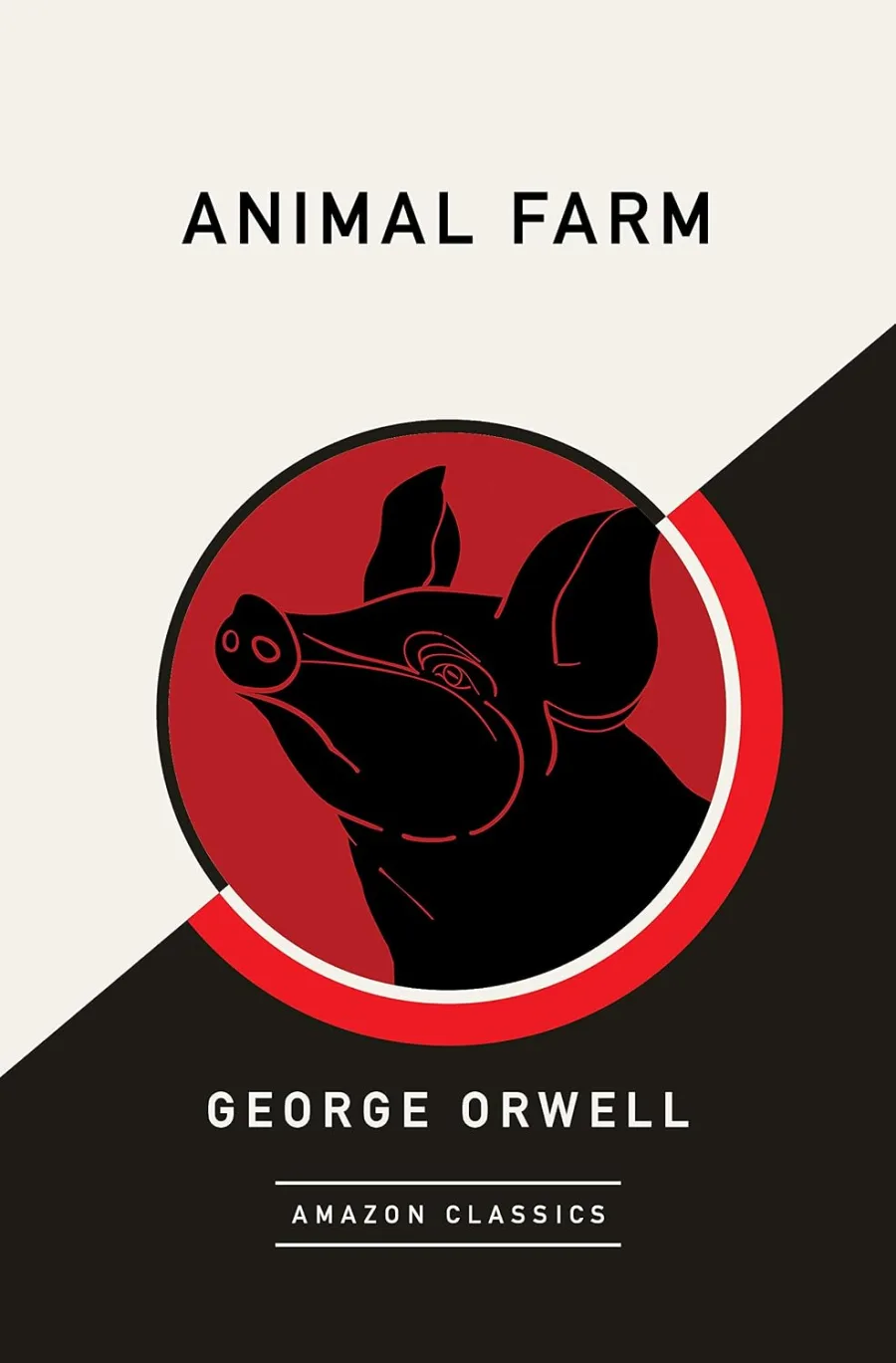
Animal Farm (AmazonClassics Edition)
eBook
• 71 Pages
• ₹ 69.00
• English
• 9781542026727
No ratings yet
| Publisher | AmazonClassics |
|---|---|
| ISBN13 | 9781542026727 |
| ASIN/SKU | B08CZX8334 |
| Book Format | eBook |
| Language | English |
| Pages | 71 |
| List Price | ₹ 69.00 |
| Publishing Date | 05/01/2021 |
| Book Code | BD00070179 |
Buy this Book
Amazon Stores
Ebook Stores
Other Stores
Discover Animal Farm (AmazonClassics Edition) by George Orwell. This book is published by AmazonClassics in eBook format, ISBN 9781542026727, ASIN B08CZX8334, under Literature and Fiction, Classic Fiction.
Book Description
After years of exploitation, neglect, and despair, the animals of Manor Farm revolt. They drive owner Mr. Jones off the land and rechristen the property Animal Farm, a utopia of equality and mutual support. But Napoleon, a young boar who assumes command after the rebellion, is hungry for power. And as the pigs consolidate control, all the good intentions of Animal Farm are crushed by a new and inevitable tyranny.
George Orwell’s Animal Farm, the chilling allegorical satire about the working class and the gripping rhetoric of despots, illustrates just how easy the slide into oppression and totalitarianism can be.
Revised edition: Previously published as Animal Farm, this edition of Animal Farm (AmazonClassics Edition) includes editorial revisions.
George Orwell’s Animal Farm, the chilling allegorical satire about the working class and the gripping rhetoric of despots, illustrates just how easy the slide into oppression and totalitarianism can be.
Revised edition: Previously published as Animal Farm, this edition of Animal Farm (AmazonClassics Edition) includes editorial revisions.
Author Biography
Eric Arthur Blair (1903–1950), best known by his pen name, George Orwell, was an English novelist, journalist, poet, critic, and essayist born in Motihari, Bihar, British India.
Upon his family’s return to England, Orwell was educated at Wellington and at Eton, where he was first published in college periodicals. Reluctantly following in his father’s footsteps, Orwell became a servant in the Indian Imperial Police until his revulsion for barriers of race and caste and colonial bigotry compelled him to resign after five years. It was a decision that would shape Orwell’s career as a writer and his advocacy for the oppressed, borne out in his debut novel, Burmese Days. Three works of nonfiction and volumes of essays and criticism followed, as did his visionary Animal Farm and 1984, the two works for which George Orwell is most celebrated today.
Upon his family’s return to England, Orwell was educated at Wellington and at Eton, where he was first published in college periodicals. Reluctantly following in his father’s footsteps, Orwell became a servant in the Indian Imperial Police until his revulsion for barriers of race and caste and colonial bigotry compelled him to resign after five years. It was a decision that would shape Orwell’s career as a writer and his advocacy for the oppressed, borne out in his debut novel, Burmese Days. Three works of nonfiction and volumes of essays and criticism followed, as did his visionary Animal Farm and 1984, the two works for which George Orwell is most celebrated today.
Editorial Reviews
Editorial Reviews will be added soon…
Book Summary
Animal Farm by George Orwell is a short but powerful political allegory about revolution, power, corruption, propaganda, and the betrayal of ideals. First published in 1945, the novel tells the story of farm animals who overthrow their human owner because they dream of creating a society in which all animals are equal. What begins as a hopeful rebellion gradually becomes another form of oppression as the pigs who lead the revolution acquire more power and privileges.
Although the story is written as a simple animal fable, its ideas are much deeper. Orwell uses the farm to examine how political movements can begin with promises of equality and freedom but become authoritarian when leaders gain unchecked power. The novel is closely associated with the Russian Revolution and the rise of Stalinism, but its broader warning applies to any society in which power is concentrated and ordinary people are encouraged to surrender their judgment to leaders.
Life Under Mr. Jones
The story takes place on Manor Farm, owned by a careless and frequently drunk farmer named Mr. Jones.
The animals work hard but receive little in return. They are poorly fed, overworked, and treated as property.
The farm's oldest and most respected animal is Old Major, an elderly boar.
One night, Old Major gathers the animals together and describes a dream of a future in which animals are free from human control.
He argues that humans are the source of the animals' suffering.
Humans take the products of animal labor while giving almost nothing back.
According to Old Major, the animals themselves create the wealth of the farm, so they should be the ones who benefit from it.
His speech inspires the animals with a revolutionary vision.
He teaches them a song called “Beasts of England,” which becomes a symbol of hope and rebellion.
Old Major dies soon afterward, but his ideas remain alive.
The Rebellion
The actual rebellion happens sooner than anyone expects.
Mr. Jones neglects to feed the animals.
Hungry and desperate, they break into the food store.
When Jones and his workers try to drive them away, the animals fight back.
The humans are forced to flee.
The animals have taken control of the farm.
They rename it Animal Farm.
At first, the revolution appears to be a complete success.
The animals destroy objects associated with human oppression.
They celebrate their freedom.
The farm's principles are written on the barn wall.
The central idea is:
“All animals are equal.”
The animals believe they are building a society based on fairness, cooperation, and shared labor.
The dream of Old Major seems to have come true.
The Rise of the Pigs
The pigs quickly become the intellectual leaders of the farm.
The most important are Snowball and Napoleon.
Snowball is energetic, imaginative, and interested in improving the farm.
Napoleon is quieter and more ambitious.
At first, the two appear to share leadership.
But their visions are different.
Snowball believes the animals can improve their lives through education, organization, and technological development.
Napoleon is more interested in controlling power.
The pigs also begin taking milk and apples for themselves.
They explain that they need this food because they are responsible for managing the farm.
The other animals accept the explanation.
This is the first major sign that the revolution's promise of equality is beginning to weaken.
The pigs are already receiving privileges that ordinary animals do not have.
Snowball and the Windmill
Snowball proposes building a windmill.
He believes it will eventually generate electricity and make life easier for the animals.
The windmill becomes his great project.
Napoleon opposes the plan.
The disagreement between the two pigs becomes increasingly intense.
Eventually, Napoleon unleashes a group of dogs he has secretly trained.
The dogs chase Snowball away from the farm.
Snowball is branded a traitor.
Napoleon takes control.
The revolution has changed.
The animals thought they had overthrown one master.
Instead, they have created another.
Napoleon's Dictatorship
After Snowball's expulsion, Napoleon abolishes open debate.
The animals are no longer allowed to vote freely on important decisions.
The pigs make the decisions.
Squealer, a persuasive pig who acts as Napoleon's spokesman, explains why every change is necessary.
Squealer is extraordinarily effective at manipulating the other animals.
Whenever someone questions Napoleon's decisions, Squealer uses complicated arguments, statistics, threats, and emotional appeals.
He repeatedly warns the animals that life under Mr. Jones could return if they fail to support Napoleon.
Fear becomes a political weapon.
The animals are told that Napoleon is protecting them.
Gradually, they surrender their freedom in exchange for the promise of security.
Propaganda and the Control of Truth
One of Orwell's most important themes is propaganda.
The animals cannot easily remember what life was like before the revolution.
Most of them are not educated enough to compare the present with the original principles written on the barn.
Squealer exploits this weakness.
He constantly changes the story of the past.
If the animals remember something differently, he tells them they must be mistaken.
If Napoleon makes a decision that contradicts the original principles, the principles themselves are quietly altered.
The animals begin to doubt their own memories.
This is one of the most frightening aspects of the novel.
Control over language becomes control over reality.
The Seven Commandments
At the beginning of the revolution, the animals establish seven commandments describing the principles of Animal Farm.
They include rules against behaving like humans and emphasize equality.
But as Napoleon gains power, these commandments are gradually changed.
For example, a rule originally stating that no animal should sleep in a bed is altered to allow beds under certain conditions.
A rule against drinking alcohol is eventually changed to allow drinking.
The commandments are not openly abolished.
They are quietly rewritten.
This shows how authoritarian systems can preserve the appearance of law while destroying its original meaning.
The Dogs and the Use of Fear
Napoleon's dogs become his private security force.
They are used to intimidate and silence opposition.
The animals quickly learn that questioning Napoleon can have serious consequences.
Eventually, several animals are accused of conspiring with Snowball.
They confess to crimes they may not have committed.
Napoleon's dogs kill them.
The atmosphere of the farm changes completely.
The rebellion that was supposed to end violence and oppression has created a system of fear.
The animals begin living under the threat of punishment.
Boxer the Horse
One of the most tragic characters is Boxer, a huge and hardworking horse.
Boxer is loyal, strong, and honest.
He believes deeply in the revolution.
His personal motto is:
“I will work harder.”
Later, when problems arise, he adopts another belief:
“Napoleon is always right.”
Boxer represents the ordinary working population.
He does not understand politics deeply.
He simply works harder whenever something goes wrong.
His loyalty is admirable but also tragic because the pigs exploit it.
Boxer assumes that if he works hard enough, the farm will eventually become better.
He does not realize that the system is using his labor to enrich its leaders.
The Battle of the Windmill
The windmill is eventually destroyed during a battle with humans.
The animals are devastated.
Napoleon tells them that the destruction was actually a victory.
They rebuild the windmill.
This episode demonstrates how propaganda can redefine failure as success.
The animals have suffered injuries and lost resources, but they are told that they have won.
Because they lack access to reliable information, they accept Napoleon's version of events.
The Growing Privileges of the Pigs
The pigs gradually become more like the humans they originally rebelled against.
They move into the farmhouse.
They sleep in beds.
They drink alcohol.
They trade with human beings.
They begin wearing clothes.
They walk on two legs.
At every stage, Squealer explains why the changes are necessary.
The animals initially believed that humans represented everything wrong with society.
Now the pigs are adopting human habits themselves.
The irony becomes impossible to ignore.
The revolution has not eliminated the old hierarchy.
It has simply replaced one ruling class with another.
Boxer's Betrayal
Boxer's final fate is one of the novel's most heartbreaking moments.
After years of hard work, Boxer becomes injured and too weak to continue.
He believes that he will be allowed to retire.
Instead, Napoleon sends him away.
The animals watch in horror as Boxer is taken away in a vehicle.
Squealer later claims that Boxer was taken to a veterinarian.
But the animals recognize the truth.
Boxer has been sold to a slaughterhouse.
The pigs use the money to buy alcohol.
This moment exposes the complete betrayal of the revolution.
The animal who worked hardest for the farm is discarded once he is no longer useful.
His loyalty meant nothing to the rulers.
The Final Transformation
By the end of the story, the pigs have become almost indistinguishable from humans.
They walk on two legs.
They carry whips.
They wear clothes.
They drink with human farmers.
The other animals look through the farmhouse window.
They see pigs and humans sitting together at a table.
They cannot tell which are pigs and which are men.
The original commandment has been reduced to one final statement:
“All animals are equal, but some animals are more equal than others.”
The contradiction is deliberately absurd.
Equality has been emptied of meaning.
The pigs have created a society based on privilege while continuing to use the language of equality.
The revolution has completely betrayed its original ideals.
The Meaning of the Farm
Animal Farm itself represents a society undergoing political transformation.
The rebellion against Mr. Jones represents the Russian Revolution of 1917.
Old Major combines elements associated with revolutionary thinkers, particularly Karl Marx and Vladimir Lenin.
Napoleon represents Joseph Stalin, who established a highly centralized dictatorship in the Soviet Union.
Snowball is commonly understood as representing Leon Trotsky, Stalin's political rival who was forced into exile.
Squealer represents the machinery of propaganda.
The dogs represent the secret police and instruments of political repression.
Boxer represents the loyal working class whose labor supports the system.
The farm's history therefore parallels major events and themes associated with the Soviet Union.
But Orwell's message is broader than a simple criticism of Stalin.
He is warning about what happens when political leaders gain unchecked authority.
The Corruption of Ideals
The most important theme is the corruption of revolutionary ideals.
The animals begin with a genuinely hopeful dream.
They want equality.
They want freedom.
They want to enjoy the fruits of their own labor.
The tragedy is that the dream itself is not necessarily wrong.
The problem is what happens when power becomes concentrated in the hands of a small group.
The pigs gradually redefine equality so that it benefits themselves.
This demonstrates how political ideals can be manipulated by people who claim to defend them.
The language remains the same.
The reality changes.
Education and Ignorance
Education is another crucial theme.
The pigs are able to dominate the other animals partly because they are more educated.
The other animals cannot read well enough to verify what is written on the wall.
Some cannot remember the original commandments.
Benjamin, the old donkey, is intelligent enough to understand what is happening, but he rarely acts.
His passivity is significant.
Knowing that something is wrong is not always enough.
If people refuse to act against injustice, injustice can continue.
Orwell therefore suggests that education must involve not only literacy but also critical thinking.
Fear and Obedience
Napoleon's power depends heavily on fear.
The animals are repeatedly told that if they oppose him, Mr. Jones might return.
This argument becomes a justification for almost everything.
The pigs can violate their own principles because they claim that difficult measures are necessary for survival.
Fear prevents the animals from asking whether the threat is genuine.
The novel therefore shows how authoritarian leaders can maintain control by presenting themselves as the only protection against an even worse enemy.
Language as a Weapon
Squealer demonstrates how language can be used to manipulate people.
He changes the meaning of words.
He rewrites history.
He uses statistics that the animals cannot verify.
He turns failures into victories.
He presents privileges as sacrifices made for the common good.
This is why Animal Farm remains relevant.
The story suggests that controlling information can be almost as powerful as controlling physical force.
If people cannot agree on what happened yesterday, it becomes difficult for them to challenge what is happening today.
Why Boxer Is So Important
Boxer's tragedy captures the emotional heart of the novel.
He is not foolish.
He is simply trusting.
He believes that honest work will eventually produce a better life.
He believes that Napoleon is working for the common good.
But his loyalty prevents him from recognizing that the system is exploiting him.
His story is a warning about blind faith in leaders.
Hard work alone cannot protect people from exploitation if they have no power to question those who control the system.
Conclusion
Animal Farm is ultimately a story about how a revolution promising freedom and equality can become another form of tyranny.
The animals overthrow Mr. Jones because they want a better life.
At first, they believe that they have succeeded.
But the pigs gradually take control.
They claim special privileges.
They eliminate political opposition.
They manipulate language.
They rewrite history.
They use violence and fear.
And eventually, they become almost indistinguishable from the humans they once condemned.
The tragedy is that the ordinary animals never completely lose their hope.
They continue working.
They continue believing.
They continue remembering fragments of the original dream.
But their lack of education, their fear, and their willingness to trust powerful leaders allow that dream to be stolen from them.
The final image of pigs and humans sitting together is therefore devastating.
The animals look through the window and realize that they can no longer tell the difference between their former oppressors and their new rulers.
The revolution has come full circle.
Orwell's warning is simple but profound: changing the people in power does not automatically change the system of power.
A society can proclaim equality while creating enormous inequality.
It can speak about freedom while silencing disagreement.
It can celebrate the people while exploiting them.
And it can rewrite the past until oppression begins to look like progress.
Animal Farm ultimately reminds readers that freedom requires more than overthrowing a tyrant. It requires education, independent thought, accountability, accurate history, and the courage to question those who claim to act in everyone's name.
The animals wanted a world in which everyone was equal.
Their greatest failure was allowing someone else to decide what equality meant.
And that is the enduring lesson of Orwell's fable: when people surrender their ability to think, question, and remember, the language of freedom can be used to build a prison.
Although the story is written as a simple animal fable, its ideas are much deeper. Orwell uses the farm to examine how political movements can begin with promises of equality and freedom but become authoritarian when leaders gain unchecked power. The novel is closely associated with the Russian Revolution and the rise of Stalinism, but its broader warning applies to any society in which power is concentrated and ordinary people are encouraged to surrender their judgment to leaders.
Life Under Mr. Jones
The story takes place on Manor Farm, owned by a careless and frequently drunk farmer named Mr. Jones.
The animals work hard but receive little in return. They are poorly fed, overworked, and treated as property.
The farm's oldest and most respected animal is Old Major, an elderly boar.
One night, Old Major gathers the animals together and describes a dream of a future in which animals are free from human control.
He argues that humans are the source of the animals' suffering.
Humans take the products of animal labor while giving almost nothing back.
According to Old Major, the animals themselves create the wealth of the farm, so they should be the ones who benefit from it.
His speech inspires the animals with a revolutionary vision.
He teaches them a song called “Beasts of England,” which becomes a symbol of hope and rebellion.
Old Major dies soon afterward, but his ideas remain alive.
The Rebellion
The actual rebellion happens sooner than anyone expects.
Mr. Jones neglects to feed the animals.
Hungry and desperate, they break into the food store.
When Jones and his workers try to drive them away, the animals fight back.
The humans are forced to flee.
The animals have taken control of the farm.
They rename it Animal Farm.
At first, the revolution appears to be a complete success.
The animals destroy objects associated with human oppression.
They celebrate their freedom.
The farm's principles are written on the barn wall.
The central idea is:
“All animals are equal.”
The animals believe they are building a society based on fairness, cooperation, and shared labor.
The dream of Old Major seems to have come true.
The Rise of the Pigs
The pigs quickly become the intellectual leaders of the farm.
The most important are Snowball and Napoleon.
Snowball is energetic, imaginative, and interested in improving the farm.
Napoleon is quieter and more ambitious.
At first, the two appear to share leadership.
But their visions are different.
Snowball believes the animals can improve their lives through education, organization, and technological development.
Napoleon is more interested in controlling power.
The pigs also begin taking milk and apples for themselves.
They explain that they need this food because they are responsible for managing the farm.
The other animals accept the explanation.
This is the first major sign that the revolution's promise of equality is beginning to weaken.
The pigs are already receiving privileges that ordinary animals do not have.
Snowball and the Windmill
Snowball proposes building a windmill.
He believes it will eventually generate electricity and make life easier for the animals.
The windmill becomes his great project.
Napoleon opposes the plan.
The disagreement between the two pigs becomes increasingly intense.
Eventually, Napoleon unleashes a group of dogs he has secretly trained.
The dogs chase Snowball away from the farm.
Snowball is branded a traitor.
Napoleon takes control.
The revolution has changed.
The animals thought they had overthrown one master.
Instead, they have created another.
Napoleon's Dictatorship
After Snowball's expulsion, Napoleon abolishes open debate.
The animals are no longer allowed to vote freely on important decisions.
The pigs make the decisions.
Squealer, a persuasive pig who acts as Napoleon's spokesman, explains why every change is necessary.
Squealer is extraordinarily effective at manipulating the other animals.
Whenever someone questions Napoleon's decisions, Squealer uses complicated arguments, statistics, threats, and emotional appeals.
He repeatedly warns the animals that life under Mr. Jones could return if they fail to support Napoleon.
Fear becomes a political weapon.
The animals are told that Napoleon is protecting them.
Gradually, they surrender their freedom in exchange for the promise of security.
Propaganda and the Control of Truth
One of Orwell's most important themes is propaganda.
The animals cannot easily remember what life was like before the revolution.
Most of them are not educated enough to compare the present with the original principles written on the barn.
Squealer exploits this weakness.
He constantly changes the story of the past.
If the animals remember something differently, he tells them they must be mistaken.
If Napoleon makes a decision that contradicts the original principles, the principles themselves are quietly altered.
The animals begin to doubt their own memories.
This is one of the most frightening aspects of the novel.
Control over language becomes control over reality.
The Seven Commandments
At the beginning of the revolution, the animals establish seven commandments describing the principles of Animal Farm.
They include rules against behaving like humans and emphasize equality.
But as Napoleon gains power, these commandments are gradually changed.
For example, a rule originally stating that no animal should sleep in a bed is altered to allow beds under certain conditions.
A rule against drinking alcohol is eventually changed to allow drinking.
The commandments are not openly abolished.
They are quietly rewritten.
This shows how authoritarian systems can preserve the appearance of law while destroying its original meaning.
The Dogs and the Use of Fear
Napoleon's dogs become his private security force.
They are used to intimidate and silence opposition.
The animals quickly learn that questioning Napoleon can have serious consequences.
Eventually, several animals are accused of conspiring with Snowball.
They confess to crimes they may not have committed.
Napoleon's dogs kill them.
The atmosphere of the farm changes completely.
The rebellion that was supposed to end violence and oppression has created a system of fear.
The animals begin living under the threat of punishment.
Boxer the Horse
One of the most tragic characters is Boxer, a huge and hardworking horse.
Boxer is loyal, strong, and honest.
He believes deeply in the revolution.
His personal motto is:
“I will work harder.”
Later, when problems arise, he adopts another belief:
“Napoleon is always right.”
Boxer represents the ordinary working population.
He does not understand politics deeply.
He simply works harder whenever something goes wrong.
His loyalty is admirable but also tragic because the pigs exploit it.
Boxer assumes that if he works hard enough, the farm will eventually become better.
He does not realize that the system is using his labor to enrich its leaders.
The Battle of the Windmill
The windmill is eventually destroyed during a battle with humans.
The animals are devastated.
Napoleon tells them that the destruction was actually a victory.
They rebuild the windmill.
This episode demonstrates how propaganda can redefine failure as success.
The animals have suffered injuries and lost resources, but they are told that they have won.
Because they lack access to reliable information, they accept Napoleon's version of events.
The Growing Privileges of the Pigs
The pigs gradually become more like the humans they originally rebelled against.
They move into the farmhouse.
They sleep in beds.
They drink alcohol.
They trade with human beings.
They begin wearing clothes.
They walk on two legs.
At every stage, Squealer explains why the changes are necessary.
The animals initially believed that humans represented everything wrong with society.
Now the pigs are adopting human habits themselves.
The irony becomes impossible to ignore.
The revolution has not eliminated the old hierarchy.
It has simply replaced one ruling class with another.
Boxer's Betrayal
Boxer's final fate is one of the novel's most heartbreaking moments.
After years of hard work, Boxer becomes injured and too weak to continue.
He believes that he will be allowed to retire.
Instead, Napoleon sends him away.
The animals watch in horror as Boxer is taken away in a vehicle.
Squealer later claims that Boxer was taken to a veterinarian.
But the animals recognize the truth.
Boxer has been sold to a slaughterhouse.
The pigs use the money to buy alcohol.
This moment exposes the complete betrayal of the revolution.
The animal who worked hardest for the farm is discarded once he is no longer useful.
His loyalty meant nothing to the rulers.
The Final Transformation
By the end of the story, the pigs have become almost indistinguishable from humans.
They walk on two legs.
They carry whips.
They wear clothes.
They drink with human farmers.
The other animals look through the farmhouse window.
They see pigs and humans sitting together at a table.
They cannot tell which are pigs and which are men.
The original commandment has been reduced to one final statement:
“All animals are equal, but some animals are more equal than others.”
The contradiction is deliberately absurd.
Equality has been emptied of meaning.
The pigs have created a society based on privilege while continuing to use the language of equality.
The revolution has completely betrayed its original ideals.
The Meaning of the Farm
Animal Farm itself represents a society undergoing political transformation.
The rebellion against Mr. Jones represents the Russian Revolution of 1917.
Old Major combines elements associated with revolutionary thinkers, particularly Karl Marx and Vladimir Lenin.
Napoleon represents Joseph Stalin, who established a highly centralized dictatorship in the Soviet Union.
Snowball is commonly understood as representing Leon Trotsky, Stalin's political rival who was forced into exile.
Squealer represents the machinery of propaganda.
The dogs represent the secret police and instruments of political repression.
Boxer represents the loyal working class whose labor supports the system.
The farm's history therefore parallels major events and themes associated with the Soviet Union.
But Orwell's message is broader than a simple criticism of Stalin.
He is warning about what happens when political leaders gain unchecked authority.
The Corruption of Ideals
The most important theme is the corruption of revolutionary ideals.
The animals begin with a genuinely hopeful dream.
They want equality.
They want freedom.
They want to enjoy the fruits of their own labor.
The tragedy is that the dream itself is not necessarily wrong.
The problem is what happens when power becomes concentrated in the hands of a small group.
The pigs gradually redefine equality so that it benefits themselves.
This demonstrates how political ideals can be manipulated by people who claim to defend them.
The language remains the same.
The reality changes.
Education and Ignorance
Education is another crucial theme.
The pigs are able to dominate the other animals partly because they are more educated.
The other animals cannot read well enough to verify what is written on the wall.
Some cannot remember the original commandments.
Benjamin, the old donkey, is intelligent enough to understand what is happening, but he rarely acts.
His passivity is significant.
Knowing that something is wrong is not always enough.
If people refuse to act against injustice, injustice can continue.
Orwell therefore suggests that education must involve not only literacy but also critical thinking.
Fear and Obedience
Napoleon's power depends heavily on fear.
The animals are repeatedly told that if they oppose him, Mr. Jones might return.
This argument becomes a justification for almost everything.
The pigs can violate their own principles because they claim that difficult measures are necessary for survival.
Fear prevents the animals from asking whether the threat is genuine.
The novel therefore shows how authoritarian leaders can maintain control by presenting themselves as the only protection against an even worse enemy.
Language as a Weapon
Squealer demonstrates how language can be used to manipulate people.
He changes the meaning of words.
He rewrites history.
He uses statistics that the animals cannot verify.
He turns failures into victories.
He presents privileges as sacrifices made for the common good.
This is why Animal Farm remains relevant.
The story suggests that controlling information can be almost as powerful as controlling physical force.
If people cannot agree on what happened yesterday, it becomes difficult for them to challenge what is happening today.
Why Boxer Is So Important
Boxer's tragedy captures the emotional heart of the novel.
He is not foolish.
He is simply trusting.
He believes that honest work will eventually produce a better life.
He believes that Napoleon is working for the common good.
But his loyalty prevents him from recognizing that the system is exploiting him.
His story is a warning about blind faith in leaders.
Hard work alone cannot protect people from exploitation if they have no power to question those who control the system.
Conclusion
Animal Farm is ultimately a story about how a revolution promising freedom and equality can become another form of tyranny.
The animals overthrow Mr. Jones because they want a better life.
At first, they believe that they have succeeded.
But the pigs gradually take control.
They claim special privileges.
They eliminate political opposition.
They manipulate language.
They rewrite history.
They use violence and fear.
And eventually, they become almost indistinguishable from the humans they once condemned.
The tragedy is that the ordinary animals never completely lose their hope.
They continue working.
They continue believing.
They continue remembering fragments of the original dream.
But their lack of education, their fear, and their willingness to trust powerful leaders allow that dream to be stolen from them.
The final image of pigs and humans sitting together is therefore devastating.
The animals look through the window and realize that they can no longer tell the difference between their former oppressors and their new rulers.
The revolution has come full circle.
Orwell's warning is simple but profound: changing the people in power does not automatically change the system of power.
A society can proclaim equality while creating enormous inequality.
It can speak about freedom while silencing disagreement.
It can celebrate the people while exploiting them.
And it can rewrite the past until oppression begins to look like progress.
Animal Farm ultimately reminds readers that freedom requires more than overthrowing a tyrant. It requires education, independent thought, accountability, accurate history, and the courage to question those who claim to act in everyone's name.
The animals wanted a world in which everyone was equal.
Their greatest failure was allowing someone else to decide what equality meant.
And that is the enduring lesson of Orwell's fable: when people surrender their ability to think, question, and remember, the language of freedom can be used to build a prison.
Sample Chapters
Sample Chapters will be added soon…
Reader Reviews
No reviews yet.
Animal Farm (AmazonClassics Edition)
Download Cover Image
Do you want to download the full cover image for Animal Farm (AmazonClassics Edition)?