
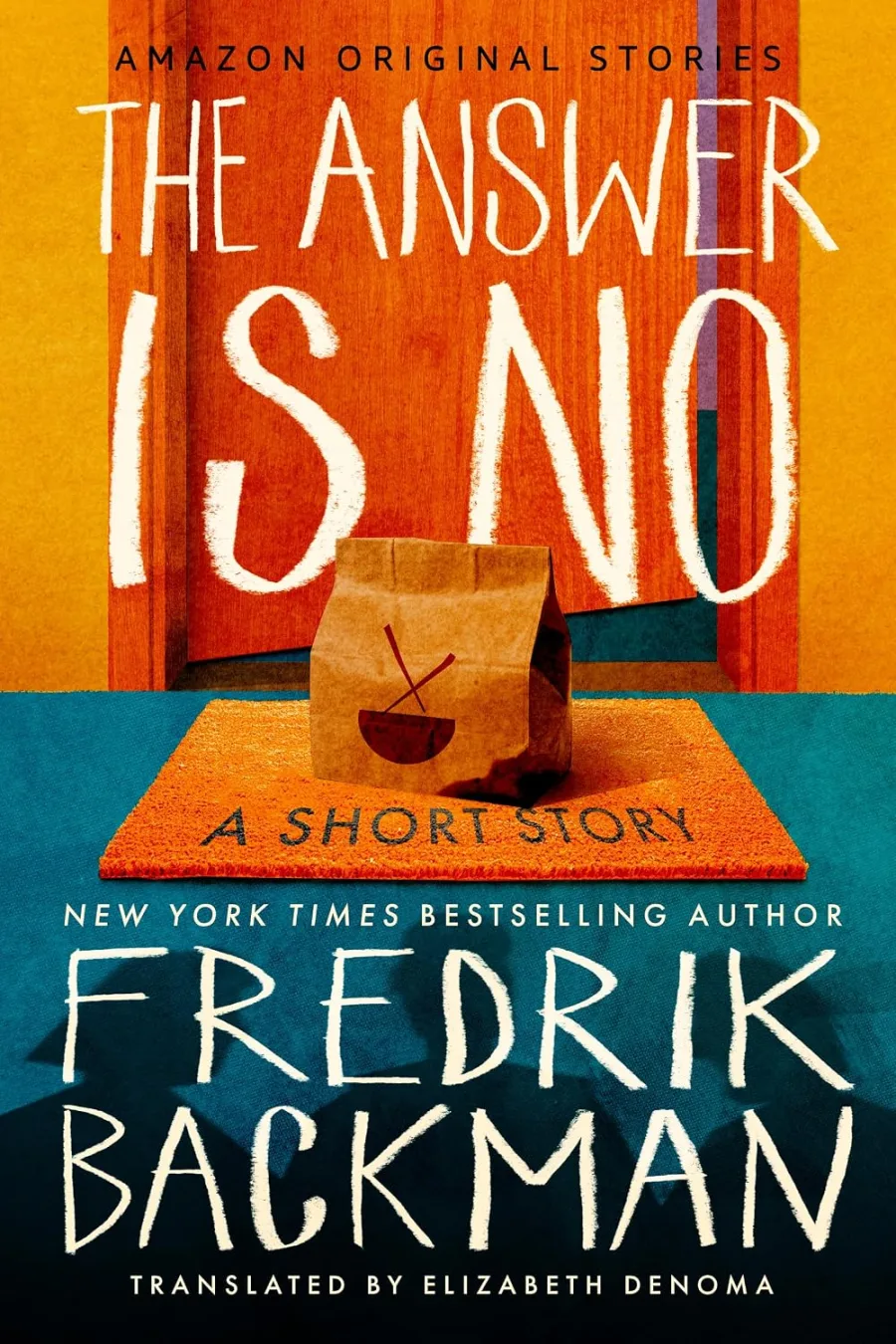
The Answer Is No: A Short Story
eBook
• 68 Pages
• ₹ 69.00
• English
• 9781662526527
No ratings yet
| Publisher | Amazon Original Stories |
|---|---|
| ISBN13 | 9781662526527 |
| ASIN/SKU | B0D5JLH3RJ |
| Book Format | eBook |
| Language | English |
| Pages | 68 |
| List Price | ₹ 69.00 |
| Publishing Date | 01/12/2024 |
| Book Code | BD00070177 |
Buy this Book
Amazon Stores
Ebook Stores
Other Stores
Discover The Answer Is No: A Short Story by Fredrik Backman. This book is published by Amazon Original Stories in eBook format, ISBN 9781662526527, ASIN B0D5JLH3RJ, under Literature and Fiction, Short Stories.
Book Description
In a hilarious short story from New York Times bestselling author Fredrik Backman, the absurdities of modern life cause one man’s solitary world to spin suddenly, and comically, out of control.
Lucas knows the perfect night entails just three things: video games, wine, and pad thai. Peanuts are a must! Other people? Not so much. Why complicate things when he’s happy alone?
Then one day the apartment board, a vexing trio of authority, rings his doorbell. And Lucas’s solitude takes a startling hike. They demand to see his frying pan. Someone left one next to the recycling room overnight, and instead of removing the errant object, as Lucas suggests, they insist on finding the guilty party. But their plan backfires. Colossally.
Told in Fredrik Backman’s singular witty style with sharply drawn characters and relatable antics, The Answer Is No is a laugh-out-loud portrait of a man struggling to keep to himself in a world that won’t leave him alone.
Lucas knows the perfect night entails just three things: video games, wine, and pad thai. Peanuts are a must! Other people? Not so much. Why complicate things when he’s happy alone?
Then one day the apartment board, a vexing trio of authority, rings his doorbell. And Lucas’s solitude takes a startling hike. They demand to see his frying pan. Someone left one next to the recycling room overnight, and instead of removing the errant object, as Lucas suggests, they insist on finding the guilty party. But their plan backfires. Colossally.
Told in Fredrik Backman’s singular witty style with sharply drawn characters and relatable antics, The Answer Is No is a laugh-out-loud portrait of a man struggling to keep to himself in a world that won’t leave him alone.
Author Biography
Fredrik Backman is the #1 New York Times bestselling author of A Man Called Ove, My Grandmother Asked Me to Tell You She’s Sorry, Britt-Marie Was Here, Beartown, Us Against You, The Winners, Anxious People, My Friends, and two novellas, And Every Morning the Way Home Gets Longer and Longer and The Deal of a Lifetime, as well as one work of nonfiction, Things My Son Needs to Know About the World. His books are published in more than forty countries. He lives in Stockholm, Sweden, with his wife and two children. Connect with him on Facebook and Twitter @BackmanLand or on Instagram @Backmansk.
Editorial Reviews
Editorial Reviews will be added soon…
Book Summary
The Answer Is No by Fredrik Backman is a short, witty, and surprisingly tender story about solitude, loneliness, human connection, bureaucracy, and the strange ways people can stumble into one another's lives. The story follows Lucas, a man who has deliberately designed his life around avoiding other people. He works from home, enjoys video games, wine, and takeout, and believes that happiness comes from removing unnecessary human interaction from his life. But his carefully protected solitude begins to collapse because of something as absurdly ordinary as a discarded frying pan.
Lucas is not presented as a traditionally unhappy loner. He genuinely likes being alone. He has no desire for romantic complications, neighborhood friendships, committees, social obligations, or even unnecessary conversations with delivery workers. For him, saying “no” is a philosophy of life. Every refusal protects his time, his peace, and his independence.
He has convinced himself that other people create problems and that happiness can be achieved by eliminating those problems before they appear.
His routine is comfortable and carefully controlled.
Then comes the frying pan.
Someone leaves an old frying pan beside the recycling area of Lucas's apartment building instead of disposing of it properly. To most people, this would be an insignificant nuisance. But the building's board of directors treats it as a serious violation.
They want to discover who left it there.
They want rules to be followed.
They want responsibility assigned.
And, most importantly, they want someone to blame.
Lucas is dragged into the matter because he happens to offer a logical suggestion about identifying the person responsible. His attempt to be helpful has an unintended consequence: the building board begins treating him as someone who can solve the problem.
Before long, what began as a single frying pan becomes a much larger issue. More unwanted objects appear near the recycling area, creating a growing pile of discarded possessions. The board becomes increasingly obsessed with the situation. The absurdity escalates until bureaucracy itself seems more interested in defining the problem than actually solving it.
Lucas's peaceful existence is now under siege.
The story's humor comes partly from this disproportion. A tiny household problem becomes a social emergency. Meetings are organized. Committees are created. Responsibilities are assigned. Arguments multiply.
The building's board behaves almost like a miniature government, demonstrating how easily people can become consumed by rules, procedures, and the need to establish authority.
Lucas, who wants nothing to do with any of this, finds himself increasingly involved.
And then his neighbors begin entering his life.
One is a woman in a purple dress, who has been using Lucas's Wi-Fi without his permission. Their interactions begin awkwardly and humorously, but she gradually reveals that she is profoundly lonely.
Another is a woman in a green shirt, who is exhausted by her responsibilities as a mother and wife. She has arranged an extraordinary escape from her everyday life: a kind of “coma vacation,” in which she pretends to be unconscious so that she can temporarily avoid the demands of her family.
These women initially seem like exactly the kind of people Lucas wants to avoid.
They talk.
They interfere.
They bring complications.
They require emotional attention.
Yet something unexpected begins happening.
Lucas starts listening.
The man who has built his entire existence around avoiding other people slowly begins to understand them.
He discovers that the woman in purple is not simply annoying or intrusive. She is lonely.
The woman in green is not simply strange. She is exhausted.
The building-board members are not merely ridiculous bureaucrats. They are also ordinary people trying, however imperfectly, to make sense of their surroundings.
This is where Backman's characteristic warmth begins to emerge beneath the comedy.
The story never completely abandons its humor. In fact, the situation becomes increasingly absurd. The pile of discarded objects grows so large that bureaucratic language is used to redefine it rather than simply remove it. A small collection of rubbish becomes something resembling an officially recognized geographical feature.
The absurdity is deliberately exaggerated, but the underlying point is recognizable.
People sometimes become so attached to rules that they forget why the rules exist.
They become more interested in responsibility than responsibility itself.
They create committees to discuss problems that could have been solved in five minutes.
And once a bureaucratic system begins growing, it can become almost impossible to stop.
Lucas's worst nightmare is therefore coming true.
He is becoming socially important.
People want his opinion.
People want his help.
People expect him to take responsibility.
He is being dragged into a community he never wanted.
But the more he interacts with his neighbors, the more his attitude begins to change.
The growing pile itself becomes a symbol.
At first, Lucas sees it simply as rubbish.
Eventually, he begins to see something else.
Every discarded object once belonged to someone.
Someone bought it because they believed it would make them happier.
Someone used it.
Someone eventually decided it was no longer useful.
The pile therefore becomes a strange monument to human attempts to find happiness through possessions.
It is a collection of failed hopes.
This realization represents a subtle turning point for Lucas.
He begins to understand that people are complicated creatures constantly searching for meaning, comfort, companionship, and happiness.
His earlier philosophy—simply eliminate people and problems—suddenly seems less complete.
One of the story's most touching ideas is the difference between solitude and loneliness.
Lucas has chosen solitude.
He believes he is happy.
The woman in purple, however, experiences loneliness as something painful and involuntary.
These are not necessarily the same thing.
A person can be alone and perfectly content.
Another person can be surrounded by people and feel desperately lonely.
Backman treats this distinction with humor but also considerable empathy.
Lucas gradually begins to recognize that other people may not simply be obstacles to happiness.
They can also be the source of meaning.
This does not mean he suddenly becomes a social butterfly.
He remains Lucas.
He still wants privacy.
He still values quiet.
He still dislikes unnecessary interaction.
The story does not suggest that everyone needs to become highly sociable.
Instead, it suggests that complete emotional isolation may not be as satisfying as Lucas believes.
The comedy becomes increasingly chaotic as the pile attracts attention from online groups and other members of the community. Social media turns a local dispute into something much larger. People begin interpreting events according to their own beliefs, and an increasingly bizarre online following develops around Lucas. Some people even begin treating him as a supernatural figure.
This section of the story satirizes the modern internet.
A small misunderstanding can become a major online controversy.
People can build entire beliefs around incomplete information.
Strangers can become emotionally invested in events they barely understand.
And once a story spreads online, reality becomes almost irrelevant.
Lucas, who wants nothing more than to be left alone, becomes the unlikely center of an absurd social phenomenon.
Yet even in the middle of this madness, he continues learning about the people around him.
The woman in green eventually confronts the realities of her family life.
Her decision to escape through the pretend-coma arrangement reflects the exhaustion that can come with constantly caring for others without receiving enough care in return.
Her story gives Lucas another lesson.
People do not always withdraw from society because they dislike others.
Sometimes they withdraw because they are overwhelmed.
The woman in purple has a different problem.
She wants connection but struggles to find it.
Her loneliness is not something she can solve simply by being alone.
Lucas begins to recognize these differences.
He realizes that there is no single formula for happiness.
Some people need solitude.
Some need companionship.
Some need a break.
Some need to be heard.
Some need to learn how to say no.
And some, perhaps, need to learn when to say yes.
The climax of the story revolves around the enormous pile of discarded objects.
Lucas eventually realizes that conventional attempts to remove it are failing.
So he finds a solution that is perfectly suited to the strange world around him.
Instead of relying on cooperation or goodwill, he uses spite.
He understands that people may be more motivated to prove someone wrong than to help someone else.
By manipulating competing online groups and encouraging them to prove their superiority, he gets people to clear the pile. The solution is absurd, but it works.
This is one of the story's funniest observations about human nature.
People may ignore kindness.
They may ignore logic.
They may ignore responsibility.
But challenge their pride, and suddenly they become incredibly energetic.
Lucas succeeds because he understands something fundamental about people: emotion often motivates action more effectively than reason.
Once the pile disappears, the immediate crisis is over.
But another problem appears.
The empty space itself becomes a new subject of debate.
The neighbors begin arguing about what should happen next.
And, naturally, they expect Lucas to solve the problem.
Lucas realizes that his nightmare has not ended.
If he allows himself to become involved, he may be trapped in endless meetings, decisions, responsibilities, and expectations.
So he does something characteristically Lucas-like.
He disappears.
With the help of his neighbors, he is declared to be in a coma.
This absurd solution allows everyone else to stop asking him to make decisions.
Lucas eventually finds refuge in a hospital storage room, where he can once again enjoy solitude and finish his video game in peace.
But something has changed.
Lucas is no longer exactly the same man who began the story.
He has learned to care about the people around him.
He has listened to their stories.
He has understood their pain.
And, most importantly, he has allowed himself to feel empathy.
One of the story's sweetest details is that Lucas keeps a photograph connected to the family of the woman in the green shirt.
It becomes a small reminder that although he has returned to solitude, other people have quietly become part of his emotional world.
This makes the ending more meaningful than it initially appears.
Lucas gets what he wanted.
He is alone.
He is not being bothered.
He can play his video game.
He can eat his food.
He can enjoy his quiet life.
But now his solitude is different.
At the beginning, he believes that people are essentially problems to be eliminated.
By the end, he knows that people are complicated, exhausting, ridiculous, frustrating—and also capable of bringing unexpected warmth and meaning into one another's lives.
The story therefore does not argue that Lucas should stop being himself.
It argues that being alone and being disconnected are not necessarily the same thing.
The Meaning of “No”
The title The Answer Is No reflects Lucas's philosophy.
For him, “no” is a protective wall.
No relationships.
No commitments.
No committees.
No unnecessary conversations.
No emotional obligations.
No responsibility for other people's problems.
His repeated refusal allows him to construct a peaceful existence.
But the story gradually shows that saying “no” to everything can also mean saying no to unexpected forms of friendship, empathy, and belonging.
The challenge is not simply learning to say “yes.”
It is learning to know when a no protects you and when it isolates you.
Bureaucracy and Absurdity
Backman also uses the story to satirize modern bureaucracy.
A frying pan becomes an investigation.
An investigation becomes a committee.
A committee creates more problems.
The pile becomes a symbol.
Social media turns the situation into a spectacle.
The story exaggerates these developments, but the humor comes from how recognizable they feel.
People can become so focused on procedures that they lose sight of common sense.
Loneliness and Connection
At its emotional center, The Answer Is No is a story about people who are lonely in different ways.
Lucas chooses solitude.
The woman in purple wants companionship.
The woman in green needs escape from overwhelming family responsibilities.
Their circumstances are different, but all three are searching for a life they can tolerate.
Through them, Backman suggests that happiness is not one-size-fits-all.
What matters is understanding what we genuinely need—and recognizing that other people may need something entirely different.
Conclusion
The Answer Is No is a deceptively simple short story that turns a discarded frying pan into a hilarious examination of modern life.
Lucas begins with a very clear philosophy: the fewer people and obligations in his life, the happier he will be.
Then the world refuses to cooperate.
A building board invades his privacy.
A pile of rubbish becomes a neighborhood crisis.
Two troubled women enter his life.
Social media transforms him into an unlikely celebrity.
And a simple household problem becomes a bizarre community drama.
Yet beneath the absurdity, Lucas experiences a quiet transformation.
He learns that people are not simply interruptions.
They are individuals carrying grief, exhaustion, hopes, fears, and desires.
He learns that loneliness can look very different from solitude.
He learns that sometimes people need help even when they do not know how to ask for it.
And he learns that empathy can enter a person's life almost without permission.
In the end, Lucas still chooses solitude.
That is part of the charm of the story.
Backman does not force him into a conventional happy ending in which he suddenly embraces a busy social life.
Instead, Lucas finds a version of happiness that remains true to his personality—but now contains a small space for other people.
The discarded frying pan has disappeared.
The enormous pile is gone.
The bureaucratic crisis is over.
But something has remained behind: connection.
The Answer Is No ultimately suggests that a peaceful life is not necessarily a life without people. Sometimes it is a life in which we learn to choose our boundaries without completely closing our hearts.
And perhaps that is the quiet joke behind the title.
Lucas's answer is always no.
But by the end of the story, even his “no” has learned how to make room for a little yes.
Lucas is not presented as a traditionally unhappy loner. He genuinely likes being alone. He has no desire for romantic complications, neighborhood friendships, committees, social obligations, or even unnecessary conversations with delivery workers. For him, saying “no” is a philosophy of life. Every refusal protects his time, his peace, and his independence.
He has convinced himself that other people create problems and that happiness can be achieved by eliminating those problems before they appear.
His routine is comfortable and carefully controlled.
Then comes the frying pan.
Someone leaves an old frying pan beside the recycling area of Lucas's apartment building instead of disposing of it properly. To most people, this would be an insignificant nuisance. But the building's board of directors treats it as a serious violation.
They want to discover who left it there.
They want rules to be followed.
They want responsibility assigned.
And, most importantly, they want someone to blame.
Lucas is dragged into the matter because he happens to offer a logical suggestion about identifying the person responsible. His attempt to be helpful has an unintended consequence: the building board begins treating him as someone who can solve the problem.
Before long, what began as a single frying pan becomes a much larger issue. More unwanted objects appear near the recycling area, creating a growing pile of discarded possessions. The board becomes increasingly obsessed with the situation. The absurdity escalates until bureaucracy itself seems more interested in defining the problem than actually solving it.
Lucas's peaceful existence is now under siege.
The story's humor comes partly from this disproportion. A tiny household problem becomes a social emergency. Meetings are organized. Committees are created. Responsibilities are assigned. Arguments multiply.
The building's board behaves almost like a miniature government, demonstrating how easily people can become consumed by rules, procedures, and the need to establish authority.
Lucas, who wants nothing to do with any of this, finds himself increasingly involved.
And then his neighbors begin entering his life.
One is a woman in a purple dress, who has been using Lucas's Wi-Fi without his permission. Their interactions begin awkwardly and humorously, but she gradually reveals that she is profoundly lonely.
Another is a woman in a green shirt, who is exhausted by her responsibilities as a mother and wife. She has arranged an extraordinary escape from her everyday life: a kind of “coma vacation,” in which she pretends to be unconscious so that she can temporarily avoid the demands of her family.
These women initially seem like exactly the kind of people Lucas wants to avoid.
They talk.
They interfere.
They bring complications.
They require emotional attention.
Yet something unexpected begins happening.
Lucas starts listening.
The man who has built his entire existence around avoiding other people slowly begins to understand them.
He discovers that the woman in purple is not simply annoying or intrusive. She is lonely.
The woman in green is not simply strange. She is exhausted.
The building-board members are not merely ridiculous bureaucrats. They are also ordinary people trying, however imperfectly, to make sense of their surroundings.
This is where Backman's characteristic warmth begins to emerge beneath the comedy.
The story never completely abandons its humor. In fact, the situation becomes increasingly absurd. The pile of discarded objects grows so large that bureaucratic language is used to redefine it rather than simply remove it. A small collection of rubbish becomes something resembling an officially recognized geographical feature.
The absurdity is deliberately exaggerated, but the underlying point is recognizable.
People sometimes become so attached to rules that they forget why the rules exist.
They become more interested in responsibility than responsibility itself.
They create committees to discuss problems that could have been solved in five minutes.
And once a bureaucratic system begins growing, it can become almost impossible to stop.
Lucas's worst nightmare is therefore coming true.
He is becoming socially important.
People want his opinion.
People want his help.
People expect him to take responsibility.
He is being dragged into a community he never wanted.
But the more he interacts with his neighbors, the more his attitude begins to change.
The growing pile itself becomes a symbol.
At first, Lucas sees it simply as rubbish.
Eventually, he begins to see something else.
Every discarded object once belonged to someone.
Someone bought it because they believed it would make them happier.
Someone used it.
Someone eventually decided it was no longer useful.
The pile therefore becomes a strange monument to human attempts to find happiness through possessions.
It is a collection of failed hopes.
This realization represents a subtle turning point for Lucas.
He begins to understand that people are complicated creatures constantly searching for meaning, comfort, companionship, and happiness.
His earlier philosophy—simply eliminate people and problems—suddenly seems less complete.
One of the story's most touching ideas is the difference between solitude and loneliness.
Lucas has chosen solitude.
He believes he is happy.
The woman in purple, however, experiences loneliness as something painful and involuntary.
These are not necessarily the same thing.
A person can be alone and perfectly content.
Another person can be surrounded by people and feel desperately lonely.
Backman treats this distinction with humor but also considerable empathy.
Lucas gradually begins to recognize that other people may not simply be obstacles to happiness.
They can also be the source of meaning.
This does not mean he suddenly becomes a social butterfly.
He remains Lucas.
He still wants privacy.
He still values quiet.
He still dislikes unnecessary interaction.
The story does not suggest that everyone needs to become highly sociable.
Instead, it suggests that complete emotional isolation may not be as satisfying as Lucas believes.
The comedy becomes increasingly chaotic as the pile attracts attention from online groups and other members of the community. Social media turns a local dispute into something much larger. People begin interpreting events according to their own beliefs, and an increasingly bizarre online following develops around Lucas. Some people even begin treating him as a supernatural figure.
This section of the story satirizes the modern internet.
A small misunderstanding can become a major online controversy.
People can build entire beliefs around incomplete information.
Strangers can become emotionally invested in events they barely understand.
And once a story spreads online, reality becomes almost irrelevant.
Lucas, who wants nothing more than to be left alone, becomes the unlikely center of an absurd social phenomenon.
Yet even in the middle of this madness, he continues learning about the people around him.
The woman in green eventually confronts the realities of her family life.
Her decision to escape through the pretend-coma arrangement reflects the exhaustion that can come with constantly caring for others without receiving enough care in return.
Her story gives Lucas another lesson.
People do not always withdraw from society because they dislike others.
Sometimes they withdraw because they are overwhelmed.
The woman in purple has a different problem.
She wants connection but struggles to find it.
Her loneliness is not something she can solve simply by being alone.
Lucas begins to recognize these differences.
He realizes that there is no single formula for happiness.
Some people need solitude.
Some need companionship.
Some need a break.
Some need to be heard.
Some need to learn how to say no.
And some, perhaps, need to learn when to say yes.
The climax of the story revolves around the enormous pile of discarded objects.
Lucas eventually realizes that conventional attempts to remove it are failing.
So he finds a solution that is perfectly suited to the strange world around him.
Instead of relying on cooperation or goodwill, he uses spite.
He understands that people may be more motivated to prove someone wrong than to help someone else.
By manipulating competing online groups and encouraging them to prove their superiority, he gets people to clear the pile. The solution is absurd, but it works.
This is one of the story's funniest observations about human nature.
People may ignore kindness.
They may ignore logic.
They may ignore responsibility.
But challenge their pride, and suddenly they become incredibly energetic.
Lucas succeeds because he understands something fundamental about people: emotion often motivates action more effectively than reason.
Once the pile disappears, the immediate crisis is over.
But another problem appears.
The empty space itself becomes a new subject of debate.
The neighbors begin arguing about what should happen next.
And, naturally, they expect Lucas to solve the problem.
Lucas realizes that his nightmare has not ended.
If he allows himself to become involved, he may be trapped in endless meetings, decisions, responsibilities, and expectations.
So he does something characteristically Lucas-like.
He disappears.
With the help of his neighbors, he is declared to be in a coma.
This absurd solution allows everyone else to stop asking him to make decisions.
Lucas eventually finds refuge in a hospital storage room, where he can once again enjoy solitude and finish his video game in peace.
But something has changed.
Lucas is no longer exactly the same man who began the story.
He has learned to care about the people around him.
He has listened to their stories.
He has understood their pain.
And, most importantly, he has allowed himself to feel empathy.
One of the story's sweetest details is that Lucas keeps a photograph connected to the family of the woman in the green shirt.
It becomes a small reminder that although he has returned to solitude, other people have quietly become part of his emotional world.
This makes the ending more meaningful than it initially appears.
Lucas gets what he wanted.
He is alone.
He is not being bothered.
He can play his video game.
He can eat his food.
He can enjoy his quiet life.
But now his solitude is different.
At the beginning, he believes that people are essentially problems to be eliminated.
By the end, he knows that people are complicated, exhausting, ridiculous, frustrating—and also capable of bringing unexpected warmth and meaning into one another's lives.
The story therefore does not argue that Lucas should stop being himself.
It argues that being alone and being disconnected are not necessarily the same thing.
The Meaning of “No”
The title The Answer Is No reflects Lucas's philosophy.
For him, “no” is a protective wall.
No relationships.
No commitments.
No committees.
No unnecessary conversations.
No emotional obligations.
No responsibility for other people's problems.
His repeated refusal allows him to construct a peaceful existence.
But the story gradually shows that saying “no” to everything can also mean saying no to unexpected forms of friendship, empathy, and belonging.
The challenge is not simply learning to say “yes.”
It is learning to know when a no protects you and when it isolates you.
Bureaucracy and Absurdity
Backman also uses the story to satirize modern bureaucracy.
A frying pan becomes an investigation.
An investigation becomes a committee.
A committee creates more problems.
The pile becomes a symbol.
Social media turns the situation into a spectacle.
The story exaggerates these developments, but the humor comes from how recognizable they feel.
People can become so focused on procedures that they lose sight of common sense.
Loneliness and Connection
At its emotional center, The Answer Is No is a story about people who are lonely in different ways.
Lucas chooses solitude.
The woman in purple wants companionship.
The woman in green needs escape from overwhelming family responsibilities.
Their circumstances are different, but all three are searching for a life they can tolerate.
Through them, Backman suggests that happiness is not one-size-fits-all.
What matters is understanding what we genuinely need—and recognizing that other people may need something entirely different.
Conclusion
The Answer Is No is a deceptively simple short story that turns a discarded frying pan into a hilarious examination of modern life.
Lucas begins with a very clear philosophy: the fewer people and obligations in his life, the happier he will be.
Then the world refuses to cooperate.
A building board invades his privacy.
A pile of rubbish becomes a neighborhood crisis.
Two troubled women enter his life.
Social media transforms him into an unlikely celebrity.
And a simple household problem becomes a bizarre community drama.
Yet beneath the absurdity, Lucas experiences a quiet transformation.
He learns that people are not simply interruptions.
They are individuals carrying grief, exhaustion, hopes, fears, and desires.
He learns that loneliness can look very different from solitude.
He learns that sometimes people need help even when they do not know how to ask for it.
And he learns that empathy can enter a person's life almost without permission.
In the end, Lucas still chooses solitude.
That is part of the charm of the story.
Backman does not force him into a conventional happy ending in which he suddenly embraces a busy social life.
Instead, Lucas finds a version of happiness that remains true to his personality—but now contains a small space for other people.
The discarded frying pan has disappeared.
The enormous pile is gone.
The bureaucratic crisis is over.
But something has remained behind: connection.
The Answer Is No ultimately suggests that a peaceful life is not necessarily a life without people. Sometimes it is a life in which we learn to choose our boundaries without completely closing our hearts.
And perhaps that is the quiet joke behind the title.
Lucas's answer is always no.
But by the end of the story, even his “no” has learned how to make room for a little yes.
Sample Chapters
Sample Chapters will be added soon…
Reader Reviews
No reviews yet.
The Answer Is No: A Short Story
Download Cover Image
Do you want to download the full cover image for The Answer Is No: A Short Story?