
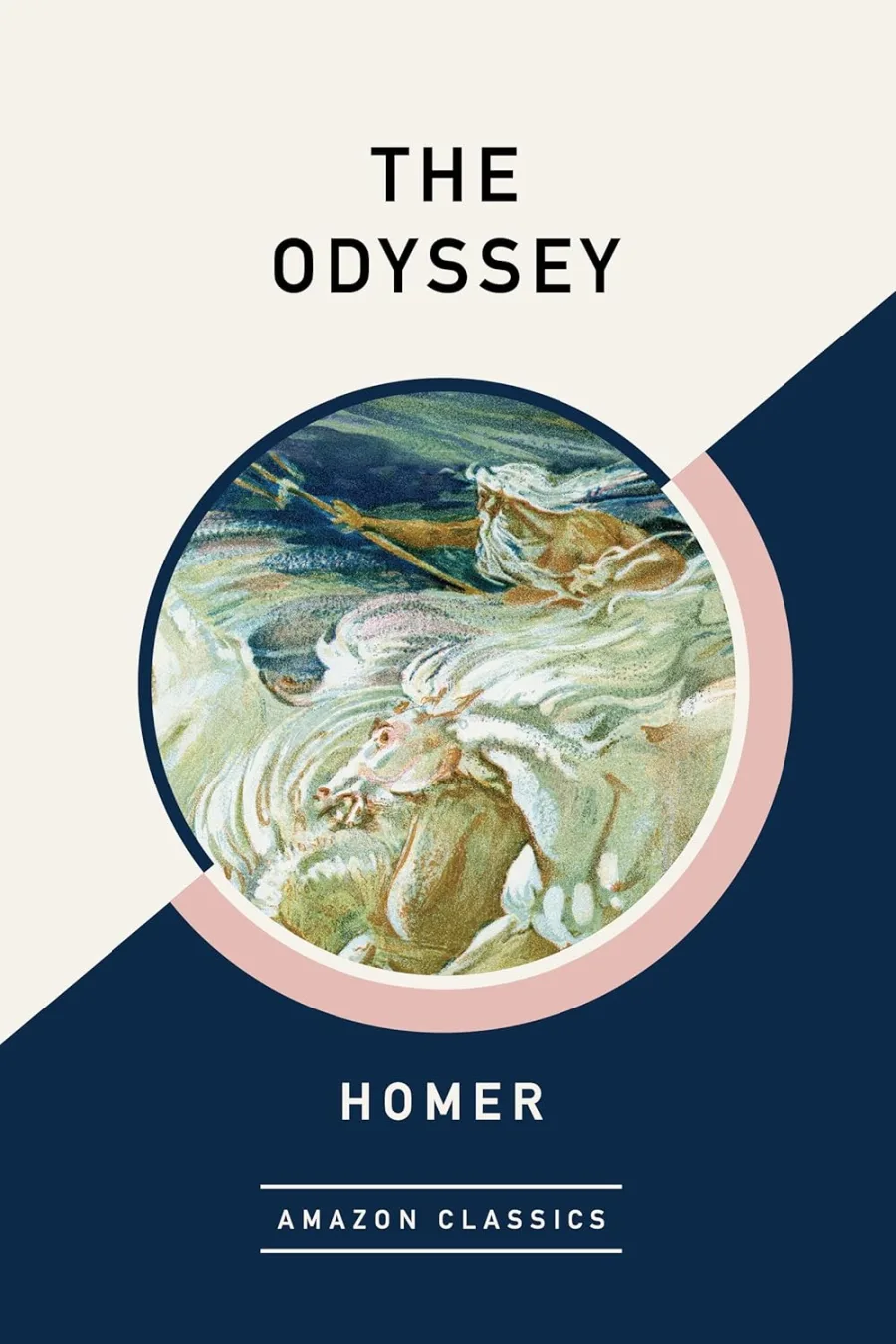
The Odyssey (AmazonClassics Edition)
eBook
• 284 Pages
• ₹ 658.68
• English
• 9781542097536
No ratings yet
| Publisher | AmazonClassics |
|---|---|
| ISBN13 | 9781542097536 |
| ASIN/SKU | B071JBJTFY |
| Book Format | eBook |
| Language | English |
| Pages | 284 |
| List Price | ₹ 658.68 |
| Publishing Date | 27/06/2017 |
| Book Code | BD00070176 |
Buy this Book
Amazon Stores
Ebook Stores
Other Stores
Discover The Odyssey (AmazonClassics Edition) by Homer. This book is published by AmazonClassics in eBook format, ISBN 9781542097536, ASIN B071JBJTFY, under Literature and Fiction, Poetry.
Book Description
After enduring the Trojan War, Odysseus begins the treacherous journey home to Ithaca. On the way, he faces ravenous monsters and vengeful gods. But the real battle awaits, as his kingdom is under siege by unruly suitors vying for his wife’s hand—and his son’s head. To reclaim his throne and save his family, Odysseus must rely on his wits…and help from the unpredictable gods.
Homer’s The Odyssey was composed around 700 BC. It is one of the earliest epics in existence and remains one of the most influential works of literature today.
Revised edition: Previously published as The Odyssey, this edition of The Odyssey (AmazonClassics Edition) includes editorial revisions.
Homer’s The Odyssey was composed around 700 BC. It is one of the earliest epics in existence and remains one of the most influential works of literature today.
Revised edition: Previously published as The Odyssey, this edition of The Odyssey (AmazonClassics Edition) includes editorial revisions.
Author Biography
Homer is believed to have been born sometime between the twelfth and eighth centuries BC. While the works of the Greek poet have had a significant influence on Western culture and literature, very little is known about the blind bard from Ionia. Some scholars allege that the epics The Iliad and The Odyssey were actually composed by groups of storytellers who worked in the oral tradition.
Regardless, the epics assigned to Homer have become the chief sources for world mythology, our understanding of early human society, and tales of life in ancient Greece.
Regardless, the epics assigned to Homer have become the chief sources for world mythology, our understanding of early human society, and tales of life in ancient Greece.
Editorial Reviews
Editorial Reviews will be added soon…
Book Summary
The Odyssey by Homer is one of the greatest adventure epics ever written and one of the foundational works of Western literature. Traditionally attributed to Homer and generally dated to the 8th century BCE, the poem follows Odysseus, the king of Ithaca, during his extraordinarily difficult journey home after the Trojan War. His return takes another ten years, during which he encounters monsters, witches, gods, storms, temptations, shipwrecks, and the supernatural. At the same time, his wife Penelope and son Telemachus struggle to protect their home from arrogant suitors who believe Odysseus is dead.
Yet The Odyssey is much more than a collection of fantastic adventures. Beneath its monsters and magical islands lies a deeply human story about homecoming, loyalty, family, identity, intelligence, temptation, pride, hospitality, and perseverance. Its central idea is the Greek concept of nostos, or return: the belief that a hero's greatest achievement may not be winning a war, but finding his way home to the people and place that give his life meaning.
A Kingdom Waiting for Its King
The epic begins after the Trojan War has already ended.
Odysseus has been away from Ithaca for twenty years—ten years fighting at Troy and another ten years attempting to return home.
His wife, Penelope, has remained faithful to him.
Their son, Telemachus, was only a baby when Odysseus left and has grown into a young man without truly knowing his father.
In Odysseus's absence, a large group of wealthy young men known as the suitors have taken over his palace. They want Penelope to marry one of them, believing Odysseus is probably dead.
But they do more than court her.
They consume Odysseus's food, drink his wine, slaughter his animals, and behave as though his property already belongs to them.
Penelope refuses to choose among them.
She cleverly delays the decision by announcing that she must first finish weaving a burial cloth for Odysseus's father, Laertes. Every day she weaves, and every night she secretly unravels part of her work.
Her deception allows her to remain faithful while buying time.
The situation demonstrates that Penelope possesses a quality very similar to Odysseus's own greatest strength: cleverness.
Telemachus Begins to Grow
Telemachus is frustrated by the suitors but initially lacks the confidence to challenge them.
The goddess Athena, one of Odysseus's strongest divine supporters, decides to help him.
She encourages Telemachus to search for information about his father.
Telemachus travels to Pylos and Sparta, where he meets Nestor and Menelaus, former companions of Odysseus from the Trojan War.
There he learns that Odysseus is still alive.
He is not dead, as many people had assumed.
He is trapped far away on the island of Ogygia.
Telemachus's journey is important because he is undergoing his own transformation. He begins as an uncertain young man living under the shadow of his absent father. Gradually, he develops confidence and learns to act with courage and responsibility.
His story is therefore a coming-of-age journey alongside Odysseus's journey home.
Odysseus and Calypso
Odysseus is being held on the island of Ogygia by the nymph Calypso.
Calypso loves him and offers him an extraordinary life.
She can give him immortality.
He could remain with her forever in comfort and beauty.
Yet Odysseus refuses.
He longs for Ithaca.
He longs for Penelope.
He longs for his ordinary human life.
This is one of the most important moments in the entire epic.
Odysseus chooses mortality and home over immortality and luxury.
His deepest desire is not eternal life.
It is belonging.
Eventually, Zeus sends Hermes to order Calypso to release him.
Odysseus builds a raft and sets out again.
But his journey is far from over.
Poseidon's Anger
The sea god Poseidon hates Odysseus.
The reason goes back to one of Odysseus's earlier adventures involving Poseidon's son, the Cyclops Polyphemus.
Poseidon therefore sends a terrible storm.
Odysseus's raft is destroyed, and he struggles desperately to survive.
Eventually, he reaches the land of the Phaeacians.
There he encounters Princess Nausicaa, who helps him.
He is welcomed into the palace of King Alcinous and Queen Arete.
The Phaeacians treat their stranger with kindness and hospitality.
This is important because hospitality is one of the central moral principles of the poem. Good hosts welcome travelers and provide food, shelter, and protection; those who abuse guests violate a sacred social order.
Odysseus Tells His Story
At the Phaeacian court, Odysseus finally reveals his identity.
He then tells the story of the adventures that have delayed his return.
This creates one of the most interesting structural features of The Odyssey: many of the famous adventures are presented as Odysseus's own account of his past experiences rather than unfolding chronologically from the beginning.
His stories include the Lotus-Eaters, the Cyclops, Circe, the Underworld, the Sirens, Scylla and Charybdis, and the island of the Sun.
The Lotus-Eaters
One of Odysseus's earliest encounters is with the Lotus-Eaters.
The people who live there consume a mysterious plant that causes them to forget their desire to return home.
Some of Odysseus's men eat the lotus and lose all interest in Ithaca.
Odysseus has to drag them back to the ships.
The episode represents one of the central dangers of his journey: forgetting the purpose of the journey itself.
Homecoming requires not merely physical endurance but the ability to remember what one is fighting to return to.
The Cyclops Polyphemus
The most famous adventure begins when Odysseus and his men enter the cave of Polyphemus, a gigantic one-eyed Cyclops.
Polyphemus traps them inside and begins killing and eating the men.
Odysseus realizes that brute strength cannot defeat the giant.
Instead, he uses intelligence.
He tells Polyphemus that his name is Nobody.
He gives the Cyclops wine and waits until he becomes drunk.
Then Odysseus and his remaining men sharpen a wooden stake and drive it into Polyphemus's eye.
When Polyphemus cries out for help, the other Cyclopes ask who is attacking him.
He answers that “Nobody” is hurting him.
They assume that no one is attacking him and leave.
Odysseus then escapes by hiding himself and his men beneath Polyphemus's sheep.
His plan is brilliant.
But his victory is undermined by his pride.
Once safely away, Odysseus cannot resist telling Polyphemus his real name.
Polyphemus calls upon his father Poseidon to punish him.
This mistake has enormous consequences.
Odysseus's intelligence saves him, but his vanity extends his suffering.
The episode establishes one of the poem's central lessons: cunning can defeat strength, but pride can undo cunning.
Circe
Odysseus and his men next encounter the enchantress Circe.
She transforms some of his companions into pigs.
With help from the god Hermes, Odysseus resists her magic and forces Circe to restore them.
Eventually, Circe becomes an ally.
Odysseus and his men remain on her island for a year.
But Circe eventually tells Odysseus that he must travel to the world of the dead to seek advice from the prophet Tiresias.
The Underworld
Odysseus travels to the Underworld.
There he encounters the spirits of the dead, including his mother and the great warrior Achilles.
The meeting with Achilles is particularly significant.
Achilles was celebrated during the Trojan War for his strength and heroic glory.
But in death, he tells Odysseus that he would rather be alive as a poor man than rule over the dead.
This moment challenges the traditional heroic obsession with fame.
Glory is valuable only while one is alive to experience it.
Odysseus's journey is increasingly about survival and return rather than heroic reputation.
Tiresias also gives Odysseus warnings about the dangers still ahead.
The Sirens
Odysseus and his crew later encounter the Sirens, whose beautiful singing is irresistible to sailors.
Their song promises knowledge and pleasure but leads those who approach them to destruction.
Odysseus wants to hear the song.
So he develops a clever solution.
He orders his men to plug their ears with wax and instructs them to tie him tightly to the ship's mast.
When the Sirens sing, Odysseus is overwhelmed by the desire to follow them.
He begs his men to release him.
But they obey his earlier instructions and keep him tied.
He survives because he understands his own weakness and prepares for it in advance.
This episode demonstrates again that intelligence often means recognizing one's own limitations.
Scylla and Charybdis
Odysseus must next navigate between Scylla, a terrifying sea monster, and Charybdis, a deadly whirlpool.
There is no perfect choice.
He must accept that some of his men will die.
Scylla attacks the ship and carries away several men.
Odysseus is forced to continue.
The episode emphasizes that leadership sometimes involves making painful decisions when every available option involves loss.
The Cattle of the Sun
Eventually, Odysseus's men reach an island containing sacred cattle belonging to the Sun God.
Odysseus has been warned not to harm them.
He tells his men not to kill the animals.
But when Odysseus falls asleep, the crew becomes hungry and slaughter the cattle.
Their disobedience brings divine punishment.
Their ship is destroyed, and Odysseus becomes the only survivor.
He eventually reaches Calypso's island, where he remains trapped until the events at the beginning of the epic.
The episode demonstrates another recurring theme: people often create their own suffering through greed, impatience, and failure to control their desires.
Odysseus Finally Reaches Ithaca
After hearing Odysseus's story, the Phaeacians help him.
They secretly transport him to Ithaca.
But Odysseus does not immediately reveal himself.
Athena disguises him as an old beggar.
He needs to discover which members of his household remain loyal and determine how he can defeat the suitors.
He visits the loyal swineherd Eumaeus, who welcomes the stranger without knowing his true identity.
This is another demonstration of proper hospitality.
Odysseus eventually meets Telemachus and reveals who he really is.
Father and son are reunited.
Together, they begin planning their attack.
Argos Recognizes His Master
When Odysseus returns to his palace in disguise, one of the most moving scenes occurs.
His old dog Argos recognizes him immediately.
The dog has been neglected for years and is lying weak and close to death.
After seeing Odysseus again, Argos dies.
This brief encounter is emotionally powerful because the dog recognizes the man beneath the disguise even when many humans do not.
It is also a symbol of loyalty.
Argos has waited for Odysseus's return.
His final moment comes only after he knows that his master is home.
Penelope's Test
Penelope has remained cautious.
She does not immediately recognize the disguised Odysseus.
She has survived twenty years by being intelligent and suspicious of appearances.
Eventually, she announces a contest.
The suitors must string Odysseus's great bow and shoot an arrow through a line of twelve axes.
None of them can even string the bow.
Then the disguised Odysseus takes it.
He strings it effortlessly.
He fires the arrow through the targets.
His identity is revealed.
The long-awaited confrontation begins.
The Defeat of the Suitors
Odysseus and Telemachus, helped by a few loyal servants and Athena, attack the suitors.
The suitors are killed.
The violence is brutal, but within the moral framework of the poem, the punishment restores the household's order after years of abuse.
The suitors have violated hospitality, consumed another man's property, and attempted to take his wife and kingdom.
Their defeat allows Odysseus to reclaim his home.
Yet the ending is not simply about revenge.
It is about restoration.
The rightful king has returned.
The household has been reunited.
The disorder created by his absence is finally being repaired.
Penelope Finally Recognizes Odysseus
Even after the suitors are defeated, Penelope does not immediately accept that the stranger is her husband.
She tests him.
She tells a servant to move their marriage bed.
Odysseus becomes upset because he knows that the bed cannot simply be moved.
It was constructed around a living olive tree.
Only Odysseus and Penelope know this secret.
His reaction proves his identity.
At last, Penelope accepts him.
Their reunion is the emotional culmination of the entire epic.
Odysseus has finally returned not merely to Ithaca but to the person who has waited for him.
Homecoming
The central theme of The Odyssey is homecoming.
Odysseus repeatedly encounters alternatives to his life in Ithaca.
Calypso offers immortality.
Nausicaa could offer him another future.
The Lotus-Eaters offer forgetfulness.
The Sirens offer irresistible knowledge and pleasure.
Yet he continues toward home.
This makes Ithaca more than a geographical destination.
It represents identity, family, memory, stability, and belonging.
The epic suggests that a person's home is valuable because it is deeply connected to who that person is. The stability of the home and the continuity of the family are central to the meaning of Odysseus's return.
Intelligence Versus Strength
Odysseus is not the strongest Greek hero.
His defining quality is his intelligence.
He defeats Polyphemus through deception.
He survives the Sirens through preparation.
He returns to Ithaca through disguise.
He defeats the suitors through strategy.
This makes him a different kind of hero from Achilles in The Iliad.
Achilles represents extraordinary physical power and martial glory.
Odysseus represents cunning, adaptability, and intelligence.
But Homer does not portray intelligence as perfect.
Odysseus's pride repeatedly creates problems.
His decision to reveal his identity to Polyphemus is one of the clearest examples.
His greatest strength becomes dangerous when it is combined with excessive confidence.
Penelope's Intelligence
Penelope is Odysseus's intellectual equal in many respects.
She uses deception to delay the suitors.
She remains patient.
She tests people.
She does not allow herself to be easily fooled.
Her intelligence is expressed through domestic strategy rather than warfare.
This makes her an important parallel to Odysseus.
Both characters survive through patience, intelligence, and the ability to conceal their true intentions.
Their eventual recognition of one another is therefore particularly meaningful.
They are united not only by marriage but by a shared understanding of cunning.
Telemachus and Maturity
Telemachus undergoes a different kind of transformation.
At the beginning, he is uncertain and intimidated by the suitors.
By the end, he stands beside Odysseus and helps reclaim the household.
His journey demonstrates that becoming an adult involves accepting responsibility.
He must stop waiting for someone else to solve his problems.
He has to become capable of defending his family and creating his own identity.
His growth parallels his father's physical journey.
Odysseus travels through the world.
Telemachus travels toward adulthood.
Hospitality
The ancient Greek concept of hospitality, or xenia, is fundamental to the poem.
The Phaeacians treat Odysseus generously.
The Cyclops treats his guests horribly.
The suitors abuse Odysseus's household.
The contrast shows that hospitality is more than politeness.
It is a moral obligation.
The way a person treats a stranger reveals the kind of person they are.
The Phaeacians help Odysseus without demanding anything in return, while the suitors exploit the household that should have been under their protection.
Gods, Fate, and Human Choice
The gods have enormous influence over the story.
Athena helps Odysseus.
Poseidon obstructs him.
Zeus makes important decisions.
Yet the characters remain responsible for their choices.
Odysseus chooses to boast to Polyphemus.
His men choose to eat the Sun God's cattle.
The suitors choose to abuse Odysseus's household.
The poem therefore balances divine intervention with human responsibility. Fate and the gods shape circumstances, but human beings still make choices that affect their lives.
Temptation
Almost every major obstacle involves temptation.
The Lotus-Eaters tempt Odysseus's men to forget home.
Circe offers pleasure and comfort.
Calypso offers immortality.
The Sirens offer irresistible knowledge.
The Sun God's cattle offer food.
Odysseus's journey is therefore not simply a battle against external enemies.
It is a battle against desire.
He must repeatedly choose between immediate pleasure and his long-term goal.
His ability to return home depends upon his ability to resist forgetting what matters most.
Conclusion
The Odyssey is ultimately a story about the long, difficult journey back to the life that gives us meaning.
Odysseus begins as a celebrated warrior returning from Troy.
But his journey strips away the certainty and glory of war.
He loses his companions.
He suffers storms and shipwrecks.
He encounters monsters and gods.
He is tempted by pleasure, immortality, forgetfulness, and fame.
Yet throughout all these experiences, one desire remains constant: Ithaca.
His return is made possible by his intelligence, endurance, and determination, but it is also made possible by the loyalty of the people waiting for him.
Penelope protects their household.
Telemachus grows into a capable young man.
Eumaeus remains loyal.
Argos waits for his master.
Even after twenty years, Ithaca still contains the people and memories that make it home.
The epic therefore suggests that home is not simply a place.
It is a relationship between people, memory, identity, and belonging.
Odysseus's greatest achievement is not defeating the Cyclops or surviving the Sirens.
It is refusing to forget who he is and where he belongs.
At the same time, the poem warns that intelligence without humility can become dangerous. Odysseus repeatedly saves himself through cleverness, but his pride repeatedly creates new problems.
His journey teaches him, as it teaches the reader, that survival requires not only strength or intelligence but also patience, self-control, loyalty, and the wisdom to recognize what truly matters.
That is why The Odyssey remains so powerful after thousands of years.
Its world is filled with gods, monsters, witches, magical islands, and heroic battles, but its deepest concern is remarkably human.
It asks what it means to belong somewhere.
What does it mean to remain faithful while someone is gone?
What does it take to grow up?
Can a person return home after being changed by years of suffering?
And what makes a place truly home?
Odysseus's answer is found in Ithaca, Penelope, Telemachus, and the life he has spent so long trying to recover.
The greatest adventure in The Odyssey is therefore not the journey across the sea. It is the journey toward home—and toward oneself.
Yet The Odyssey is much more than a collection of fantastic adventures. Beneath its monsters and magical islands lies a deeply human story about homecoming, loyalty, family, identity, intelligence, temptation, pride, hospitality, and perseverance. Its central idea is the Greek concept of nostos, or return: the belief that a hero's greatest achievement may not be winning a war, but finding his way home to the people and place that give his life meaning.
A Kingdom Waiting for Its King
The epic begins after the Trojan War has already ended.
Odysseus has been away from Ithaca for twenty years—ten years fighting at Troy and another ten years attempting to return home.
His wife, Penelope, has remained faithful to him.
Their son, Telemachus, was only a baby when Odysseus left and has grown into a young man without truly knowing his father.
In Odysseus's absence, a large group of wealthy young men known as the suitors have taken over his palace. They want Penelope to marry one of them, believing Odysseus is probably dead.
But they do more than court her.
They consume Odysseus's food, drink his wine, slaughter his animals, and behave as though his property already belongs to them.
Penelope refuses to choose among them.
She cleverly delays the decision by announcing that she must first finish weaving a burial cloth for Odysseus's father, Laertes. Every day she weaves, and every night she secretly unravels part of her work.
Her deception allows her to remain faithful while buying time.
The situation demonstrates that Penelope possesses a quality very similar to Odysseus's own greatest strength: cleverness.
Telemachus Begins to Grow
Telemachus is frustrated by the suitors but initially lacks the confidence to challenge them.
The goddess Athena, one of Odysseus's strongest divine supporters, decides to help him.
She encourages Telemachus to search for information about his father.
Telemachus travels to Pylos and Sparta, where he meets Nestor and Menelaus, former companions of Odysseus from the Trojan War.
There he learns that Odysseus is still alive.
He is not dead, as many people had assumed.
He is trapped far away on the island of Ogygia.
Telemachus's journey is important because he is undergoing his own transformation. He begins as an uncertain young man living under the shadow of his absent father. Gradually, he develops confidence and learns to act with courage and responsibility.
His story is therefore a coming-of-age journey alongside Odysseus's journey home.
Odysseus and Calypso
Odysseus is being held on the island of Ogygia by the nymph Calypso.
Calypso loves him and offers him an extraordinary life.
She can give him immortality.
He could remain with her forever in comfort and beauty.
Yet Odysseus refuses.
He longs for Ithaca.
He longs for Penelope.
He longs for his ordinary human life.
This is one of the most important moments in the entire epic.
Odysseus chooses mortality and home over immortality and luxury.
His deepest desire is not eternal life.
It is belonging.
Eventually, Zeus sends Hermes to order Calypso to release him.
Odysseus builds a raft and sets out again.
But his journey is far from over.
Poseidon's Anger
The sea god Poseidon hates Odysseus.
The reason goes back to one of Odysseus's earlier adventures involving Poseidon's son, the Cyclops Polyphemus.
Poseidon therefore sends a terrible storm.
Odysseus's raft is destroyed, and he struggles desperately to survive.
Eventually, he reaches the land of the Phaeacians.
There he encounters Princess Nausicaa, who helps him.
He is welcomed into the palace of King Alcinous and Queen Arete.
The Phaeacians treat their stranger with kindness and hospitality.
This is important because hospitality is one of the central moral principles of the poem. Good hosts welcome travelers and provide food, shelter, and protection; those who abuse guests violate a sacred social order.
Odysseus Tells His Story
At the Phaeacian court, Odysseus finally reveals his identity.
He then tells the story of the adventures that have delayed his return.
This creates one of the most interesting structural features of The Odyssey: many of the famous adventures are presented as Odysseus's own account of his past experiences rather than unfolding chronologically from the beginning.
His stories include the Lotus-Eaters, the Cyclops, Circe, the Underworld, the Sirens, Scylla and Charybdis, and the island of the Sun.
The Lotus-Eaters
One of Odysseus's earliest encounters is with the Lotus-Eaters.
The people who live there consume a mysterious plant that causes them to forget their desire to return home.
Some of Odysseus's men eat the lotus and lose all interest in Ithaca.
Odysseus has to drag them back to the ships.
The episode represents one of the central dangers of his journey: forgetting the purpose of the journey itself.
Homecoming requires not merely physical endurance but the ability to remember what one is fighting to return to.
The Cyclops Polyphemus
The most famous adventure begins when Odysseus and his men enter the cave of Polyphemus, a gigantic one-eyed Cyclops.
Polyphemus traps them inside and begins killing and eating the men.
Odysseus realizes that brute strength cannot defeat the giant.
Instead, he uses intelligence.
He tells Polyphemus that his name is Nobody.
He gives the Cyclops wine and waits until he becomes drunk.
Then Odysseus and his remaining men sharpen a wooden stake and drive it into Polyphemus's eye.
When Polyphemus cries out for help, the other Cyclopes ask who is attacking him.
He answers that “Nobody” is hurting him.
They assume that no one is attacking him and leave.
Odysseus then escapes by hiding himself and his men beneath Polyphemus's sheep.
His plan is brilliant.
But his victory is undermined by his pride.
Once safely away, Odysseus cannot resist telling Polyphemus his real name.
Polyphemus calls upon his father Poseidon to punish him.
This mistake has enormous consequences.
Odysseus's intelligence saves him, but his vanity extends his suffering.
The episode establishes one of the poem's central lessons: cunning can defeat strength, but pride can undo cunning.
Circe
Odysseus and his men next encounter the enchantress Circe.
She transforms some of his companions into pigs.
With help from the god Hermes, Odysseus resists her magic and forces Circe to restore them.
Eventually, Circe becomes an ally.
Odysseus and his men remain on her island for a year.
But Circe eventually tells Odysseus that he must travel to the world of the dead to seek advice from the prophet Tiresias.
The Underworld
Odysseus travels to the Underworld.
There he encounters the spirits of the dead, including his mother and the great warrior Achilles.
The meeting with Achilles is particularly significant.
Achilles was celebrated during the Trojan War for his strength and heroic glory.
But in death, he tells Odysseus that he would rather be alive as a poor man than rule over the dead.
This moment challenges the traditional heroic obsession with fame.
Glory is valuable only while one is alive to experience it.
Odysseus's journey is increasingly about survival and return rather than heroic reputation.
Tiresias also gives Odysseus warnings about the dangers still ahead.
The Sirens
Odysseus and his crew later encounter the Sirens, whose beautiful singing is irresistible to sailors.
Their song promises knowledge and pleasure but leads those who approach them to destruction.
Odysseus wants to hear the song.
So he develops a clever solution.
He orders his men to plug their ears with wax and instructs them to tie him tightly to the ship's mast.
When the Sirens sing, Odysseus is overwhelmed by the desire to follow them.
He begs his men to release him.
But they obey his earlier instructions and keep him tied.
He survives because he understands his own weakness and prepares for it in advance.
This episode demonstrates again that intelligence often means recognizing one's own limitations.
Scylla and Charybdis
Odysseus must next navigate between Scylla, a terrifying sea monster, and Charybdis, a deadly whirlpool.
There is no perfect choice.
He must accept that some of his men will die.
Scylla attacks the ship and carries away several men.
Odysseus is forced to continue.
The episode emphasizes that leadership sometimes involves making painful decisions when every available option involves loss.
The Cattle of the Sun
Eventually, Odysseus's men reach an island containing sacred cattle belonging to the Sun God.
Odysseus has been warned not to harm them.
He tells his men not to kill the animals.
But when Odysseus falls asleep, the crew becomes hungry and slaughter the cattle.
Their disobedience brings divine punishment.
Their ship is destroyed, and Odysseus becomes the only survivor.
He eventually reaches Calypso's island, where he remains trapped until the events at the beginning of the epic.
The episode demonstrates another recurring theme: people often create their own suffering through greed, impatience, and failure to control their desires.
Odysseus Finally Reaches Ithaca
After hearing Odysseus's story, the Phaeacians help him.
They secretly transport him to Ithaca.
But Odysseus does not immediately reveal himself.
Athena disguises him as an old beggar.
He needs to discover which members of his household remain loyal and determine how he can defeat the suitors.
He visits the loyal swineherd Eumaeus, who welcomes the stranger without knowing his true identity.
This is another demonstration of proper hospitality.
Odysseus eventually meets Telemachus and reveals who he really is.
Father and son are reunited.
Together, they begin planning their attack.
Argos Recognizes His Master
When Odysseus returns to his palace in disguise, one of the most moving scenes occurs.
His old dog Argos recognizes him immediately.
The dog has been neglected for years and is lying weak and close to death.
After seeing Odysseus again, Argos dies.
This brief encounter is emotionally powerful because the dog recognizes the man beneath the disguise even when many humans do not.
It is also a symbol of loyalty.
Argos has waited for Odysseus's return.
His final moment comes only after he knows that his master is home.
Penelope's Test
Penelope has remained cautious.
She does not immediately recognize the disguised Odysseus.
She has survived twenty years by being intelligent and suspicious of appearances.
Eventually, she announces a contest.
The suitors must string Odysseus's great bow and shoot an arrow through a line of twelve axes.
None of them can even string the bow.
Then the disguised Odysseus takes it.
He strings it effortlessly.
He fires the arrow through the targets.
His identity is revealed.
The long-awaited confrontation begins.
The Defeat of the Suitors
Odysseus and Telemachus, helped by a few loyal servants and Athena, attack the suitors.
The suitors are killed.
The violence is brutal, but within the moral framework of the poem, the punishment restores the household's order after years of abuse.
The suitors have violated hospitality, consumed another man's property, and attempted to take his wife and kingdom.
Their defeat allows Odysseus to reclaim his home.
Yet the ending is not simply about revenge.
It is about restoration.
The rightful king has returned.
The household has been reunited.
The disorder created by his absence is finally being repaired.
Penelope Finally Recognizes Odysseus
Even after the suitors are defeated, Penelope does not immediately accept that the stranger is her husband.
She tests him.
She tells a servant to move their marriage bed.
Odysseus becomes upset because he knows that the bed cannot simply be moved.
It was constructed around a living olive tree.
Only Odysseus and Penelope know this secret.
His reaction proves his identity.
At last, Penelope accepts him.
Their reunion is the emotional culmination of the entire epic.
Odysseus has finally returned not merely to Ithaca but to the person who has waited for him.
Homecoming
The central theme of The Odyssey is homecoming.
Odysseus repeatedly encounters alternatives to his life in Ithaca.
Calypso offers immortality.
Nausicaa could offer him another future.
The Lotus-Eaters offer forgetfulness.
The Sirens offer irresistible knowledge and pleasure.
Yet he continues toward home.
This makes Ithaca more than a geographical destination.
It represents identity, family, memory, stability, and belonging.
The epic suggests that a person's home is valuable because it is deeply connected to who that person is. The stability of the home and the continuity of the family are central to the meaning of Odysseus's return.
Intelligence Versus Strength
Odysseus is not the strongest Greek hero.
His defining quality is his intelligence.
He defeats Polyphemus through deception.
He survives the Sirens through preparation.
He returns to Ithaca through disguise.
He defeats the suitors through strategy.
This makes him a different kind of hero from Achilles in The Iliad.
Achilles represents extraordinary physical power and martial glory.
Odysseus represents cunning, adaptability, and intelligence.
But Homer does not portray intelligence as perfect.
Odysseus's pride repeatedly creates problems.
His decision to reveal his identity to Polyphemus is one of the clearest examples.
His greatest strength becomes dangerous when it is combined with excessive confidence.
Penelope's Intelligence
Penelope is Odysseus's intellectual equal in many respects.
She uses deception to delay the suitors.
She remains patient.
She tests people.
She does not allow herself to be easily fooled.
Her intelligence is expressed through domestic strategy rather than warfare.
This makes her an important parallel to Odysseus.
Both characters survive through patience, intelligence, and the ability to conceal their true intentions.
Their eventual recognition of one another is therefore particularly meaningful.
They are united not only by marriage but by a shared understanding of cunning.
Telemachus and Maturity
Telemachus undergoes a different kind of transformation.
At the beginning, he is uncertain and intimidated by the suitors.
By the end, he stands beside Odysseus and helps reclaim the household.
His journey demonstrates that becoming an adult involves accepting responsibility.
He must stop waiting for someone else to solve his problems.
He has to become capable of defending his family and creating his own identity.
His growth parallels his father's physical journey.
Odysseus travels through the world.
Telemachus travels toward adulthood.
Hospitality
The ancient Greek concept of hospitality, or xenia, is fundamental to the poem.
The Phaeacians treat Odysseus generously.
The Cyclops treats his guests horribly.
The suitors abuse Odysseus's household.
The contrast shows that hospitality is more than politeness.
It is a moral obligation.
The way a person treats a stranger reveals the kind of person they are.
The Phaeacians help Odysseus without demanding anything in return, while the suitors exploit the household that should have been under their protection.
Gods, Fate, and Human Choice
The gods have enormous influence over the story.
Athena helps Odysseus.
Poseidon obstructs him.
Zeus makes important decisions.
Yet the characters remain responsible for their choices.
Odysseus chooses to boast to Polyphemus.
His men choose to eat the Sun God's cattle.
The suitors choose to abuse Odysseus's household.
The poem therefore balances divine intervention with human responsibility. Fate and the gods shape circumstances, but human beings still make choices that affect their lives.
Temptation
Almost every major obstacle involves temptation.
The Lotus-Eaters tempt Odysseus's men to forget home.
Circe offers pleasure and comfort.
Calypso offers immortality.
The Sirens offer irresistible knowledge.
The Sun God's cattle offer food.
Odysseus's journey is therefore not simply a battle against external enemies.
It is a battle against desire.
He must repeatedly choose between immediate pleasure and his long-term goal.
His ability to return home depends upon his ability to resist forgetting what matters most.
Conclusion
The Odyssey is ultimately a story about the long, difficult journey back to the life that gives us meaning.
Odysseus begins as a celebrated warrior returning from Troy.
But his journey strips away the certainty and glory of war.
He loses his companions.
He suffers storms and shipwrecks.
He encounters monsters and gods.
He is tempted by pleasure, immortality, forgetfulness, and fame.
Yet throughout all these experiences, one desire remains constant: Ithaca.
His return is made possible by his intelligence, endurance, and determination, but it is also made possible by the loyalty of the people waiting for him.
Penelope protects their household.
Telemachus grows into a capable young man.
Eumaeus remains loyal.
Argos waits for his master.
Even after twenty years, Ithaca still contains the people and memories that make it home.
The epic therefore suggests that home is not simply a place.
It is a relationship between people, memory, identity, and belonging.
Odysseus's greatest achievement is not defeating the Cyclops or surviving the Sirens.
It is refusing to forget who he is and where he belongs.
At the same time, the poem warns that intelligence without humility can become dangerous. Odysseus repeatedly saves himself through cleverness, but his pride repeatedly creates new problems.
His journey teaches him, as it teaches the reader, that survival requires not only strength or intelligence but also patience, self-control, loyalty, and the wisdom to recognize what truly matters.
That is why The Odyssey remains so powerful after thousands of years.
Its world is filled with gods, monsters, witches, magical islands, and heroic battles, but its deepest concern is remarkably human.
It asks what it means to belong somewhere.
What does it mean to remain faithful while someone is gone?
What does it take to grow up?
Can a person return home after being changed by years of suffering?
And what makes a place truly home?
Odysseus's answer is found in Ithaca, Penelope, Telemachus, and the life he has spent so long trying to recover.
The greatest adventure in The Odyssey is therefore not the journey across the sea. It is the journey toward home—and toward oneself.
Sample Chapters
Sample Chapters will be added soon…
Reader Reviews
No reviews yet.
The Odyssey (AmazonClassics Edition)
Download Cover Image
Do you want to download the full cover image for The Odyssey (AmazonClassics Edition)?