
PW NEET Easy Handwritten Notes Inorganic Chemistry For NEET & JEE Main By Om Pandey
Paperback
• 373 Pages
• ₹ 379.00
• English
• 9789371539487
No ratings yet
| Publisher | Physics Wallah Limited |
|---|---|
| ISBN13 | 9789371539487 |
| ASIN/SKU | 9371539488 |
| Book Format | Paperback |
| Language | English |
| Pages | 373 |
| List Price | ₹ 379.00 |
| Publishing Date | 08/08/2025 |
| Dimensions | 28 x 22 x 2 cm |
| Weight | 300 g |
| Book Code | BD00070115 |
Buy this Book
Amazon Stores
Ebook Stores
Other Stores
Discover PW NEET Easy Handwritten Notes Inorganic Chemistry For NEET and JEE Main By Om Pandey by Om Pandey. This book is published by Physics Wallah Limited in Paperback format, ISBN 9789371539487, ASIN 9371539488, under Exam Preparation, AIIMS and NEET Exams.
Book Description
"Turn Tough Inorganic Concepts into Easy Handwritten Notes
Introducing ‘PW Easy Handwritten Notes Inorganic Chemistry For NEET & JEE Main By Om Pandey’ – the ideal resource for NEET & JEE Main aspirants. This book combines complete theory with Previous Year Questions (PYQs), offering the perfect balance of concept clarity and exam practice.
How will this Book Help You?
Complete Theory & PYQs: Comprehensive theory coupled with Previous Year Questions (PYQs) ensures a thorough understanding and hands-on practice for both NEET & JEE Main.
Jwala Concept by Om Sir: Benefit from the unique Jwala Concept, a simplified, engaging teaching method created by Om Pandey himself.
Multicoloured Handwritten Notes: Learn with multicoloured handwritten notes that make complex topics visually engaging and easy to remember.
Real Classroom Vibes: Feel the warmth of real classroom vibes with handwritten notes that bring Om Sir's personalized teaching style directly to your study session.
Easy Learning of Inorganic Chemistry: This book breaks down tough topics into simple, digestible portions, ensuring you understand every concept and can recall it with ease.
Creative Core Concept Presentation: Visualize core concepts in a creative, easy-to-retain format that ensures long-term retention.
NCERT Decoded in Simple Language: Understand NCERT concepts effortlessly with clear, simple explanations from Om Pandey.
PYQs Integrated with Topics: Master exam-style questions directly integrated with each topic for practical exposure to the JEE exam pattern.
Introducing ‘PW Easy Handwritten Notes Inorganic Chemistry For NEET & JEE Main By Om Pandey’ – the ideal resource for NEET & JEE Main aspirants. This book combines complete theory with Previous Year Questions (PYQs), offering the perfect balance of concept clarity and exam practice.
How will this Book Help You?
Complete Theory & PYQs: Comprehensive theory coupled with Previous Year Questions (PYQs) ensures a thorough understanding and hands-on practice for both NEET & JEE Main.
Jwala Concept by Om Sir: Benefit from the unique Jwala Concept, a simplified, engaging teaching method created by Om Pandey himself.
Multicoloured Handwritten Notes: Learn with multicoloured handwritten notes that make complex topics visually engaging and easy to remember.
Real Classroom Vibes: Feel the warmth of real classroom vibes with handwritten notes that bring Om Sir's personalized teaching style directly to your study session.
Easy Learning of Inorganic Chemistry: This book breaks down tough topics into simple, digestible portions, ensuring you understand every concept and can recall it with ease.
Creative Core Concept Presentation: Visualize core concepts in a creative, easy-to-retain format that ensures long-term retention.
NCERT Decoded in Simple Language: Understand NCERT concepts effortlessly with clear, simple explanations from Om Pandey.
PYQs Integrated with Topics: Master exam-style questions directly integrated with each topic for practical exposure to the JEE exam pattern.
Author Biography
Author Biography will be added soon…
Editorial Reviews
Editorial Reviews will be added soon…
Book Summary
PW NEET Easy Handwritten Notes Inorganic Chemistry for NEET & JEE Main by Om Pandey is an exam-oriented study and revision resource designed for students preparing for NEET and JEE Main. The book presents Inorganic Chemistry in a concise handwritten-notes format and focuses on chapterwise and topicwise preparation, selected questions, previous-year questions, and revision-oriented content. Its “Backlog Killer Notes” approach is particularly useful for students who have missed lectures or accumulated unfinished portions of the syllabus.
Inorganic Chemistry can appear difficult because it contains a large amount of factual information, periodic trends, chemical properties, reactions, exceptions, compounds, and terminology. Unlike subjects where every answer can be derived through a lengthy calculation, many Inorganic Chemistry questions require students to remember precise information while also understanding the underlying chemical principles. This makes organized revision extremely important.
The handwritten-notes format is intended to make this large syllabus easier to approach. Instead of reading long textbook explanations, students can use concise notes to review important concepts and facts. The format resembles classroom notes, which can make revision more direct and less time-consuming, particularly for students who already have a basic understanding of the subject.
The book is organized chapterwise and topicwise, allowing students to prepare in a structured manner. This is useful because Inorganic Chemistry contains several interconnected areas. Students can complete one chapter, solve the associated questions, identify their weak points, and then proceed to the next chapter. Topicwise organization is also helpful when revising only a particular concept before a test.
A major focus of the book is NCERT-oriented preparation. For NEET, NCERT Chemistry is an essential foundation, particularly for Inorganic Chemistry. Students need to know not only broad concepts but also specific statements, trends, examples, reactions, properties, and exceptions given in the textbook. Handwritten notes can help organize this information for faster revision, while students should continue referring to the original NCERT text for complete coverage.
The book is also designed for JEE Main preparation, where Inorganic Chemistry requires a combination of conceptual understanding and factual accuracy. Students need to understand periodic behavior, bonding, coordination chemistry, metallurgy, qualitative properties, and the chemistry of important elements and compounds.
One of the most important skills in Inorganic Chemistry is understanding periodic trends. Properties such as atomic size, ionization energy, electron affinity, electronegativity, metallic character, and oxidation states follow recognizable patterns across the periodic table. Learning these trends provides a conceptual framework that helps students predict chemical behavior instead of memorizing every fact separately.
For example, when students understand how atomic size changes across a period and down a group, they can better understand why certain elements show particular chemical properties. Such relationships become especially useful when questions ask students to compare elements or identify trends.
The book also helps students approach chemical bonding, an important foundation for understanding many areas of Inorganic Chemistry. Students need to understand ionic and covalent bonding, molecular structures, hybridization, polarity, and related concepts. These ideas influence the properties and shapes of compounds and therefore connect with later chapters.
Another important area is the s-block and p-block elements. These chapters contain many compounds, reactions, properties, trends, and exceptions. Students can easily become overwhelmed if they try to memorize every reaction independently. A more effective approach is to organize the information according to groups and periodic trends.
The handwritten notes can help students identify important properties and reactions in a compact format. Students can then connect those facts with their understanding of periodicity. This reduces the feeling that Inorganic Chemistry is simply a huge collection of unrelated facts.
The chemistry of transition and inner-transition elements introduces another set of concepts. Students need to understand oxidation states, electronic configurations, color, magnetic behavior, complex formation, and other properties. These topics require both conceptual understanding and memory.
Coordination Chemistry is particularly important for JEE Main and NEET preparation. Students need to become familiar with coordination compounds, ligands, coordination numbers, nomenclature, isomerism, and related concepts. Once the basic terminology is clear, students can approach more complicated questions with greater confidence.
The book's chapterwise structure can be useful for systematically revising these topics. Students can first understand the terminology, then study the properties and reactions, and finally solve questions to check whether they can apply the concepts.
Another major feature is the inclusion of handpicked previous-year questions or PYQs. Previous-year questions are among the most useful resources for competitive-examination preparation because they demonstrate how the concepts are actually tested. Students can learn which facts are repeatedly important and what level of understanding is expected.
PYQs also teach students to distinguish between simply recognizing information and actually applying it. A statement that seems easy while reading may become difficult when presented as an assertion, comparison, multiple-choice question, or application-based problem.
The book's chapterwise and topicwise questions provide an opportunity for immediate practice after studying a concept. This is important because reading notes creates familiarity, but solving questions demonstrates whether the student can actually recall and apply the information.
For NEET students, repeated question practice can improve speed and accuracy. Since Biology, Physics, and Chemistry must all be completed within a limited examination period, students need to become comfortable answering familiar Chemistry questions quickly.
For JEE Main students, question practice is equally important because Chemistry questions may combine concepts from different parts of the syllabus. Strong fundamentals allow students to recognize the relevant concept without spending too much time reconstructing it.
The “Backlog Killer Notes” aspect is especially relevant for students who have fallen behind in their preparation. A backlog can become stressful because students may feel they need to watch every missed lecture before they can start practising. Concise notes can provide a way to review the essential material more quickly and identify which concepts require deeper study.
However, backlog reduction should not mean rushing through everything without understanding. Students should use the notes to create a foundation, identify important concepts, and then return to detailed sources whenever a topic remains unclear.
The book can also be used for rapid revision before mock tests. Students can revise a chapter's important points and then attempt a set of questions. Their performance can reveal whether the chapter is actually prepared or whether further study is necessary.
Regular revision is particularly important in Inorganic Chemistry because factual information can fade quickly. A student may remember a reaction immediately after studying it but forget the details several weeks later. Short and repeated revision sessions are therefore more effective than relying entirely on one long study session.
One useful method is active recall. Instead of simply reading a page repeatedly, students can close the book and try to recall important properties, reactions, trends, or exceptions. They can then reopen the notes and identify what they missed.
Tables and comparison-based revision can also be helpful. Students can compare elements, compounds, oxidation states, colors, magnetic behavior, or chemical properties. Organizing information in this way makes relationships more visible and can improve memory.
Students should also maintain a separate list of exceptions and frequently forgotten facts. Inorganic Chemistry contains many situations where a general trend does not apply perfectly. Such exceptions are often important in competitive examinations and should be revised regularly.
Another important strategy is to connect factual information with concepts. Rather than memorizing that one compound has a particular property without explanation, students should ask why that property occurs. Understanding the reason behind a fact often makes it easier to remember.
Inorganic Chemistry can appear difficult because it contains a large amount of factual information, periodic trends, chemical properties, reactions, exceptions, compounds, and terminology. Unlike subjects where every answer can be derived through a lengthy calculation, many Inorganic Chemistry questions require students to remember precise information while also understanding the underlying chemical principles. This makes organized revision extremely important.
The handwritten-notes format is intended to make this large syllabus easier to approach. Instead of reading long textbook explanations, students can use concise notes to review important concepts and facts. The format resembles classroom notes, which can make revision more direct and less time-consuming, particularly for students who already have a basic understanding of the subject.
The book is organized chapterwise and topicwise, allowing students to prepare in a structured manner. This is useful because Inorganic Chemistry contains several interconnected areas. Students can complete one chapter, solve the associated questions, identify their weak points, and then proceed to the next chapter. Topicwise organization is also helpful when revising only a particular concept before a test.
A major focus of the book is NCERT-oriented preparation. For NEET, NCERT Chemistry is an essential foundation, particularly for Inorganic Chemistry. Students need to know not only broad concepts but also specific statements, trends, examples, reactions, properties, and exceptions given in the textbook. Handwritten notes can help organize this information for faster revision, while students should continue referring to the original NCERT text for complete coverage.
The book is also designed for JEE Main preparation, where Inorganic Chemistry requires a combination of conceptual understanding and factual accuracy. Students need to understand periodic behavior, bonding, coordination chemistry, metallurgy, qualitative properties, and the chemistry of important elements and compounds.
One of the most important skills in Inorganic Chemistry is understanding periodic trends. Properties such as atomic size, ionization energy, electron affinity, electronegativity, metallic character, and oxidation states follow recognizable patterns across the periodic table. Learning these trends provides a conceptual framework that helps students predict chemical behavior instead of memorizing every fact separately.
For example, when students understand how atomic size changes across a period and down a group, they can better understand why certain elements show particular chemical properties. Such relationships become especially useful when questions ask students to compare elements or identify trends.
The book also helps students approach chemical bonding, an important foundation for understanding many areas of Inorganic Chemistry. Students need to understand ionic and covalent bonding, molecular structures, hybridization, polarity, and related concepts. These ideas influence the properties and shapes of compounds and therefore connect with later chapters.
Another important area is the s-block and p-block elements. These chapters contain many compounds, reactions, properties, trends, and exceptions. Students can easily become overwhelmed if they try to memorize every reaction independently. A more effective approach is to organize the information according to groups and periodic trends.
The handwritten notes can help students identify important properties and reactions in a compact format. Students can then connect those facts with their understanding of periodicity. This reduces the feeling that Inorganic Chemistry is simply a huge collection of unrelated facts.
The chemistry of transition and inner-transition elements introduces another set of concepts. Students need to understand oxidation states, electronic configurations, color, magnetic behavior, complex formation, and other properties. These topics require both conceptual understanding and memory.
Coordination Chemistry is particularly important for JEE Main and NEET preparation. Students need to become familiar with coordination compounds, ligands, coordination numbers, nomenclature, isomerism, and related concepts. Once the basic terminology is clear, students can approach more complicated questions with greater confidence.
The book's chapterwise structure can be useful for systematically revising these topics. Students can first understand the terminology, then study the properties and reactions, and finally solve questions to check whether they can apply the concepts.
Another major feature is the inclusion of handpicked previous-year questions or PYQs. Previous-year questions are among the most useful resources for competitive-examination preparation because they demonstrate how the concepts are actually tested. Students can learn which facts are repeatedly important and what level of understanding is expected.
PYQs also teach students to distinguish between simply recognizing information and actually applying it. A statement that seems easy while reading may become difficult when presented as an assertion, comparison, multiple-choice question, or application-based problem.
The book's chapterwise and topicwise questions provide an opportunity for immediate practice after studying a concept. This is important because reading notes creates familiarity, but solving questions demonstrates whether the student can actually recall and apply the information.
For NEET students, repeated question practice can improve speed and accuracy. Since Biology, Physics, and Chemistry must all be completed within a limited examination period, students need to become comfortable answering familiar Chemistry questions quickly.
For JEE Main students, question practice is equally important because Chemistry questions may combine concepts from different parts of the syllabus. Strong fundamentals allow students to recognize the relevant concept without spending too much time reconstructing it.
The “Backlog Killer Notes” aspect is especially relevant for students who have fallen behind in their preparation. A backlog can become stressful because students may feel they need to watch every missed lecture before they can start practising. Concise notes can provide a way to review the essential material more quickly and identify which concepts require deeper study.
However, backlog reduction should not mean rushing through everything without understanding. Students should use the notes to create a foundation, identify important concepts, and then return to detailed sources whenever a topic remains unclear.
The book can also be used for rapid revision before mock tests. Students can revise a chapter's important points and then attempt a set of questions. Their performance can reveal whether the chapter is actually prepared or whether further study is necessary.
Regular revision is particularly important in Inorganic Chemistry because factual information can fade quickly. A student may remember a reaction immediately after studying it but forget the details several weeks later. Short and repeated revision sessions are therefore more effective than relying entirely on one long study session.
One useful method is active recall. Instead of simply reading a page repeatedly, students can close the book and try to recall important properties, reactions, trends, or exceptions. They can then reopen the notes and identify what they missed.
Tables and comparison-based revision can also be helpful. Students can compare elements, compounds, oxidation states, colors, magnetic behavior, or chemical properties. Organizing information in this way makes relationships more visible and can improve memory.
Students should also maintain a separate list of exceptions and frequently forgotten facts. Inorganic Chemistry contains many situations where a general trend does not apply perfectly. Such exceptions are often important in competitive examinations and should be revised regularly.
Another important strategy is to connect factual information with concepts. Rather than memorizing that one compound has a particular property without explanation, students should ask why that property occurs. Understanding the reason behind a fact often makes it easier to remember.
Sample Chapters
Sample Chapters will be added soon…
Reader Reviews
No reviews yet.
PW NEET Easy Handwritten Notes Inorganic Chemistry For NEET & JEE Main By Om Pandey
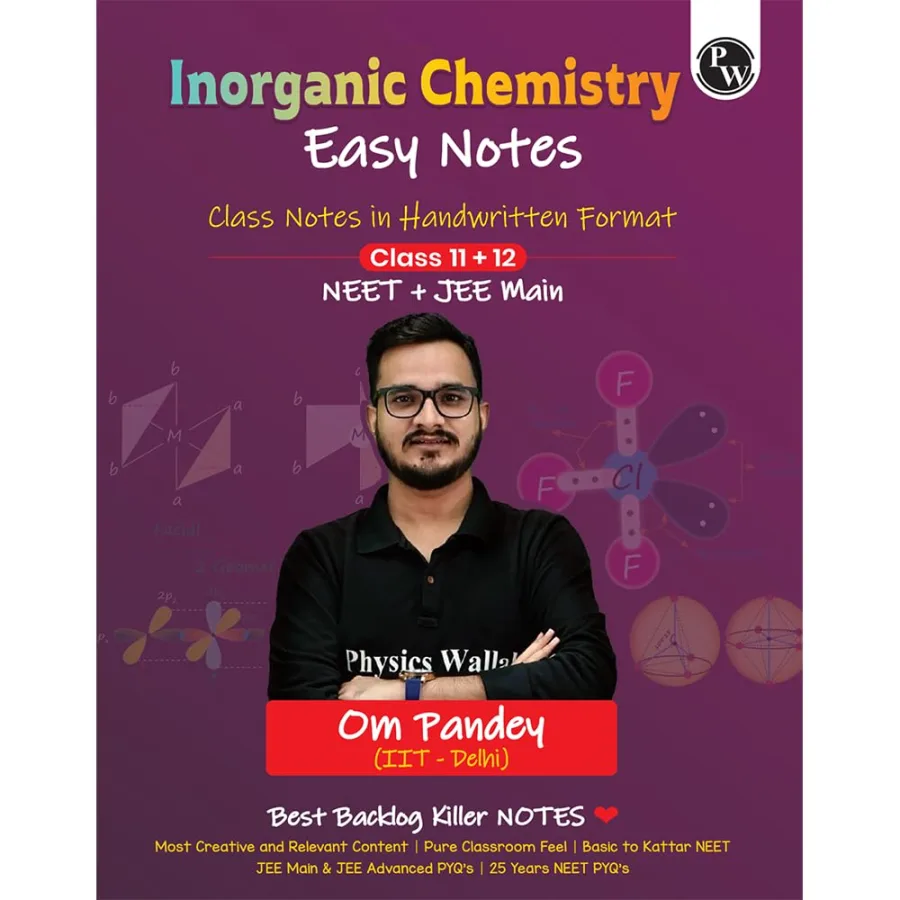
Download Cover Image
Do you want to download the full cover image for PW NEET Easy Handwritten Notes Inorganic Chemistry For NEET & JEE Main By Om Pandey?