
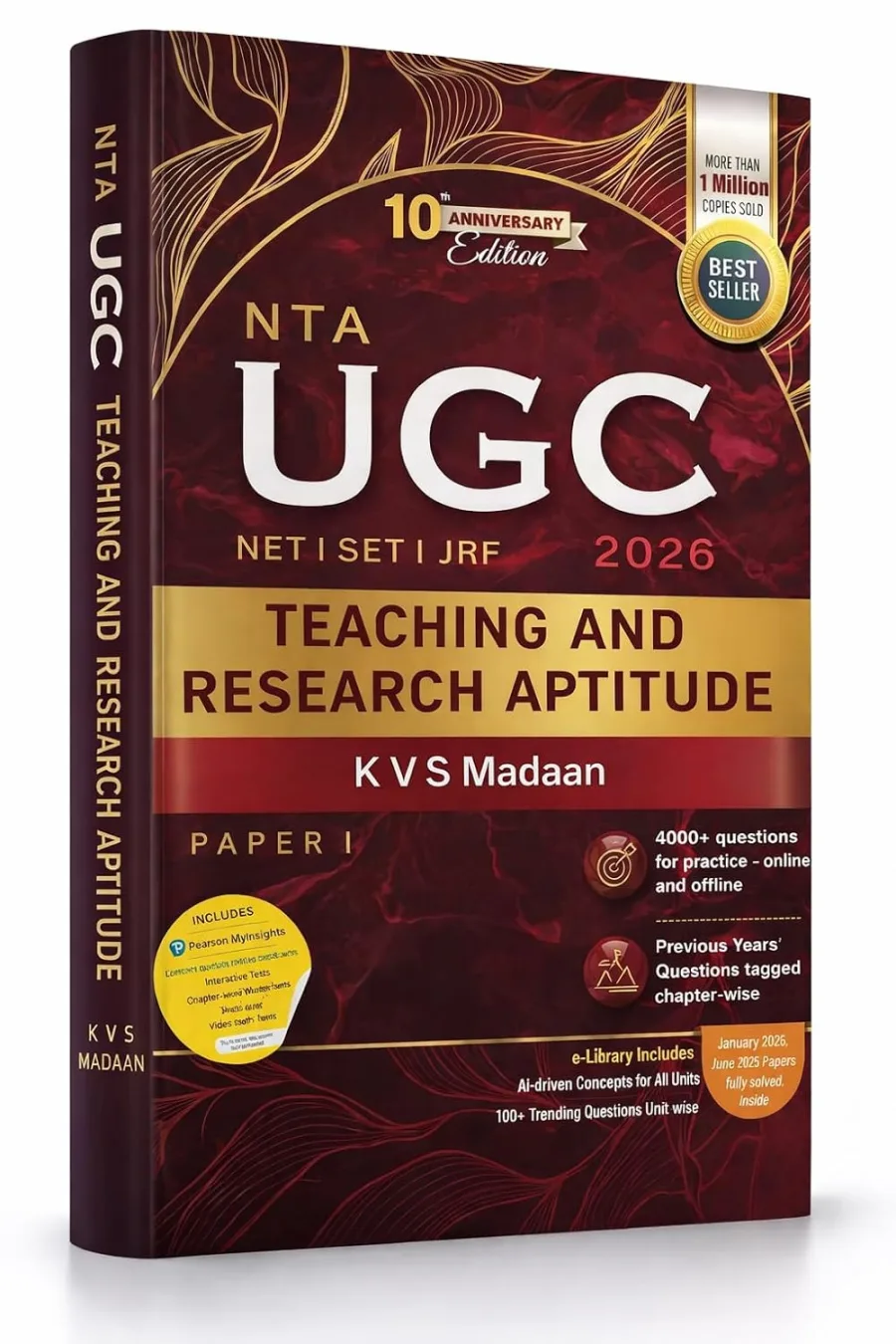
Pearson 2026 UGC NET Paper 1 Teaching & Research Aptitude by KVS Madaan | NET/SET/JRF |4000+ Practic
Paperback
• 688 Pages
• ₹ 630.00
• English
• 9789371360128
No ratings yet
| Publisher | Pearson Education |
|---|---|
| ISBN13 | 9789371360128 |
| ASIN/SKU | 9371360127 |
| Book Format | Paperback |
| Language | English |
| Pages | 688 |
| List Price | ₹ 630.00 |
| Publishing Date | 09/02/2026 |
| Dimensions | 25.4 x 20.3 x 2.7 cm |
| Weight | 1 kg 40 g |
| Book Code | BD00070112 |
Buy this Book
Amazon Stores
Ebook Stores
Other Stores
Discover Pearson 2026 UGC NET Paper 1 Teaching and Research Aptitude by KVS Madaan | NET/SET/JRF |4000+ Practic by KVS Madaan. This book is published by Pearson Education in Paperback format, ISBN 9789371360128, ASIN 9371360127, under Exam Preparation, UGC Exam, Teacher Recruitment Exams.
Book Description
PEARSON’S UGC NET PAPER 1 – TEACHING AND RESEARCH APTITUDE (10TH ANNIVERSARY EDITION)
Pearson’s UGC NET Paper 1 – Teaching and Research Aptitude is now available in its 10th Anniversary Edition, featuring a completely revamped design and updated content aligned with the latest exam trends and syllabus.
The book incorporates recent advancements and exam-relevant topics, with thoroughly updated questions to ensure effective preparation for the current examination pattern.
KEY FEATURES
Updated with June 2025 and January 2026 fully solved papers
Includes recent trending questions as per latest exam pattern
Concept Boxes embedded within chapters for focused revision
Comprehensive coverage of all Paper 1 units
CONTENT OVERVIEW
Teaching Aptitude
Research Aptitude
Comprehension
Communication
Mathematical Reasoning and Aptitude
Logical Reasoning
Data Interpretation
Information and Communication Technology (ICT)
People, Development and Environment
Higher Education System
ADDITIONAL CONTENT
UGC NET Question Paper 1 – January 2026
UGC NET Question Paper 1 – June 2025
Mock Test
Previous Years’ Papers
UGC NET Question Paper 1 – January 2025
UGC NET Question Paper 1 – August 2024
Pearson’s UGC NET Paper 1 – Teaching and Research Aptitude is now available in its 10th Anniversary Edition, featuring a completely revamped design and updated content aligned with the latest exam trends and syllabus.
The book incorporates recent advancements and exam-relevant topics, with thoroughly updated questions to ensure effective preparation for the current examination pattern.
KEY FEATURES
Updated with June 2025 and January 2026 fully solved papers
Includes recent trending questions as per latest exam pattern
Concept Boxes embedded within chapters for focused revision
Comprehensive coverage of all Paper 1 units
CONTENT OVERVIEW
Teaching Aptitude
Research Aptitude
Comprehension
Communication
Mathematical Reasoning and Aptitude
Logical Reasoning
Data Interpretation
Information and Communication Technology (ICT)
People, Development and Environment
Higher Education System
ADDITIONAL CONTENT
UGC NET Question Paper 1 – January 2026
UGC NET Question Paper 1 – June 2025
Mock Test
Previous Years’ Papers
UGC NET Question Paper 1 – January 2025
UGC NET Question Paper 1 – August 2024
Author Biography
KVS Madaan, Author and Director, KVS Madaan Online Classes/KvsMadaan.com has been a Former Associate Director, Arni School of Business Management, Arni University, Himachal Pradesh is a renowned author and academician. He is post graduate in Business Administration from Haryana School of Business, GJUST, Hisar. He has helped thousands of career aspirants realize their goals. He worked at top positions in many Universities and institutions. He has been a keynote speaker at UGC and AICTE sponsored faculty development programmes. He has authored a book for Commerce, NTA UGC NET, Paper 2.
Editorial Reviews
Editorial Reviews will be added soon…
Book Summary
Pearson 2026 UGC NET Paper 1 Teaching & Research Aptitude by KVS Madaan is a comprehensive preparation guide designed for candidates appearing for the UGC NET, SET, and JRF examinations. The book focuses on Paper 1, which tests general teaching and research aptitude rather than the candidate's chosen subject. It is intended to help aspirants build conceptual understanding, practise a large number of questions, improve reasoning ability, and become familiar with the examination-oriented approach required for success.
UGC NET Paper 1 is common to candidates from different academic backgrounds. While Paper 2 tests subject-specific knowledge, Paper 1 evaluates broader abilities such as teaching aptitude, research aptitude, comprehension, communication, reasoning, data interpretation, information and communication technology, people and environment, higher education systems, and related areas. Because the paper covers many different topics, preparation can initially feel scattered. A structured guide such as this can help bring the syllabus together.
One of the central strengths of the book is its comprehensive coverage of Paper 1 concepts. Rather than treating the examination as a collection of unrelated questions, it introduces the fundamental ideas behind each unit and then provides opportunities for practice. This is important because candidates need both conceptual clarity and the ability to apply those concepts quickly.
The book is particularly useful for candidates who are preparing for NET, SET, or JRF examinations and want a single resource for Paper 1. The inclusion of more than 4,000 practice questions, as indicated in the title, provides extensive opportunities for repeated testing and revision.
Teaching aptitude is one of the important areas covered in Paper 1. It deals with the principles and practices involved in effective teaching and learning. Candidates need to understand concepts such as teaching objectives, learner characteristics, teaching methods, evaluation, classroom interaction, and factors affecting the teaching-learning process.
A good understanding of teaching aptitude requires more than memorizing definitions. Candidates should be able to identify appropriate teaching methods for different situations and understand why a particular approach may be more effective than another. Practice questions can help develop this ability.
The book also addresses research aptitude, another major component of Paper 1. Research aptitude involves understanding the nature and process of research, research methods, types of research, research ethics, sampling, data collection, and related concepts.
Research-related questions can sometimes be confusing because several terms appear similar. Candidates need to understand distinctions between concepts rather than memorize isolated definitions. For example, they should know the differences between qualitative and quantitative approaches, basic and applied research, or different types of research designs.
The book can help students organize these concepts and practise applying them through examination-style questions.
Another important area is comprehension. Candidates are generally required to read a passage carefully and answer questions based on the information provided. These questions test the ability to identify the main idea, understand specific details, draw logical conclusions, and interpret the author's argument.
Comprehension is a skill that improves through practice. Reading the passage repeatedly without answering questions does not provide the same benefit as actively solving comprehension exercises. The large practice component of the book can therefore be useful for developing speed and accuracy.
Communication is another key Paper 1 area. Candidates need to understand different forms and models of communication, barriers to communication, effective communication, and related concepts. Questions may ask students to identify a communication process, recognize a barrier, or determine which form of communication is most appropriate in a particular situation.
Understanding communication is useful not only for the examination but also for academic and professional life. Teaching, research, presentations, interviews, and teamwork all depend on effective communication.
The book also covers mathematical reasoning and aptitude. Candidates may encounter questions involving number systems, basic arithmetic, series, ratios, percentages, averages, relationships, and other reasoning-oriented concepts.
For many candidates, this section can be challenging if they have not practised mathematics recently. Regular practice is therefore essential. The aim is not simply to remember formulas but to become comfortable identifying the quickest method of solving a problem.
Similarly, logical reasoning requires candidates to analyze statements, identify relationships, recognize patterns, and draw conclusions. Questions may involve arguments, analogies, syllogisms, classifications, or logical relationships.
Reasoning skills become stronger when students practise a wide range of questions. Over time, they begin to recognize recurring structures and can solve familiar question types more quickly.
Data interpretation is another area where practice plays an important role. Candidates may be asked to interpret tables, graphs, charts, or numerical information. The challenge is often not complicated mathematics but accurately understanding what the data represents.
Students need to read the information carefully, identify the relevant figures, perform the required calculations, and select the correct conclusion. Practising different formats can improve both speed and confidence.
The book also covers information and communication technology, an increasingly important part of the Paper 1 syllabus. Candidates need to understand basic computer concepts, internet-related terminology, digital communication, networking, and the role of technology in education and research.
Because technology changes rapidly, candidates should also verify current syllabus requirements and terminology from official sources when preparing for a specific examination cycle.
Another component is people, development, and environment. This area connects social development with environmental concerns. Candidates may encounter questions related to sustainable development, environmental issues, pollution, natural resources, climate-related concerns, and human interaction with the environment.
The subject requires both factual knowledge and conceptual understanding. Students should understand not only what environmental problems exist but also why they occur and how different approaches can address them.
The book also provides preparation for higher education system and institutions. This is an important area because Paper 1 includes questions about the development of higher education in India, regulatory and educational institutions, policies, governance, and related developments.
This section requires candidates to remember specific information, but understanding the broader structure of Indian higher education can make the facts easier to organize.
One of the major advantages of the book is the large number of practice questions. More than 4,000 questions provide enough material for candidates to practise repeatedly after completing the theory sections.
Practice should ideally follow a structured progression. Candidates can first study a topic, attempt basic questions, review mistakes, and then move to more challenging questions. Once they have completed the syllabus, they can begin mixed-topic practice.
This transition is important because the actual Paper 1 examination does not present questions in a way that allows candidates to prepare for only one topic at a time. Students need to be able to switch quickly between teaching aptitude, reasoning, research, ICT, data interpretation, and other areas.
The book can also help candidates develop question-selection skills. In a competitive examination, knowing the answer is important, but managing time is equally important. Candidates need to identify questions they can answer confidently and avoid spending too much time on difficult problems.
Regular practice under timed conditions can help develop this skill.
Another important use of the book is self-assessment. Candidates can periodically attempt a large set of questions without referring to their notes. Their score can reveal which units require more attention.
It is useful to divide mistakes into categories. Some mistakes occur because the candidate does not know the concept. Others happen because the candidate misunderstands the question, makes a calculation error, confuses two terms, or runs out of time. Identifying the reason behind each mistake makes revision much more effective.
UGC NET Paper 1 is common to candidates from different academic backgrounds. While Paper 2 tests subject-specific knowledge, Paper 1 evaluates broader abilities such as teaching aptitude, research aptitude, comprehension, communication, reasoning, data interpretation, information and communication technology, people and environment, higher education systems, and related areas. Because the paper covers many different topics, preparation can initially feel scattered. A structured guide such as this can help bring the syllabus together.
One of the central strengths of the book is its comprehensive coverage of Paper 1 concepts. Rather than treating the examination as a collection of unrelated questions, it introduces the fundamental ideas behind each unit and then provides opportunities for practice. This is important because candidates need both conceptual clarity and the ability to apply those concepts quickly.
The book is particularly useful for candidates who are preparing for NET, SET, or JRF examinations and want a single resource for Paper 1. The inclusion of more than 4,000 practice questions, as indicated in the title, provides extensive opportunities for repeated testing and revision.
Teaching aptitude is one of the important areas covered in Paper 1. It deals with the principles and practices involved in effective teaching and learning. Candidates need to understand concepts such as teaching objectives, learner characteristics, teaching methods, evaluation, classroom interaction, and factors affecting the teaching-learning process.
A good understanding of teaching aptitude requires more than memorizing definitions. Candidates should be able to identify appropriate teaching methods for different situations and understand why a particular approach may be more effective than another. Practice questions can help develop this ability.
The book also addresses research aptitude, another major component of Paper 1. Research aptitude involves understanding the nature and process of research, research methods, types of research, research ethics, sampling, data collection, and related concepts.
Research-related questions can sometimes be confusing because several terms appear similar. Candidates need to understand distinctions between concepts rather than memorize isolated definitions. For example, they should know the differences between qualitative and quantitative approaches, basic and applied research, or different types of research designs.
The book can help students organize these concepts and practise applying them through examination-style questions.
Another important area is comprehension. Candidates are generally required to read a passage carefully and answer questions based on the information provided. These questions test the ability to identify the main idea, understand specific details, draw logical conclusions, and interpret the author's argument.
Comprehension is a skill that improves through practice. Reading the passage repeatedly without answering questions does not provide the same benefit as actively solving comprehension exercises. The large practice component of the book can therefore be useful for developing speed and accuracy.
Communication is another key Paper 1 area. Candidates need to understand different forms and models of communication, barriers to communication, effective communication, and related concepts. Questions may ask students to identify a communication process, recognize a barrier, or determine which form of communication is most appropriate in a particular situation.
Understanding communication is useful not only for the examination but also for academic and professional life. Teaching, research, presentations, interviews, and teamwork all depend on effective communication.
The book also covers mathematical reasoning and aptitude. Candidates may encounter questions involving number systems, basic arithmetic, series, ratios, percentages, averages, relationships, and other reasoning-oriented concepts.
For many candidates, this section can be challenging if they have not practised mathematics recently. Regular practice is therefore essential. The aim is not simply to remember formulas but to become comfortable identifying the quickest method of solving a problem.
Similarly, logical reasoning requires candidates to analyze statements, identify relationships, recognize patterns, and draw conclusions. Questions may involve arguments, analogies, syllogisms, classifications, or logical relationships.
Reasoning skills become stronger when students practise a wide range of questions. Over time, they begin to recognize recurring structures and can solve familiar question types more quickly.
Data interpretation is another area where practice plays an important role. Candidates may be asked to interpret tables, graphs, charts, or numerical information. The challenge is often not complicated mathematics but accurately understanding what the data represents.
Students need to read the information carefully, identify the relevant figures, perform the required calculations, and select the correct conclusion. Practising different formats can improve both speed and confidence.
The book also covers information and communication technology, an increasingly important part of the Paper 1 syllabus. Candidates need to understand basic computer concepts, internet-related terminology, digital communication, networking, and the role of technology in education and research.
Because technology changes rapidly, candidates should also verify current syllabus requirements and terminology from official sources when preparing for a specific examination cycle.
Another component is people, development, and environment. This area connects social development with environmental concerns. Candidates may encounter questions related to sustainable development, environmental issues, pollution, natural resources, climate-related concerns, and human interaction with the environment.
The subject requires both factual knowledge and conceptual understanding. Students should understand not only what environmental problems exist but also why they occur and how different approaches can address them.
The book also provides preparation for higher education system and institutions. This is an important area because Paper 1 includes questions about the development of higher education in India, regulatory and educational institutions, policies, governance, and related developments.
This section requires candidates to remember specific information, but understanding the broader structure of Indian higher education can make the facts easier to organize.
One of the major advantages of the book is the large number of practice questions. More than 4,000 questions provide enough material for candidates to practise repeatedly after completing the theory sections.
Practice should ideally follow a structured progression. Candidates can first study a topic, attempt basic questions, review mistakes, and then move to more challenging questions. Once they have completed the syllabus, they can begin mixed-topic practice.
This transition is important because the actual Paper 1 examination does not present questions in a way that allows candidates to prepare for only one topic at a time. Students need to be able to switch quickly between teaching aptitude, reasoning, research, ICT, data interpretation, and other areas.
The book can also help candidates develop question-selection skills. In a competitive examination, knowing the answer is important, but managing time is equally important. Candidates need to identify questions they can answer confidently and avoid spending too much time on difficult problems.
Regular practice under timed conditions can help develop this skill.
Another important use of the book is self-assessment. Candidates can periodically attempt a large set of questions without referring to their notes. Their score can reveal which units require more attention.
It is useful to divide mistakes into categories. Some mistakes occur because the candidate does not know the concept. Others happen because the candidate misunderstands the question, makes a calculation error, confuses two terms, or runs out of time. Identifying the reason behind each mistake makes revision much more effective.
Sample Chapters
Sample Chapters will be added soon…
Reader Reviews
No reviews yet.
Pearson 2026 UGC NET Paper 1 Teaching & Research Aptitude by KVS Madaan | NET/SET/JRF |4000+ Practic
Download Cover Image
Do you want to download the full cover image for Pearson 2026 UGC NET Paper 1 Teaching & Research Aptitude by KVS Madaan | NET/SET/JRF |4000+ Practic?