
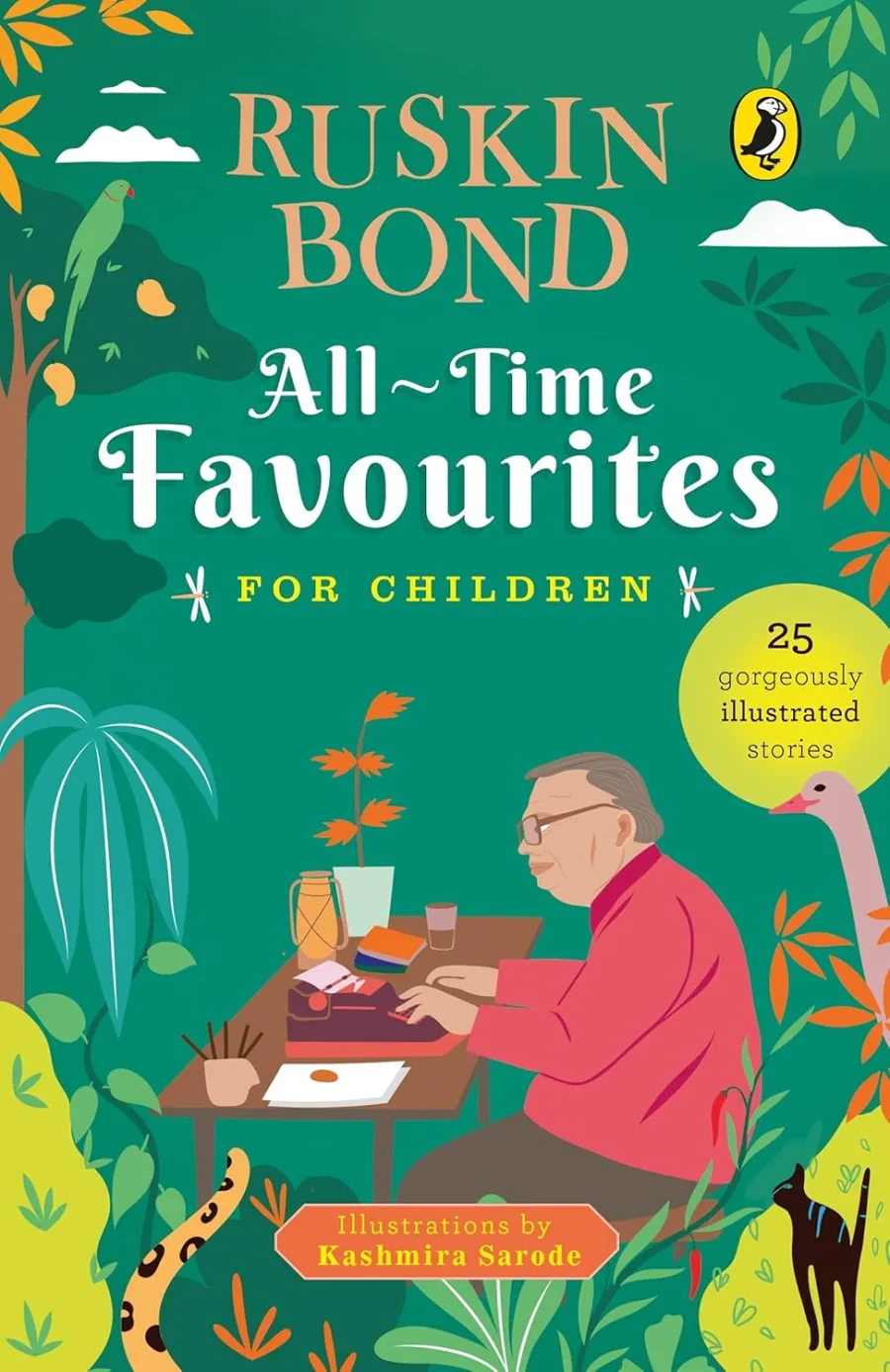
All-Time Favourites for Children: Classic Collection of 25+ Most-Loved, Great Stories
Paperback
• 232 Pages
• ₹ 299.00
• English
• 9780143451938
No ratings yet
| Publisher | Puffin |
|---|---|
| ISBN13 | 9780143451938 |
| ASIN/SKU | 0143451936 |
| Book Format | Paperback |
| Language | English |
| Pages | 232 |
| List Price | ₹ 299.00 |
| Publishing Date | 25/05/2021 |
| Dimensions | 15.24 x 1.02 x 22.86 cm |
| Weight | 272 g |
| Book Code | BD00070111 |
Buy this Book
Amazon Stores
Ebook Stores
Other Stores
Discover All-Time Favourites for Children: Classic Collection of 25+ Most-Loved, Great Stories by Ruskin Bond. This book is published by Puffin in Paperback format, ISBN 9780143451938, ASIN 0143451936, under Children's Books, Children's Humour, Children's Action and Adventure.
Book Description
A keepsake edition with 25 stories.
Beautiful illustrations accompanying the stories make it a fun read
Engages middle-school students--an essential book to be stocked in libraries
A collection of Ruskin Bond's best stories with endearing characters--hand-picked by the author himself.
All Time Favourites for Children celebrates Ruskin Bond's writing with stories that are perennially loved and can now be enjoyed in a single collectible volume. Curated and selected by India's most loved writer, this collection brings some of the evocative episodes from Ruskin's life, iconic Rusty, eccentric Uncle Ken, ubiquitous grandmother, and many other charming, endearing characters in a single volume while also introducing us to a smattering of new ones that are sure to be firm favourites with young readers. Heart-warming, funny and spirited, this is a must-have on every bookshelf!
Beautiful illustrations accompanying the stories make it a fun read
Engages middle-school students--an essential book to be stocked in libraries
A collection of Ruskin Bond's best stories with endearing characters--hand-picked by the author himself.
All Time Favourites for Children celebrates Ruskin Bond's writing with stories that are perennially loved and can now be enjoyed in a single collectible volume. Curated and selected by India's most loved writer, this collection brings some of the evocative episodes from Ruskin's life, iconic Rusty, eccentric Uncle Ken, ubiquitous grandmother, and many other charming, endearing characters in a single volume while also introducing us to a smattering of new ones that are sure to be firm favourites with young readers. Heart-warming, funny and spirited, this is a must-have on every bookshelf!
Author Biography
Ruskin Bond, born in Kasauli in 1934, grew up in Jamnagar, Dehradun, New Delhi and Shimla. His first novel, The Room on the Roof, which was written when he was seventeen, received the John Llewellyn Rhys Memorial Prize in 1957. Since then he has written over 500 short stories, essays and novellas (including Vagrants in the Valley and A Flight of Pigeons) and more than forty books for children. He received the Sahitya Akademi Award for English writing in India in 1992, the Padma Shri in 1999, the Delhi government's Lifetime Achievement Award in 2012 and Padma Bhushan in 2014 for his contribution to literature.
Ruskin lives in Landour, Mussoorie, with his extended family.
Ruskin lives in Landour, Mussoorie, with his extended family.
Editorial Reviews
Bond's trademark writing style-- simple, sincere and heartfelt-- will tug at your heartstrings and give you a warm and fuzzy feeling. Each story is just a few pages long and can be read in any order, any time, anywhere. -- Times of India
Heart-warming, funny and spirited, this is a must-have on every bookshelf! -- IANS
Sometimes, it feels like he is not creating stories, he is conjuring the deepest magic of the soul through his words. -- The Week
Heart-warming, funny and spirited, this is a must-have on every bookshelf! -- IANS
Sometimes, it feels like he is not creating stories, he is conjuring the deepest magic of the soul through his words. -- The Week
Book Summary
All-Time Favourites for Children: Classic Collection of 25+ Most-Loved, Great Stories by Ruskin Bond is a delightful collection created for young readers who enjoy simple, warm, imaginative, and memorable stories. The book brings together more than twenty-five stories from one of India's most beloved storytellers. Ruskin Bond is known for his gentle writing style, love for nature, memorable child characters, and ability to find beauty in ordinary moments. In this collection, children are introduced to stories filled with friendship, family, animals, adventure, curiosity, kindness, courage, and the simple pleasures of growing up.
The greatest strength of the collection is its simplicity. Ruskin Bond does not usually depend on complicated plots or difficult language to make a story interesting. Instead, he takes ordinary situations and gives them emotional depth. A journey, a meeting with a stranger, a visit to the hills, an encounter with an animal, a childhood memory, or a small adventure can become the center of a meaningful story. This makes his work particularly suitable for children because young readers can understand the situations while also discovering deeper ideas about life.
Many of Bond's stories are connected with the natural world. Mountains, forests, rivers, gardens, birds, animals, rain, trees, and small hill towns frequently appear in his writing. Nature is not merely a background in these stories. It becomes part of the experience of the characters. Children reading the collection can develop a greater appreciation for the natural world and begin noticing details that they might otherwise overlook.
The stories also reflect the atmosphere of Indian childhood. Bond often writes about children growing up in small towns and hill stations, where life can be slower and more closely connected with neighbors, family members, animals, and the surrounding environment. His characters experience excitement without needing extraordinary circumstances. A walk through the countryside or a simple friendship can become an adventure.
One of the most appealing aspects of the collection is the way Bond presents childhood curiosity. Children naturally ask questions, explore unfamiliar places, observe people, and imagine possibilities. His young characters often behave in ways that feel genuine because they are curious, sometimes mischievous, occasionally frightened, and frequently eager to discover something new.
The stories also highlight the importance of friendship. Friendships in Bond's stories are often simple and sincere. Children may form connections with classmates, neighbors, travelers, animals, or unusual people they meet during their adventures. These relationships teach young readers that friendship can come from unexpected places.
Some stories explore the relationship between children and animals. Bond has a special ability to make animals memorable characters. Birds, dogs, monkeys, tigers, and other creatures appear in different stories, sometimes creating humor and sometimes becoming important companions. Through these encounters, children can learn empathy and develop a greater understanding of animals as living beings with their own behavior and personalities.
The collection also contains a strong sense of family and affection. Grandparents, parents, siblings, relatives, and other adults appear in different stories and influence the lives of the younger characters. Family relationships are not always perfect, but they are often presented with warmth and understanding. Children can recognize emotions such as love, loneliness, disagreement, care, and belonging.
Another recurring theme is courage. Courage in these stories does not always mean performing a heroic act. Sometimes it means facing fear, trying something new, admitting a mistake, standing up for someone, or dealing with an unfamiliar situation. This makes the idea of courage accessible to young readers because they can connect it with their own experiences.
Bond's stories often show that small events can have great emotional meaning. A character may remember a particular person, place, animal, or experience long after the event itself has ended. This teaches children that life is not made meaningful only by major achievements. Everyday experiences can become some of our most precious memories.
The author's writing is particularly effective because he pays attention to small details. The sound of rain, the appearance of a mountain, the behavior of a bird, the smell of a garden, or the atmosphere of a quiet evening can become important parts of a story. Young readers can learn from this style that observation is an important part of storytelling.
The collection also encourages children to develop their imagination. Even when the events are realistic, Bond creates a sense of wonder around them. His stories encourage readers to look at familiar places differently and imagine what might happen beyond the next road, hill, forest, or railway track.
A strong feature of these stories is their gentle humor. Bond's humor is often based on everyday situations, misunderstandings, mischievous children, unusual characters, or funny encounters with animals. The humor does not overpower the story but makes the reading experience lighter and more enjoyable.
The stories also contain valuable life lessons, but they generally do not feel like direct moral lectures. Instead, readers learn through what the characters experience. A story may show the value of kindness without explicitly telling the child, “You should be kind.” Another may demonstrate the importance of friendship through the actions of its characters.
This makes the collection suitable for bedtime reading and family reading sessions. Parents can read a story aloud and then talk with children about the characters and events. Questions such as “What would you have done?” or “Why do you think the character behaved that way?” can encourage children to think beyond the basic plot.
The book can also support reading development. Ruskin Bond's accessible storytelling allows young readers to encounter longer narratives without feeling overwhelmed by unnecessarily complicated language. Reading stories regularly can improve vocabulary, sentence understanding, concentration, and overall confidence.
For children who are beginning to read independently, the collection can also serve as a bridge toward more advanced literature. The stories introduce them to characterization, setting, dialogue, description, conflict, and resolution in a natural way. As their reading ability improves, they can begin noticing how the author creates atmosphere and emotion.
Another important quality is the Indian setting and cultural familiarity found in many of Bond's stories. Young readers can encounter places, landscapes, traditions, people, and situations that feel connected to India. At the same time, the emotions in the stories are universal, allowing children from different backgrounds to identify with the characters.
The collection can also encourage an appreciation for quietness and observation in an age when children are often surrounded by screens and constant stimulation. Bond's stories do not require spectacular action on every page. They teach readers to find interest in a walk, a conversation, a rainy afternoon, an animal encounter, or a journey through the hills.
There is also an underlying message about simplicity. Many of the characters do not need wealth or extraordinary possessions to experience happiness. A good friend, an interesting adventure, a beautiful landscape, or a memorable conversation can be enough. This perspective can help young readers understand that happiness is often found in experiences and relationships rather than material things.
The stories can also teach children about empathy. Characters sometimes feel lonely, misunderstood, frightened, or disappointed. By seeing situations from different perspectives, young readers can become more sensitive to the feelings of others.
Nature and environmental awareness are another natural part of the collection. Bond's affection for trees, birds, animals, and the hills encourages readers to value the environment. Children may become more curious about the birds they see, the plants around them, and the natural spaces in their own surroundings.
The book is therefore more than a collection of entertaining stories. It introduces young readers to a particular way of seeing the world—one that values curiosity, kindness, friendship, nature, imagination, and simple moments.
One of the reasons Ruskin Bond's stories continue to appeal to different generations is that they do not depend heavily on trends or technology. The emotional experiences remain understandable even as the world changes.
The greatest strength of the collection is its simplicity. Ruskin Bond does not usually depend on complicated plots or difficult language to make a story interesting. Instead, he takes ordinary situations and gives them emotional depth. A journey, a meeting with a stranger, a visit to the hills, an encounter with an animal, a childhood memory, or a small adventure can become the center of a meaningful story. This makes his work particularly suitable for children because young readers can understand the situations while also discovering deeper ideas about life.
Many of Bond's stories are connected with the natural world. Mountains, forests, rivers, gardens, birds, animals, rain, trees, and small hill towns frequently appear in his writing. Nature is not merely a background in these stories. It becomes part of the experience of the characters. Children reading the collection can develop a greater appreciation for the natural world and begin noticing details that they might otherwise overlook.
The stories also reflect the atmosphere of Indian childhood. Bond often writes about children growing up in small towns and hill stations, where life can be slower and more closely connected with neighbors, family members, animals, and the surrounding environment. His characters experience excitement without needing extraordinary circumstances. A walk through the countryside or a simple friendship can become an adventure.
One of the most appealing aspects of the collection is the way Bond presents childhood curiosity. Children naturally ask questions, explore unfamiliar places, observe people, and imagine possibilities. His young characters often behave in ways that feel genuine because they are curious, sometimes mischievous, occasionally frightened, and frequently eager to discover something new.
The stories also highlight the importance of friendship. Friendships in Bond's stories are often simple and sincere. Children may form connections with classmates, neighbors, travelers, animals, or unusual people they meet during their adventures. These relationships teach young readers that friendship can come from unexpected places.
Some stories explore the relationship between children and animals. Bond has a special ability to make animals memorable characters. Birds, dogs, monkeys, tigers, and other creatures appear in different stories, sometimes creating humor and sometimes becoming important companions. Through these encounters, children can learn empathy and develop a greater understanding of animals as living beings with their own behavior and personalities.
The collection also contains a strong sense of family and affection. Grandparents, parents, siblings, relatives, and other adults appear in different stories and influence the lives of the younger characters. Family relationships are not always perfect, but they are often presented with warmth and understanding. Children can recognize emotions such as love, loneliness, disagreement, care, and belonging.
Another recurring theme is courage. Courage in these stories does not always mean performing a heroic act. Sometimes it means facing fear, trying something new, admitting a mistake, standing up for someone, or dealing with an unfamiliar situation. This makes the idea of courage accessible to young readers because they can connect it with their own experiences.
Bond's stories often show that small events can have great emotional meaning. A character may remember a particular person, place, animal, or experience long after the event itself has ended. This teaches children that life is not made meaningful only by major achievements. Everyday experiences can become some of our most precious memories.
The author's writing is particularly effective because he pays attention to small details. The sound of rain, the appearance of a mountain, the behavior of a bird, the smell of a garden, or the atmosphere of a quiet evening can become important parts of a story. Young readers can learn from this style that observation is an important part of storytelling.
The collection also encourages children to develop their imagination. Even when the events are realistic, Bond creates a sense of wonder around them. His stories encourage readers to look at familiar places differently and imagine what might happen beyond the next road, hill, forest, or railway track.
A strong feature of these stories is their gentle humor. Bond's humor is often based on everyday situations, misunderstandings, mischievous children, unusual characters, or funny encounters with animals. The humor does not overpower the story but makes the reading experience lighter and more enjoyable.
The stories also contain valuable life lessons, but they generally do not feel like direct moral lectures. Instead, readers learn through what the characters experience. A story may show the value of kindness without explicitly telling the child, “You should be kind.” Another may demonstrate the importance of friendship through the actions of its characters.
This makes the collection suitable for bedtime reading and family reading sessions. Parents can read a story aloud and then talk with children about the characters and events. Questions such as “What would you have done?” or “Why do you think the character behaved that way?” can encourage children to think beyond the basic plot.
The book can also support reading development. Ruskin Bond's accessible storytelling allows young readers to encounter longer narratives without feeling overwhelmed by unnecessarily complicated language. Reading stories regularly can improve vocabulary, sentence understanding, concentration, and overall confidence.
For children who are beginning to read independently, the collection can also serve as a bridge toward more advanced literature. The stories introduce them to characterization, setting, dialogue, description, conflict, and resolution in a natural way. As their reading ability improves, they can begin noticing how the author creates atmosphere and emotion.
Another important quality is the Indian setting and cultural familiarity found in many of Bond's stories. Young readers can encounter places, landscapes, traditions, people, and situations that feel connected to India. At the same time, the emotions in the stories are universal, allowing children from different backgrounds to identify with the characters.
The collection can also encourage an appreciation for quietness and observation in an age when children are often surrounded by screens and constant stimulation. Bond's stories do not require spectacular action on every page. They teach readers to find interest in a walk, a conversation, a rainy afternoon, an animal encounter, or a journey through the hills.
There is also an underlying message about simplicity. Many of the characters do not need wealth or extraordinary possessions to experience happiness. A good friend, an interesting adventure, a beautiful landscape, or a memorable conversation can be enough. This perspective can help young readers understand that happiness is often found in experiences and relationships rather than material things.
The stories can also teach children about empathy. Characters sometimes feel lonely, misunderstood, frightened, or disappointed. By seeing situations from different perspectives, young readers can become more sensitive to the feelings of others.
Nature and environmental awareness are another natural part of the collection. Bond's affection for trees, birds, animals, and the hills encourages readers to value the environment. Children may become more curious about the birds they see, the plants around them, and the natural spaces in their own surroundings.
The book is therefore more than a collection of entertaining stories. It introduces young readers to a particular way of seeing the world—one that values curiosity, kindness, friendship, nature, imagination, and simple moments.
One of the reasons Ruskin Bond's stories continue to appeal to different generations is that they do not depend heavily on trends or technology. The emotional experiences remain understandable even as the world changes.
Sample Chapters
Sample Chapters will be added soon…
Reader Reviews
No reviews yet.
All-Time Favourites for Children: Classic Collection of 25+ Most-Loved, Great Stories
Download Cover Image
Do you want to download the full cover image for All-Time Favourites for Children: Classic Collection of 25+ Most-Loved, Great Stories?