
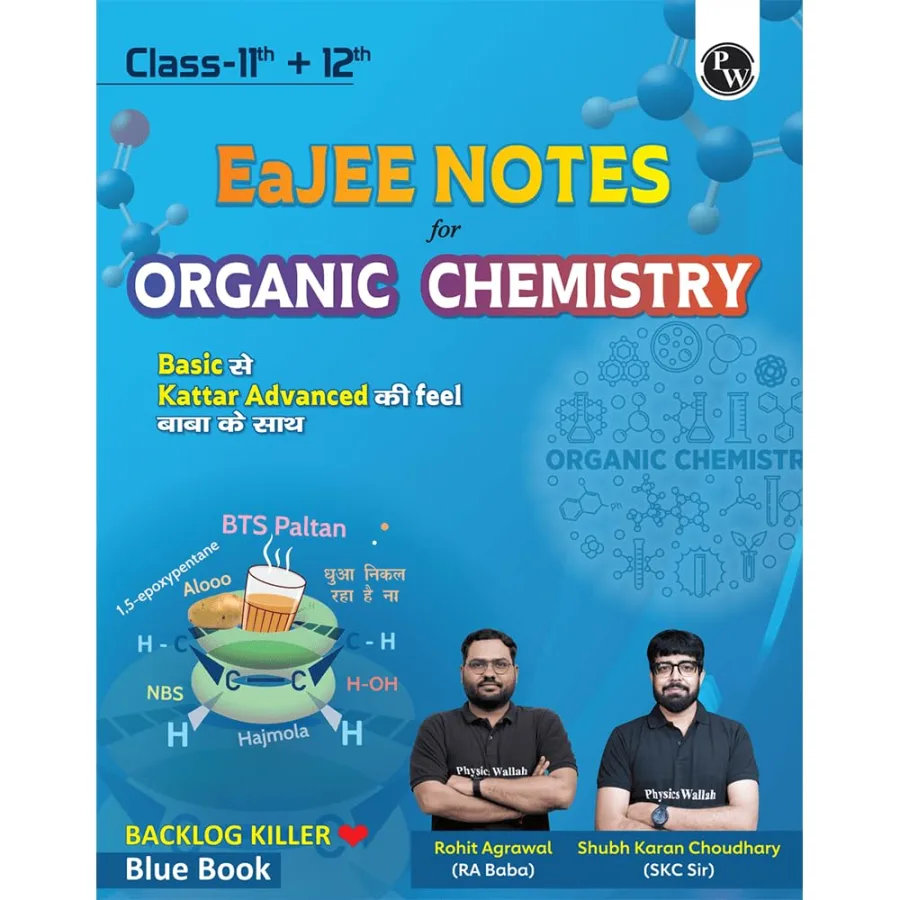
PW EaJEE Handwritten Notes For Organic Chemistry By Rohit Sir & SKC Sir For JEE Main & Advanced
Rohit Agrawal, Shubh Karan Chaudhary
Paperback
• 460 Pages
• ₹ 599.00
• English
• 9789368974932
No ratings yet
| Publisher | Physics Wallah Limited |
|---|---|
| ISBN13 | 9789368974932 |
| ASIN/SKU | 9368974934 |
| Book Format | Paperback |
| Language | English |
| Pages | 460 |
| List Price | ₹ 599.00 |
| Publishing Date | 14/08/2026 |
| Dimensions | 28 x 22 x 2 cm |
| Weight | 300 g |
| Book Code | BD00070110 |
Buy this Book
Amazon Stores
Ebook Stores
Other Stores
Discover PW EaJEE Handwritten Notes For Organic Chemistry By Rohit Sir and SKC Sir For JEE Main and Advanced by Rohit Agrawal. This book is published by Physics Wallah Limited in Paperback format, ISBN 9789368974932, ASIN 9368974934, under Exam Preparation, JEE.
Book Description
Conquer Organic Chemistry for JEE with Ease — Tackle Every Topic Fearlessly!
Gear up for JEE preparation with the ‘PW EaJEE Handwritten Notes’ created by the expert minds of Rohit Sir and Shubh Sir. Packed with in-depth explanations, comprehensive coverage, and high-quality practice questions, this book transforms Organic Chemistry into an accessible and engaging subject.
How This Book Will Help You:
3000+ Practice Questions Including PYQs: Strengthen your concepts with an extensive set of questions, including previous years’ JEE Main & Advanced problems.
Mechanisms for Every Reaction: Master Organic Chemistry by understanding detailed step-by-step mechanisms for each reaction, simplifying even the most complex concepts.
Special Characteristics of Reactions (BTS): Gain deeper insight with unique breakdowns that explain special features of every reaction for better problem-solving.
Chapter Summaries for Quick Revision: Get concise, exam-focused summaries that highlight the most important concepts — perfect for last-minute prep.
Real Classroom Vibes: Enjoy explanations and tips that feel like direct guidance from your mentor, bringing clarity to every topic.
Quick Reference Appendix: Find important reactions, formulas, and concepts instantly for efficient revision.
Multicoloured Handwritten Notes: Learn from visually appealing, colour-coded handwritten notes that improve retention and make studying more engaging.
Your Shortcut to JEE Organic Chemistry Mastery: Whether you’re aiming to strengthen your basics or excel at advanced problem-solving, this book gives you the tools, strategies, and practice you need to excel in JEE Main & Advanced.
Gear up for JEE preparation with the ‘PW EaJEE Handwritten Notes’ created by the expert minds of Rohit Sir and Shubh Sir. Packed with in-depth explanations, comprehensive coverage, and high-quality practice questions, this book transforms Organic Chemistry into an accessible and engaging subject.
How This Book Will Help You:
3000+ Practice Questions Including PYQs: Strengthen your concepts with an extensive set of questions, including previous years’ JEE Main & Advanced problems.
Mechanisms for Every Reaction: Master Organic Chemistry by understanding detailed step-by-step mechanisms for each reaction, simplifying even the most complex concepts.
Special Characteristics of Reactions (BTS): Gain deeper insight with unique breakdowns that explain special features of every reaction for better problem-solving.
Chapter Summaries for Quick Revision: Get concise, exam-focused summaries that highlight the most important concepts — perfect for last-minute prep.
Real Classroom Vibes: Enjoy explanations and tips that feel like direct guidance from your mentor, bringing clarity to every topic.
Quick Reference Appendix: Find important reactions, formulas, and concepts instantly for efficient revision.
Multicoloured Handwritten Notes: Learn from visually appealing, colour-coded handwritten notes that improve retention and make studying more engaging.
Your Shortcut to JEE Organic Chemistry Mastery: Whether you’re aiming to strengthen your basics or excel at advanced problem-solving, this book gives you the tools, strategies, and practice you need to excel in JEE Main & Advanced.
Author Biography
Author Biography will be added soon…
Editorial Reviews
Editorial Reviews will be added soon…
Book Summary
PW EaJEE Handwritten Notes for Organic Chemistry by Rohit Sir & SKC Sir for JEE Main & Advanced is a focused preparation and revision book designed for students preparing for the engineering entrance examinations JEE Main and JEE Advanced. The book is published by Physics Wallah and presents Organic Chemistry in a handwritten-notes format, with chapterwise and topicwise coverage, handpicked practice questions, and previous-year questions. The official PW listing identifies the book as an English paperback with ISBN 9789368974932.
Organic Chemistry is often considered one of the most challenging sections of JEE Chemistry because students have to understand reactions, mechanisms, reagents, structures, properties, exceptions, and interconnected concepts. Simply memorizing hundreds of reactions can become confusing because similar reagents may produce different products depending on the reaction conditions. This book attempts to make the subject more manageable by combining concise notes with practice and examination-oriented material.
The handwritten format is one of the main attractions of the book. Instead of presenting the subject like a conventional textbook, the material is organized in the style of classroom notes. This can make important concepts easier to identify during revision. Students can quickly go through highlighted explanations, reaction patterns, mechanisms, and important observations without having to reread lengthy textbook chapters.
The book is organized chapterwise and topicwise, which makes it easier for students to follow a systematic preparation strategy. Organic Chemistry contains many interconnected chapters, and studying them randomly can create confusion. A chapterwise structure allows students to complete one area, practise it, identify their mistakes, and then move to the next topic.
The topicwise approach is especially helpful when a student has a specific weakness. For example, a student may understand basic organic chemistry but struggle with reaction mechanisms, stereochemistry, hydrocarbons, carbonyl compounds, amines, or named reactions. Topic-based practice allows that particular weakness to be addressed instead of forcing the student to revise an entire syllabus.
One of the most important features highlighted for the book is its emphasis on reaction mechanisms. Understanding mechanisms is extremely important in Organic Chemistry because reactions are not isolated facts. They are processes in which bonds break, bonds form, electrons move, and intermediates may be produced. Once students understand the mechanism behind a reaction, they can often predict the product of a new reaction instead of relying entirely on memory. The book's product information specifically highlights mechanisms for reactions as one of its features.
This mechanism-oriented approach can help students develop stronger conceptual understanding. For example, when studying substitution, elimination, addition, or rearrangement reactions, students need to understand why a particular pathway is favored. Factors such as the structure of the substrate, nature of the reagent, solvent, temperature, and stability of intermediates can influence the outcome.
The book also emphasizes the special characteristics of reactions, sometimes described as a breakdown of important reaction features. This can be useful because JEE questions often test not only whether students know a reaction but whether they know its special conditions, limitations, exceptions, or distinguishing characteristics.
Organic Chemistry becomes much easier when students learn to identify patterns. A reagent should not be remembered merely as a name. Students should understand what kind of transformation it generally causes and what structural features determine the product. This allows them to solve unfamiliar questions more logically.
The book also includes handpicked practice questions and previous-year questions, giving students an opportunity to apply the concepts they have studied. The official PW listing specifically mentions chapterwise and topicwise notes along with handpicked practice questions and PYQs.
Previous-year questions are particularly important for JEE preparation because they demonstrate how concepts are actually tested. Students may understand a reaction perfectly in theory but discover that examination questions combine several ideas or present the reaction in an unfamiliar form. PYQs help bridge the gap between studying and examination performance.
The book is reported by marketplace listings to contain around 3,000 practice questions including PYQs, although students should verify the exact contents of their edition. These questions are intended to provide substantial practice and help students strengthen their ability to apply Organic Chemistry concepts.
The question practice also helps students improve their ability to recognize reaction patterns quickly. JEE is a time-bound examination, so students cannot spend several minutes reconstructing every basic reaction from scratch. Repeated practice gradually improves recognition and speed.
Another useful feature is the inclusion of chapter summaries for quick revision. Organic Chemistry contains a large amount of interconnected information, so concise summaries can be extremely useful before mock tests and examinations. A student can revise a complete chapter through its key points and then move directly to problem solving.
The early chapters of Organic Chemistry generally establish the foundation required for later topics. Concepts such as the nature of organic compounds, electronic effects, acidity and basicity, resonance, inductive effects, hyperconjugation, isomerism, and reaction mechanisms become the language through which later reactions are understood.
A student who skips these fundamentals may find later chapters difficult because they will have to memorize reactions without understanding why they occur. The handwritten notes can therefore be most effective when students use them to strengthen these foundational concepts before moving to more advanced reaction chemistry.
General Organic Chemistry, or GOC, is especially important because it provides the conceptual tools used throughout Organic Chemistry. Students need to understand how electron density changes, how different groups influence molecules, and how the stability of intermediates affects reactions.
Isomerism is another foundational area. Students need to understand how compounds can have the same molecular formula but different arrangements of atoms. Structural and stereochemical concepts become increasingly important as the syllabus progresses. Strong preparation in this area can make later reaction questions easier.
The study of hydrocarbons provides another important stage in Organic Chemistry. Students encounter reactions of alkanes, alkenes, alkynes, and aromatic compounds. Understanding addition, substitution, oxidation, and related reactions helps students develop familiarity with how different types of carbon-carbon bonds behave.
Aromatic chemistry is particularly important because students need to understand the special stability and reaction behavior of aromatic systems. Rather than memorizing every substitution reaction separately, students can learn the underlying electronic principles and then apply them to different situations.
The book's mechanism-based approach can also be useful for haloalkanes and haloarenes, where substitution and elimination reactions become important. Students need to distinguish between different reaction pathways and understand the factors that favor one mechanism over another.
Similarly, chapters dealing with alcohols, phenols, ethers, aldehydes, ketones, carboxylic acids, and their derivatives involve numerous transformations. These chapters can appear overwhelming because the number of reactions increases rapidly. A structured notes format can help students organize them according to reaction type rather than treating every reaction as an isolated fact.
For example, students can think in terms of oxidation, reduction, substitution, addition, elimination, condensation, and rearrangement. This classification makes it easier to recognize what is happening when a new question is presented.
The study of amines and nitrogen-containing compounds also requires attention to both reactions and basicity. Students need to understand how molecular structure influences properties and how different reagents transform nitrogen-containing functional groups.
Organic Chemistry also contains many named reactions and reagents. These are often difficult for students because they involve specific combinations of starting materials and products. The best approach is to understand the transformation first and then associate the name with it. This creates stronger memory connections.
Organic Chemistry is often considered one of the most challenging sections of JEE Chemistry because students have to understand reactions, mechanisms, reagents, structures, properties, exceptions, and interconnected concepts. Simply memorizing hundreds of reactions can become confusing because similar reagents may produce different products depending on the reaction conditions. This book attempts to make the subject more manageable by combining concise notes with practice and examination-oriented material.
The handwritten format is one of the main attractions of the book. Instead of presenting the subject like a conventional textbook, the material is organized in the style of classroom notes. This can make important concepts easier to identify during revision. Students can quickly go through highlighted explanations, reaction patterns, mechanisms, and important observations without having to reread lengthy textbook chapters.
The book is organized chapterwise and topicwise, which makes it easier for students to follow a systematic preparation strategy. Organic Chemistry contains many interconnected chapters, and studying them randomly can create confusion. A chapterwise structure allows students to complete one area, practise it, identify their mistakes, and then move to the next topic.
The topicwise approach is especially helpful when a student has a specific weakness. For example, a student may understand basic organic chemistry but struggle with reaction mechanisms, stereochemistry, hydrocarbons, carbonyl compounds, amines, or named reactions. Topic-based practice allows that particular weakness to be addressed instead of forcing the student to revise an entire syllabus.
One of the most important features highlighted for the book is its emphasis on reaction mechanisms. Understanding mechanisms is extremely important in Organic Chemistry because reactions are not isolated facts. They are processes in which bonds break, bonds form, electrons move, and intermediates may be produced. Once students understand the mechanism behind a reaction, they can often predict the product of a new reaction instead of relying entirely on memory. The book's product information specifically highlights mechanisms for reactions as one of its features.
This mechanism-oriented approach can help students develop stronger conceptual understanding. For example, when studying substitution, elimination, addition, or rearrangement reactions, students need to understand why a particular pathway is favored. Factors such as the structure of the substrate, nature of the reagent, solvent, temperature, and stability of intermediates can influence the outcome.
The book also emphasizes the special characteristics of reactions, sometimes described as a breakdown of important reaction features. This can be useful because JEE questions often test not only whether students know a reaction but whether they know its special conditions, limitations, exceptions, or distinguishing characteristics.
Organic Chemistry becomes much easier when students learn to identify patterns. A reagent should not be remembered merely as a name. Students should understand what kind of transformation it generally causes and what structural features determine the product. This allows them to solve unfamiliar questions more logically.
The book also includes handpicked practice questions and previous-year questions, giving students an opportunity to apply the concepts they have studied. The official PW listing specifically mentions chapterwise and topicwise notes along with handpicked practice questions and PYQs.
Previous-year questions are particularly important for JEE preparation because they demonstrate how concepts are actually tested. Students may understand a reaction perfectly in theory but discover that examination questions combine several ideas or present the reaction in an unfamiliar form. PYQs help bridge the gap between studying and examination performance.
The book is reported by marketplace listings to contain around 3,000 practice questions including PYQs, although students should verify the exact contents of their edition. These questions are intended to provide substantial practice and help students strengthen their ability to apply Organic Chemistry concepts.
The question practice also helps students improve their ability to recognize reaction patterns quickly. JEE is a time-bound examination, so students cannot spend several minutes reconstructing every basic reaction from scratch. Repeated practice gradually improves recognition and speed.
Another useful feature is the inclusion of chapter summaries for quick revision. Organic Chemistry contains a large amount of interconnected information, so concise summaries can be extremely useful before mock tests and examinations. A student can revise a complete chapter through its key points and then move directly to problem solving.
The early chapters of Organic Chemistry generally establish the foundation required for later topics. Concepts such as the nature of organic compounds, electronic effects, acidity and basicity, resonance, inductive effects, hyperconjugation, isomerism, and reaction mechanisms become the language through which later reactions are understood.
A student who skips these fundamentals may find later chapters difficult because they will have to memorize reactions without understanding why they occur. The handwritten notes can therefore be most effective when students use them to strengthen these foundational concepts before moving to more advanced reaction chemistry.
General Organic Chemistry, or GOC, is especially important because it provides the conceptual tools used throughout Organic Chemistry. Students need to understand how electron density changes, how different groups influence molecules, and how the stability of intermediates affects reactions.
Isomerism is another foundational area. Students need to understand how compounds can have the same molecular formula but different arrangements of atoms. Structural and stereochemical concepts become increasingly important as the syllabus progresses. Strong preparation in this area can make later reaction questions easier.
The study of hydrocarbons provides another important stage in Organic Chemistry. Students encounter reactions of alkanes, alkenes, alkynes, and aromatic compounds. Understanding addition, substitution, oxidation, and related reactions helps students develop familiarity with how different types of carbon-carbon bonds behave.
Aromatic chemistry is particularly important because students need to understand the special stability and reaction behavior of aromatic systems. Rather than memorizing every substitution reaction separately, students can learn the underlying electronic principles and then apply them to different situations.
The book's mechanism-based approach can also be useful for haloalkanes and haloarenes, where substitution and elimination reactions become important. Students need to distinguish between different reaction pathways and understand the factors that favor one mechanism over another.
Similarly, chapters dealing with alcohols, phenols, ethers, aldehydes, ketones, carboxylic acids, and their derivatives involve numerous transformations. These chapters can appear overwhelming because the number of reactions increases rapidly. A structured notes format can help students organize them according to reaction type rather than treating every reaction as an isolated fact.
For example, students can think in terms of oxidation, reduction, substitution, addition, elimination, condensation, and rearrangement. This classification makes it easier to recognize what is happening when a new question is presented.
The study of amines and nitrogen-containing compounds also requires attention to both reactions and basicity. Students need to understand how molecular structure influences properties and how different reagents transform nitrogen-containing functional groups.
Organic Chemistry also contains many named reactions and reagents. These are often difficult for students because they involve specific combinations of starting materials and products. The best approach is to understand the transformation first and then associate the name with it. This creates stronger memory connections.
Sample Chapters
Sample Chapters will be added soon…
Reader Reviews
No reviews yet.
PW EaJEE Handwritten Notes For Organic Chemistry By Rohit Sir & SKC Sir For JEE Main & Advanced
Download Cover Image
Do you want to download the full cover image for PW EaJEE Handwritten Notes For Organic Chemistry By Rohit Sir & SKC Sir For JEE Main & Advanced?