
Mathematics at Advance Level 9 CBSE Textbook New Edition (Mathematics At Advance Level (grade-9)
Paperback
• 94 Pages
• ₹ 120.00
• English
No ratings yet
| Publisher | Tovira |
|---|---|
| ASIN/SKU | B0H8XML2WJ |
| Book Format | Paperback |
| Language | English |
| Pages | 94 |
| List Price | ₹ 120.00 |
| Publishing Date | 31/12/2025 |
| Dimensions | 25 x 24 x 4 cm |
| Weight | 450 g |
| Book Code | BD00070106 |
Buy this Book
Amazon Stores
Ebook Stores
Other Stores
Discover Mathematics at Advance Level 9 CBSE Textbook New Edition (Mathematics At Advance Level (grade-9) by Tovira. This book is published by Tovira in Paperback format, ASIN B0H8XML2WJ, under School Books, CBSE Textbooks.
Book Description
Book Description will be added soon…
Author Biography
Author Biography will be added soon…
Editorial Reviews
Editorial Reviews will be added soon…
Book Summary
Mathematics at Advance Level 9 CBSE Textbook – New Edition by Tovira is a school-level mathematics textbook designed for students studying in Grade 9 under the CBSE curriculum. The book aims to help students build a strong mathematical foundation while gradually introducing them to more challenging concepts and problem-solving methods. It is intended not only to help students complete their school syllabus but also to develop logical thinking, accuracy, analytical ability, and confidence in solving mathematical problems.
At Class 9, mathematics becomes considerably more structured and demanding than in the earlier classes. Students begin working with concepts that will remain important throughout their higher education, including number systems, algebra, geometry, coordinate geometry, mensuration, statistics, and probability. A textbook such as Mathematics at Advance Level 9 provides students with a systematic way to study these ideas, understand the underlying principles, and practice applying them to different types of questions.
One of the main purposes of the book is to make students comfortable with mathematical concepts rather than relying only on memorization. Mathematics is a subject in which formulas are useful, but knowing when and how to use them is even more important. Students are therefore encouraged to understand relationships between quantities, recognize patterns, follow logical steps, and explain how they arrive at an answer.
The book begins with fundamental mathematical ideas and gradually moves toward more advanced applications. This progression is important because many Class 9 topics are connected to one another. A strong understanding of numbers supports algebra, algebra supports coordinate geometry, and geometric reasoning becomes useful in later mathematical studies. Learning these concepts in the correct order can prevent confusion.
The number system is one of the basic areas of Grade 9 Mathematics. Students learn to distinguish between different kinds of numbers and understand how they are represented and related. These ideas provide a foundation for later work with algebraic expressions, equations, and mathematical operations. Instead of simply performing calculations, students learn to recognize the structure and properties of numbers.
The study of numbers also develops logical reasoning. Students may be asked to determine whether a statement is true, identify a pattern, or explain why a particular mathematical result occurs. Such exercises encourage them to think beyond routine calculation.
Algebra is another major component of the Grade 9 curriculum. Students work with variables, expressions, identities, and equations and begin to understand how letters can represent unknown or changing quantities. This can initially seem abstract, but algebra becomes much easier when students understand that it is essentially a language for describing relationships.
The book helps students practice simplifying expressions and using algebraic identities. These identities are important because they allow complicated expressions to be transformed into simpler forms. However, the emphasis should be on understanding the structure of the identities rather than memorizing them without context.
Linear equations introduce students to another important mathematical skill: finding an unknown quantity from known relationships. Students learn how to translate statements into mathematical equations and then solve them systematically. This develops problem-solving skills that are useful far beyond school mathematics.
The book also gives importance to geometry, one of the most reasoning-intensive parts of Class 9 Mathematics. Geometry requires students to understand figures, properties, relationships, and logical arguments. Concepts involving lines, angles, triangles, quadrilaterals, circles, and other shapes encourage students to think visually as well as logically.
Geometry is particularly valuable because it teaches students how to construct a proof. Instead of simply stating that something is true, students must show why it is true. They learn to begin with known facts, apply appropriate properties or theorems, and arrive at a logical conclusion.
The study of triangles is especially important. Students encounter different types of triangles and learn about their properties, relationships between sides and angles, and conditions under which triangles can be considered congruent. Understanding these concepts creates a strong foundation for more advanced geometry.
The book also introduces students to coordinate geometry, where algebra and geometry come together. A coordinate system allows points and shapes to be represented using numbers. Students learn to locate points and understand their positions on a plane. This topic demonstrates how two seemingly different branches of mathematics can work together.
Coordinate geometry is useful because it develops spatial awareness and analytical thinking. Students learn to interpret mathematical information visually and numerically at the same time. This approach becomes increasingly important in higher classes.
Another important area is mensuration, which connects mathematics with measurement. Students work with quantities such as length, area, surface area, and volume. These concepts have many real-life applications. Architects, engineers, designers, builders, and many other professionals rely on mathematical measurement.
Learning mensuration also teaches students how formulas represent real objects. Instead of seeing a formula simply as a collection of symbols, students can understand that it describes a measurable property of a shape or object.
The book also covers statistics and data handling, helping students understand how numerical information can be collected, organized, represented, and interpreted. In everyday life, people frequently encounter data in newspapers, reports, surveys, graphs, and digital platforms. Learning how to interpret data is therefore an important practical skill.
Students may work with tables, graphs, averages, and other methods of summarizing information. The goal is not simply to calculate an answer but to understand what the data actually tells us. This encourages careful interpretation and reduces the possibility of drawing incorrect conclusions from numbers.
Probability introduces students to the mathematical study of uncertainty. Students begin to understand how likely or unlikely an event is and how probability can be represented mathematically. Simple examples involving everyday situations can help make this concept easier to understand.
Probability also teaches students to distinguish between certainty, possibility, and impossibility. These ideas may appear simple, but they form the foundation for more advanced mathematical and statistical reasoning.
A major strength of an advanced-level mathematics textbook is its focus on problem-solving. Students are encouraged to move beyond routine exercises and attempt questions that require multiple steps or a combination of concepts. Such questions help develop flexibility in mathematical thinking.
When solving a challenging problem, students have to identify what information is given, determine what is being asked, select an appropriate method, and then check whether the answer makes sense. This process is much more valuable than simply memorizing a procedure.
The book can also help students develop accuracy and discipline. Mathematics requires careful handling of signs, units, symbols, formulas, and calculations. A small error in one step can change the final answer. Regular practice helps students become more careful and systematic.
Another important benefit is the development of independent learning habits. Students should gradually learn how to read a mathematical explanation, work through an example, attempt a similar question themselves, and review their mistakes. A textbook provides the structure for this process.
The new edition is particularly relevant for students following an updated CBSE curriculum. As school education increasingly emphasizes competency-based questions, students need to be prepared for questions that test application rather than simple recall. A student may be given a real-world situation and asked to identify the mathematical principle involved. Such questions require understanding rather than memorization.
The book can therefore be used as both a classroom textbook and a self-study resource. Students can read the relevant section before or after classroom instruction, work through examples, and then solve exercises for additional practice. Teachers can also use the problems for assignments, revision, and classroom discussion.
At Class 9, mathematics becomes considerably more structured and demanding than in the earlier classes. Students begin working with concepts that will remain important throughout their higher education, including number systems, algebra, geometry, coordinate geometry, mensuration, statistics, and probability. A textbook such as Mathematics at Advance Level 9 provides students with a systematic way to study these ideas, understand the underlying principles, and practice applying them to different types of questions.
One of the main purposes of the book is to make students comfortable with mathematical concepts rather than relying only on memorization. Mathematics is a subject in which formulas are useful, but knowing when and how to use them is even more important. Students are therefore encouraged to understand relationships between quantities, recognize patterns, follow logical steps, and explain how they arrive at an answer.
The book begins with fundamental mathematical ideas and gradually moves toward more advanced applications. This progression is important because many Class 9 topics are connected to one another. A strong understanding of numbers supports algebra, algebra supports coordinate geometry, and geometric reasoning becomes useful in later mathematical studies. Learning these concepts in the correct order can prevent confusion.
The number system is one of the basic areas of Grade 9 Mathematics. Students learn to distinguish between different kinds of numbers and understand how they are represented and related. These ideas provide a foundation for later work with algebraic expressions, equations, and mathematical operations. Instead of simply performing calculations, students learn to recognize the structure and properties of numbers.
The study of numbers also develops logical reasoning. Students may be asked to determine whether a statement is true, identify a pattern, or explain why a particular mathematical result occurs. Such exercises encourage them to think beyond routine calculation.
Algebra is another major component of the Grade 9 curriculum. Students work with variables, expressions, identities, and equations and begin to understand how letters can represent unknown or changing quantities. This can initially seem abstract, but algebra becomes much easier when students understand that it is essentially a language for describing relationships.
The book helps students practice simplifying expressions and using algebraic identities. These identities are important because they allow complicated expressions to be transformed into simpler forms. However, the emphasis should be on understanding the structure of the identities rather than memorizing them without context.
Linear equations introduce students to another important mathematical skill: finding an unknown quantity from known relationships. Students learn how to translate statements into mathematical equations and then solve them systematically. This develops problem-solving skills that are useful far beyond school mathematics.
The book also gives importance to geometry, one of the most reasoning-intensive parts of Class 9 Mathematics. Geometry requires students to understand figures, properties, relationships, and logical arguments. Concepts involving lines, angles, triangles, quadrilaterals, circles, and other shapes encourage students to think visually as well as logically.
Geometry is particularly valuable because it teaches students how to construct a proof. Instead of simply stating that something is true, students must show why it is true. They learn to begin with known facts, apply appropriate properties or theorems, and arrive at a logical conclusion.
The study of triangles is especially important. Students encounter different types of triangles and learn about their properties, relationships between sides and angles, and conditions under which triangles can be considered congruent. Understanding these concepts creates a strong foundation for more advanced geometry.
The book also introduces students to coordinate geometry, where algebra and geometry come together. A coordinate system allows points and shapes to be represented using numbers. Students learn to locate points and understand their positions on a plane. This topic demonstrates how two seemingly different branches of mathematics can work together.
Coordinate geometry is useful because it develops spatial awareness and analytical thinking. Students learn to interpret mathematical information visually and numerically at the same time. This approach becomes increasingly important in higher classes.
Another important area is mensuration, which connects mathematics with measurement. Students work with quantities such as length, area, surface area, and volume. These concepts have many real-life applications. Architects, engineers, designers, builders, and many other professionals rely on mathematical measurement.
Learning mensuration also teaches students how formulas represent real objects. Instead of seeing a formula simply as a collection of symbols, students can understand that it describes a measurable property of a shape or object.
The book also covers statistics and data handling, helping students understand how numerical information can be collected, organized, represented, and interpreted. In everyday life, people frequently encounter data in newspapers, reports, surveys, graphs, and digital platforms. Learning how to interpret data is therefore an important practical skill.
Students may work with tables, graphs, averages, and other methods of summarizing information. The goal is not simply to calculate an answer but to understand what the data actually tells us. This encourages careful interpretation and reduces the possibility of drawing incorrect conclusions from numbers.
Probability introduces students to the mathematical study of uncertainty. Students begin to understand how likely or unlikely an event is and how probability can be represented mathematically. Simple examples involving everyday situations can help make this concept easier to understand.
Probability also teaches students to distinguish between certainty, possibility, and impossibility. These ideas may appear simple, but they form the foundation for more advanced mathematical and statistical reasoning.
A major strength of an advanced-level mathematics textbook is its focus on problem-solving. Students are encouraged to move beyond routine exercises and attempt questions that require multiple steps or a combination of concepts. Such questions help develop flexibility in mathematical thinking.
When solving a challenging problem, students have to identify what information is given, determine what is being asked, select an appropriate method, and then check whether the answer makes sense. This process is much more valuable than simply memorizing a procedure.
The book can also help students develop accuracy and discipline. Mathematics requires careful handling of signs, units, symbols, formulas, and calculations. A small error in one step can change the final answer. Regular practice helps students become more careful and systematic.
Another important benefit is the development of independent learning habits. Students should gradually learn how to read a mathematical explanation, work through an example, attempt a similar question themselves, and review their mistakes. A textbook provides the structure for this process.
The new edition is particularly relevant for students following an updated CBSE curriculum. As school education increasingly emphasizes competency-based questions, students need to be prepared for questions that test application rather than simple recall. A student may be given a real-world situation and asked to identify the mathematical principle involved. Such questions require understanding rather than memorization.
The book can therefore be used as both a classroom textbook and a self-study resource. Students can read the relevant section before or after classroom instruction, work through examples, and then solve exercises for additional practice. Teachers can also use the problems for assignments, revision, and classroom discussion.
Sample Chapters
Sample Chapters will be added soon…
Reader Reviews
No reviews yet.
Mathematics at Advance Level 9 CBSE Textbook New Edition (Mathematics At Advance Level (grade-9)
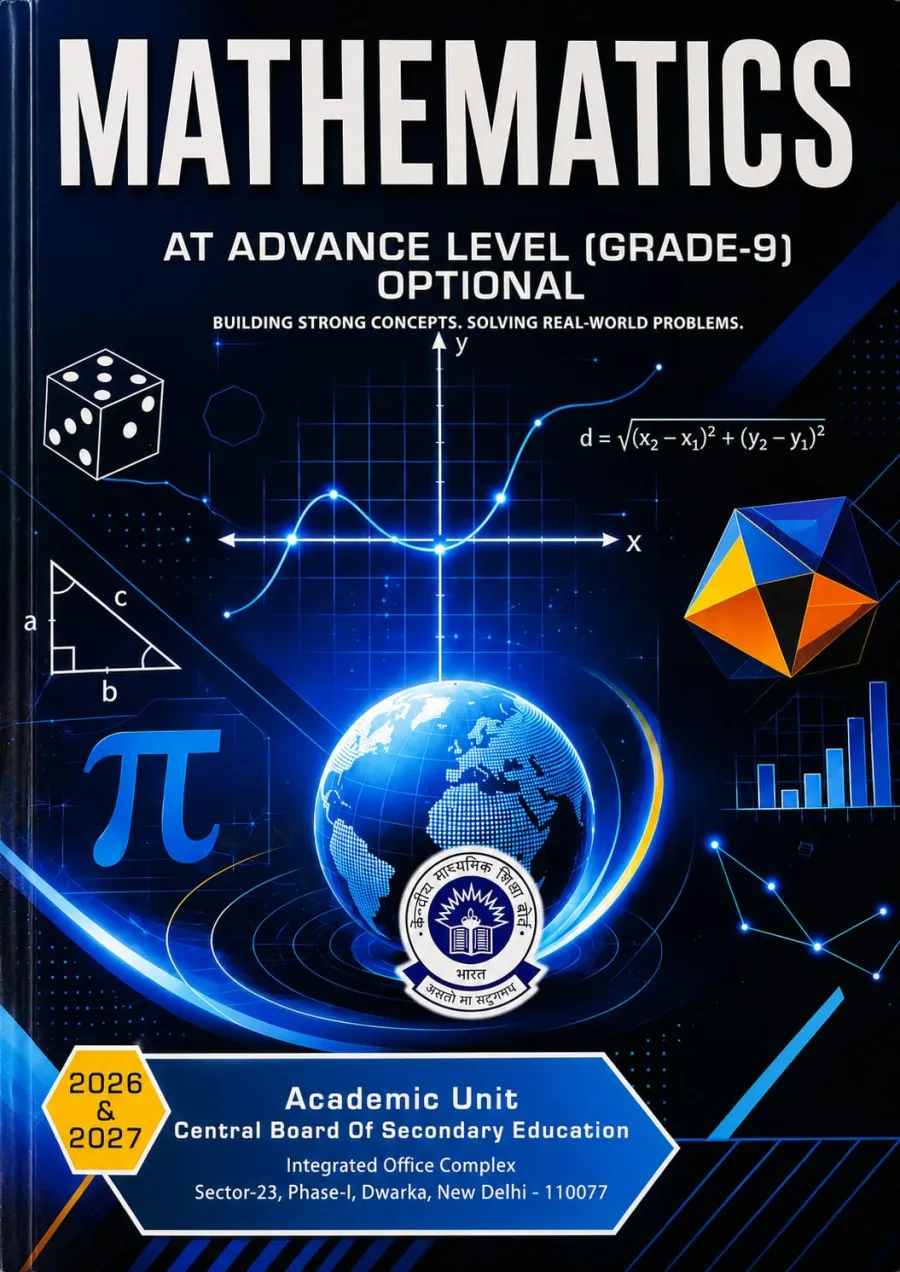
Download Cover Image
Do you want to download the full cover image for Mathematics at Advance Level 9 CBSE Textbook New Edition (Mathematics At Advance Level (grade-9)?