
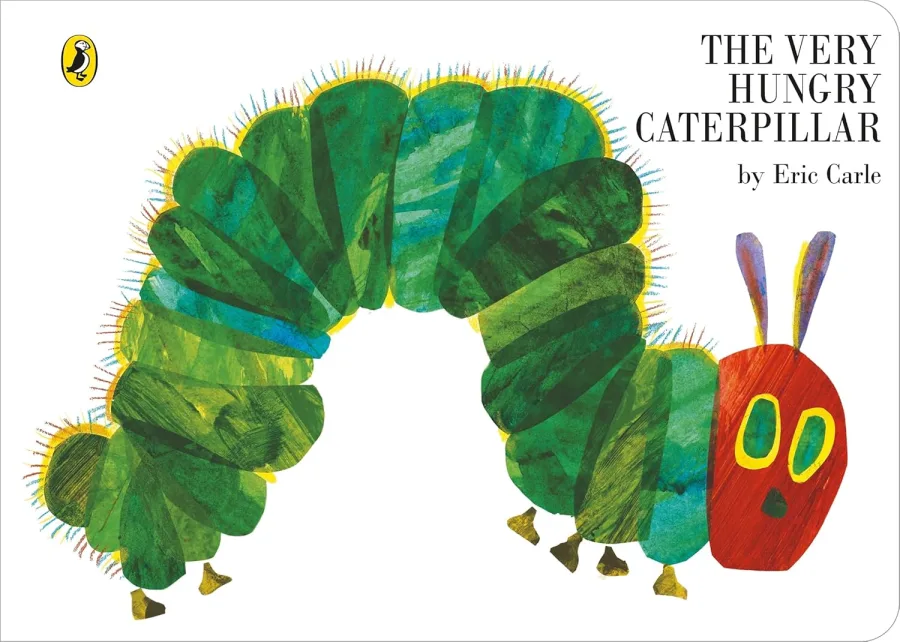
The Very Hungry Caterpillar
Board Book
• 24 Pages
• ₹ 299.00
• English
• 9780241003008
No ratings yet
Children's Books
Children's Early Learning Books on Numbers & Counting
Children's Books on Insects & Spiders
| Publisher | Puffin |
|---|---|
| ISBN13 | 9780241003008 |
| ASIN/SKU | 0241003008 |
| Book Format | Board Book |
| Language | English |
| Pages | 24 |
| List Price | ₹ 299.00 |
| Publishing Date | 29/09/1994 |
| Dimensions | 13.3 x 1.3 x 18.6 cm |
| Weight | 254 g |
| Book Code | BD00070105 |
Buy this Book
Amazon Stores
Ebook Stores
Other Stores
Discover The Very Hungry Caterpillar by Eric Carle. This book is published by Puffin in Board Book format, ISBN 9780241003008, ASIN 0241003008, under Children's Books, Children's Early Learning Books on Numbers and Counting, Children's Books on Insects and Spiders.
Book Description
Eric Carle's The Very Hungry Caterpillar is a perennial favourite with children and adults alike. Its imaginative illustration and clever cut-out detail charts the progress of a very hungry caterpillar as he eats his way through the week.
Don't miss out on other Very Hungry Caterpillar and Eric Carle books:
The Very Hungry Caterpillar's First 100 Words: a lift-the-flap book
The Very Hungry Caterpillar's Hide and Seek: a finger trail lift-the-flap book
The Very Hungry Caterpillar's Magnet Book: with 8 chunky magnets
Sleep Tight, Very Hungry Caterpillar: a lift-the-flap book
The Very Hungry Caterpillar's Birthday Party: with a special fold-out surprise
Where Is The Very Hungry Caterpillar: a lift-the-flap book
The Very Hungry Caterpillar Touch and Feel Playbook
The Very Hungry Caterpillar Little Learning Library
The Very Hungry Caterpillar Big Board Book
The Very Hungry Caterpillar Book and Toy
The Very Busy Spider
The Bad-Tempered Ladybird
From Head to Toe
Don't miss out on other Very Hungry Caterpillar and Eric Carle books:
The Very Hungry Caterpillar's First 100 Words: a lift-the-flap book
The Very Hungry Caterpillar's Hide and Seek: a finger trail lift-the-flap book
The Very Hungry Caterpillar's Magnet Book: with 8 chunky magnets
Sleep Tight, Very Hungry Caterpillar: a lift-the-flap book
The Very Hungry Caterpillar's Birthday Party: with a special fold-out surprise
Where Is The Very Hungry Caterpillar: a lift-the-flap book
The Very Hungry Caterpillar Touch and Feel Playbook
The Very Hungry Caterpillar Little Learning Library
The Very Hungry Caterpillar Big Board Book
The Very Hungry Caterpillar Book and Toy
The Very Busy Spider
The Bad-Tempered Ladybird
From Head to Toe
Author Biography
Eric Carle is acclaimed and beloved as the creator of brilliantly illustrated and innovatively designed picture books for very young children. His best-known work, The Very Hungry Caterpillar, has been translated into 70 languages and sold over 55 million copies. Carle illustrated more than seventy books, many best sellers, most of which he also wrote, and more than 170 million copies of his books have sold around the world. In 2003, Carle received the Laura Ingalls Wilder Award (now called the Children's Literature Legacy Award) for lifetime achievement in children's literature. In 2002, Eric and his wife, Barbara, cofounded The Eric Carle Museum of Picture Book Art (www.carlemuseum.org) in Amherst, Massachusetts, a 40,000-square-foot space dedicated to the celebration of picture books and picture book illustrations from around the world, underscoring the cultural, historical, and artistic significance of picture books and their art form. Eric Carle passed away in May 2021 at the age of 91. His work remains an important influence on artists and illustrators at work today. www.eric-carle.com
Editorial Reviews
Editorial Reviews will be added soon…
Book Summary
The Very Hungry Caterpillar by Eric Carle is a beloved children's picture book about a tiny caterpillar who begins life as a small egg and gradually transforms through eating, growing, and eventually becoming a beautiful butterfly. First published in 1969, the book has become one of the most widely recognized children's books in the world. Its simple story, colorful collage-style illustrations, repetition, and interactive page design make it appealing to very young children while also introducing basic ideas about numbers, days of the week, food, nature, and transformation. The book has been published in numerous editions and languages and remains a popular choice for early childhood reading. (eric-carle.com)
The story begins with a tiny white egg resting on a leaf. When the sun rises on Sunday morning, the egg hatches and a small caterpillar emerges. The caterpillar is extremely hungry. This simple beginning introduces the central character and immediately establishes the main pattern of the story: the caterpillar will search for food, eat, grow, and eventually change.
At first, the caterpillar eats through a sequence of fruits. On Monday, it eats through one apple. On Tuesday, it eats two pears. On Wednesday, it eats three plums. On Thursday, it eats four strawberries, and on Friday, it eats five oranges. The repetition makes the story easy for young children to follow and remember. At the same time, the increasing numbers introduce a very simple counting sequence from one to five. (eric-carle.com)
The fruit pages are especially effective as an early-learning tool. Children can count the pieces of fruit while listening to the story, identify their colors, and name the foods. Because each day adds another item, children begin to notice the numerical pattern naturally. The book does not feel like a mathematics lesson, but counting is built into the story.
The repetition of the days of the week also helps children become familiar with the sequence from Sunday through Saturday. Young children may not fully understand calendars yet, but repeated exposure to the names and order of the days can help build early awareness of time and routine.
After eating the fruit, the caterpillar is still hungry. On Saturday, he eats through a much larger collection of foods, including cake, ice cream, a pickle, cheese, salami, a lollipop, cherry pie, sausage, a cupcake, and watermelon. These foods are much heavier and more varied than the fruit he ate during the earlier days. The caterpillar eventually develops a stomachache because he has eaten far too much. (eric-carle.com)
This part of the story introduces a simple idea about moderation. The caterpillar's enormous appetite leads to discomfort, while returning to a healthy leaf makes him feel better. Young children can understand the basic connection between eating too much and feeling unwell without needing a complicated explanation about nutrition.
The caterpillar then becomes less hungry and begins to feel stronger. He finds a leaf to eat and feels better. Soon, he becomes a much larger caterpillar than he was at the beginning. This change demonstrates one of the most important ideas in the story: living things grow.
The caterpillar then builds a cocoon, called a chrysalis in the scientific description of butterfly development. He stays inside for more than two weeks. When he finally emerges, he is no longer a caterpillar. He has transformed into a beautiful butterfly with colorful wings. The final illustration provides a dramatic contrast with the tiny caterpillar from the beginning. (eric-carle.com)
The transformation from caterpillar to butterfly is the book's central natural-history theme. Children are introduced to the idea of a life cycle in a very simple form. They see that an organism can look completely different at different stages of its development. The book does not overwhelm young readers with scientific vocabulary, but it gives them a memorable first understanding of metamorphosis.
The story's simplicity is one of its greatest strengths. There is no complicated plot, large cast of characters, or difficult conflict. Instead, children follow one small creature through a sequence of familiar events. The caterpillar eats, grows, becomes uncomfortable, rests, and changes. This straightforward structure is particularly suitable for preschool and early-school readers.
Eric Carle's illustrations are another defining feature. The book uses his distinctive collage technique, in which painted papers are combined to create colorful shapes and textures. The illustrations are bold, bright, and visually simple enough for young children to understand. (eric-carle.com)
The colors also change the emotional feel of the pages. Bright fruits and foods create a lively atmosphere, while the final butterfly provides a colorful visual conclusion. The pictures are not simply decorative; they help children understand the story even before they can read the words independently.
One of the most memorable features of the book is its interactive page design. The pages vary in size, and small holes appear where the caterpillar has eaten through the food. These holes make the story feel almost physical. Children can see and touch the openings, creating a stronger connection between the written story and the caterpillar's actions.
The holes also provide an opportunity for children to practice simple cause-and-effect reasoning. They can see that the caterpillar has eaten through the food because of the visible marks. The physical design therefore reinforces the narrative in a way that an ordinary flat page might not.
The book's repetition makes it ideal for read-aloud sessions. Children often enjoy hearing the same phrases repeatedly and may begin to anticipate what comes next. A parent or teacher can pause before revealing the next number or food item and allow the child to participate.
Children can also become involved by counting aloud. When the story reaches the fruit sequence, the adult can ask, “How many apples did the caterpillar eat?” or “How many strawberries are there?” This turns passive listening into active participation.
The story can also introduce colors and vocabulary. Children can identify fruits, foods, insects, leaves, and body parts. Adults can ask children to name colors, describe shapes, compare sizes, or talk about which foods they like. Because the pictures are so prominent, the book provides many opportunities for conversation.
The caterpillar itself is a useful character for teaching observation. Children can compare the caterpillar at the beginning with the butterfly at the end and notice how dramatically it has changed. This can lead to questions about other animals that change as they grow, such as frogs.
The book also introduces a gentle lesson about growth and patience. The caterpillar does not become a butterfly immediately. It goes through several stages. Children can learn that some changes take time and that growth happens gradually. This can be connected to their own experiences as they learn new skills and become more independent.
Another subtle theme is the importance of natural processes. The caterpillar does not choose to become a butterfly through effort in the usual human sense. Its transformation happens as part of its natural life cycle. The story can therefore encourage curiosity about insects, plants, seasons, and the natural world.
The book's treatment of food is particularly interesting because it moves from healthy fruits to a large collection of indulgent foods. The caterpillar's stomachache provides a simple consequence. Young readers can understand that food can be enjoyable but that too much of anything can cause discomfort. The story then returns the caterpillar to a leaf before the transformation begins.
The book is also valuable because it supports early literacy. Repeated phrases, predictable patterns, and simple sentence structures make it easier for children to participate in reading. A child may initially listen to the adult but eventually begin recognizing familiar words and phrases.
The story's predictable structure can help children develop a sense of narrative. They learn that stories have a beginning, a sequence of events, and an ending. They can identify what happened first, what happened next, and what eventually happened to the caterpillar. This basic understanding is important for later reading comprehension.
The book also encourages children to make predictions. Once they understand the pattern of the fruit pages, they may guess what the caterpillar will eat next. When the caterpillar enters the chrysalis, they may wonder what will emerge. These predictions encourage children to think actively while listening to a story.
Parents and teachers can extend the book into simple activities.
The story begins with a tiny white egg resting on a leaf. When the sun rises on Sunday morning, the egg hatches and a small caterpillar emerges. The caterpillar is extremely hungry. This simple beginning introduces the central character and immediately establishes the main pattern of the story: the caterpillar will search for food, eat, grow, and eventually change.
At first, the caterpillar eats through a sequence of fruits. On Monday, it eats through one apple. On Tuesday, it eats two pears. On Wednesday, it eats three plums. On Thursday, it eats four strawberries, and on Friday, it eats five oranges. The repetition makes the story easy for young children to follow and remember. At the same time, the increasing numbers introduce a very simple counting sequence from one to five. (eric-carle.com)
The fruit pages are especially effective as an early-learning tool. Children can count the pieces of fruit while listening to the story, identify their colors, and name the foods. Because each day adds another item, children begin to notice the numerical pattern naturally. The book does not feel like a mathematics lesson, but counting is built into the story.
The repetition of the days of the week also helps children become familiar with the sequence from Sunday through Saturday. Young children may not fully understand calendars yet, but repeated exposure to the names and order of the days can help build early awareness of time and routine.
After eating the fruit, the caterpillar is still hungry. On Saturday, he eats through a much larger collection of foods, including cake, ice cream, a pickle, cheese, salami, a lollipop, cherry pie, sausage, a cupcake, and watermelon. These foods are much heavier and more varied than the fruit he ate during the earlier days. The caterpillar eventually develops a stomachache because he has eaten far too much. (eric-carle.com)
This part of the story introduces a simple idea about moderation. The caterpillar's enormous appetite leads to discomfort, while returning to a healthy leaf makes him feel better. Young children can understand the basic connection between eating too much and feeling unwell without needing a complicated explanation about nutrition.
The caterpillar then becomes less hungry and begins to feel stronger. He finds a leaf to eat and feels better. Soon, he becomes a much larger caterpillar than he was at the beginning. This change demonstrates one of the most important ideas in the story: living things grow.
The caterpillar then builds a cocoon, called a chrysalis in the scientific description of butterfly development. He stays inside for more than two weeks. When he finally emerges, he is no longer a caterpillar. He has transformed into a beautiful butterfly with colorful wings. The final illustration provides a dramatic contrast with the tiny caterpillar from the beginning. (eric-carle.com)
The transformation from caterpillar to butterfly is the book's central natural-history theme. Children are introduced to the idea of a life cycle in a very simple form. They see that an organism can look completely different at different stages of its development. The book does not overwhelm young readers with scientific vocabulary, but it gives them a memorable first understanding of metamorphosis.
The story's simplicity is one of its greatest strengths. There is no complicated plot, large cast of characters, or difficult conflict. Instead, children follow one small creature through a sequence of familiar events. The caterpillar eats, grows, becomes uncomfortable, rests, and changes. This straightforward structure is particularly suitable for preschool and early-school readers.
Eric Carle's illustrations are another defining feature. The book uses his distinctive collage technique, in which painted papers are combined to create colorful shapes and textures. The illustrations are bold, bright, and visually simple enough for young children to understand. (eric-carle.com)
The colors also change the emotional feel of the pages. Bright fruits and foods create a lively atmosphere, while the final butterfly provides a colorful visual conclusion. The pictures are not simply decorative; they help children understand the story even before they can read the words independently.
One of the most memorable features of the book is its interactive page design. The pages vary in size, and small holes appear where the caterpillar has eaten through the food. These holes make the story feel almost physical. Children can see and touch the openings, creating a stronger connection between the written story and the caterpillar's actions.
The holes also provide an opportunity for children to practice simple cause-and-effect reasoning. They can see that the caterpillar has eaten through the food because of the visible marks. The physical design therefore reinforces the narrative in a way that an ordinary flat page might not.
The book's repetition makes it ideal for read-aloud sessions. Children often enjoy hearing the same phrases repeatedly and may begin to anticipate what comes next. A parent or teacher can pause before revealing the next number or food item and allow the child to participate.
Children can also become involved by counting aloud. When the story reaches the fruit sequence, the adult can ask, “How many apples did the caterpillar eat?” or “How many strawberries are there?” This turns passive listening into active participation.
The story can also introduce colors and vocabulary. Children can identify fruits, foods, insects, leaves, and body parts. Adults can ask children to name colors, describe shapes, compare sizes, or talk about which foods they like. Because the pictures are so prominent, the book provides many opportunities for conversation.
The caterpillar itself is a useful character for teaching observation. Children can compare the caterpillar at the beginning with the butterfly at the end and notice how dramatically it has changed. This can lead to questions about other animals that change as they grow, such as frogs.
The book also introduces a gentle lesson about growth and patience. The caterpillar does not become a butterfly immediately. It goes through several stages. Children can learn that some changes take time and that growth happens gradually. This can be connected to their own experiences as they learn new skills and become more independent.
Another subtle theme is the importance of natural processes. The caterpillar does not choose to become a butterfly through effort in the usual human sense. Its transformation happens as part of its natural life cycle. The story can therefore encourage curiosity about insects, plants, seasons, and the natural world.
The book's treatment of food is particularly interesting because it moves from healthy fruits to a large collection of indulgent foods. The caterpillar's stomachache provides a simple consequence. Young readers can understand that food can be enjoyable but that too much of anything can cause discomfort. The story then returns the caterpillar to a leaf before the transformation begins.
The book is also valuable because it supports early literacy. Repeated phrases, predictable patterns, and simple sentence structures make it easier for children to participate in reading. A child may initially listen to the adult but eventually begin recognizing familiar words and phrases.
The story's predictable structure can help children develop a sense of narrative. They learn that stories have a beginning, a sequence of events, and an ending. They can identify what happened first, what happened next, and what eventually happened to the caterpillar. This basic understanding is important for later reading comprehension.
The book also encourages children to make predictions. Once they understand the pattern of the fruit pages, they may guess what the caterpillar will eat next. When the caterpillar enters the chrysalis, they may wonder what will emerge. These predictions encourage children to think actively while listening to a story.
Parents and teachers can extend the book into simple activities.
Sample Chapters
Sample Chapters will be added soon…
Reader Reviews
No reviews yet.
The Very Hungry Caterpillar
Download Cover Image
Do you want to download the full cover image for The Very Hungry Caterpillar?