
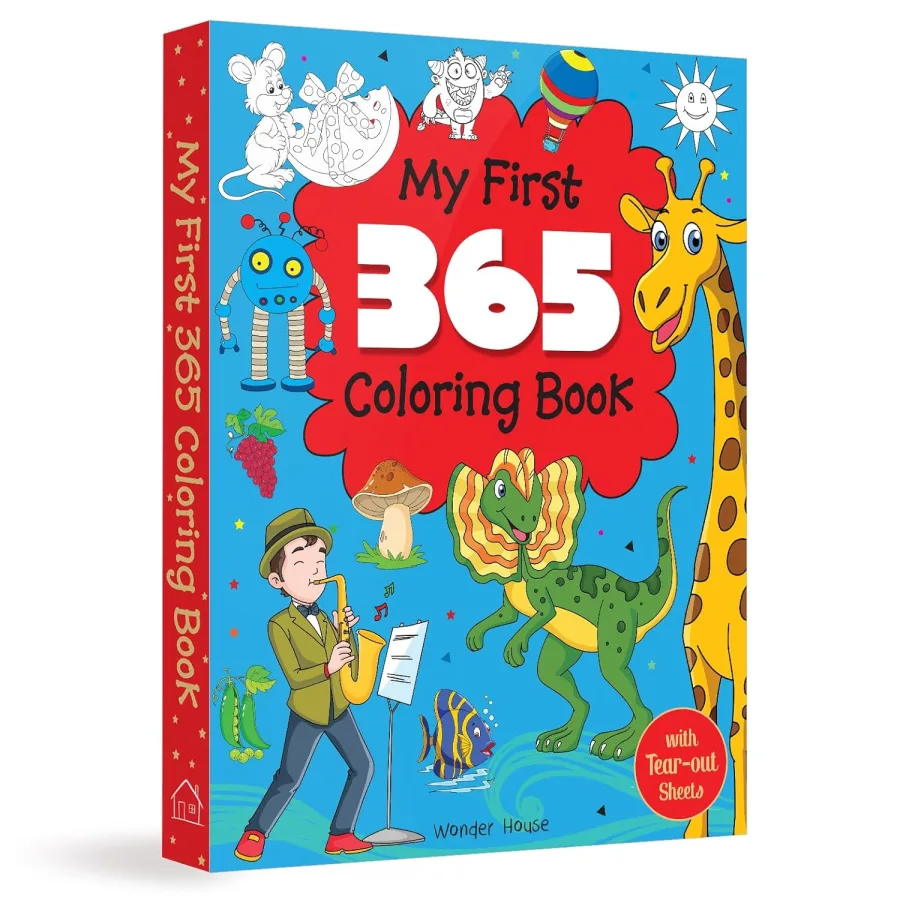
My First 365 Coloring Book | Jumbo Coloring Book For Kids (With Tear Out Sheets)
Paperback
• 272 Pages
• ₹ 399.00
• English
• 9789390183005
No ratings yet
Children's Books
Children's Crafts, Hobbies & Practical Interests
Children's Books on School & Education
| Publisher | Wonder House Books |
|---|---|
| ISBN13 | 9789390183005 |
| ASIN/SKU | 9390183006 |
| Book Format | Paperback |
| Language | English |
| Pages | 272 |
| List Price | ₹ 399.00 |
| Publishing Date | 06/08/2020 |
| Dimensions | 21.59 x 27.64 x 2 cm |
| Weight | 700 g |
| Book Code | BD00070083 |
Buy this Book
Amazon Stores
Ebook Stores
Other Stores
Discover My First 365 Coloring Book | Jumbo Coloring Book For Kids (With Tear Out Sheets) by Wonder House Books. This book is published by Wonder House Books in Paperback format, ISBN 9789390183005, ASIN 9390183006, under Children's Books, Children's Crafts, Hobbies and Practical Interests, Children's Books on School and Education.
Book Description
My First 365 Coloring Book: Jumbo Coloring Book For Kids (With Tear Out Sheets)
This gorgeous coloring book contains 365 adorable designs to give wings to your little artist's imagination. Appealing artwork with thick lines and eye-catching designs make this book perfect for your child's entertainment. Coloring within these large and bold designs will improve their motor and observation skills, and spark their creativity.
Color, Create, Doodle: A Year’s Worth of Jumbo Fun for Kids!
Provides a full year's worth of coloring activities and encourages daily artistic expression.
Contains a diverse range of illustrations
The jumbo size and durable paper allows children to use a variety of coloring tools
Each page is perforated for easy removal
Allows children to engage in hours of screen-free enjoyable activities
This gorgeous coloring book contains 365 adorable designs to give wings to your little artist's imagination. Appealing artwork with thick lines and eye-catching designs make this book perfect for your child's entertainment. Coloring within these large and bold designs will improve their motor and observation skills, and spark their creativity.
Color, Create, Doodle: A Year’s Worth of Jumbo Fun for Kids!
Provides a full year's worth of coloring activities and encourages daily artistic expression.
Contains a diverse range of illustrations
The jumbo size and durable paper allows children to use a variety of coloring tools
Each page is perforated for easy removal
Allows children to engage in hours of screen-free enjoyable activities
Author Biography
Wonder House has a dedicated team of editors and designers involved in the development of magnificent and enriching children books. The team pays special attention to develop age appropriate content and does extensive research on every topic included in the book. Our mission is to develop highly informative content which will help the children to master different skills. At Wonder House, we strive to make learning a joy.
Editorial Reviews
Editorial Reviews will be added soon…
Book Summary
My First 365 Coloring Book by Wonder House Books is a large, child-friendly coloring activity book created to introduce young children to the enjoyable world of colors, drawing, and creative expression. Designed primarily for children around 3–7 years old, the book contains 365 different illustrations, giving children a new coloring activity for practically every day of the year. It is a 272-page jumbo-format book with thick, bold outlines and large illustrations that are intended to be easy for small hands to color.
The basic idea behind the book is wonderfully simple: give children plenty of opportunities to color, experiment, and create without making the activity feel like a formal lesson. Instead of asking children to learn complicated artistic techniques, the book allows them to begin with familiar pictures and gradually become more comfortable holding coloring tools, selecting colors, filling spaces, and creating their own combinations.
The collection contains 365 charming designs, making it possible to treat coloring as a regular daily activity. A child can complete one picture a day, although there is no need to follow such a strict schedule. Some children may want to finish several pictures in one sitting, while others may prefer to spend more time on a single illustration. The large number of designs means that children have plenty of material to explore over an extended period.
The illustrations cover a variety of familiar and appealing subjects. Descriptions of the book mention themes such as plants and animals, while other descriptions refer to varied designs, characters, shapes, and patterns. This variety prevents coloring from becoming repetitive and gives children opportunities to encounter different kinds of images. A child may enjoy coloring an animal on one page and then move on to a completely different type of picture on the next.
One of the most important features is the use of thick and bold outlines. For young children who are still developing pencil and hand control, staying inside a very thin outline can be frustrating. Bold boundaries make the coloring area easier to recognize and provide children with a clear visual guide. This can make the activity feel more manageable, especially for beginners who are still learning how to control crayons or pencils.
The large size of the book is another practical advantage. The jumbo format gives children more room to move their hands and coloring tools. Large pictures are particularly appropriate for younger children because their fine motor control is still developing. Instead of requiring tiny, precise movements, the book allows them to practice broader strokes while gradually improving their accuracy.
Coloring also provides valuable practice in fine motor skills. Children have to hold a crayon, colored pencil, or marker and guide it across the page. They need to adjust pressure, direction, and movement as they color different parts of a picture. With regular practice, these activities can strengthen the small muscles involved in controlled hand movements. The publisher specifically describes the book as helping to enhance children's motor skills.
Hand-eye coordination is developed at the same time. A child has to look at the boundary of a picture while moving the coloring tool with the hand. When the child tries to remain inside the outline, the eyes continuously guide the hand. This is a basic but important skill that can later support activities such as handwriting, drawing, cutting, and other classroom tasks.
The book also encourages observation. Children need to look carefully at each illustration to understand its different sections. They may notice the shape of an object, the spaces that need coloring, and the relationship between different parts of the picture. The publisher and other descriptions specifically highlight observation as one of the skills supported through the coloring activities.
Creativity is perhaps the most obvious benefit. Although children may initially be encouraged to use familiar colors, there is no need for every picture to look exactly the same. A child can decide whether a flower should be pink, yellow, purple, or a combination of colors. An animal can be colored realistically or imaginatively. The activity gives children permission to make choices and see what happens when different colors are placed together.
This freedom is important because creative development does not always come from producing technically perfect artwork. Young children learn through experimentation. They may use unusual combinations, color outside the lines, mix several shades, or create patterns of their own. These choices are part of the learning process. The book provides a structured picture while still leaving room for individual expression.
The collection can also help children develop concentration. Coloring requires a child to remain with one activity for a period of time. Unlike rapidly changing digital entertainment, a coloring page does not constantly provide new stimulation. The child must gradually fill the picture and decide what to do next. This can encourage patience and sustained attention.
For parents, the book offers a useful screen-free activity. Modern children have many opportunities to interact with phones, tablets, televisions, and other digital devices. Coloring provides a simple alternative that keeps children engaged with a physical activity. The publisher specifically presents the book as providing hours of creative, screen-free entertainment.
The book can also become part of a daily routine. A parent might encourage a child to complete one page after school, during quiet time, or before another activity. Because there are 365 designs, the book naturally lends itself to a year-long coloring habit. The daily concept can also give children a small, achievable goal. Completing a picture can create a sense of accomplishment and encourage them to return to the activity again.
The tear-out sheets add another useful dimension. The pages are perforated so that completed artwork can be removed easily. Instead of leaving every picture permanently attached to the book, children can take out their favorite creations and display them on a refrigerator, wall, noticeboard, or in a frame. The feature also makes it possible to share finished pictures with family members or friends.
Displaying artwork can be especially meaningful for young children. When adults show interest in something a child has created, the child receives encouragement and develops greater confidence in their abilities. A completed picture becomes more than a finished page; it becomes something the child can proudly show to others.
The tear-out design can also make group activities easier. A parent, teacher, or caregiver can remove individual pages and give different pictures to several children. This makes the book useful for classrooms, playgroups, travel, family activities, or children's gatherings. The pages can be handled separately without requiring children to work directly from the bound book.
The book is also flexible in terms of coloring materials. Product descriptions mention crayons, colored pencils, sketch pens, and other coloring tools. For younger children, crayons may be particularly comfortable because they are easy to hold and allow broad movements. Older children can experiment with colored pencils or markers to create different effects.
Parents can use the book to introduce basic ideas about colors without turning coloring into a formal academic exercise. They can talk about primary and secondary colors, light and dark shades, warm and cool colors, or ask children why they chose particular colors. However, the child should still have freedom to make personal choices. The purpose is creative exploration rather than producing a “correct” picture.
Coloring can also support language development when adults talk with children about the illustrations. A parent might ask what an animal is called, where it lives, what it eats, or what colors it could have. A picture of a plant can lead to a conversation about leaves, flowers, fruits, or gardens. In this way, a simple coloring page can become the starting point for broader learning.
The book's variety also makes it suitable for children with different interests. Some children may be attracted to animals, while others may enjoy plants, characters, patterns, or imaginative illustrations. Having many different designs allows children to discover which subjects they enjoy most.
An important point is that young children should not be expected to color perfectly. At the beginning, they may go outside the lines, leave spaces unfinished, press too hard, or change colors frequently. These are normal parts of learning. The value of the activity comes from practice and enjoyment, not from producing flawless pages.
The basic idea behind the book is wonderfully simple: give children plenty of opportunities to color, experiment, and create without making the activity feel like a formal lesson. Instead of asking children to learn complicated artistic techniques, the book allows them to begin with familiar pictures and gradually become more comfortable holding coloring tools, selecting colors, filling spaces, and creating their own combinations.
The collection contains 365 charming designs, making it possible to treat coloring as a regular daily activity. A child can complete one picture a day, although there is no need to follow such a strict schedule. Some children may want to finish several pictures in one sitting, while others may prefer to spend more time on a single illustration. The large number of designs means that children have plenty of material to explore over an extended period.
The illustrations cover a variety of familiar and appealing subjects. Descriptions of the book mention themes such as plants and animals, while other descriptions refer to varied designs, characters, shapes, and patterns. This variety prevents coloring from becoming repetitive and gives children opportunities to encounter different kinds of images. A child may enjoy coloring an animal on one page and then move on to a completely different type of picture on the next.
One of the most important features is the use of thick and bold outlines. For young children who are still developing pencil and hand control, staying inside a very thin outline can be frustrating. Bold boundaries make the coloring area easier to recognize and provide children with a clear visual guide. This can make the activity feel more manageable, especially for beginners who are still learning how to control crayons or pencils.
The large size of the book is another practical advantage. The jumbo format gives children more room to move their hands and coloring tools. Large pictures are particularly appropriate for younger children because their fine motor control is still developing. Instead of requiring tiny, precise movements, the book allows them to practice broader strokes while gradually improving their accuracy.
Coloring also provides valuable practice in fine motor skills. Children have to hold a crayon, colored pencil, or marker and guide it across the page. They need to adjust pressure, direction, and movement as they color different parts of a picture. With regular practice, these activities can strengthen the small muscles involved in controlled hand movements. The publisher specifically describes the book as helping to enhance children's motor skills.
Hand-eye coordination is developed at the same time. A child has to look at the boundary of a picture while moving the coloring tool with the hand. When the child tries to remain inside the outline, the eyes continuously guide the hand. This is a basic but important skill that can later support activities such as handwriting, drawing, cutting, and other classroom tasks.
The book also encourages observation. Children need to look carefully at each illustration to understand its different sections. They may notice the shape of an object, the spaces that need coloring, and the relationship between different parts of the picture. The publisher and other descriptions specifically highlight observation as one of the skills supported through the coloring activities.
Creativity is perhaps the most obvious benefit. Although children may initially be encouraged to use familiar colors, there is no need for every picture to look exactly the same. A child can decide whether a flower should be pink, yellow, purple, or a combination of colors. An animal can be colored realistically or imaginatively. The activity gives children permission to make choices and see what happens when different colors are placed together.
This freedom is important because creative development does not always come from producing technically perfect artwork. Young children learn through experimentation. They may use unusual combinations, color outside the lines, mix several shades, or create patterns of their own. These choices are part of the learning process. The book provides a structured picture while still leaving room for individual expression.
The collection can also help children develop concentration. Coloring requires a child to remain with one activity for a period of time. Unlike rapidly changing digital entertainment, a coloring page does not constantly provide new stimulation. The child must gradually fill the picture and decide what to do next. This can encourage patience and sustained attention.
For parents, the book offers a useful screen-free activity. Modern children have many opportunities to interact with phones, tablets, televisions, and other digital devices. Coloring provides a simple alternative that keeps children engaged with a physical activity. The publisher specifically presents the book as providing hours of creative, screen-free entertainment.
The book can also become part of a daily routine. A parent might encourage a child to complete one page after school, during quiet time, or before another activity. Because there are 365 designs, the book naturally lends itself to a year-long coloring habit. The daily concept can also give children a small, achievable goal. Completing a picture can create a sense of accomplishment and encourage them to return to the activity again.
The tear-out sheets add another useful dimension. The pages are perforated so that completed artwork can be removed easily. Instead of leaving every picture permanently attached to the book, children can take out their favorite creations and display them on a refrigerator, wall, noticeboard, or in a frame. The feature also makes it possible to share finished pictures with family members or friends.
Displaying artwork can be especially meaningful for young children. When adults show interest in something a child has created, the child receives encouragement and develops greater confidence in their abilities. A completed picture becomes more than a finished page; it becomes something the child can proudly show to others.
The tear-out design can also make group activities easier. A parent, teacher, or caregiver can remove individual pages and give different pictures to several children. This makes the book useful for classrooms, playgroups, travel, family activities, or children's gatherings. The pages can be handled separately without requiring children to work directly from the bound book.
The book is also flexible in terms of coloring materials. Product descriptions mention crayons, colored pencils, sketch pens, and other coloring tools. For younger children, crayons may be particularly comfortable because they are easy to hold and allow broad movements. Older children can experiment with colored pencils or markers to create different effects.
Parents can use the book to introduce basic ideas about colors without turning coloring into a formal academic exercise. They can talk about primary and secondary colors, light and dark shades, warm and cool colors, or ask children why they chose particular colors. However, the child should still have freedom to make personal choices. The purpose is creative exploration rather than producing a “correct” picture.
Coloring can also support language development when adults talk with children about the illustrations. A parent might ask what an animal is called, where it lives, what it eats, or what colors it could have. A picture of a plant can lead to a conversation about leaves, flowers, fruits, or gardens. In this way, a simple coloring page can become the starting point for broader learning.
The book's variety also makes it suitable for children with different interests. Some children may be attracted to animals, while others may enjoy plants, characters, patterns, or imaginative illustrations. Having many different designs allows children to discover which subjects they enjoy most.
An important point is that young children should not be expected to color perfectly. At the beginning, they may go outside the lines, leave spaces unfinished, press too hard, or change colors frequently. These are normal parts of learning. The value of the activity comes from practice and enjoyment, not from producing flawless pages.
Sample Chapters
Sample Chapters will be added soon…
Reader Reviews
No reviews yet.
My First 365 Coloring Book | Jumbo Coloring Book For Kids (With Tear Out Sheets)
Download Cover Image
Do you want to download the full cover image for My First 365 Coloring Book | Jumbo Coloring Book For Kids (With Tear Out Sheets)?