
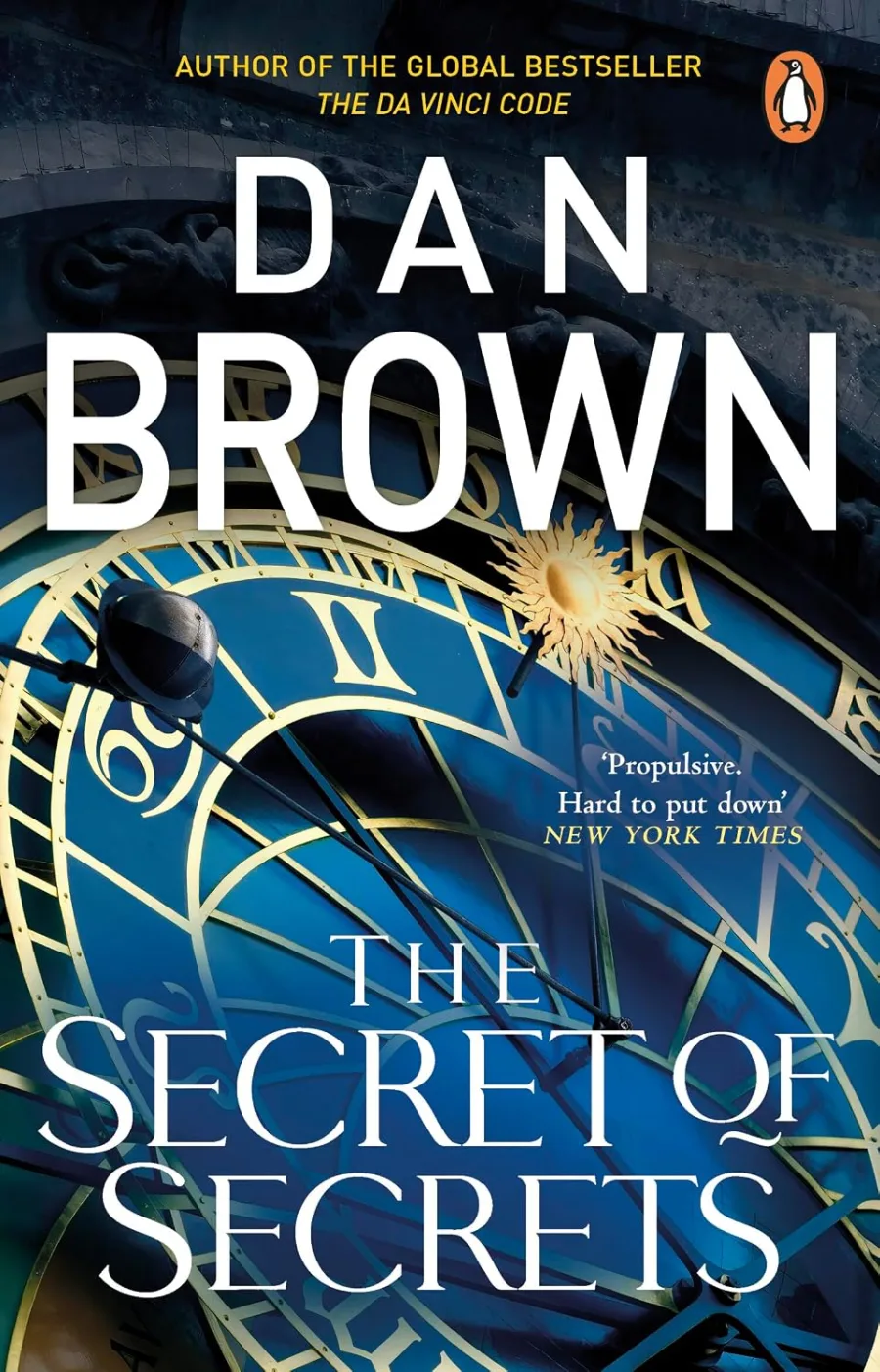
The Secret of Secrets: (Robert Langdon Book 6)
Paperback
• 720 Pages
• ₹ 432.00
• English
• 9780552178013
No ratings yet
| Publisher | Penguin |
|---|---|
| ISBN13 | 9780552178013 |
| ASIN/SKU | 0552178012 |
| Book Format | Paperback |
| Language | English |
| Pages | 720 |
| List Price | ₹ 432.00 |
| Publishing Date | 02/07/2026 |
| Dimensions | 12.8 x 4.6 x 19.7 cm |
| Weight | 488 g |
| Book Code | BD00070068 |
Buy this Book
Amazon Stores
Ebook Stores
Other Stores
Discover The Secret of Secrets: (Robert Langdon Book 6) by Dan Brown. This book is published by Penguin in Paperback format, ISBN 9780552178013, ASIN 0552178012, under Mystery, Thriller and Suspense, Action and Adventure, Mysteries.
Book Description
The long-awaited new race-against-time thriller from the global bestselling author of The Da Vinci Code and Angels & Demons.
‘Propulsive... Hard to put down’ New York Times
‘A master of the brainy, twisty thriller... Dan Brown's novels move with kinetic energy’ Los Angeles Times
‘Like so many things that are insanely popular... Brown's thrillers look easy to imitate but aren't. He shatters dramatic moments into shiny, irresistible shards’ Washington Post
Accompanying celebrated academic, Katherine Solomon, to a lecture she’s been invited to give in Prague, Robert Langdon’s world spirals out of control when she disappears without trace from their hotel room. Far from home and out of his comfort zone, Langdon must pit his wits against forces unknown to recover the woman he loves.
But Prague is an old and dangerous place, steeped in folklore and mystery. Little can Langdon know that he is being stalked by a spectre from that dark past. He must use all of his arcane knowledge to navigate a shadow city hiding in plain sight, a city which has successfully kept its secrets for centuries and will not readily give them up.
The Secret Of Secrets is Dan Brown’s first novel for over eight years and sees the stunning return of Harvard symbologist Robert Langdon, this time pitting his wits against a conspiracy which will test even his considerable brainpower and take him to the edge of losing all that he holds dear…
‘Propulsive... Hard to put down’ New York Times
‘A master of the brainy, twisty thriller... Dan Brown's novels move with kinetic energy’ Los Angeles Times
‘Like so many things that are insanely popular... Brown's thrillers look easy to imitate but aren't. He shatters dramatic moments into shiny, irresistible shards’ Washington Post
Accompanying celebrated academic, Katherine Solomon, to a lecture she’s been invited to give in Prague, Robert Langdon’s world spirals out of control when she disappears without trace from their hotel room. Far from home and out of his comfort zone, Langdon must pit his wits against forces unknown to recover the woman he loves.
But Prague is an old and dangerous place, steeped in folklore and mystery. Little can Langdon know that he is being stalked by a spectre from that dark past. He must use all of his arcane knowledge to navigate a shadow city hiding in plain sight, a city which has successfully kept its secrets for centuries and will not readily give them up.
The Secret Of Secrets is Dan Brown’s first novel for over eight years and sees the stunning return of Harvard symbologist Robert Langdon, this time pitting his wits against a conspiracy which will test even his considerable brainpower and take him to the edge of losing all that he holds dear…
Author Biography
Dan Brown is the author of eight #1 bestselling novels, including The Da Vinci Code, which has become one of the bestselling novels of all time as well as the subject of intellectual debate among readers and scholars. Brown’s novels are published in 56 languages around the world with over 250 million copies in print.
Brown was named one of the 100 Most Influential People in the World by TIME Magazine, whose editors credited him with “keeping the publishing industry afloat; renewed interest in Leonardo da Vinci and early Christian history; spiking tourism to Paris and Rome; a growing membership in secret societies; the ire of Cardinals in Rome; eight books denying the claims of the novel and seven guides to read along with it; a flood of historical thrillers; and a major motion picture franchise.”
The son of a mathematics teacher and a church organist, Brown was raised on a prep school campus where he developed a fascination with the paradoxical interplay between science and religion. These themes eventually formed the backdrop for his books. He is a graduate of Amherst College and Phillips Exeter Academy, where he later returned to teach English before focusing his attention full time to writing. He lives in New England.
Brown was named one of the 100 Most Influential People in the World by TIME Magazine, whose editors credited him with “keeping the publishing industry afloat; renewed interest in Leonardo da Vinci and early Christian history; spiking tourism to Paris and Rome; a growing membership in secret societies; the ire of Cardinals in Rome; eight books denying the claims of the novel and seven guides to read along with it; a flood of historical thrillers; and a major motion picture franchise.”
The son of a mathematics teacher and a church organist, Brown was raised on a prep school campus where he developed a fascination with the paradoxical interplay between science and religion. These themes eventually formed the backdrop for his books. He is a graduate of Amherst College and Phillips Exeter Academy, where he later returned to teach English before focusing his attention full time to writing. He lives in New England.
Editorial Reviews
Editorial Reviews will be added soon…
Book Summary
The Secret of Secrets is the sixth novel in Dan Brown's bestselling Robert Langdon series, bringing the Harvard professor of symbology into another high-stakes mystery involving ancient knowledge, hidden societies, cryptic symbols, science, and powerful forces determined to keep dangerous secrets concealed. The novel combines Brown's familiar ingredients—rapid-fire puzzles, intellectual intrigue, historical mysteries, international locations, and unexpected revelations—with questions about consciousness, the human mind, and the boundaries of scientific knowledge.
The story begins in Prague, where Robert Langdon arrives for what should be a relatively personal and intellectual occasion. He is there in connection with Katherine Solomon, a scientist whose work has increasingly focused on the nature of human consciousness. Katherine is not simply an academic researcher; she has become associated with ideas that could challenge some of the most deeply held assumptions about the human mind and human existence.
Katherine's latest work is potentially revolutionary. Her research explores the relationship between consciousness, the brain, and the possibility that human beings have not yet understood the full extent of their own mental capabilities. What initially appears to be an exciting scientific development soon becomes the center of a dangerous conflict. Powerful people have an interest in Katherine's discoveries, and not all of them want the truth to become public.
Robert Langdon's role quickly changes from intellectual companion to investigator. When circumstances surrounding Katherine become increasingly disturbing, Langdon finds himself drawn into a mystery that crosses the boundaries between science, history, religion, and secret knowledge. As he tries to understand what is happening, he discovers that clues have been deliberately hidden in symbols, artworks, historical references, and Prague's architecture.
Prague is particularly well suited to Brown's storytelling. The city's medieval streets, churches, monuments, libraries, and mysterious atmosphere provide a richly layered setting for the investigation. As Langdon moves through the city, familiar places become part of a vast intellectual puzzle. Architecture is not merely background scenery; it becomes a language through which secrets have been encoded.
Langdon's greatest strength is his ability to interpret symbols and recognize connections that others overlook. He approaches the mystery not primarily as a detective with traditional investigative methods but as a scholar trained to understand the hidden meanings embedded in cultural artifacts. A symbol that seems decorative to an ordinary observer may reveal an important clue to Langdon.
As the investigation progresses, the story introduces a complex network of individuals and institutions. Some are genuinely interested in protecting scientific discovery, while others are motivated by power, ideology, money, or fear. The reader is repeatedly encouraged to question who can be trusted. Brown uses this uncertainty to maintain suspense: an apparent ally may have hidden motives, while someone who initially seems threatening may possess information essential to solving the mystery.
Katherine Solomon is central to the novel's intellectual dimension. Her scientific perspective provides a counterbalance to Langdon's expertise in history and symbolism. Their partnership allows the story to bring together two very different approaches to knowledge. Langdon looks backward, examining humanity's cultural and intellectual history, while Katherine looks forward through scientific research.
This contrast is one of the novel's most interesting features. The story repeatedly asks whether ancient traditions and modern science are really as separate as they appear. Human beings have been fascinated by consciousness for thousands of years, using religion, philosophy, mythology, meditation, art, and mystical traditions to explain experiences that science has only recently begun to investigate systematically.
The central mystery therefore extends beyond a conventional hunt for a hidden object. Brown explores a much larger question: What if humanity's understanding of consciousness is fundamentally incomplete? If scientific research were to reveal something extraordinary about the nature of the mind, the consequences could reach far beyond the laboratory.
That possibility makes Katherine's research dangerous. Knowledge can transform society, but it can also threaten institutions and individuals whose power depends upon existing beliefs. Brown uses this tension to create one of the novel's central conflicts: whether humanity is prepared to accept a discovery simply because it is true.
As Langdon follows one clue after another, Brown employs the rapid pacing that has become characteristic of the Robert Langdon novels. Chapters frequently end with new questions or revelations, encouraging the reader to continue. A symbol leads to a location, a location reveals a historical connection, and that connection produces another clue. The narrative consequently has the structure of a puzzle box, with each solution opening another layer of mystery.
The novel's use of historical and cultural references is equally important. Brown transforms Prague into a kind of enormous manuscript. Religious imagery, sculptures, paintings, architecture, manuscripts, and old traditions become pieces of a hidden message. Langdon's knowledge allows him to read this environment in ways that other characters cannot.
Yet the deeper Langdon goes, the less certain the distinction becomes between truth and interpretation. Symbols can have multiple meanings, and historical knowledge can be manipulated. The novel therefore reminds readers that discovering information is only the first step; understanding what that information means can be even more difficult.
The title, The Secret of Secrets, points toward the novel's central fascination with hidden knowledge. Human history is filled with mysteries that people have attempted to explain through religion, philosophy, science, and mythology. Some questions remain unresolved because humanity lacks the tools to answer them. Others remain hidden because individuals or institutions deliberately protect them.
Brown is particularly interested in what happens when these two forms of secrecy collide. A scientific discovery can become a secret because it is not yet understood, because it is politically dangerous, or because someone wants to control its consequences. The novel plays with all three possibilities.
One of the book's recurring themes is the relationship between knowledge and power. Information gives people influence, but possessing information also creates responsibility. The question is not simply whether a discovery should be made. It is whether the discoverer has the right to reveal it, whether society is prepared for it, and whether revealing it could cause more harm than keeping it secret.
Another major theme is the nature of human consciousness. The human mind is perhaps the most intimate thing people possess, yet it remains one of science's greatest mysteries. We experience thoughts, memories, emotions, dreams, and a sense of self every day, but understanding how consciousness arises remains extraordinarily difficult.
Brown uses this mystery to connect scientific speculation with ancient philosophical questions. What is the self? Is consciousness entirely produced by the brain? Does the mind possess capabilities that science has underestimated? What does it mean to be human if our understanding of consciousness changes?
These questions give the thriller a philosophical dimension without abandoning its entertainment value. Readers are still taken through secret passages, coded messages, dangerous confrontations, and surprising discoveries, but beneath the action lies an inquiry into one of the oldest mysteries of human existence.
As Langdon and Katherine continue their investigation, they also have to contend with forces determined to stop them. The danger becomes increasingly personal, and the pair must rely on intelligence, cooperation, and quick thinking. Their survival depends on their ability to recognize patterns before their opponents do.
Langdon's characteristic mixture of curiosity and skepticism remains central to his character. He is fascinated by mystery, but he does not automatically accept extraordinary claims. His training encourages him to investigate evidence, examine historical context, and question assumptions. This makes him an effective guide for readers as the story moves between scientific concepts and symbolic traditions.
The novel also continues Brown's broader interest in the relationship between religion and science. Rather than treating them simply as opposing forces, the story examines the ways both traditions have attempted to answer fundamental questions about human existence. Religion often approaches such questions through belief, symbolism, and spiritual experience, while science approaches them through experimentation and evidence. The novel's mystery emerges partly from the tension between these methods.
At the emotional level, the story is also concerned with trust. Langdon and Katherine must determine whom they can believe while facing people whose motives are difficult to understand. Their personal connection adds emotional stakes to the intellectual investigation. The danger surrounding Katherine's work means that the mystery is not merely an academic exercise; it affects the lives of people Langdon cares about.
Like the earlier Robert Langdon novels, The Secret of Secrets moves quickly between intellectual discovery and physical danger. The reader is encouraged to solve clues alongside Langdon, although Brown frequently provides enough information to make readers believe they are close to understanding the truth before introducing another complication.
Ultimately, the novel suggests that the greatest secrets are not always hidden objects or forgotten manuscripts. Sometimes the most profound mysteries are hidden within humanity itself. The search for a secret can therefore become a search for a deeper understanding of who we are and what consciousness means.
The Secret of Secrets is consequently both a fast-paced thriller and an exploration of humanity's fascination with knowledge. Through Robert Langdon and Katherine Solomon, Dan Brown combines art, history, science, symbolism, and mystery into a story driven by a fundamental question: What if discovering the truth about ourselves changes everything we believe about being human?
The novel's lasting appeal lies in that combination of intellectual curiosity and suspense. Readers receive the familiar pleasures of a Robert Langdon adventure—codes, symbols, hidden histories, secret organizations, dramatic locations, and unexpected twists—while also being invited to think about consciousness, scientific discovery, belief, and the responsibilities that accompany knowledge.
In the end, The Secret of Secrets presents knowledge as both a gift and a danger. The pursuit of truth can liberate people, but it can also destabilize everything they thought they understood. For Langdon, the journey is therefore not simply about solving another mystery. It is about confronting the possibility that the greatest secret may be one humanity has been carrying within itself all along.
The story begins in Prague, where Robert Langdon arrives for what should be a relatively personal and intellectual occasion. He is there in connection with Katherine Solomon, a scientist whose work has increasingly focused on the nature of human consciousness. Katherine is not simply an academic researcher; she has become associated with ideas that could challenge some of the most deeply held assumptions about the human mind and human existence.
Katherine's latest work is potentially revolutionary. Her research explores the relationship between consciousness, the brain, and the possibility that human beings have not yet understood the full extent of their own mental capabilities. What initially appears to be an exciting scientific development soon becomes the center of a dangerous conflict. Powerful people have an interest in Katherine's discoveries, and not all of them want the truth to become public.
Robert Langdon's role quickly changes from intellectual companion to investigator. When circumstances surrounding Katherine become increasingly disturbing, Langdon finds himself drawn into a mystery that crosses the boundaries between science, history, religion, and secret knowledge. As he tries to understand what is happening, he discovers that clues have been deliberately hidden in symbols, artworks, historical references, and Prague's architecture.
Prague is particularly well suited to Brown's storytelling. The city's medieval streets, churches, monuments, libraries, and mysterious atmosphere provide a richly layered setting for the investigation. As Langdon moves through the city, familiar places become part of a vast intellectual puzzle. Architecture is not merely background scenery; it becomes a language through which secrets have been encoded.
Langdon's greatest strength is his ability to interpret symbols and recognize connections that others overlook. He approaches the mystery not primarily as a detective with traditional investigative methods but as a scholar trained to understand the hidden meanings embedded in cultural artifacts. A symbol that seems decorative to an ordinary observer may reveal an important clue to Langdon.
As the investigation progresses, the story introduces a complex network of individuals and institutions. Some are genuinely interested in protecting scientific discovery, while others are motivated by power, ideology, money, or fear. The reader is repeatedly encouraged to question who can be trusted. Brown uses this uncertainty to maintain suspense: an apparent ally may have hidden motives, while someone who initially seems threatening may possess information essential to solving the mystery.
Katherine Solomon is central to the novel's intellectual dimension. Her scientific perspective provides a counterbalance to Langdon's expertise in history and symbolism. Their partnership allows the story to bring together two very different approaches to knowledge. Langdon looks backward, examining humanity's cultural and intellectual history, while Katherine looks forward through scientific research.
This contrast is one of the novel's most interesting features. The story repeatedly asks whether ancient traditions and modern science are really as separate as they appear. Human beings have been fascinated by consciousness for thousands of years, using religion, philosophy, mythology, meditation, art, and mystical traditions to explain experiences that science has only recently begun to investigate systematically.
The central mystery therefore extends beyond a conventional hunt for a hidden object. Brown explores a much larger question: What if humanity's understanding of consciousness is fundamentally incomplete? If scientific research were to reveal something extraordinary about the nature of the mind, the consequences could reach far beyond the laboratory.
That possibility makes Katherine's research dangerous. Knowledge can transform society, but it can also threaten institutions and individuals whose power depends upon existing beliefs. Brown uses this tension to create one of the novel's central conflicts: whether humanity is prepared to accept a discovery simply because it is true.
As Langdon follows one clue after another, Brown employs the rapid pacing that has become characteristic of the Robert Langdon novels. Chapters frequently end with new questions or revelations, encouraging the reader to continue. A symbol leads to a location, a location reveals a historical connection, and that connection produces another clue. The narrative consequently has the structure of a puzzle box, with each solution opening another layer of mystery.
The novel's use of historical and cultural references is equally important. Brown transforms Prague into a kind of enormous manuscript. Religious imagery, sculptures, paintings, architecture, manuscripts, and old traditions become pieces of a hidden message. Langdon's knowledge allows him to read this environment in ways that other characters cannot.
Yet the deeper Langdon goes, the less certain the distinction becomes between truth and interpretation. Symbols can have multiple meanings, and historical knowledge can be manipulated. The novel therefore reminds readers that discovering information is only the first step; understanding what that information means can be even more difficult.
The title, The Secret of Secrets, points toward the novel's central fascination with hidden knowledge. Human history is filled with mysteries that people have attempted to explain through religion, philosophy, science, and mythology. Some questions remain unresolved because humanity lacks the tools to answer them. Others remain hidden because individuals or institutions deliberately protect them.
Brown is particularly interested in what happens when these two forms of secrecy collide. A scientific discovery can become a secret because it is not yet understood, because it is politically dangerous, or because someone wants to control its consequences. The novel plays with all three possibilities.
One of the book's recurring themes is the relationship between knowledge and power. Information gives people influence, but possessing information also creates responsibility. The question is not simply whether a discovery should be made. It is whether the discoverer has the right to reveal it, whether society is prepared for it, and whether revealing it could cause more harm than keeping it secret.
Another major theme is the nature of human consciousness. The human mind is perhaps the most intimate thing people possess, yet it remains one of science's greatest mysteries. We experience thoughts, memories, emotions, dreams, and a sense of self every day, but understanding how consciousness arises remains extraordinarily difficult.
Brown uses this mystery to connect scientific speculation with ancient philosophical questions. What is the self? Is consciousness entirely produced by the brain? Does the mind possess capabilities that science has underestimated? What does it mean to be human if our understanding of consciousness changes?
These questions give the thriller a philosophical dimension without abandoning its entertainment value. Readers are still taken through secret passages, coded messages, dangerous confrontations, and surprising discoveries, but beneath the action lies an inquiry into one of the oldest mysteries of human existence.
As Langdon and Katherine continue their investigation, they also have to contend with forces determined to stop them. The danger becomes increasingly personal, and the pair must rely on intelligence, cooperation, and quick thinking. Their survival depends on their ability to recognize patterns before their opponents do.
Langdon's characteristic mixture of curiosity and skepticism remains central to his character. He is fascinated by mystery, but he does not automatically accept extraordinary claims. His training encourages him to investigate evidence, examine historical context, and question assumptions. This makes him an effective guide for readers as the story moves between scientific concepts and symbolic traditions.
The novel also continues Brown's broader interest in the relationship between religion and science. Rather than treating them simply as opposing forces, the story examines the ways both traditions have attempted to answer fundamental questions about human existence. Religion often approaches such questions through belief, symbolism, and spiritual experience, while science approaches them through experimentation and evidence. The novel's mystery emerges partly from the tension between these methods.
At the emotional level, the story is also concerned with trust. Langdon and Katherine must determine whom they can believe while facing people whose motives are difficult to understand. Their personal connection adds emotional stakes to the intellectual investigation. The danger surrounding Katherine's work means that the mystery is not merely an academic exercise; it affects the lives of people Langdon cares about.
Like the earlier Robert Langdon novels, The Secret of Secrets moves quickly between intellectual discovery and physical danger. The reader is encouraged to solve clues alongside Langdon, although Brown frequently provides enough information to make readers believe they are close to understanding the truth before introducing another complication.
Ultimately, the novel suggests that the greatest secrets are not always hidden objects or forgotten manuscripts. Sometimes the most profound mysteries are hidden within humanity itself. The search for a secret can therefore become a search for a deeper understanding of who we are and what consciousness means.
The Secret of Secrets is consequently both a fast-paced thriller and an exploration of humanity's fascination with knowledge. Through Robert Langdon and Katherine Solomon, Dan Brown combines art, history, science, symbolism, and mystery into a story driven by a fundamental question: What if discovering the truth about ourselves changes everything we believe about being human?
The novel's lasting appeal lies in that combination of intellectual curiosity and suspense. Readers receive the familiar pleasures of a Robert Langdon adventure—codes, symbols, hidden histories, secret organizations, dramatic locations, and unexpected twists—while also being invited to think about consciousness, scientific discovery, belief, and the responsibilities that accompany knowledge.
In the end, The Secret of Secrets presents knowledge as both a gift and a danger. The pursuit of truth can liberate people, but it can also destabilize everything they thought they understood. For Langdon, the journey is therefore not simply about solving another mystery. It is about confronting the possibility that the greatest secret may be one humanity has been carrying within itself all along.
Sample Chapters
Sample Chapters will be added soon…
Reader Reviews
No reviews yet.
The Secret of Secrets: (Robert Langdon Book 6)
Download Cover Image
Do you want to download the full cover image for The Secret of Secrets: (Robert Langdon Book 6)?