
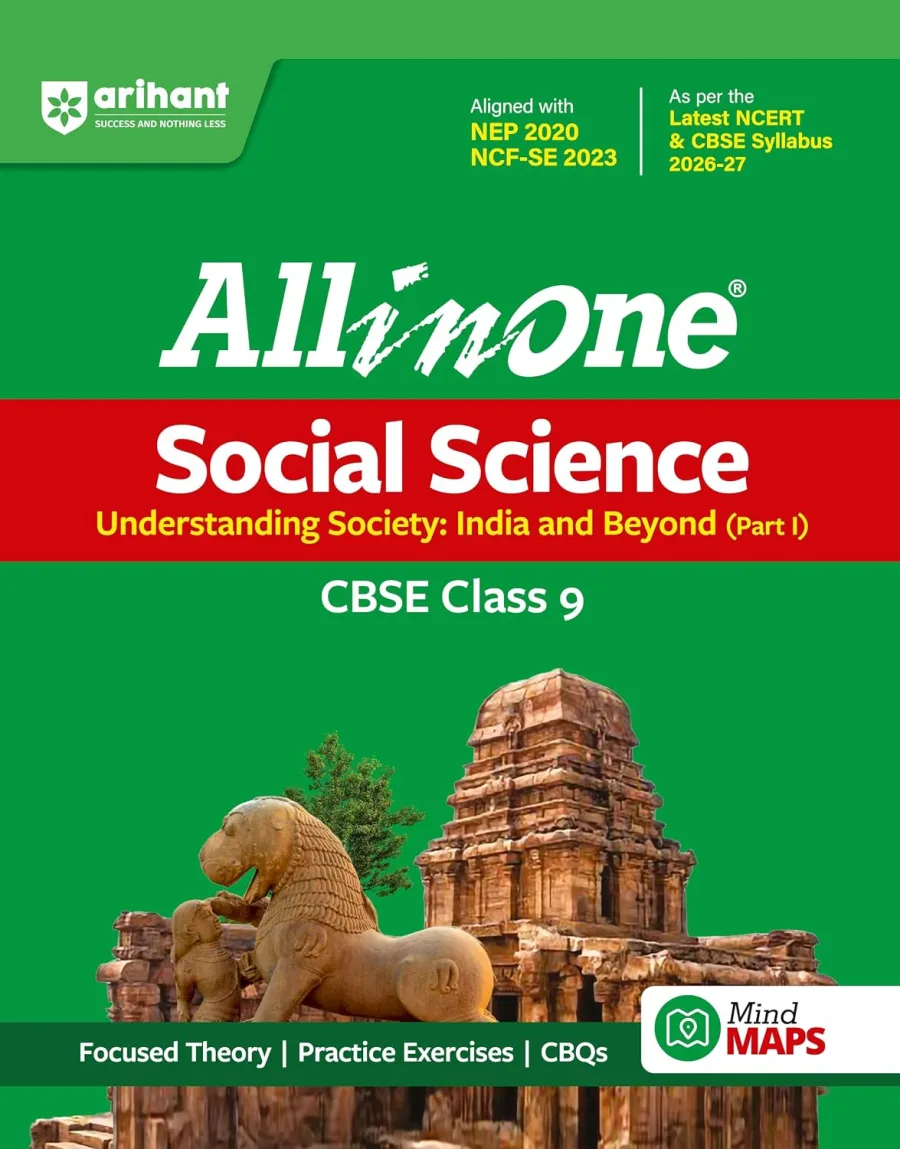
Arihant All in One Social Science (Understanding Society: India and Beyond – Part I) Class 9
Paperback
• 297 Pages
• ₹ 350.00
• English
• 9789378164927
No ratings yet
| Publisher | Arihant Publications India Limited |
|---|---|
| ISBN13 | 9789378164927 |
| ASIN/SKU | 9378164927 |
| Book Format | Paperback |
| Language | English |
| Pages | 297 |
| List Price | ₹ 350.00 |
| Publishing Date | 25/07/2026 |
| Dimensions | 25 x 21 x 2 cm |
| Weight | 475 g |
| Book Code | BD00070049 |
Buy this Book
Amazon Stores
Ebook Stores
Other Stores
Discover Arihant All in One Social Science (Understanding Society: India and Beyond – Part I) Class 9 by Nazma Ansari. This book is published by Arihant Publications India Limited in Paperback format, ISBN 9789378164927, ASIN 9378164927, under School Books, Reference, CBSE.
Book Description
Book Description will be added soon…
Author Biography
Author Biography will be added soon…
Editorial Reviews
Editorial Reviews will be added soon…
Book Summary
Arihant All in One Social Science (Understanding Society: India and Beyond – Part I) Class 9 by Nazma Ansari and Namita Sharma is a comprehensive study guide designed for students following the new CBSE Class 9 Social Science curriculum for the 2026–27 academic session. The book is based on the latest NCERT syllabus and is presented as an exam-oriented resource combining theory, practice, competency-based questions, assertion-reason questions, sample papers, and mind maps. Arihant describes the book as aligned with NEP 2020, NCF-SE 2023, and the latest NCERT and CBSE syllabus.
The book is intended to make Social Science easier to understand by bringing the major learning material into one organized resource. Social Science can sometimes feel difficult because it combines history, geography, political understanding, economics, society, culture, and contemporary issues. Students are expected not only to remember information but also to understand relationships, interpret situations, and answer questions in a clear and logical way. This guide attempts to address these requirements through simplified explanations and examination-focused practice.
At the foundation of the book is the NCERT textbook Understanding Society: India and Beyond – Part I. The new Class 9 Social Science curriculum places greater emphasis on understanding society and India's relationship with its geographical, historical, cultural, political, and economic environment. The Arihant guide follows this framework and presents the material in a student-friendly manner. Rather than encouraging students to memorize isolated facts, it aims to help them understand important concepts and then apply those concepts when answering questions.
History-related learning helps students understand how societies and civilizations develop over time. Historical knowledge is not simply a collection of dates and names. Students need to understand how political institutions, economies, cultures, communities, technologies, and ideas change. The guide's explanatory approach can help students connect individual historical developments with broader social changes. This is particularly useful for competency-based examinations, where questions may present a situation or source and ask students to interpret it rather than simply recall a fact.
Geographical understanding is another important part of Social Science. Students need to understand India's physical environment and the relationship between people and places. Geography helps explain why different regions have different patterns of settlement, agriculture, resources, occupations, and lifestyles. When geographical concepts are studied together with social and economic information, students can develop a broader understanding of how human societies interact with their surroundings.
The book also encourages students to think about Indian society. Society is made up of individuals, families, communities, institutions, and cultural traditions, and these elements continuously influence one another. Students can explore ideas related to diversity, social interaction, identity, cooperation, differences, and shared experiences. Such topics are important because they encourage learners to look beyond textbook definitions and consider how social concepts appear in everyday life.
The phrase “India and Beyond” reflects the broader perspective of the curriculum. India is studied within a wider world rather than as an isolated subject. Students can therefore develop an understanding of how geographical, historical, cultural, and economic connections extend beyond national boundaries. This approach encourages curiosity about other societies while also helping students understand India's place within the wider world.
One of the major strengths of the guide is its focused theory. Instead of presenting information in an unnecessarily complicated manner, the book attempts to explain concepts in language that is accessible to Class 9 students. Clear explanations are particularly important at this stage because the new curriculum requires students to understand concepts rather than merely reproduce textbook sentences. The guide can therefore function as a companion to the original NCERT material.
The book also contains chapter-wise practice exercises. Practice is important because understanding a chapter while reading it does not necessarily mean that a student can answer examination questions correctly. Exercises encourage students to recall information, apply concepts, and identify areas where their understanding is incomplete. Regular practice can also make students more comfortable with different question formats.
Competency-Based Questions (CBQs) are another significant feature. CBQs are designed to test whether students can use what they have learned in a particular situation. Instead of asking only direct factual questions, such questions may provide a scenario, information, data, or context and require students to interpret it. This type of preparation is increasingly important in modern school examinations because students are expected to demonstrate understanding and application.
The guide also includes Assertion-Reason questions, which require students to examine two related statements and determine their relationship. These questions can be challenging because students must understand both statements independently and then decide whether the second statement correctly explains the first. Practicing this format can improve precision and discourage students from relying on superficial memorization.
Mind maps provide another useful learning tool. Social Science chapters can contain numerous interconnected ideas, and students may find it difficult to remember how individual concepts relate to one another. A mind map condenses the central information into a visual structure. During revision, students can use these maps to quickly recall the main ideas of a chapter and understand their relationships.
The book is also designed to support self-assessment. Students can use practice questions to determine which areas they understand well and which require additional attention. This is an important part of effective examination preparation because students often spend too much time revising topics they already know while neglecting weaker areas. Self-assessment helps make study time more purposeful.
Sample papers provide another layer of preparation. Once students have completed the theory and chapter-level exercises, sample papers allow them to experience a more complete examination-style environment. They can practice answering different types of questions within a limited amount of time. This can help improve time management, answer organization, and confidence before school examinations.
The guide is particularly useful because Social Science requires different styles of learning. Some information needs to be remembered, some needs to be understood conceptually, and some needs to be interpreted. For example, a student may need to remember an important historical development but also explain why it happened. Similarly, a geographical concept may need to be connected with an economic or social consequence. The combination of theory and application-oriented practice helps address these different requirements.
The book can also help students prepare for periodic tests and classroom assessments rather than being used only before the annual examination. Chapter-wise preparation allows students to study alongside their school lessons. After completing a chapter in class and reading the corresponding NCERT material, students can use the Arihant guide to reinforce their understanding and practice questions.
However, the guide is best used as a companion to the NCERT textbook rather than a complete replacement for it. Since the book is specifically designed around the NCERT and CBSE curriculum, students should first become familiar with the original textbook. Reading NCERT carefully helps students understand the official presentation, examples, activities, maps, illustrations, and explanations. The Arihant guide can then simplify revision and provide additional examination practice.
The book is also valuable for developing analytical thinking. Social Science is not only about knowing what happened or what a particular term means. It is also about understanding why societies change, how institutions function, how people interact with their environment, and how different forces influence one another. Questions that require comparison, interpretation, reasoning, or application can help students develop these skills.
The book is intended to make Social Science easier to understand by bringing the major learning material into one organized resource. Social Science can sometimes feel difficult because it combines history, geography, political understanding, economics, society, culture, and contemporary issues. Students are expected not only to remember information but also to understand relationships, interpret situations, and answer questions in a clear and logical way. This guide attempts to address these requirements through simplified explanations and examination-focused practice.
At the foundation of the book is the NCERT textbook Understanding Society: India and Beyond – Part I. The new Class 9 Social Science curriculum places greater emphasis on understanding society and India's relationship with its geographical, historical, cultural, political, and economic environment. The Arihant guide follows this framework and presents the material in a student-friendly manner. Rather than encouraging students to memorize isolated facts, it aims to help them understand important concepts and then apply those concepts when answering questions.
History-related learning helps students understand how societies and civilizations develop over time. Historical knowledge is not simply a collection of dates and names. Students need to understand how political institutions, economies, cultures, communities, technologies, and ideas change. The guide's explanatory approach can help students connect individual historical developments with broader social changes. This is particularly useful for competency-based examinations, where questions may present a situation or source and ask students to interpret it rather than simply recall a fact.
Geographical understanding is another important part of Social Science. Students need to understand India's physical environment and the relationship between people and places. Geography helps explain why different regions have different patterns of settlement, agriculture, resources, occupations, and lifestyles. When geographical concepts are studied together with social and economic information, students can develop a broader understanding of how human societies interact with their surroundings.
The book also encourages students to think about Indian society. Society is made up of individuals, families, communities, institutions, and cultural traditions, and these elements continuously influence one another. Students can explore ideas related to diversity, social interaction, identity, cooperation, differences, and shared experiences. Such topics are important because they encourage learners to look beyond textbook definitions and consider how social concepts appear in everyday life.
The phrase “India and Beyond” reflects the broader perspective of the curriculum. India is studied within a wider world rather than as an isolated subject. Students can therefore develop an understanding of how geographical, historical, cultural, and economic connections extend beyond national boundaries. This approach encourages curiosity about other societies while also helping students understand India's place within the wider world.
One of the major strengths of the guide is its focused theory. Instead of presenting information in an unnecessarily complicated manner, the book attempts to explain concepts in language that is accessible to Class 9 students. Clear explanations are particularly important at this stage because the new curriculum requires students to understand concepts rather than merely reproduce textbook sentences. The guide can therefore function as a companion to the original NCERT material.
The book also contains chapter-wise practice exercises. Practice is important because understanding a chapter while reading it does not necessarily mean that a student can answer examination questions correctly. Exercises encourage students to recall information, apply concepts, and identify areas where their understanding is incomplete. Regular practice can also make students more comfortable with different question formats.
Competency-Based Questions (CBQs) are another significant feature. CBQs are designed to test whether students can use what they have learned in a particular situation. Instead of asking only direct factual questions, such questions may provide a scenario, information, data, or context and require students to interpret it. This type of preparation is increasingly important in modern school examinations because students are expected to demonstrate understanding and application.
The guide also includes Assertion-Reason questions, which require students to examine two related statements and determine their relationship. These questions can be challenging because students must understand both statements independently and then decide whether the second statement correctly explains the first. Practicing this format can improve precision and discourage students from relying on superficial memorization.
Mind maps provide another useful learning tool. Social Science chapters can contain numerous interconnected ideas, and students may find it difficult to remember how individual concepts relate to one another. A mind map condenses the central information into a visual structure. During revision, students can use these maps to quickly recall the main ideas of a chapter and understand their relationships.
The book is also designed to support self-assessment. Students can use practice questions to determine which areas they understand well and which require additional attention. This is an important part of effective examination preparation because students often spend too much time revising topics they already know while neglecting weaker areas. Self-assessment helps make study time more purposeful.
Sample papers provide another layer of preparation. Once students have completed the theory and chapter-level exercises, sample papers allow them to experience a more complete examination-style environment. They can practice answering different types of questions within a limited amount of time. This can help improve time management, answer organization, and confidence before school examinations.
The guide is particularly useful because Social Science requires different styles of learning. Some information needs to be remembered, some needs to be understood conceptually, and some needs to be interpreted. For example, a student may need to remember an important historical development but also explain why it happened. Similarly, a geographical concept may need to be connected with an economic or social consequence. The combination of theory and application-oriented practice helps address these different requirements.
The book can also help students prepare for periodic tests and classroom assessments rather than being used only before the annual examination. Chapter-wise preparation allows students to study alongside their school lessons. After completing a chapter in class and reading the corresponding NCERT material, students can use the Arihant guide to reinforce their understanding and practice questions.
However, the guide is best used as a companion to the NCERT textbook rather than a complete replacement for it. Since the book is specifically designed around the NCERT and CBSE curriculum, students should first become familiar with the original textbook. Reading NCERT carefully helps students understand the official presentation, examples, activities, maps, illustrations, and explanations. The Arihant guide can then simplify revision and provide additional examination practice.
The book is also valuable for developing analytical thinking. Social Science is not only about knowing what happened or what a particular term means. It is also about understanding why societies change, how institutions function, how people interact with their environment, and how different forces influence one another. Questions that require comparison, interpretation, reasoning, or application can help students develop these skills.
Sample Chapters
Sample Chapters will be added soon…
Reader Reviews
No reviews yet.
Arihant All in One Social Science (Understanding Society: India and Beyond – Part I) Class 9
Download Cover Image
Do you want to download the full cover image for Arihant All in One Social Science (Understanding Society: India and Beyond – Part I) Class 9?