
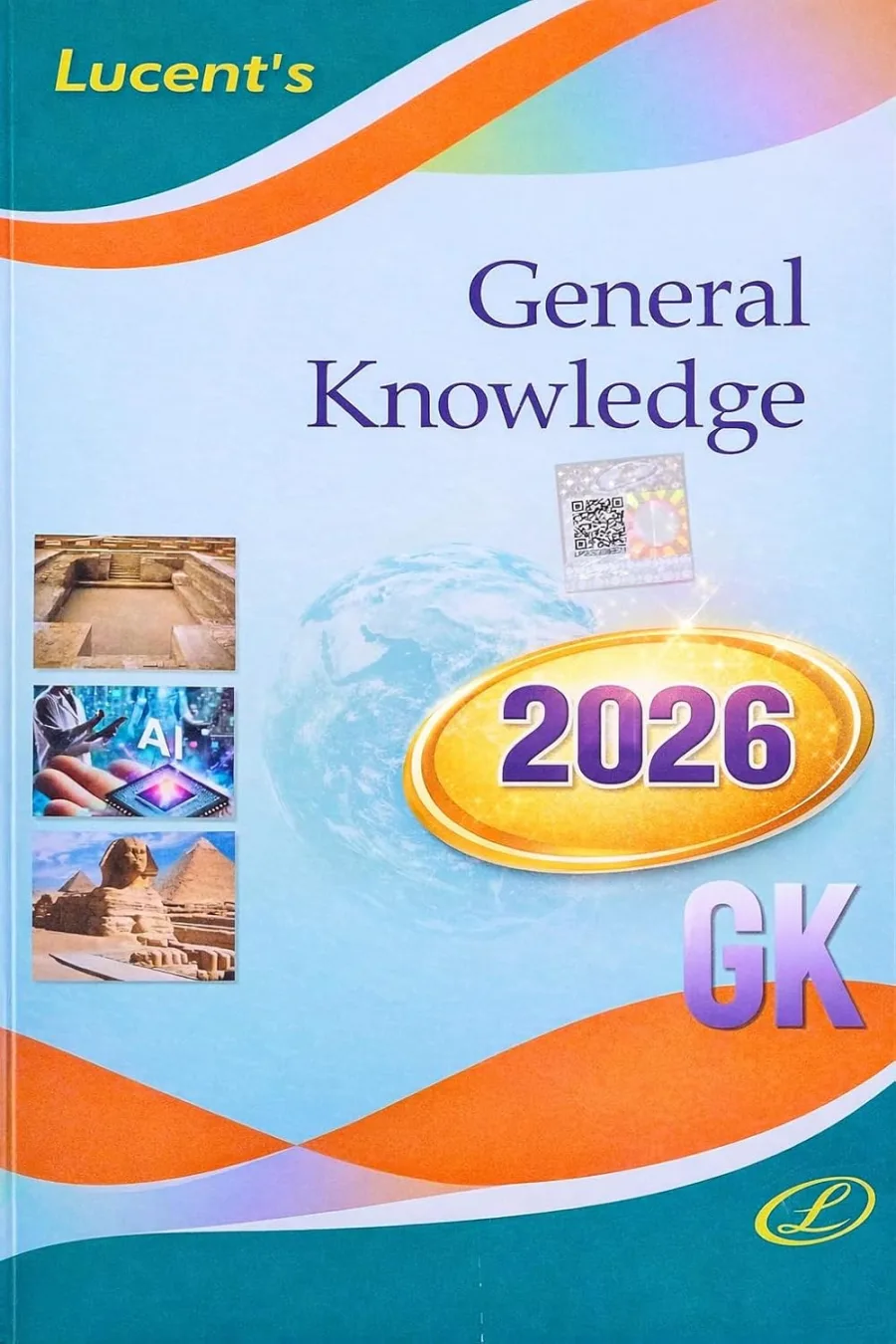
Lucent's General Knowledge 2026 - English | Lucent Gk 2026 New Edition English | 15th Revised
Paperback
• 460 Pages
• ₹ 285.00
• English
No ratings yet
| Publisher | Lucent Publications |
|---|---|
| ASIN/SKU | B0GDQLFJSB |
| Book Format | Paperback |
| Language | English |
| Pages | 460 |
| List Price | ₹ 285.00 |
| Publishing Date | 02/01/2026 |
| Dimensions | 27 x 18 x 1.5 cm |
| Weight | 600 g |
| Book Code | BD00070047 |
Buy this Book
Amazon Stores
Ebook Stores
Other Stores
Discover Lucent's General Knowledge 2026 - English | Lucent Gk 2026 New Edition English | 15th Revised by Dr. Binay Karna. This book is published by Lucent Publications in Paperback format, ASIN B0GDQLFJSB, under Exam Preparation, Uttarakhand Education Board, UPSC Civil Services.
Book Description
Lucent's General Knowledge 2026 - English | Lucent Gk 2026 New Edition English | 15th Revised Edition | For UPSC, SSC, NDA, CDS, Banking, Railways, Defence & All Competitive Exams (2026-27)
Author Biography
Author Biography will be added soon…
Editorial Reviews
Editorial Reviews will be added soon…
Book Summary
Lucent's General Knowledge 2026 – English, edited by Dr. Binay Karna, is a comprehensive general knowledge reference book designed mainly for students preparing for competitive examinations in India. The 15th revised edition brings together important information from history, geography, Indian polity, economics, general science, and general awareness in one organized volume. Its primary purpose is to help students build a broad foundation of factual and conceptual knowledge that can be useful for examinations such as SSC, Railway, banking, defence, teaching, and various state-level competitive examinations.
The book is especially useful because General Knowledge can be a difficult subject to prepare for systematically. Unlike a single academic subject, GK covers many different areas. A student may need to remember historical events, constitutional provisions, geographical facts, scientific principles, economic terms, important personalities, cultural developments, and many other pieces of information. Lucent's General Knowledge attempts to bring these subjects together so that learners can study them in a structured manner instead of depending on numerous separate reference books.
The History section provides a broad overview of the Indian past. It introduces important developments from ancient, medieval, and modern India. Ancient history covers subjects connected with early civilizations, the Vedic period, major kingdoms and empires, religious and cultural developments, and important archaeological and literary sources. The medieval section discusses major dynasties, political developments, important rulers, administration, religion, architecture, literature, and cultural movements. Modern Indian history receives particular attention because it is highly relevant to many competitive examinations. Students encounter the growth of British power, important administrative changes, social and religious reform movements, the Revolt of 1857, the rise of nationalism, the freedom struggle, and the events leading to Independence.
The historical information is presented primarily for quick learning and revision. Instead of providing the lengthy narrative found in a conventional history textbook, the book focuses on facts, names, dates, events, institutions, and developments that students are likely to encounter in objective examinations. This makes it particularly useful for revision when an aspirant needs to recall a large amount of information in a relatively short period.
Geography is another major section. It introduces students to the physical and human geography of India as well as important aspects of world geography. Topics include the Earth, continents, oceans, mountains, rivers, climate, soils, natural resources, agriculture, industries, population, transportation, and other geographical features. Indian geography receives special emphasis because questions about India's physical structure, rivers, states, climate, crops, minerals, and natural resources frequently appear in competitive examinations.
The geography material also helps students understand relationships between physical conditions and human activities. Climate influences agriculture, rivers support settlement and economic activity, and natural resources affect industrial development. Although the book is primarily examination-oriented, learning these connections can make individual facts easier to remember because students can place them within a larger geographical framework.
Indian Polity is another important area covered by the book. Students are introduced to the Constitution of India, its basic features, Fundamental Rights, Fundamental Duties, Directive Principles of State Policy, Parliament, the President, the Prime Minister, the Council of Ministers, the Supreme Court, the High Courts, constitutional bodies, elections, local government, and important constitutional amendments. These topics are particularly important for competitive examinations because questions frequently test knowledge of constitutional provisions and the structure of Indian government.
The polity section provides students with a foundation for understanding how India's political system functions. Instead of seeing constitutional articles and institutions as completely separate facts, students can begin to understand how different parts of the system are connected. For example, learning about Parliament alongside the executive and judiciary helps explain the broader structure of government and the distribution of constitutional responsibilities.
Economics forms another important component of the book. It introduces basic economic concepts and terminology while also discussing the Indian economy. Students encounter topics related to national income, money, banking, taxation, public finance, inflation, poverty, unemployment, agriculture, industries, economic planning, and other important areas. The purpose is to give learners enough understanding to answer common examination questions without requiring them to study economics at an advanced academic level.
General Science is one of the most useful sections for students preparing for examinations in which science questions form part of General Awareness. The material broadly covers Physics, Chemistry, Biology, and everyday science. Physics introduces basic principles involving motion, force, energy, heat, light, sound, electricity, and related concepts. Chemistry covers elements, compounds, acids, bases, metals, chemical reactions, and common substances. Biology includes the human body, cells, nutrition, diseases, plants, animals, reproduction, and other fundamental biological concepts.
The science section is especially helpful because it presents scientific information in an accessible examination-oriented form. Students who have not studied science recently can use it to revise basic concepts and important facts. The emphasis on everyday applications also makes many topics easier to connect with familiar experiences.
The book also contains information relating to culture, sports, awards, important personalities, books and authors, national symbols, organizations, and other areas of static General Knowledge. These topics can be difficult to organize independently because they do not belong to one specific school subject. Including them within the same reference book gives students a convenient source for broad revision.
One of the major advantages of a comprehensive GK book is that it allows students to make connections between subjects. History can be linked with geography, geography with economics, and polity with modern history. For example, understanding India's freedom movement becomes easier when students know something about colonial administration and the economic conditions of the period. Similarly, knowledge of India's natural resources can help explain aspects of agriculture and industrial development. Although the book is organized into separate subject areas, its overall usefulness increases when students study these subjects as parts of a larger picture.
The revised edition is particularly relevant for students preparing for the 2026 examination cycle because updated editions are intended to incorporate corrections, revisions, and changes in the presentation of the material. However, students should remember that a static GK reference book cannot replace current-affairs preparation. Political office-holders, awards, appointments, government schemes, sports results, scientific developments, and other contemporary information can change after publication. Aspirants preparing for examinations that include current affairs should therefore supplement the book with reliable and up-to-date sources.
Another important strength of Lucent's General Knowledge is its usefulness for revision. Competitive-exam preparation often requires students to revisit the same information several times. A large academic textbook may be difficult to revise quickly, whereas a concise GK reference allows students to return to important topics repeatedly. Regular revision can help transform information from short-term recognition into stronger long-term memory.
The book can also function as a starting point for beginners. Students who are unfamiliar with the competitive-exam GK syllabus can use it to understand the major areas they need to study. Once they identify weaker subjects, they can use specialized books or other resources for deeper preparation. More experienced students can use the book as a revision source alongside previous-year question papers and mock tests.
Overall, Lucent's General Knowledge 2026 – English, 15th Revised Edition by Dr. Binay Karna is designed as a broad and practical reference for Indian competitive-exam aspirants.
The book is especially useful because General Knowledge can be a difficult subject to prepare for systematically. Unlike a single academic subject, GK covers many different areas. A student may need to remember historical events, constitutional provisions, geographical facts, scientific principles, economic terms, important personalities, cultural developments, and many other pieces of information. Lucent's General Knowledge attempts to bring these subjects together so that learners can study them in a structured manner instead of depending on numerous separate reference books.
The History section provides a broad overview of the Indian past. It introduces important developments from ancient, medieval, and modern India. Ancient history covers subjects connected with early civilizations, the Vedic period, major kingdoms and empires, religious and cultural developments, and important archaeological and literary sources. The medieval section discusses major dynasties, political developments, important rulers, administration, religion, architecture, literature, and cultural movements. Modern Indian history receives particular attention because it is highly relevant to many competitive examinations. Students encounter the growth of British power, important administrative changes, social and religious reform movements, the Revolt of 1857, the rise of nationalism, the freedom struggle, and the events leading to Independence.
The historical information is presented primarily for quick learning and revision. Instead of providing the lengthy narrative found in a conventional history textbook, the book focuses on facts, names, dates, events, institutions, and developments that students are likely to encounter in objective examinations. This makes it particularly useful for revision when an aspirant needs to recall a large amount of information in a relatively short period.
Geography is another major section. It introduces students to the physical and human geography of India as well as important aspects of world geography. Topics include the Earth, continents, oceans, mountains, rivers, climate, soils, natural resources, agriculture, industries, population, transportation, and other geographical features. Indian geography receives special emphasis because questions about India's physical structure, rivers, states, climate, crops, minerals, and natural resources frequently appear in competitive examinations.
The geography material also helps students understand relationships between physical conditions and human activities. Climate influences agriculture, rivers support settlement and economic activity, and natural resources affect industrial development. Although the book is primarily examination-oriented, learning these connections can make individual facts easier to remember because students can place them within a larger geographical framework.
Indian Polity is another important area covered by the book. Students are introduced to the Constitution of India, its basic features, Fundamental Rights, Fundamental Duties, Directive Principles of State Policy, Parliament, the President, the Prime Minister, the Council of Ministers, the Supreme Court, the High Courts, constitutional bodies, elections, local government, and important constitutional amendments. These topics are particularly important for competitive examinations because questions frequently test knowledge of constitutional provisions and the structure of Indian government.
The polity section provides students with a foundation for understanding how India's political system functions. Instead of seeing constitutional articles and institutions as completely separate facts, students can begin to understand how different parts of the system are connected. For example, learning about Parliament alongside the executive and judiciary helps explain the broader structure of government and the distribution of constitutional responsibilities.
Economics forms another important component of the book. It introduces basic economic concepts and terminology while also discussing the Indian economy. Students encounter topics related to national income, money, banking, taxation, public finance, inflation, poverty, unemployment, agriculture, industries, economic planning, and other important areas. The purpose is to give learners enough understanding to answer common examination questions without requiring them to study economics at an advanced academic level.
General Science is one of the most useful sections for students preparing for examinations in which science questions form part of General Awareness. The material broadly covers Physics, Chemistry, Biology, and everyday science. Physics introduces basic principles involving motion, force, energy, heat, light, sound, electricity, and related concepts. Chemistry covers elements, compounds, acids, bases, metals, chemical reactions, and common substances. Biology includes the human body, cells, nutrition, diseases, plants, animals, reproduction, and other fundamental biological concepts.
The science section is especially helpful because it presents scientific information in an accessible examination-oriented form. Students who have not studied science recently can use it to revise basic concepts and important facts. The emphasis on everyday applications also makes many topics easier to connect with familiar experiences.
The book also contains information relating to culture, sports, awards, important personalities, books and authors, national symbols, organizations, and other areas of static General Knowledge. These topics can be difficult to organize independently because they do not belong to one specific school subject. Including them within the same reference book gives students a convenient source for broad revision.
One of the major advantages of a comprehensive GK book is that it allows students to make connections between subjects. History can be linked with geography, geography with economics, and polity with modern history. For example, understanding India's freedom movement becomes easier when students know something about colonial administration and the economic conditions of the period. Similarly, knowledge of India's natural resources can help explain aspects of agriculture and industrial development. Although the book is organized into separate subject areas, its overall usefulness increases when students study these subjects as parts of a larger picture.
The revised edition is particularly relevant for students preparing for the 2026 examination cycle because updated editions are intended to incorporate corrections, revisions, and changes in the presentation of the material. However, students should remember that a static GK reference book cannot replace current-affairs preparation. Political office-holders, awards, appointments, government schemes, sports results, scientific developments, and other contemporary information can change after publication. Aspirants preparing for examinations that include current affairs should therefore supplement the book with reliable and up-to-date sources.
Another important strength of Lucent's General Knowledge is its usefulness for revision. Competitive-exam preparation often requires students to revisit the same information several times. A large academic textbook may be difficult to revise quickly, whereas a concise GK reference allows students to return to important topics repeatedly. Regular revision can help transform information from short-term recognition into stronger long-term memory.
The book can also function as a starting point for beginners. Students who are unfamiliar with the competitive-exam GK syllabus can use it to understand the major areas they need to study. Once they identify weaker subjects, they can use specialized books or other resources for deeper preparation. More experienced students can use the book as a revision source alongside previous-year question papers and mock tests.
Overall, Lucent's General Knowledge 2026 – English, 15th Revised Edition by Dr. Binay Karna is designed as a broad and practical reference for Indian competitive-exam aspirants.
Sample Chapters
Sample Chapters will be added soon…
Reader Reviews
No reviews yet.
Lucent's General Knowledge 2026 - English | Lucent Gk 2026 New Edition English | 15th Revised
Download Cover Image
Do you want to download the full cover image for Lucent's General Knowledge 2026 - English | Lucent Gk 2026 New Edition English | 15th Revised?