
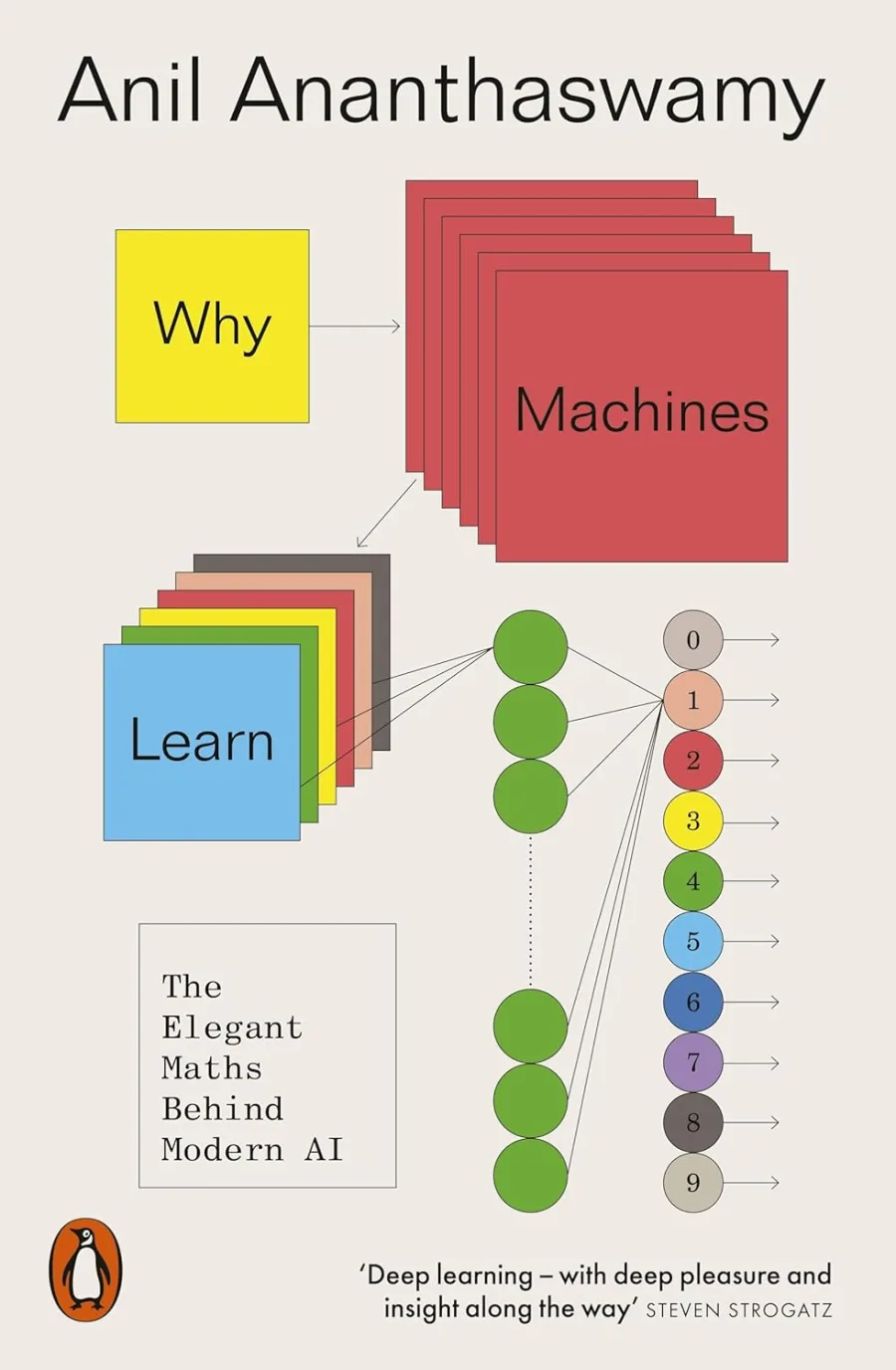
Why Machines Learn: The Elegant Maths Behind Modern AI
Paperback
• 480 Pages
• INR 850.00
• English
• 9781802060867
No ratings yet
| Publisher | Penguin |
|---|---|
| ISBN13 | 9781802060867 |
| ASIN/SKU | 1802060863 |
| Book Format | Paperback |
| Language | English |
| Pages | 480 |
| List Price | INR 850.00 |
| Publishing Date | 28/08/2025 |
| Dimensions | 15.3 x 3.5 x 23.4 cm |
| Weight | 500 g |
| Book Code | BD00069807 |
Buy this Book
Amazon Stores
Ebook Stores
Other Stores
Discover Why Machines Learn: The Elegant Maths Behind Modern AI by Anil Ananthaswamy. This book is published by Penguin in Paperback format, ISBN 9781802060867, ASIN 1802060863, under Computers and Technology, Artificial Intelligence, Computer Science Books.
Book Description
'An invaluable companion for anyone who wants a deep understanding of what’s under the hood of often inscrutable machines' Melanie Mitchell
A rich, narrative explanation of the mathematics that has brought us machine learning and the ongoing explosion of artificial intelligence
Machine-learning systems are making life-altering decisions for us: approving mortgage loans, determining whether a tumour is cancerous, or deciding whether someone gets bail. They now influence discoveries in chemistry, biology and physics - the study of genomes, extra-solar planets, even the intricacies of quantum systems.
We are living through a revolution in artificial intelligence that is not slowing down. This major shift is based on simple mathematics, some of which goes back centuries: linear algebra and calculus, the stuff of eighteenth-century mathematics. Indeed by the mid-1850s, a lot of the groundwork was all done. It took the development of computer science and the kindling of 1990s computer chips designed for video games to ignite the explosion of AI that we see all around us today. In this enlightening book, Anil Ananthaswamy explains the fundamental maths behind AI, which suggests that the basics of natural and artificial intelligence might follow the same mathematical rules.
As Ananthaswamy resonantly concludes, to make the most of our most wondrous technologies we need to understand their profound limitations - the clues lie in the maths that makes AI possible.
A rich, narrative explanation of the mathematics that has brought us machine learning and the ongoing explosion of artificial intelligence
Machine-learning systems are making life-altering decisions for us: approving mortgage loans, determining whether a tumour is cancerous, or deciding whether someone gets bail. They now influence discoveries in chemistry, biology and physics - the study of genomes, extra-solar planets, even the intricacies of quantum systems.
We are living through a revolution in artificial intelligence that is not slowing down. This major shift is based on simple mathematics, some of which goes back centuries: linear algebra and calculus, the stuff of eighteenth-century mathematics. Indeed by the mid-1850s, a lot of the groundwork was all done. It took the development of computer science and the kindling of 1990s computer chips designed for video games to ignite the explosion of AI that we see all around us today. In this enlightening book, Anil Ananthaswamy explains the fundamental maths behind AI, which suggests that the basics of natural and artificial intelligence might follow the same mathematical rules.
As Ananthaswamy resonantly concludes, to make the most of our most wondrous technologies we need to understand their profound limitations - the clues lie in the maths that makes AI possible.
Author Biography
ANIL ANANTHASWAMY is former deputy news editor and current consultant for New Scientist. He is a guest editor at UC Santa Cruz’s science-writing program and teaches an annual science journalism workshop at the National Centre for Biological Sciences in Bangalore, India. He is a freelance feature editor for the Proceedings of the National Academy of Science’s “Front Matter” and has written for National Geographic News, Discover, and Matter. He has been a columnist for PBS NOVA’s The Nature of Reality blog. He won the UK Institute of Physics’ Physics Journalism award and the British Association of Science Writers’ award for Best Investigative Journalism. His first book, The Edge of Physics, was voted book of the year in 2010 by Physics World.
Editorial Reviews
Editorial Reviews will be added soon…
Book Summary
Book Summary will be added soon…
Sample Chapters
Sample Chapters will be added soon…
Reader Reviews
No reviews yet.
Why Machines Learn: The Elegant Maths Behind Modern AI
Download Cover Image
Do you want to download the full cover image for Why Machines Learn: The Elegant Maths Behind Modern AI?