
Computer Systems: A Programmer's Perspective, 3/e
Randal E. Bryant, David R. O'Hallaron
Paperback
• 1120 Pages
• ₹ 1125.00
• English
• 9789332573901
No ratings yet
| Publisher | Pearson Education India |
|---|---|
| ISBN13 | 9789332573901 |
| ASIN/SKU | 9332573905 |
| Book Format | Paperback |
| Language | English |
| Pages | 1120 |
| List Price | ₹ 1125.00 |
| Publishing Date | 17/06/2026 |
| Dimensions | 20.3 x 25.4 x 4.7 cm |
| Weight | 1 kg 320 g |
| Book Code | BD00069628 |
Buy this Book
Amazon Stores
Ebook Stores
Other Stores
Discover Computer Systems: A Programmer's Perspective, 3/e by Randal E. Bryant. This book is published by Pearson Education India in Paperback format, ISBN 9789332573901, ASIN 9332573905, under Higher Education Textbooks, Operating Systems Textbooks.
Book Description
COMPUTER SYSTEMS
A Programmer’s Perspective
Randal E. Bryant | David R. O’Hallaron
Computer Systems: A Programmer’s Perspective explains the underlying elements common among all computer systems and how they affect general application performance. Written from the programmer’s perspective, this book strives to teach students how understanding basic elements of computer systems and executing real practice can lead them to create better programs.
Spanning across computer science themes such as hardware architecture, the operating system, and systems software, the Third Edition serves as a comprehensive introduction to programming. This book strives to create programmers who understand all elements of computer systems and will be able to engage in any application of the field from fixing faulty software, to writing more capable programs, to avoiding common flaws. It lays the groundwork for students to delve into more intensive topics such as computer architecture, embedded systems, and cyber security.
Includes greater coverage of using thread-level parallelism to make programs run faster on multi-core machines.
Introduces techniques for protocol-independent and thread-safe network programming using the modern getaddrinfo and getnameinfo functions to replace older, obsolete functions.
Has more in-depth information about signal handlers, including async-signal-safe functions, specific guidelines for writing signal handlers, and using sigsuspend to wait for handlers.
Contains new material on the performance capabilities of recent generations of x86-64 processors, which is a more reliable predictor of performance.
A Programmer’s Perspective
Randal E. Bryant | David R. O’Hallaron
Computer Systems: A Programmer’s Perspective explains the underlying elements common among all computer systems and how they affect general application performance. Written from the programmer’s perspective, this book strives to teach students how understanding basic elements of computer systems and executing real practice can lead them to create better programs.
Spanning across computer science themes such as hardware architecture, the operating system, and systems software, the Third Edition serves as a comprehensive introduction to programming. This book strives to create programmers who understand all elements of computer systems and will be able to engage in any application of the field from fixing faulty software, to writing more capable programs, to avoiding common flaws. It lays the groundwork for students to delve into more intensive topics such as computer architecture, embedded systems, and cyber security.
Includes greater coverage of using thread-level parallelism to make programs run faster on multi-core machines.
Introduces techniques for protocol-independent and thread-safe network programming using the modern getaddrinfo and getnameinfo functions to replace older, obsolete functions.
Has more in-depth information about signal handlers, including async-signal-safe functions, specific guidelines for writing signal handlers, and using sigsuspend to wait for handlers.
Contains new material on the performance capabilities of recent generations of x86-64 processors, which is a more reliable predictor of performance.
Author Biography
Randal E. Bryant received his bachelor’s degree from the University of Michigan in 1973 and then attended graduate school at the Massachusetts Institute of Technology, receiving his PhD degree in computer science in 1981. He spent three years as an assistant professor at the California Institute of Technology, and has been on the faculty at Carnegie Mellon since 1984. For five of those years he served as head of the Computer Science Department, and for ten of them he served as Dean of the School of Computer Science. He is currently a university professor of computer science. He also holds a courtesy appointment with the Department of Electrical and Computer Engineering.
Professor Bryant has taught courses in computer systems at both the undergraduate and graduate level for around 40 years. Over many years of teaching computer architecture courses, he began shifting the focus from how computers are designed to how programmers can write more efficient and reliable programs if they understand the system better. Together with Professor O’Hallaron, he developed the course 15-213, Introduction to Computer Systems, at Carnegie Mellon that is the basis for this book. He has also taught courses in algorithms, programming, computer networking, distributed systems, and VLSI design.
Most of Professor Bryant’s research concerns the design of software tools to help software and hardware designers verify the correctness of their systems. These include several types of simulators, as well as formal verification tools that prove the correctness of a design using mathematical methods. He has published over 150 technical papers. His research results are used by major computer manufacturers, including Intel, IBM, Fujitsu, and Microsoft. He has won several major awards for his research. These include two inventor recognition awards and a technical achievement award from the Semiconductor Research Corporation, the Kanellakis Theory and Practice Award from the Association for Computer Machinery (ACM), and the W. R. G. Baker Award, the Emmanuel Piore Award, the Phil Kaufman Award, and the A. Richard Newton Award from the Institute of Electrical and Electronics Engineers (IEEE). He is a fellow of both the ACM and the IEEE and a member of both the US National Academy of Engineering and the American Academy of Arts and Sciences.
Professor Bryant has taught courses in computer systems at both the undergraduate and graduate level for around 40 years. Over many years of teaching computer architecture courses, he began shifting the focus from how computers are designed to how programmers can write more efficient and reliable programs if they understand the system better. Together with Professor O’Hallaron, he developed the course 15-213, Introduction to Computer Systems, at Carnegie Mellon that is the basis for this book. He has also taught courses in algorithms, programming, computer networking, distributed systems, and VLSI design.
Most of Professor Bryant’s research concerns the design of software tools to help software and hardware designers verify the correctness of their systems. These include several types of simulators, as well as formal verification tools that prove the correctness of a design using mathematical methods. He has published over 150 technical papers. His research results are used by major computer manufacturers, including Intel, IBM, Fujitsu, and Microsoft. He has won several major awards for his research. These include two inventor recognition awards and a technical achievement award from the Semiconductor Research Corporation, the Kanellakis Theory and Practice Award from the Association for Computer Machinery (ACM), and the W. R. G. Baker Award, the Emmanuel Piore Award, the Phil Kaufman Award, and the A. Richard Newton Award from the Institute of Electrical and Electronics Engineers (IEEE). He is a fellow of both the ACM and the IEEE and a member of both the US National Academy of Engineering and the American Academy of Arts and Sciences.
Editorial Reviews
Editorial Reviews will be added soon…
Book Summary
Book Summary will be added soon…
Sample Chapters
Sample Chapters will be added soon…
Reader Reviews
No reviews yet.
Computer Systems: A Programmer's Perspective, 3/e
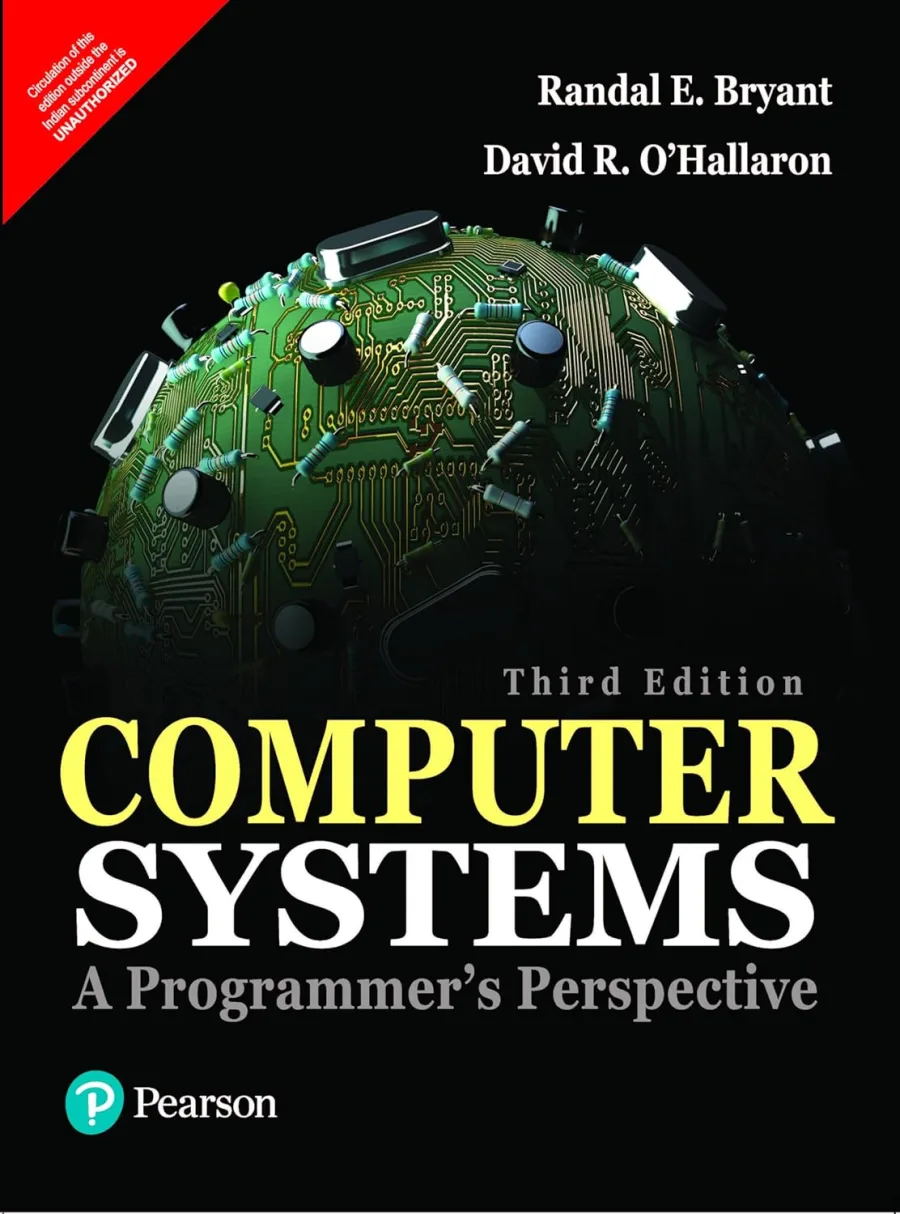
Download Cover Image
Do you want to download the full cover image for Computer Systems: A Programmer's Perspective, 3/e?