
Hands-On Machine Learning with Scikit-Learn, Keras, and TensorFlow
Paperback
• 864 Pages
• ₹ 3250.00
• English
• 9789355421982
No ratings yet
| Publisher | Shroff/O'Reilly |
|---|---|
| ISBN13 | 9789355421982 |
| ASIN/SKU | 9355421982 |
| Book Format | Paperback |
| Language | English |
| Pages | 864 |
| List Price | ₹ 3250.00 |
| Publishing Date | 10/10/2022 |
| Dimensions | 22.86 x 17.78 x 4.32 cm |
| Weight | 1 kg 500 g |
| Book Code | BD00069557 |
Buy this Book
Amazon Stores
Ebook Stores
Other Stores
Discover Hands-On Machine Learning with Scikit-Learn, Keras, and TensorFlow by Aurélien Géron. This book is published by Shroff/O'Reilly in Paperback format, ISBN 9789355421982, ASIN 9355421982, under Higher Education Textbooks, Artificial Intelligence.
Book Description
Shroff Publishers do not endorse the preview pages of kindle linked to our ISBNs.
Through a recent series of breakthroughs, deep learning has boosted the entire field of machine learning. Now, even programmers who know close to nothing about this technology can use simple, efficient tools to implement programs capable of learning from data. This best-selling book uses concrete examples, minimal theory, and production-ready Python frameworks--scikit-learn, Keras, and TensorFlow--to help you gain an intuitive understanding of the concepts and tools for building intelligent systems.
With this updated third edition, author Aurelien Geron explores a range of techniques, starting with simple linear regression and progressing to deep neural networks. Numerous code examples and exercises throughout the book help you apply what you've learned. Programming experience is all you need to get started.
Use scikit-learn to track an example machine learning project end to end
Explore several models, including support vector machines, decision trees, random forests, and ensemble methods
Exploit unsupervised learning techniques such as dimensionality reduction, clustering, and anomaly detection
Dive into neural net architectures, including convolutional nets, recurrent nets, generative adversarial networks, and transformers
Use TensorFlow and Keras to build and train neural nets for computer vision, natural language processing, generative models, and deep reinforcement learning
Train neural nets using multiple GPUs and deploy them at scale using Google's Vertex AI
Through a recent series of breakthroughs, deep learning has boosted the entire field of machine learning. Now, even programmers who know close to nothing about this technology can use simple, efficient tools to implement programs capable of learning from data. This best-selling book uses concrete examples, minimal theory, and production-ready Python frameworks--scikit-learn, Keras, and TensorFlow--to help you gain an intuitive understanding of the concepts and tools for building intelligent systems.
With this updated third edition, author Aurelien Geron explores a range of techniques, starting with simple linear regression and progressing to deep neural networks. Numerous code examples and exercises throughout the book help you apply what you've learned. Programming experience is all you need to get started.
Use scikit-learn to track an example machine learning project end to end
Explore several models, including support vector machines, decision trees, random forests, and ensemble methods
Exploit unsupervised learning techniques such as dimensionality reduction, clustering, and anomaly detection
Dive into neural net architectures, including convolutional nets, recurrent nets, generative adversarial networks, and transformers
Use TensorFlow and Keras to build and train neural nets for computer vision, natural language processing, generative models, and deep reinforcement learning
Train neural nets using multiple GPUs and deploy them at scale using Google's Vertex AI
Author Biography
Aurélien Géron is a Machine Learning consultant. A former Googler, he led the YouTube video classification team from 2013 to 2016. He was also a founder and CTO of Wifirst from 2002 to 2012, a leading Wireless ISP in France, and a founder and CTO of Polyconseil in 2001, the firm that now manages the electric car sharing service Autolib'.
Before this he worked as an engineer in a variety of domains: finance (JP Morgan and Société Générale), defense (Canada's DOD), and healthcare (blood transfusion). He published a few technical books (on C++, WiFi, and Internet architectures), and was a Computer Science lecturer in a French engineering school.
A few fun facts: he taught his 3 children to count in binary with their fingers (up to 1023), he studied microbiology and evolutionary genetics before going into software engineering, and his parachute didn't open on the 2nd jump.
Before this he worked as an engineer in a variety of domains: finance (JP Morgan and Société Générale), defense (Canada's DOD), and healthcare (blood transfusion). He published a few technical books (on C++, WiFi, and Internet architectures), and was a Computer Science lecturer in a French engineering school.
A few fun facts: he taught his 3 children to count in binary with their fingers (up to 1023), he studied microbiology and evolutionary genetics before going into software engineering, and his parachute didn't open on the 2nd jump.
Editorial Reviews
Editorial Reviews will be added soon…
Book Summary
Book Summary will be added soon…
Sample Chapters
Sample Chapters will be added soon…
Reader Reviews
No reviews yet.
Hands-On Machine Learning with Scikit-Learn, Keras, and TensorFlow
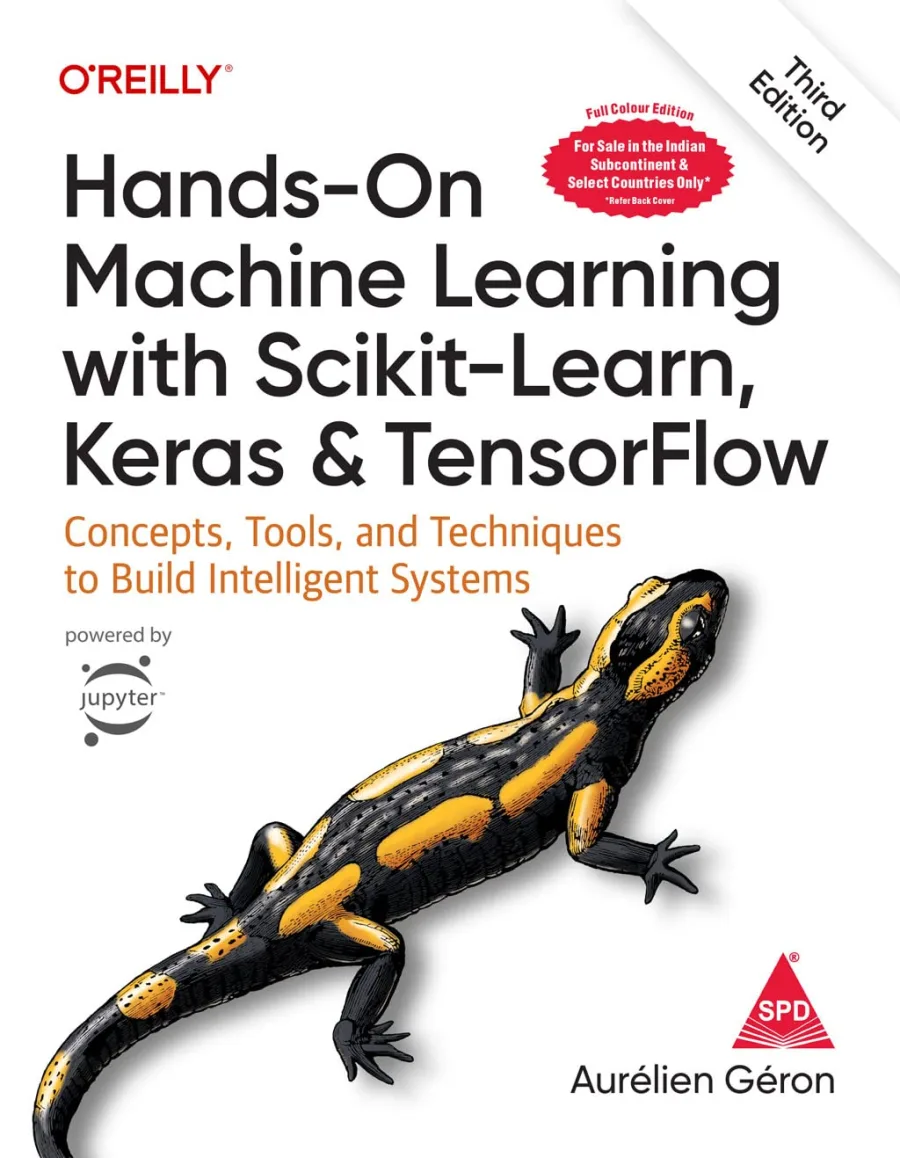
Download Cover Image
Do you want to download the full cover image for Hands-On Machine Learning with Scikit-Learn, Keras, and TensorFlow?