
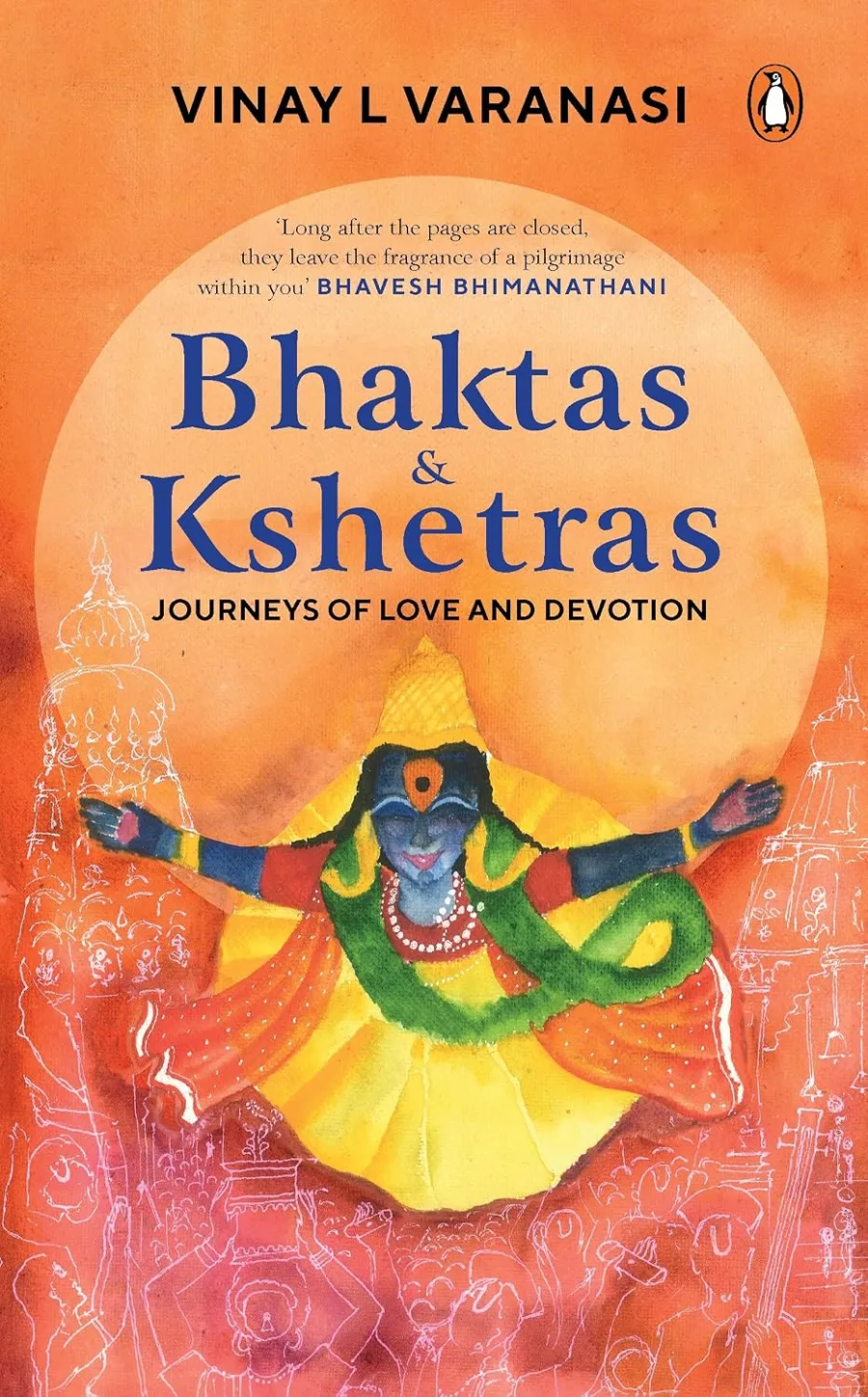
Bhaktas & Kshetras: Journeys of Love and Devotion
Paperback
• 272 Pages
• ₹ 399.00
• English
• 9789377305406
No ratings yet
| Publisher | India Penguin Ananda |
|---|---|
| ISBN13 | 9789377305406 |
| ASIN/SKU | 9377305403 |
| Book Format | Paperback |
| Language | English |
| Pages | 272 |
| List Price | ₹ 399.00 |
| Publishing Date | 21/07/2026 |
| Dimensions | 21.6 x 13.5 x 1.52 cm |
| Weight | 230 g |
| Book Code | BD00068385 |
Buy this Book
Amazon Stores
Ebook Stores
Other Stores
Discover Bhaktas and Kshetras: Journeys of Love and Devotion by Vinay L Varanasi. This book is published by India Penguin Ananda in Paperback format, ISBN 9789377305406, ASIN 9377305403, under Religion and Spirituality, Spirituality, Hinduism.
Book Description
For many, a temple is simply a place of worship. For devotees, however, it is much more. Ancient temples have been built on energized lands (known as kshetras), where for centuries, devotees have journeyed for various reasons. They went seeking solace, spiritual connection and growth. Due to the power of these spaces, they ended up discovering more―ultimately, they found their god, literally and metaphorically.
This heartfelt book is a homage to the experiences of such devotees arising out of these sacred lands. Vinay L Varanasi explores stories from eight revered kshetras, going beyond legend to include divine experiences from more recent times too. Bhaktas & Kshetras offers readers a deeper lens to experience the deity, the devotee and the sacred geography that binds them together.
This heartfelt book is a homage to the experiences of such devotees arising out of these sacred lands. Vinay L Varanasi explores stories from eight revered kshetras, going beyond legend to include divine experiences from more recent times too. Bhaktas & Kshetras offers readers a deeper lens to experience the deity, the devotee and the sacred geography that binds them together.
Author Biography
Vinay L Varanasi is a storyteller and artist who has dedicated himself to bringing to life cultural stories from India’s rich heritage. Vinay speaks on stories that are drawn from the Puranas, Itihasas, temple legends, regional literature and local histories. His storytelling sessions are marked with a fundamental reverence to the core subject coupled with the curiousness of a seeker. He believes that these stories are worlds in themselves, containing nuggets of wisdom that are relevant across times. Across India and countries such as Malaysia, Australia, UAE, Switzerland, Germany, Denmark, Sweden and more, Vinay’s storytelling has enthralled audiences across diverse age groups. His programs are received with overwhelming enthusiasm, which he believes is a reflection of our civilization’s inherent love for bhagavath katha―the stories of the divine.
Vinay has set up an organization called Shuka, which aims to bring these immortal stories to life through productions involving storytelling, classical and devotional music, dance and visual arts. By adopting this integrated approach to his presentations, Vinay reaffirms his core belief: stories, when presented aesthetically, have something to offer everyone―the spiritual seeker, the art connoisseur, the cultural enthusiast, or simply put, anyone at all.
Vinay holds a Bachelor’s degree in Architecture and a Master’s degree in Design. When he is not engrossed in scriptural readings, Vinay can be found dabbling with watercolours, preparing for a marathon, or in more recent times, writing this book.
Vinay has set up an organization called Shuka, which aims to bring these immortal stories to life through productions involving storytelling, classical and devotional music, dance and visual arts. By adopting this integrated approach to his presentations, Vinay reaffirms his core belief: stories, when presented aesthetically, have something to offer everyone―the spiritual seeker, the art connoisseur, the cultural enthusiast, or simply put, anyone at all.
Vinay holds a Bachelor’s degree in Architecture and a Master’s degree in Design. When he is not engrossed in scriptural readings, Vinay can be found dabbling with watercolours, preparing for a marathon, or in more recent times, writing this book.
Editorial Reviews
There is a certain intimacy in these writings, one that can only come from lived experience. Long after the pages are closed, they leave the fragrance of a pilgrimage within you. -- Bhavesh Bhimanathani, sadhaka, Bhavesh Yuj
With every leela in every chapter, Vinay takes you right into the mysterious divine heart of the Lord. Kshetra by kshetra, this book is guaranteed to reignite true bhakti in this dark age of disconnection from the divine. Find your divine substrate and thrive again with this book -- Guru Pashupati, co-founder, Chamundi Gurukulam
With every leela in every chapter, Vinay takes you right into the mysterious divine heart of the Lord. Kshetra by kshetra, this book is guaranteed to reignite true bhakti in this dark age of disconnection from the divine. Find your divine substrate and thrive again with this book -- Guru Pashupati, co-founder, Chamundi Gurukulam
Book Summary
Bhaktas & Kshetras: Journeys of Love and Devotion by Vinay L. Varanasi is a reflective journey into the living world of Indian devotion, where sacred places and the devotees connected to them become inseparable parts of a larger spiritual story. The title itself brings together two important ideas: bhaktas, the people whose love for the Divine becomes a way of life, and kshetras, the sacred spaces where that love has been expressed, remembered, and preserved across generations. Rather than presenting pilgrimage merely as travel from one temple to another, the book invites the reader to see India's sacred geography as a landscape shaped by memory, faith, sacrifice, poetry, music, ritual, and personal transformation.
At its heart, the book explores a simple but powerful question: what makes a place sacred? Is it only the ancient temple, the deity installed within it, the rituals performed there, or the stories associated with the place? The book's deeper answer is that sacredness is also created through human relationships with the Divine. A temple becomes alive through the prayers of generations. A pilgrimage route becomes meaningful because countless devotees have walked it with hope, surrender, longing, and gratitude. A sacred town becomes more than a geographical location because saints and ordinary worshippers have filled it with stories of devotion.
The word bhakta means a devotee, but the book presents devotion as something much richer than simply performing religious rituals. Bhakti is portrayed as an intimate relationship between the human heart and the Divine. It may appear as love, surrender, longing, service, remembrance, poetry, music, pilgrimage, or quiet prayer. A devotee may approach God as a beloved, parent, child, friend, master, or ultimate refuge. The emotional forms may differ, but the underlying movement is toward a deeper connection with something greater than the individual self.
The concept of kshetra is equally important. In the Indian spiritual tradition, a kshetra is a sacred field or holy place. Such places can include famous temples, pilgrimage towns, riverbanks, hills, forests, ancient shrines, and locations associated with divine manifestations or saints. But the book encourages readers to understand these places not simply through architecture or history. Every sacred location carries layers of human experience. Its walls may have witnessed centuries of prayer; its streets may have been walked by saints; its festivals may preserve traditions that have survived political and social changes; and its rituals may connect present-day devotees with people who lived hundreds or thousands of years ago.
This creates one of the book's central themes: the relationship between place and memory. Pilgrimage allows people to enter a landscape where mythology, history, and personal experience overlap. A visitor may stand before an ancient shrine and remember a story learned in childhood. A particular river may become meaningful because of its association with a deity or saint. A temple festival may transform an ordinary town into a space of collective celebration. In such moments, sacred geography becomes a form of living memory.
Varanasi's approach is particularly human because devotion is not presented as something belonging only to saints and religious scholars. The world of bhakti is also inhabited by ordinary people: temple workers, pilgrims, musicians, storytellers, families, priests, artists, and countless unnamed devotees. Their everyday actions help keep sacred traditions alive. The book therefore draws attention to the human beings behind religious heritage.
The stories of devotees are important because they demonstrate how spiritual traditions become embodied in individual lives. A saint's greatness may be remembered through poetry or teachings, but the deeper impact of that person often lies in the way they transformed devotion into everyday action. Some devotees express their faith through extraordinary sacrifice; others through humble service. Some sing, some write, some travel, some build temples, some feed pilgrims, and some simply maintain a lifelong relationship with a chosen deity.
This variety reflects the broad character of Indian bhakti traditions. There is no single emotional formula for loving God. Devotion can be passionate or quiet, intellectual or emotional, ritualistic or spontaneous. One person may spend hours chanting sacred names, while another may experience devotion through service to other people. The book's portrait of bhakti therefore resists the idea that spirituality has only one legitimate outward form.
The sacred places discussed through the book's larger theme can similarly be understood as meeting points between different traditions. India's religious landscape is extraordinarily diverse, and pilgrimage networks often connect regions, languages, communities, and traditions. A temple in the South may be connected through mythology and devotional literature to traditions in the North. A saint's songs may travel far beyond the region in which they were composed. A pilgrimage can therefore become a journey across India's cultural diversity.
This aspect of the book highlights how devotion can create connections across differences. Language, dress, customs, and local traditions may vary, yet the emotional experience of seeking the Divine can remain recognizable. The pilgrim arriving at a sacred place carries personal concerns but becomes part of a much larger community of seekers.
One of the most meaningful ideas associated with pilgrimage is that the journey itself can matter as much as the destination. Modern travel is often measured by efficiency: how quickly one can reach a place and how many locations can be visited. Traditional pilgrimage works differently. Walking, waiting, observing rituals, sharing food, meeting other devotees, and experiencing unfamiliar surroundings can all become part of the spiritual process.
The physical journey can therefore mirror an inner journey. The pilgrim begins with an intention and gradually moves through experiences that may challenge expectations. Crowds, discomfort, fatigue, uncertainty, and emotional intensity can become opportunities to practice patience and surrender. When the pilgrim finally reaches the sacred shrine, the moment carries the weight of everything experienced along the way.
This understanding of pilgrimage also changes the meaning of darshan. Darshan is not simply looking at a deity. It is an encounter between devotee and Divine presence. The devotee comes to see and, in the devotional understanding, to be seen by the deity. The moment may last only a few seconds, yet it can carry enormous emotional significance. A person may travel hundreds of miles for that brief encounter because the value lies not in its duration but in its meaning.
The book's emphasis on love and devotion also brings attention to the emotional language of Indian spirituality. Bhakti traditions frequently describe the soul's relationship with God through human emotions. Longing for God can be compared to the longing of separated lovers. Trust can resemble the relationship between a child and parent. Service can express the humility of a devoted servant. Friendship can become a spiritual model. These metaphors make abstract theological ideas emotionally accessible.
This emotional dimension is particularly important because devotion is not always portrayed as a state of constant happiness. The devotee may experience separation, doubt, disappointment, longing, and silence. In many bhakti traditions, longing itself becomes a form of spiritual intensity. The absence of the beloved Divine can make remembrance stronger. Prayer becomes not merely a request but an expression of yearning.
The book's exploration of sacred places also naturally raises the question of preservation. Temples and pilgrimage centers are not frozen historical objects. They are living institutions that must negotiate the pressures of modern life. Growing populations, tourism, commercialization, changing lifestyles, environmental challenges, and the demands of infrastructure can all affect sacred spaces. The survival of a pilgrimage tradition therefore depends not only on preserving old buildings but also on preserving the cultural and spiritual practices that give those buildings meaning.
This is where the human dimension of Bhaktas & Kshetras becomes especially important. Heritage is ultimately sustained by people. A temple survives because communities continue to worship there. A devotional song survives because someone continues to sing it. A pilgrimage tradition survives because people continue to make the journey. Sacred memory survives because stories continue to be told from one generation to another.
The book also encourages the reader to look beyond the idea that spirituality belongs only to the past. Ancient traditions continue to influence contemporary lives. A modern pilgrim may arrive by train or airplane, use a smartphone to navigate, take photographs, and communicate instantly with people elsewhere, yet still experience an ancient ritual in a centuries-old temple. Modernity and tradition therefore coexist within the pilgrimage experience.
This coexistence reveals an important truth: traditions survive not by remaining completely unchanged but by finding ways to remain meaningful. The outward forms of pilgrimage may evolve, but the underlying human needs—belonging, hope, forgiveness, gratitude, protection, meaning, and connection—remain remarkably constant.
The stories of devotees also suggest that spirituality is not necessarily about escaping ordinary life. Many forms of bhakti emphasize bringing devotion into everyday responsibilities. Cooking can become an offering, work can become service, singing can become prayer, and caring for another person can become an expression of love for God. Sacredness therefore does not have to remain confined within temple walls.
This idea gives the book a universal quality. Even readers who do not personally follow the traditions described can recognize the human emotions involved. The longing to find meaning, the desire to belong to something larger, the need to preserve memories of loved ones and ancestors, and the search for moments of peace are not limited to one religion or culture.
Ultimately, Bhaktas & Kshetras: Journeys of Love and Devotion presents India's sacred landscape as a meeting place between geography and emotion, history and faith, individual experience and collective memory. The bhakta gives the sacred place a human heart, while the kshetra gives the devotee a physical landscape in which devotion can be experienced and remembered.
The deepest message of the book is that pilgrimage is not simply about reaching a holy destination. It is about becoming receptive to what the journey reveals. Sacred places can remind people to slow down, remember, listen, and recognize dimensions of life that are easily forgotten in ordinary routines. The stories of devotees demonstrate that genuine devotion is ultimately expressed not only through words but through the way one lives.
In this sense, the book is an invitation to see India differently. Temples become more than monuments, pilgrims become more than tourists, rituals become more than ceremonies, and saints become more than historical figures. Behind each sacred place lies a human story, and behind each story lies a search for love, meaning, and connection with the Divine.
Bhaktas & Kshetras therefore celebrates devotion as a living tradition. Its world is populated by sacred landscapes, devoted hearts, remembered saints, ancient rituals, and ordinary people who continue to seek something timeless. The journey it describes is ultimately both outward and inward: outward toward temples, rivers, pilgrimage towns, and sacred landscapes, and inward toward humility, love, remembrance, surrender, and spiritual awakening. In bringing bhaktas and kshetras together, Vinay L. Varanasi presents pilgrimage as one of humanity's oldest and most enduring journeys—the journey of the heart toward the sacred.
At its heart, the book explores a simple but powerful question: what makes a place sacred? Is it only the ancient temple, the deity installed within it, the rituals performed there, or the stories associated with the place? The book's deeper answer is that sacredness is also created through human relationships with the Divine. A temple becomes alive through the prayers of generations. A pilgrimage route becomes meaningful because countless devotees have walked it with hope, surrender, longing, and gratitude. A sacred town becomes more than a geographical location because saints and ordinary worshippers have filled it with stories of devotion.
The word bhakta means a devotee, but the book presents devotion as something much richer than simply performing religious rituals. Bhakti is portrayed as an intimate relationship between the human heart and the Divine. It may appear as love, surrender, longing, service, remembrance, poetry, music, pilgrimage, or quiet prayer. A devotee may approach God as a beloved, parent, child, friend, master, or ultimate refuge. The emotional forms may differ, but the underlying movement is toward a deeper connection with something greater than the individual self.
The concept of kshetra is equally important. In the Indian spiritual tradition, a kshetra is a sacred field or holy place. Such places can include famous temples, pilgrimage towns, riverbanks, hills, forests, ancient shrines, and locations associated with divine manifestations or saints. But the book encourages readers to understand these places not simply through architecture or history. Every sacred location carries layers of human experience. Its walls may have witnessed centuries of prayer; its streets may have been walked by saints; its festivals may preserve traditions that have survived political and social changes; and its rituals may connect present-day devotees with people who lived hundreds or thousands of years ago.
This creates one of the book's central themes: the relationship between place and memory. Pilgrimage allows people to enter a landscape where mythology, history, and personal experience overlap. A visitor may stand before an ancient shrine and remember a story learned in childhood. A particular river may become meaningful because of its association with a deity or saint. A temple festival may transform an ordinary town into a space of collective celebration. In such moments, sacred geography becomes a form of living memory.
Varanasi's approach is particularly human because devotion is not presented as something belonging only to saints and religious scholars. The world of bhakti is also inhabited by ordinary people: temple workers, pilgrims, musicians, storytellers, families, priests, artists, and countless unnamed devotees. Their everyday actions help keep sacred traditions alive. The book therefore draws attention to the human beings behind religious heritage.
The stories of devotees are important because they demonstrate how spiritual traditions become embodied in individual lives. A saint's greatness may be remembered through poetry or teachings, but the deeper impact of that person often lies in the way they transformed devotion into everyday action. Some devotees express their faith through extraordinary sacrifice; others through humble service. Some sing, some write, some travel, some build temples, some feed pilgrims, and some simply maintain a lifelong relationship with a chosen deity.
This variety reflects the broad character of Indian bhakti traditions. There is no single emotional formula for loving God. Devotion can be passionate or quiet, intellectual or emotional, ritualistic or spontaneous. One person may spend hours chanting sacred names, while another may experience devotion through service to other people. The book's portrait of bhakti therefore resists the idea that spirituality has only one legitimate outward form.
The sacred places discussed through the book's larger theme can similarly be understood as meeting points between different traditions. India's religious landscape is extraordinarily diverse, and pilgrimage networks often connect regions, languages, communities, and traditions. A temple in the South may be connected through mythology and devotional literature to traditions in the North. A saint's songs may travel far beyond the region in which they were composed. A pilgrimage can therefore become a journey across India's cultural diversity.
This aspect of the book highlights how devotion can create connections across differences. Language, dress, customs, and local traditions may vary, yet the emotional experience of seeking the Divine can remain recognizable. The pilgrim arriving at a sacred place carries personal concerns but becomes part of a much larger community of seekers.
One of the most meaningful ideas associated with pilgrimage is that the journey itself can matter as much as the destination. Modern travel is often measured by efficiency: how quickly one can reach a place and how many locations can be visited. Traditional pilgrimage works differently. Walking, waiting, observing rituals, sharing food, meeting other devotees, and experiencing unfamiliar surroundings can all become part of the spiritual process.
The physical journey can therefore mirror an inner journey. The pilgrim begins with an intention and gradually moves through experiences that may challenge expectations. Crowds, discomfort, fatigue, uncertainty, and emotional intensity can become opportunities to practice patience and surrender. When the pilgrim finally reaches the sacred shrine, the moment carries the weight of everything experienced along the way.
This understanding of pilgrimage also changes the meaning of darshan. Darshan is not simply looking at a deity. It is an encounter between devotee and Divine presence. The devotee comes to see and, in the devotional understanding, to be seen by the deity. The moment may last only a few seconds, yet it can carry enormous emotional significance. A person may travel hundreds of miles for that brief encounter because the value lies not in its duration but in its meaning.
The book's emphasis on love and devotion also brings attention to the emotional language of Indian spirituality. Bhakti traditions frequently describe the soul's relationship with God through human emotions. Longing for God can be compared to the longing of separated lovers. Trust can resemble the relationship between a child and parent. Service can express the humility of a devoted servant. Friendship can become a spiritual model. These metaphors make abstract theological ideas emotionally accessible.
This emotional dimension is particularly important because devotion is not always portrayed as a state of constant happiness. The devotee may experience separation, doubt, disappointment, longing, and silence. In many bhakti traditions, longing itself becomes a form of spiritual intensity. The absence of the beloved Divine can make remembrance stronger. Prayer becomes not merely a request but an expression of yearning.
The book's exploration of sacred places also naturally raises the question of preservation. Temples and pilgrimage centers are not frozen historical objects. They are living institutions that must negotiate the pressures of modern life. Growing populations, tourism, commercialization, changing lifestyles, environmental challenges, and the demands of infrastructure can all affect sacred spaces. The survival of a pilgrimage tradition therefore depends not only on preserving old buildings but also on preserving the cultural and spiritual practices that give those buildings meaning.
This is where the human dimension of Bhaktas & Kshetras becomes especially important. Heritage is ultimately sustained by people. A temple survives because communities continue to worship there. A devotional song survives because someone continues to sing it. A pilgrimage tradition survives because people continue to make the journey. Sacred memory survives because stories continue to be told from one generation to another.
The book also encourages the reader to look beyond the idea that spirituality belongs only to the past. Ancient traditions continue to influence contemporary lives. A modern pilgrim may arrive by train or airplane, use a smartphone to navigate, take photographs, and communicate instantly with people elsewhere, yet still experience an ancient ritual in a centuries-old temple. Modernity and tradition therefore coexist within the pilgrimage experience.
This coexistence reveals an important truth: traditions survive not by remaining completely unchanged but by finding ways to remain meaningful. The outward forms of pilgrimage may evolve, but the underlying human needs—belonging, hope, forgiveness, gratitude, protection, meaning, and connection—remain remarkably constant.
The stories of devotees also suggest that spirituality is not necessarily about escaping ordinary life. Many forms of bhakti emphasize bringing devotion into everyday responsibilities. Cooking can become an offering, work can become service, singing can become prayer, and caring for another person can become an expression of love for God. Sacredness therefore does not have to remain confined within temple walls.
This idea gives the book a universal quality. Even readers who do not personally follow the traditions described can recognize the human emotions involved. The longing to find meaning, the desire to belong to something larger, the need to preserve memories of loved ones and ancestors, and the search for moments of peace are not limited to one religion or culture.
Ultimately, Bhaktas & Kshetras: Journeys of Love and Devotion presents India's sacred landscape as a meeting place between geography and emotion, history and faith, individual experience and collective memory. The bhakta gives the sacred place a human heart, while the kshetra gives the devotee a physical landscape in which devotion can be experienced and remembered.
The deepest message of the book is that pilgrimage is not simply about reaching a holy destination. It is about becoming receptive to what the journey reveals. Sacred places can remind people to slow down, remember, listen, and recognize dimensions of life that are easily forgotten in ordinary routines. The stories of devotees demonstrate that genuine devotion is ultimately expressed not only through words but through the way one lives.
In this sense, the book is an invitation to see India differently. Temples become more than monuments, pilgrims become more than tourists, rituals become more than ceremonies, and saints become more than historical figures. Behind each sacred place lies a human story, and behind each story lies a search for love, meaning, and connection with the Divine.
Bhaktas & Kshetras therefore celebrates devotion as a living tradition. Its world is populated by sacred landscapes, devoted hearts, remembered saints, ancient rituals, and ordinary people who continue to seek something timeless. The journey it describes is ultimately both outward and inward: outward toward temples, rivers, pilgrimage towns, and sacred landscapes, and inward toward humility, love, remembrance, surrender, and spiritual awakening. In bringing bhaktas and kshetras together, Vinay L. Varanasi presents pilgrimage as one of humanity's oldest and most enduring journeys—the journey of the heart toward the sacred.
Sample Chapters
Sample Chapters will be added soon…
Reader Reviews
No reviews yet.
Bhaktas & Kshetras: Journeys of Love and Devotion
Download Cover Image
Do you want to download the full cover image for Bhaktas & Kshetras: Journeys of Love and Devotion?