
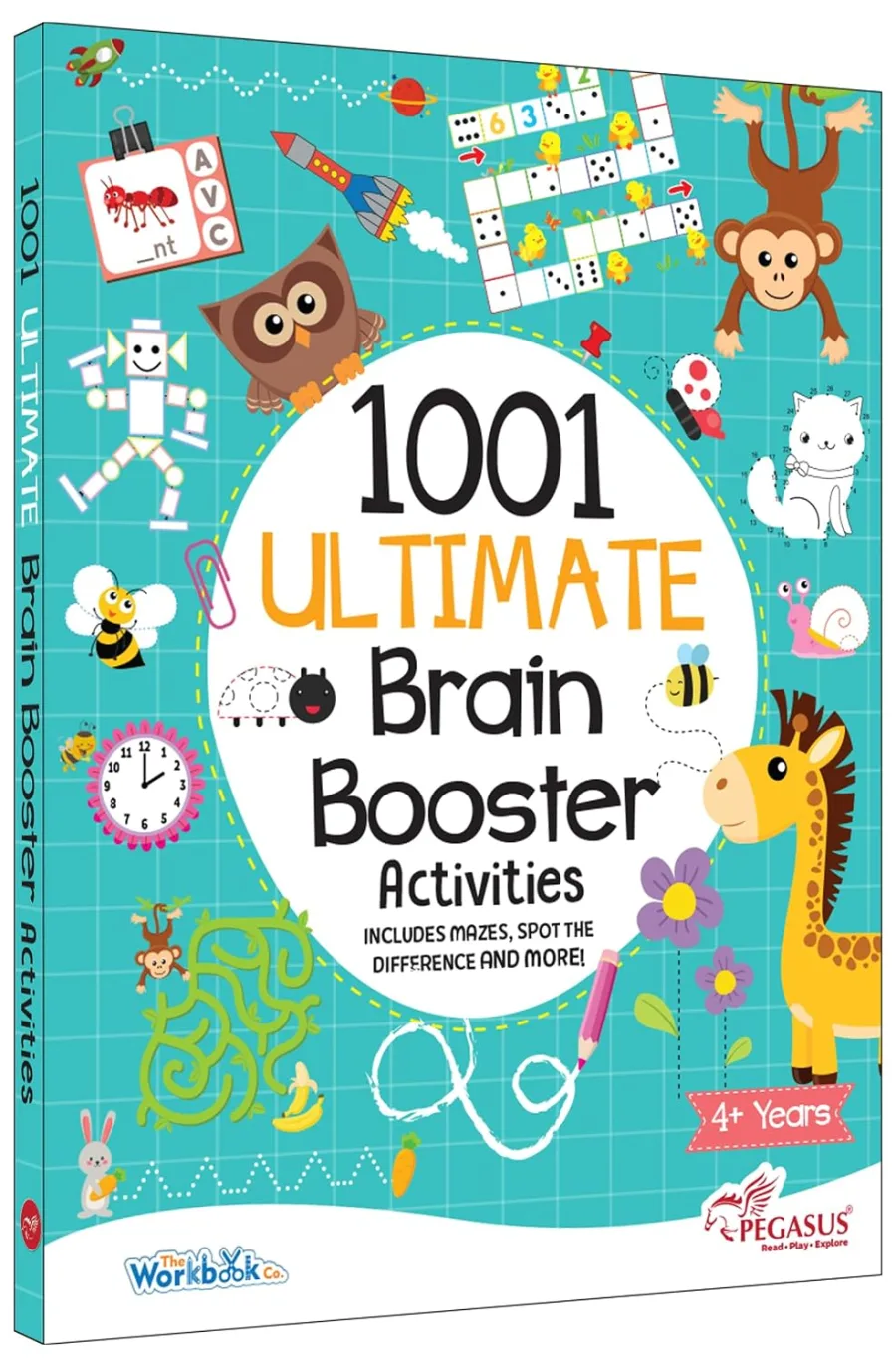
1001 Ultimate Brain Booster Activity book for 3 to 6 Years Old Kids |Enhance the Child Mind
Paperback
• 256 Pages
• ₹ 296.00
• English
• 9788131958247
No ratings yet
| Publisher | Pegasus Books |
|---|---|
| ISBN13 | 9788131958247 |
| ASIN/SKU | 8131958248 |
| Book Format | Paperback |
| Language | English |
| Pages | 256 |
| List Price | ₹ 296.00 |
| Publishing Date | 01/08/2021 |
| Dimensions | 22 x 2 x 28 cm |
| Weight | 660 g |
| Book Code | BD00068333 |
Buy this Book
Amazon Stores
Ebook Stores
Other Stores
Discover 1001 Ultimate Brain Booster Activity book for 3 to 6 Years Old Kids |Enhance the Child Mind by Team Pegasus. This book is published by Pegasus Books in Paperback format, ISBN 9788131958247, ASIN 8131958248, under Children's Books, Children's Interactive and Activity Books.
Book Description
Give your child an exciting learning adventure with 1001 Ultimate Brain Booster Activities, an action-packed educational activity book specially designed for children aged 4 years and above. Filled with 1001 engaging activities, this comprehensive workbook transforms learning into an enjoyable experience while building essential early childhood skills. Children can explore a wide variety of activities including mazes, dot-to-dot puzzles, tracing exercises, spot the difference, matching games, observation challenges, colouring activities, pattern recognition, visual puzzles, and many more. Every page is carefully designed to keep young minds active, curious, and entertained. As children complete the activities, they naturally develop logical reasoning, concentration, memory, critical thinking, fine motor skills, hand-eye coordination, creativity, problem-solving abilities, and confidence. The colourful illustrations and easy-to-understand instructions make it ideal for independent learning as well as parent-guided practice. Perfect for home learning, preschool preparation, classroom enrichment, homeschooling, travel, holidays, or everyday educational fun, 1001 Ultimate Brain Booster Activities offers hours of productive, screen-free entertainment that supports overall cognitive development.
1001 FUN BRAIN BOOSTING ACTIVITIES – Packed with 1001 exciting activities including mazes, dot-to-dot, tracing, spot the difference, matching, puzzles, colouring, and much more to keep children engaged for hours.
DEVELOPS ESSENTIAL EARLY LEARNING SKILLS – Helps improve logical thinking, observation, concentration, memory, problem-solving, fine motor skills, hand-eye coordination, and creative thinking through interactive learning.
SCREEN-FREE EDUCATIONAL ENTERTAINMENT – A perfect alternative to digital devices, encouraging meaningful learning and independent play while making education fun and engaging.
BOOSTS SCHOOL READINESS – Supports preschool and kindergarten learning by strengthening early maths, pattern recognition, visual discrimination, sequencing, tracing, and cognitive development.
OVER 1000 ACTIVITIES TO EXPLORE – A huge collection of age-appropriate exercises that keeps children entertained while reinforcing essential educational concepts.
COLOURFUL & CHILD-FRIENDLY DESIGN – Bright illustrations, engaging layouts, and easy-to-follow activities make learning enjoyable for young learners.
IDEAL FOR AGES 4+ YEARS – Perfect for preschoolers, kindergarten children, homeschooling, classroom practice, travel, holiday learning, and everyday educational fun.
PERFECT GIFT FOR YOUNG LEARNERS – An excellent gift for birthdays, holidays, return gifts, school rewards, vacations, and children who enjoy puzzles and educational activities.
1001 FUN BRAIN BOOSTING ACTIVITIES – Packed with 1001 exciting activities including mazes, dot-to-dot, tracing, spot the difference, matching, puzzles, colouring, and much more to keep children engaged for hours.
DEVELOPS ESSENTIAL EARLY LEARNING SKILLS – Helps improve logical thinking, observation, concentration, memory, problem-solving, fine motor skills, hand-eye coordination, and creative thinking through interactive learning.
SCREEN-FREE EDUCATIONAL ENTERTAINMENT – A perfect alternative to digital devices, encouraging meaningful learning and independent play while making education fun and engaging.
BOOSTS SCHOOL READINESS – Supports preschool and kindergarten learning by strengthening early maths, pattern recognition, visual discrimination, sequencing, tracing, and cognitive development.
OVER 1000 ACTIVITIES TO EXPLORE – A huge collection of age-appropriate exercises that keeps children entertained while reinforcing essential educational concepts.
COLOURFUL & CHILD-FRIENDLY DESIGN – Bright illustrations, engaging layouts, and easy-to-follow activities make learning enjoyable for young learners.
IDEAL FOR AGES 4+ YEARS – Perfect for preschoolers, kindergarten children, homeschooling, classroom practice, travel, holiday learning, and everyday educational fun.
PERFECT GIFT FOR YOUNG LEARNERS – An excellent gift for birthdays, holidays, return gifts, school rewards, vacations, and children who enjoy puzzles and educational activities.
Author Biography
B. Jain Publishing Group started publishing Children Books in 2008 with brand new imprint Pegasus. With more than 2000 books in print and over 200 new titles added every year Pegasus is one of the largest independent children books publisher in the world. Pegasus has been a favourite choice for many schools when it comes to quality books for children. Pegasus has been focused on providing excellent quality reading and learning material for children aged 0+ years to 12 + years. With famous and award winning series including Read and Shine and Pegasus Encyclopaedias it has become a household name in many countries. Pegasus Books have been translated in more than 30 languages and are actively sold across the globe.
Editorial Reviews
Editorial Reviews will be added soon…
Book Summary
1001 Ultimate Brain Booster Activity Book for 3 to 6 Years Old Kids | Enhance the Child Mind by Team Pegasus is a large activity-based learning book designed for young children between the ages of three and six. The book is built around the idea that children learn most effectively when they are actively involved in a task. Instead of presenting learning as a series of formal lessons, an activity book encourages children to observe, think, draw, match, trace, solve, identify, and explore. Through this approach, the book aims to strengthen early cognitive abilities while keeping learning enjoyable.
The age group of three to six years is an important stage in a child's development. During these years, children rapidly develop language, memory, attention, hand control, observation, reasoning, and early academic skills. They are also becoming more independent and curious about the world around them. An activity book with a wide variety of exercises can give children opportunities to practise these abilities repeatedly in a playful manner.
The title 1001 Ultimate Brain Booster Activity Book suggests that the collection contains a very large number of activities intended to keep children engaged over an extended period. Rather than completing everything in a single sitting, children can use the book gradually. Parents and teachers can select activities according to the child's age, ability, and interests. This makes the book suitable for both regular practice and occasional learning sessions.
One of the most important goals of such an activity book is to develop observation skills. Young children are naturally curious, but they need practice in looking carefully at details. Activities involving differences, similarities, matching, identifying objects, completing pictures, or recognizing patterns encourage children to pay attention to what they see.
For example, a child may be asked to find which object is different from the others or identify two pictures that are similar. These exercises may appear simple, but they encourage the child to compare details and notice relationships. Such visual discrimination is useful later when children begin recognizing letters, numbers, shapes, and words.
Another important area is logical thinking. Brain-boosting activities often require children to make simple decisions based on clues or patterns. A child may need to determine what comes next in a sequence, match objects according to a particular rule, or identify which item belongs in a group.
These activities teach children that problems can be approached systematically. Instead of guessing randomly, they begin to look for clues and relationships. This is an important foundation for later mathematics and problem solving.
The book can also help develop memory. Some activities require children to remember objects, patterns, sequences, or visual information. Memory exercises encourage children to hold information in their minds and recall it after a short period.
Memory development is important for school readiness because children eventually need to remember letters, numbers, instructions, vocabulary, mathematical procedures, and other information. Games and activities provide a less stressful way of practising this ability.
Concentration is another important skill that the book can support. Young children often have short attention spans, so activities need to be engaging enough to encourage them to remain focused. A child who spends several minutes completing a puzzle or tracing exercise is gradually learning to maintain attention on one task.
The book can be particularly useful for parents who want to reduce the amount of passive screen time in a child's daily routine. Activity books provide an alternative form of entertainment in which the child is physically and mentally involved. Instead of simply watching something, the child has to make decisions and complete actions.
Another important feature of activity-based learning is the development of fine motor skills. Children between three and six are still developing control over the small muscles in their hands and fingers. Activities such as tracing, drawing, coloring, connecting dots, circling objects, and completing simple written exercises help strengthen this control.
Fine motor development is closely connected with future writing skills. Before a child can write letters and numbers comfortably, they need to develop sufficient control over a pencil or crayon. Repeated practice with lines, curves, shapes, and patterns can gradually improve hand-eye coordination.
Hand-eye coordination is also developed through activities that require children to follow a visual path or place a mark in a particular location. The child has to look at the page while simultaneously controlling the movement of the hand. This coordination becomes useful for writing, drawing, cutting, and other classroom activities.
The book can also introduce or reinforce early mathematics. At the preschool level, mathematics is not only about formal calculations. Children first need to understand quantities, numbers, shapes, sizes, comparisons, sequences, and simple relationships.
Activities involving counting can help children connect numbers with actual quantities. Instead of simply reciting numbers from memory, children can count objects and understand that the final number represents how many objects are present.
Shape activities can introduce children to basic geometric forms such as circles, squares, triangles, rectangles, and other familiar shapes. Recognizing shapes develops visual understanding and provides a foundation for geometry in later classes.
The book can also support pattern recognition, an important early mathematical skill. Children may be asked to identify what comes next in a sequence of shapes, colors, objects, or numbers. Recognizing patterns helps children understand order and relationships.
Sorting and classification activities are similarly valuable. A child may be asked to group objects according to size, shape, category, or another characteristic. This teaches the basic idea that objects can be organized according to shared properties.
Language development can also be supported through picture-based activities. Children can identify objects, name them, match pictures, complete simple associations, or answer questions about what they see. Such activities encourage vocabulary growth and communication.
Parents can make these exercises more effective by asking children to describe their answers. Instead of simply saying “circle the animal,” a parent can ask, “What animal is this?” or “Where does this animal live?” This turns a simple activity into a conversation and provides additional language practice.
The book can also encourage creative thinking. Some activities may have a clear correct answer, while others can allow children to use their imagination through drawing, coloring, or completing pictures. Creative tasks give children freedom to express themselves and make independent choices.
Coloring activities are particularly useful because they combine creativity with fine motor development. Children can practise staying within boundaries, choosing colors, and controlling a crayon or pencil. At the same time, they can make artistic decisions without worrying about a single correct answer.
Another benefit is problem-solving confidence. A child may initially find a puzzle difficult, make mistakes, and then try again. Successfully completing it teaches the child that difficulty does not necessarily mean failure. This can encourage persistence.
Persistence is an important quality for school readiness. Children will eventually encounter subjects and tasks that do not become easy immediately. Learning to keep trying, seek clues, and correct mistakes is therefore more valuable than simply completing easy exercises.
The book can also support independent learning. Parents can initially explain an activity and demonstrate one example. Once the child understands the instructions, they can attempt similar activities independently. This gradually builds confidence and a sense of responsibility.
However, children should not be expected to complete long sessions. At the age of three to six, shorter and more frequent activities may be more effective than forcing a child to sit for a long period. Parents can choose a few pages each day and stop when the child becomes tired or loses interest.
The large number of activities allows parents to adapt the book to the child's needs. A three-year-old may focus more on matching, coloring, shapes, and simple tracing, while an older child may be ready for more complicated puzzles, patterns, counting, and reasoning exercises.
This makes the book potentially useful across several stages of preschool development.
The age group of three to six years is an important stage in a child's development. During these years, children rapidly develop language, memory, attention, hand control, observation, reasoning, and early academic skills. They are also becoming more independent and curious about the world around them. An activity book with a wide variety of exercises can give children opportunities to practise these abilities repeatedly in a playful manner.
The title 1001 Ultimate Brain Booster Activity Book suggests that the collection contains a very large number of activities intended to keep children engaged over an extended period. Rather than completing everything in a single sitting, children can use the book gradually. Parents and teachers can select activities according to the child's age, ability, and interests. This makes the book suitable for both regular practice and occasional learning sessions.
One of the most important goals of such an activity book is to develop observation skills. Young children are naturally curious, but they need practice in looking carefully at details. Activities involving differences, similarities, matching, identifying objects, completing pictures, or recognizing patterns encourage children to pay attention to what they see.
For example, a child may be asked to find which object is different from the others or identify two pictures that are similar. These exercises may appear simple, but they encourage the child to compare details and notice relationships. Such visual discrimination is useful later when children begin recognizing letters, numbers, shapes, and words.
Another important area is logical thinking. Brain-boosting activities often require children to make simple decisions based on clues or patterns. A child may need to determine what comes next in a sequence, match objects according to a particular rule, or identify which item belongs in a group.
These activities teach children that problems can be approached systematically. Instead of guessing randomly, they begin to look for clues and relationships. This is an important foundation for later mathematics and problem solving.
The book can also help develop memory. Some activities require children to remember objects, patterns, sequences, or visual information. Memory exercises encourage children to hold information in their minds and recall it after a short period.
Memory development is important for school readiness because children eventually need to remember letters, numbers, instructions, vocabulary, mathematical procedures, and other information. Games and activities provide a less stressful way of practising this ability.
Concentration is another important skill that the book can support. Young children often have short attention spans, so activities need to be engaging enough to encourage them to remain focused. A child who spends several minutes completing a puzzle or tracing exercise is gradually learning to maintain attention on one task.
The book can be particularly useful for parents who want to reduce the amount of passive screen time in a child's daily routine. Activity books provide an alternative form of entertainment in which the child is physically and mentally involved. Instead of simply watching something, the child has to make decisions and complete actions.
Another important feature of activity-based learning is the development of fine motor skills. Children between three and six are still developing control over the small muscles in their hands and fingers. Activities such as tracing, drawing, coloring, connecting dots, circling objects, and completing simple written exercises help strengthen this control.
Fine motor development is closely connected with future writing skills. Before a child can write letters and numbers comfortably, they need to develop sufficient control over a pencil or crayon. Repeated practice with lines, curves, shapes, and patterns can gradually improve hand-eye coordination.
Hand-eye coordination is also developed through activities that require children to follow a visual path or place a mark in a particular location. The child has to look at the page while simultaneously controlling the movement of the hand. This coordination becomes useful for writing, drawing, cutting, and other classroom activities.
The book can also introduce or reinforce early mathematics. At the preschool level, mathematics is not only about formal calculations. Children first need to understand quantities, numbers, shapes, sizes, comparisons, sequences, and simple relationships.
Activities involving counting can help children connect numbers with actual quantities. Instead of simply reciting numbers from memory, children can count objects and understand that the final number represents how many objects are present.
Shape activities can introduce children to basic geometric forms such as circles, squares, triangles, rectangles, and other familiar shapes. Recognizing shapes develops visual understanding and provides a foundation for geometry in later classes.
The book can also support pattern recognition, an important early mathematical skill. Children may be asked to identify what comes next in a sequence of shapes, colors, objects, or numbers. Recognizing patterns helps children understand order and relationships.
Sorting and classification activities are similarly valuable. A child may be asked to group objects according to size, shape, category, or another characteristic. This teaches the basic idea that objects can be organized according to shared properties.
Language development can also be supported through picture-based activities. Children can identify objects, name them, match pictures, complete simple associations, or answer questions about what they see. Such activities encourage vocabulary growth and communication.
Parents can make these exercises more effective by asking children to describe their answers. Instead of simply saying “circle the animal,” a parent can ask, “What animal is this?” or “Where does this animal live?” This turns a simple activity into a conversation and provides additional language practice.
The book can also encourage creative thinking. Some activities may have a clear correct answer, while others can allow children to use their imagination through drawing, coloring, or completing pictures. Creative tasks give children freedom to express themselves and make independent choices.
Coloring activities are particularly useful because they combine creativity with fine motor development. Children can practise staying within boundaries, choosing colors, and controlling a crayon or pencil. At the same time, they can make artistic decisions without worrying about a single correct answer.
Another benefit is problem-solving confidence. A child may initially find a puzzle difficult, make mistakes, and then try again. Successfully completing it teaches the child that difficulty does not necessarily mean failure. This can encourage persistence.
Persistence is an important quality for school readiness. Children will eventually encounter subjects and tasks that do not become easy immediately. Learning to keep trying, seek clues, and correct mistakes is therefore more valuable than simply completing easy exercises.
The book can also support independent learning. Parents can initially explain an activity and demonstrate one example. Once the child understands the instructions, they can attempt similar activities independently. This gradually builds confidence and a sense of responsibility.
However, children should not be expected to complete long sessions. At the age of three to six, shorter and more frequent activities may be more effective than forcing a child to sit for a long period. Parents can choose a few pages each day and stop when the child becomes tired or loses interest.
The large number of activities allows parents to adapt the book to the child's needs. A three-year-old may focus more on matching, coloring, shapes, and simple tracing, while an older child may be ready for more complicated puzzles, patterns, counting, and reasoning exercises.
This makes the book potentially useful across several stages of preschool development.
Sample Chapters
Sample Chapters will be added soon…
Reader Reviews
No reviews yet.
1001 Ultimate Brain Booster Activity book for 3 to 6 Years Old Kids |Enhance the Child Mind
Download Cover Image
Do you want to download the full cover image for 1001 Ultimate Brain Booster Activity book for 3 to 6 Years Old Kids |Enhance the Child Mind?