
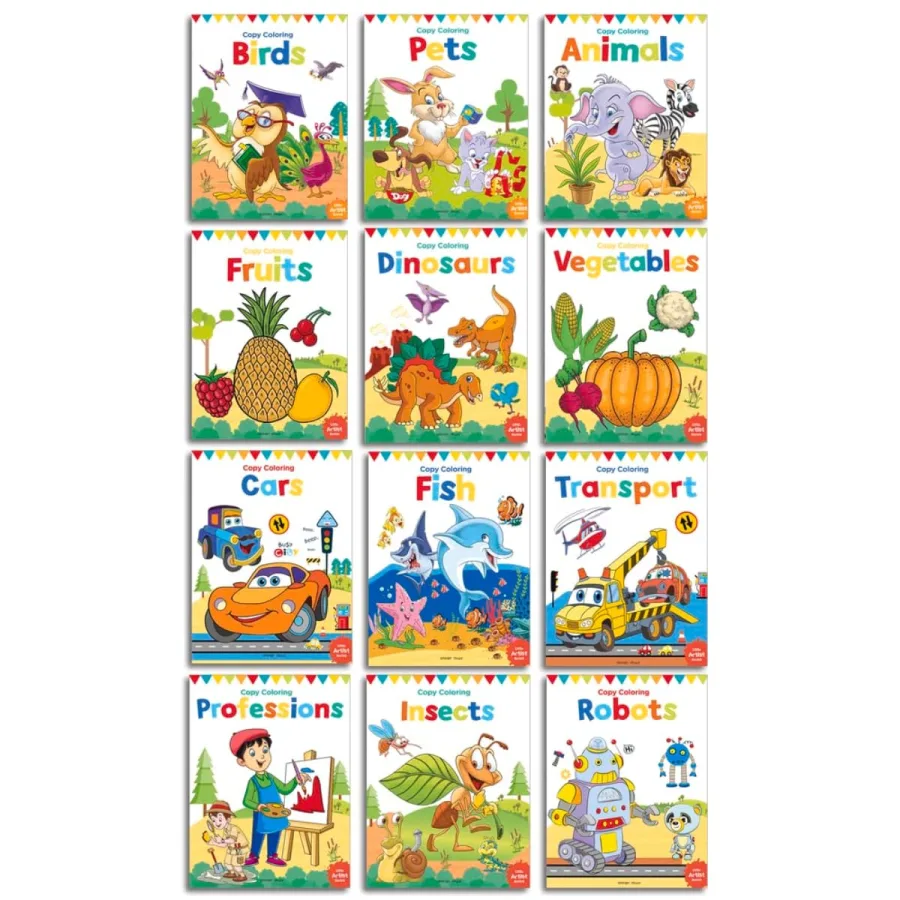
Colouring Books: Pack of 12 Copy Colour Books For Children | Premium Paper Quality
Paperback
• 192 Pages
• ₹ 579.00
• English
• 9789388369787
No ratings yet
| Publisher | Wonder House Books |
|---|---|
| ISBN13 | 9789388369787 |
| ASIN/SKU | 9388369785 |
| Book Format | Paperback |
| Language | English |
| Pages | 192 |
| List Price | ₹ 579.00 |
| Publishing Date | 01/01/2019 |
| Dimensions | 17.48 x 2.16 x 23.65 cm |
| Weight | 1 kg 80 g |
| Book Code | BD00068328 |
Buy this Book
Amazon Stores
Ebook Stores
Other Stores
Discover Colouring Books: Pack of 12 Copy Colour Books For Children | Premium Paper Quality by Wonder House Books. This book is published by Wonder House Books in Paperback format, ISBN 9789388369787, ASIN 9388369785, under Children's Books, Children's Crafts, Hobbies and Practical Interests, Children's Books on Home.
Book Description
Explore, Imagine, and Create with Colors!
This delightful collection of 12 coloring books is designed to spark the creativity and imagination of young learners. Covering engaging topics like animals, birds, cars, transport, and more, this coloring pack offers hours of screen-free fun while building essential developmental skills.
Each book features bold outlines and adorable illustrations that help children learn to color within the lines—perfect for improving focus, fine motor skills, and color awareness. Ideal for preschoolers and early learners, these books turn coloring time into a joyful learning experience.
🎨 Key Features:
Develops Fine Motor Skills: Coloring within bold lines builds pencil control and hand-eye coordination
Encourages Creativity: Inspires children to explore color choices and express themselves artistically
Bold and Cute Illustrations: Easy-to-color drawings tailored for small hands
Reinforces Early Learning Topics: Familiar objects and animals help build vocabulary and understanding
Promotes Observation Skills: Encourages attention to detail through visual learning
📚 What’s Inside:
12 themed coloring books featuring topics like:
Animals
Birds
Cars
Transport
Everyday objects and more
Each book includes multiple illustrations ready to be filled with color
🎯 Ideal For:
Preschool and kindergarten-aged children (3–6 years)
At-home learning and creative play
Travel activity packs and gifting
Enhancing focus, patience, and early art skills
Give your child a joyful introduction to the world of colors with this all-in-one coloring pack—because every stroke is a step toward learning!
This delightful collection of 12 coloring books is designed to spark the creativity and imagination of young learners. Covering engaging topics like animals, birds, cars, transport, and more, this coloring pack offers hours of screen-free fun while building essential developmental skills.
Each book features bold outlines and adorable illustrations that help children learn to color within the lines—perfect for improving focus, fine motor skills, and color awareness. Ideal for preschoolers and early learners, these books turn coloring time into a joyful learning experience.
🎨 Key Features:
Develops Fine Motor Skills: Coloring within bold lines builds pencil control and hand-eye coordination
Encourages Creativity: Inspires children to explore color choices and express themselves artistically
Bold and Cute Illustrations: Easy-to-color drawings tailored for small hands
Reinforces Early Learning Topics: Familiar objects and animals help build vocabulary and understanding
Promotes Observation Skills: Encourages attention to detail through visual learning
📚 What’s Inside:
12 themed coloring books featuring topics like:
Animals
Birds
Cars
Transport
Everyday objects and more
Each book includes multiple illustrations ready to be filled with color
🎯 Ideal For:
Preschool and kindergarten-aged children (3–6 years)
At-home learning and creative play
Travel activity packs and gifting
Enhancing focus, patience, and early art skills
Give your child a joyful introduction to the world of colors with this all-in-one coloring pack—because every stroke is a step toward learning!
Author Biography
Wonder House has a dedicated team of editors and designers involved in the development of magnificent and enriching children books. The team pays special attention to develop age appropriate content and does extensive research on every topic included in the book. Our mission is to develop highly informative content which will help the children to master different skills. At Wonder House, we strive to make learning a joy.
Editorial Reviews
Editorial Reviews will be added soon…
Book Summary
Colouring Books: Pack of 12 Copy Colour Books for Children by Wonder House Books is a creative activity collection designed to introduce young children to coloring, drawing, observation, and basic artistic expression. The pack brings together twelve individual copy-colouring books, giving children a large variety of pictures and themes to explore. Its focus is simple: children look at an example picture, identify its colors and shapes, and then try to reproduce or complete it in their own books. The collection is particularly suitable for children who are beginning to develop confidence with crayons, pencils, and other coloring materials.
The central idea behind copy-coloring is learning through observation and imitation. Young children may enjoy coloring but often do not know which colors to choose or how to begin filling a picture. A reference image provides them with a clear starting point. They can look at the example, recognize the main objects, notice their colors, and attempt to create a similar version. This makes the activity both creative and structured.
The twelve-book format gives children plenty of opportunities for repeated practice. Instead of finishing one coloring book and immediately needing another, children have access to a complete collection with different pictures and activities. This variety can help prevent boredom and encourage children to return to coloring regularly. It also allows them to spend more time practicing without feeling that they are repeatedly doing exactly the same exercise.
One of the major attractions of the collection is its premium paper quality. Good paper is particularly important for children's coloring books because young children often press crayons or pencils firmly against the page. Better-quality paper can make coloring more comfortable and can allow children to work with greater confidence. It also helps the finished pictures look cleaner and more attractive.
The coloring activities are not only about producing beautiful pictures. They also support the development of fine motor skills. Holding a crayon or pencil and moving it carefully within a particular area requires controlled movements of the fingers, hand, and wrist. Young children gradually develop this control through repeated activities such as coloring, tracing, drawing, and writing.
This fine motor development becomes important later when children begin formal handwriting. Before they can write letters and numbers accurately, they need to control a pencil comfortably. Coloring provides a natural and enjoyable way to strengthen these basic movements without making the child feel that they are doing handwriting practice.
The books also help improve hand-eye coordination. Children have to look at the picture while simultaneously moving the coloring tool. They learn to judge where a line begins and ends, how much space is available, and how to keep the coloring within a particular shape. With regular practice, these movements can become more controlled and precise.
Copy coloring additionally encourages visual observation. Children need to look carefully at the reference picture to identify different colors, shapes, sizes, and objects. They may notice that one part of an illustration is a different color from another or that several objects have similar shapes. This attention to detail can support early learning in other areas as well.
The activity also introduces children to colors and color recognition. A child can learn to identify basic colors such as red, blue, yellow, green, orange, pink, and purple while deciding how to reproduce the reference picture. Parents can turn the activity into a simple learning exercise by asking children to name the colors they see.
For younger children, this can become a vocabulary-building activity as well. If the picture shows an animal, vehicle, fruit, flower, toy, or household object, parents can ask the child to name it and describe its colors. In this way, a simple coloring exercise can encourage language development.
Another important benefit is concentration. Coloring requires children to remain focused on a task for a certain period. They need to choose a color, hold the coloring tool, fill the appropriate area, and decide when the section is complete. These small decisions encourage sustained attention.
Children can also develop patience through coloring. Completing a detailed picture takes time. A child may initially want to finish quickly, but gradually learns that careful coloring produces a more satisfying result. This can help develop the habit of working steadily instead of expecting immediate completion.
The collection also provides an opportunity for creative expression. Although copy coloring provides a reference image, children do not have to reproduce every picture perfectly. They may choose slightly different shades, add their own details, or experiment with unusual combinations. Parents can encourage this creativity rather than insisting that every picture match the example exactly.
This balance between guidance and freedom is one of the strengths of coloring activities. The reference picture gives children confidence because they know what they are trying to create, while the act of coloring still allows personal choices. A child can follow the model closely or gradually develop an individual style.
The books can also help children understand shapes and visual boundaries. Coloring within a particular area teaches children to recognize where one object ends and another begins. This awareness of boundaries is useful later when children practice writing letters and numbers within lines or boxes.
Another valuable aspect is the feeling of achievement. Children often enjoy looking at a finished picture and seeing what they have created. Completing a page provides a small sense of accomplishment. For young children, these repeated experiences can build confidence and encourage them to attempt more challenging activities.
The pack is also suitable for quiet and screen-free time. Children can become deeply engaged in digital entertainment, but physical creative activities offer a different kind of experience. Coloring requires direct interaction with paper and coloring tools and allows children to work at their own pace. It can be used at home, during travel, during free time, or as a relaxing activity before bedtime.
Parents can make the activity more interactive by sitting with the child while they color. Instead of simply watching, they can ask questions such as what the picture represents, which color the child has selected, why they chose that color, or what they think should happen in the picture. Such conversations combine creativity with language and observation.
The collection can also be useful in preschool and classroom settings. Teachers can use the pictures as quiet activities after lessons or as part of art sessions. Children can work individually or compare their finished pictures with classmates. The activity can also be connected with lessons about animals, nature, transport, food, seasons, or everyday objects, depending on the pictures included.
Coloring can also encourage children to practice decision-making. Even when a reference image is provided, the child still needs to decide which crayon to pick up, where to begin, and how carefully to fill each section. These small choices encourage independence.
The activity can also help children learn that mistakes are not disasters. A color may go outside the boundary or a child may choose a different shade from the reference picture. Instead of treating this as failure, parents can encourage the child to continue. This creates a positive environment where experimentation is acceptable.
For children who are just beginning to use pencils and crayons, the collection can be particularly helpful. They may initially hold a crayon awkwardly or have difficulty controlling pressure. With repeated practice, they can gradually become more comfortable. The goal is not perfection but improvement.
The premium paper also supports experimentation with different coloring materials. Depending on the specific medium used, children may try crayons, colored pencils, or other suitable tools. Parents should choose materials appropriate for the child's age and supervise very young children when necessary.
Another advantage of having twelve books is that children can work at different difficulty levels. Some pictures can be used when the child is still learning basic coloring, while more detailed pictures can be introduced later. This allows the activity to grow with the child's abilities.
The books also encourage children to appreciate visual details. When copying a picture, a child may notice patterns, repeated shapes, facial expressions, objects in the background, or differences between similar elements.
The central idea behind copy-coloring is learning through observation and imitation. Young children may enjoy coloring but often do not know which colors to choose or how to begin filling a picture. A reference image provides them with a clear starting point. They can look at the example, recognize the main objects, notice their colors, and attempt to create a similar version. This makes the activity both creative and structured.
The twelve-book format gives children plenty of opportunities for repeated practice. Instead of finishing one coloring book and immediately needing another, children have access to a complete collection with different pictures and activities. This variety can help prevent boredom and encourage children to return to coloring regularly. It also allows them to spend more time practicing without feeling that they are repeatedly doing exactly the same exercise.
One of the major attractions of the collection is its premium paper quality. Good paper is particularly important for children's coloring books because young children often press crayons or pencils firmly against the page. Better-quality paper can make coloring more comfortable and can allow children to work with greater confidence. It also helps the finished pictures look cleaner and more attractive.
The coloring activities are not only about producing beautiful pictures. They also support the development of fine motor skills. Holding a crayon or pencil and moving it carefully within a particular area requires controlled movements of the fingers, hand, and wrist. Young children gradually develop this control through repeated activities such as coloring, tracing, drawing, and writing.
This fine motor development becomes important later when children begin formal handwriting. Before they can write letters and numbers accurately, they need to control a pencil comfortably. Coloring provides a natural and enjoyable way to strengthen these basic movements without making the child feel that they are doing handwriting practice.
The books also help improve hand-eye coordination. Children have to look at the picture while simultaneously moving the coloring tool. They learn to judge where a line begins and ends, how much space is available, and how to keep the coloring within a particular shape. With regular practice, these movements can become more controlled and precise.
Copy coloring additionally encourages visual observation. Children need to look carefully at the reference picture to identify different colors, shapes, sizes, and objects. They may notice that one part of an illustration is a different color from another or that several objects have similar shapes. This attention to detail can support early learning in other areas as well.
The activity also introduces children to colors and color recognition. A child can learn to identify basic colors such as red, blue, yellow, green, orange, pink, and purple while deciding how to reproduce the reference picture. Parents can turn the activity into a simple learning exercise by asking children to name the colors they see.
For younger children, this can become a vocabulary-building activity as well. If the picture shows an animal, vehicle, fruit, flower, toy, or household object, parents can ask the child to name it and describe its colors. In this way, a simple coloring exercise can encourage language development.
Another important benefit is concentration. Coloring requires children to remain focused on a task for a certain period. They need to choose a color, hold the coloring tool, fill the appropriate area, and decide when the section is complete. These small decisions encourage sustained attention.
Children can also develop patience through coloring. Completing a detailed picture takes time. A child may initially want to finish quickly, but gradually learns that careful coloring produces a more satisfying result. This can help develop the habit of working steadily instead of expecting immediate completion.
The collection also provides an opportunity for creative expression. Although copy coloring provides a reference image, children do not have to reproduce every picture perfectly. They may choose slightly different shades, add their own details, or experiment with unusual combinations. Parents can encourage this creativity rather than insisting that every picture match the example exactly.
This balance between guidance and freedom is one of the strengths of coloring activities. The reference picture gives children confidence because they know what they are trying to create, while the act of coloring still allows personal choices. A child can follow the model closely or gradually develop an individual style.
The books can also help children understand shapes and visual boundaries. Coloring within a particular area teaches children to recognize where one object ends and another begins. This awareness of boundaries is useful later when children practice writing letters and numbers within lines or boxes.
Another valuable aspect is the feeling of achievement. Children often enjoy looking at a finished picture and seeing what they have created. Completing a page provides a small sense of accomplishment. For young children, these repeated experiences can build confidence and encourage them to attempt more challenging activities.
The pack is also suitable for quiet and screen-free time. Children can become deeply engaged in digital entertainment, but physical creative activities offer a different kind of experience. Coloring requires direct interaction with paper and coloring tools and allows children to work at their own pace. It can be used at home, during travel, during free time, or as a relaxing activity before bedtime.
Parents can make the activity more interactive by sitting with the child while they color. Instead of simply watching, they can ask questions such as what the picture represents, which color the child has selected, why they chose that color, or what they think should happen in the picture. Such conversations combine creativity with language and observation.
The collection can also be useful in preschool and classroom settings. Teachers can use the pictures as quiet activities after lessons or as part of art sessions. Children can work individually or compare their finished pictures with classmates. The activity can also be connected with lessons about animals, nature, transport, food, seasons, or everyday objects, depending on the pictures included.
Coloring can also encourage children to practice decision-making. Even when a reference image is provided, the child still needs to decide which crayon to pick up, where to begin, and how carefully to fill each section. These small choices encourage independence.
The activity can also help children learn that mistakes are not disasters. A color may go outside the boundary or a child may choose a different shade from the reference picture. Instead of treating this as failure, parents can encourage the child to continue. This creates a positive environment where experimentation is acceptable.
For children who are just beginning to use pencils and crayons, the collection can be particularly helpful. They may initially hold a crayon awkwardly or have difficulty controlling pressure. With repeated practice, they can gradually become more comfortable. The goal is not perfection but improvement.
The premium paper also supports experimentation with different coloring materials. Depending on the specific medium used, children may try crayons, colored pencils, or other suitable tools. Parents should choose materials appropriate for the child's age and supervise very young children when necessary.
Another advantage of having twelve books is that children can work at different difficulty levels. Some pictures can be used when the child is still learning basic coloring, while more detailed pictures can be introduced later. This allows the activity to grow with the child's abilities.
The books also encourage children to appreciate visual details. When copying a picture, a child may notice patterns, repeated shapes, facial expressions, objects in the background, or differences between similar elements.
Sample Chapters
Sample Chapters will be added soon…
Reader Reviews
No reviews yet.
Colouring Books: Pack of 12 Copy Colour Books For Children | Premium Paper Quality
Download Cover Image
Do you want to download the full cover image for Colouring Books: Pack of 12 Copy Colour Books For Children | Premium Paper Quality?