
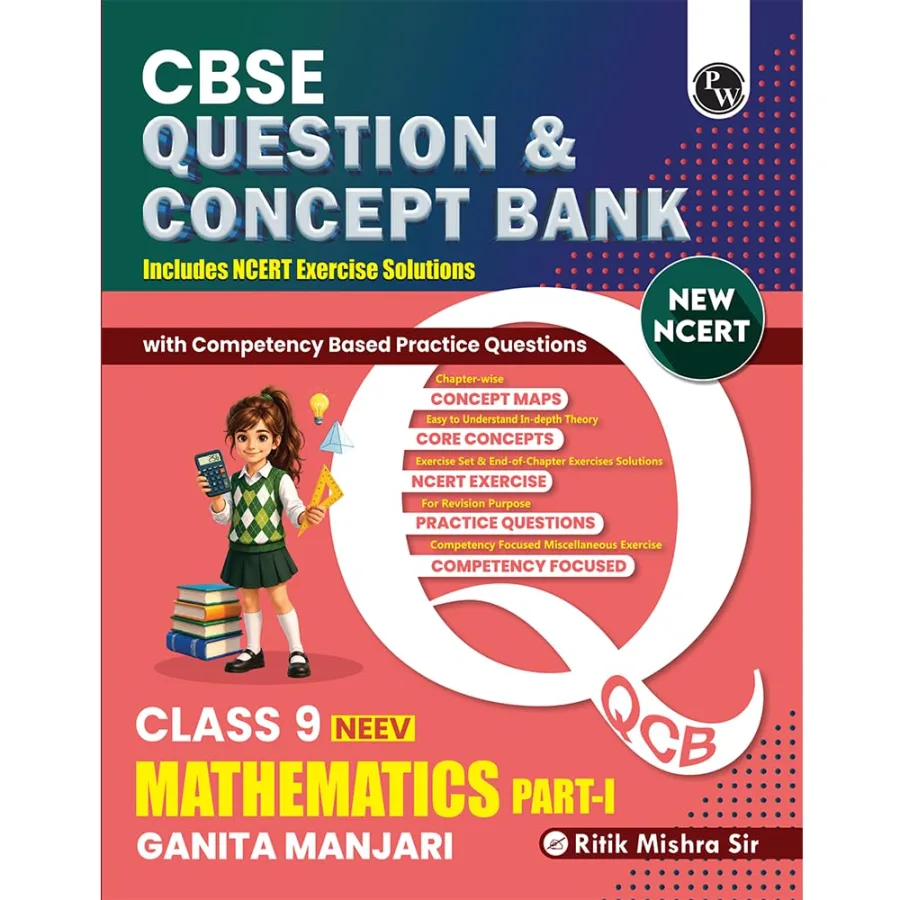
PW CBSE Class 9 Maths Ganita Manjari-1 New NCERT 2026-27 Question and Concept Bank with NCERT
Paperback
• 256 Pages
• ₹ 399.00
• English
• 9789378180439
No ratings yet
| Publisher | Physics Wallah Limited |
|---|---|
| ISBN13 | 9789378180439 |
| ASIN/SKU | 9378180434 |
| Book Format | Paperback |
| Language | English |
| Pages | 256 |
| List Price | ₹ 399.00 |
| Publishing Date | 16/06/2026 |
| Dimensions | 28 x 22 x 1 cm |
| Weight | 470 g |
| Book Code | BD00068310 |
Buy this Book
Amazon Stores
Ebook Stores
Other Stores
Discover PW CBSE Class 9 Maths Ganita Manjari-1 New NCERT 2026-27 Question and Concept Bank with NCERT by Physics Wallah. This book is published by Physics Wallah Limited in Paperback format, ISBN 9789378180439, ASIN 9378180434, under School Books, CBSE Question Papers, CBSE Textbooks.
Book Description
The PW CBSE Class 9 Maths Ganita Manjari-1 New NCERT 2026–27 Question & Concept Bank by Ritik Sir is a complete learning and practice resource designed to help students build a strong foundation in Mathematics. Aligned with the latest NCERT and CBSE curriculum, this book combines concept clarity, solved examples, competency-based learning, and extensive practice to make Mathematics easier, more engaging, and exam-oriented.
Why PhysicsWallah Question Bank?
PhysicsWallah Question & Concept Banks help students learn better, practice smarter, and perform confidently with comprehensive coverage of the latest CBSE syllabus. With concept-focused learning, exam-oriented practice, and competency-based questions, PW enables students to strengthen understanding and excel academically.
What You'll Learn from This Book
📘 Chapter-wise Concept Maps
Visualize and connect important mathematical concepts for better understanding, retention, and revision.
📘 Topic-wise Core Concepts
Learn every topic through clear, structured, and easy-to-understand explanations that build a strong conceptual foundation.
📘 Solved Examples
Understand problem-solving techniques with step-by-step worked-out examples designed to simplify complex concepts.
📘 Different Problem Types
Develop flexibility in solving questions across varying difficulty levels and formats to improve mathematical thinking.
📘 NCERT Exercise Solutions
Master NCERT questions with detailed explanations and systematic approaches to every exercise.
📘 Comprehensive Practice
Strengthen concepts through MCQs, Assertion-Reason, Match the Column, True/False, and Fill in the Blanks for complete preparation.
📘 Competency-Based Learning
Improve analytical thinking and application skills through case-based, subjective, and competency-focused questions.
📘 Exam-Oriented Preparation
Practice according to the latest CBSE assessment pattern with exercises aligned to modern evaluation methods.
Why You Should Buy This Book?
✅ Based on the latest NCERT & CBSE 2026–27 curriculum
✅ Includes detailed NCERT textbook solutions for complete syllabus coverage
✅ Features competency-based questions aligned with modern CBSE evaluation methods
✅ Helps improve problem-solving skills, logical reasoning, and mathematical confidence
✅ Supports effective revision and self-assessment through structured practice
✅ Makes Mathematics engaging and easier to understand
✅ Ideal for building a strong foundation for higher studies and competitive exams
Why PhysicsWallah Question Bank?
PhysicsWallah Question & Concept Banks help students learn better, practice smarter, and perform confidently with comprehensive coverage of the latest CBSE syllabus. With concept-focused learning, exam-oriented practice, and competency-based questions, PW enables students to strengthen understanding and excel academically.
What You'll Learn from This Book
📘 Chapter-wise Concept Maps
Visualize and connect important mathematical concepts for better understanding, retention, and revision.
📘 Topic-wise Core Concepts
Learn every topic through clear, structured, and easy-to-understand explanations that build a strong conceptual foundation.
📘 Solved Examples
Understand problem-solving techniques with step-by-step worked-out examples designed to simplify complex concepts.
📘 Different Problem Types
Develop flexibility in solving questions across varying difficulty levels and formats to improve mathematical thinking.
📘 NCERT Exercise Solutions
Master NCERT questions with detailed explanations and systematic approaches to every exercise.
📘 Comprehensive Practice
Strengthen concepts through MCQs, Assertion-Reason, Match the Column, True/False, and Fill in the Blanks for complete preparation.
📘 Competency-Based Learning
Improve analytical thinking and application skills through case-based, subjective, and competency-focused questions.
📘 Exam-Oriented Preparation
Practice according to the latest CBSE assessment pattern with exercises aligned to modern evaluation methods.
Why You Should Buy This Book?
✅ Based on the latest NCERT & CBSE 2026–27 curriculum
✅ Includes detailed NCERT textbook solutions for complete syllabus coverage
✅ Features competency-based questions aligned with modern CBSE evaluation methods
✅ Helps improve problem-solving skills, logical reasoning, and mathematical confidence
✅ Supports effective revision and self-assessment through structured practice
✅ Makes Mathematics engaging and easier to understand
✅ Ideal for building a strong foundation for higher studies and competitive exams
Author Biography
Author Biography will be added soon…
Editorial Reviews
Editorial Reviews will be added soon…
Book Summary
PW CBSE Class 9 Maths Ganita Manjari-1 New NCERT 2026–27 Question and Concept Bank by Physics Wallah is a comprehensive practice and revision resource designed for students studying the updated CBSE Class 9 Mathematics curriculum. The book is based on the new NCERT framework for 2026–27 and is intended to bring together conceptual learning and question practice in one place. The current listing identifies it as a paperback question bank published by PW in June 2026, with ISBN 9789378180439.
The main purpose of the book is to help Class 9 students understand mathematical concepts clearly and then apply them through a wide variety of questions. The title “Question and Concept Bank” reflects this dual purpose. It is not meant to be used only for solving exercises; it also provides a structured way to revise concepts before attempting questions. This approach is useful because Mathematics requires both understanding and practice. A student may understand a formula while reading it but still struggle when faced with a slightly different problem.
The book follows the Ganita Manjari-1 portion of the new NCERT Mathematics curriculum. This is particularly relevant for students preparing under the updated 2026–27 academic framework. Since the curriculum is changing toward greater emphasis on conceptual understanding, application, reasoning, and competency-based learning, students need to prepare for questions that may test how well they can use an idea rather than simply recall a formula.
The concept-oriented portion of the book helps students build a foundation before moving to more difficult problems. Mathematical concepts become much easier to use when students understand the relationships behind them. Instead of memorizing procedures mechanically, students can learn why a particular method works and recognize situations in which it should be applied.
Class 9 is an important stage in Mathematics because the subject becomes more abstract and interconnected. Students begin dealing with ideas that will continue into Classes 10, 11, and 12. Strong fundamentals at this stage can therefore make future Mathematics much easier. The book provides an opportunity for students to strengthen these fundamentals while also becoming familiar with different question formats.
One of the central areas of Class 9 Mathematics is the number system. Students need to understand different types of numbers and the relationships between them. These concepts are more than simple calculations. They help students understand how numbers behave, how they can be represented, and how mathematical operations work under different conditions.
A question bank can be especially useful in this area because students may encounter the same concept in several forms. One question may ask them to identify a type of number, another may involve an operation, and another may require them to reason about a mathematical property. Solving different forms of questions helps students develop flexibility.
Algebra is another important part of the Class 9 curriculum. Students begin working with variables, expressions, identities, equations, and relationships between quantities. For many students, algebra initially seems difficult because letters replace familiar numerical values. Regular practice can make this transition much easier.
The book's question-oriented approach can help students understand how algebraic concepts are applied. Students learn to simplify expressions, identify patterns, use identities, and solve problems systematically. The goal is to move from simply knowing a formula to recognizing when that formula or method is appropriate.
Mathematical identities are particularly important because they can simplify complicated expressions. Students who understand their structure can often solve problems more efficiently. However, memorization without understanding can lead to mistakes. Concept-based explanations and repeated practice can help students develop stronger familiarity with these relationships.
Geometry forms another important part of school Mathematics. Students have to understand shapes, lines, angles, relationships, properties, and logical arguments. Geometry is different from routine calculation because many questions require students to explain why something is true.
The book can help students practise this kind of reasoning through different question formats. Working through geometry problems encourages students to identify given information, select relevant properties, and organize their solution step by step.
Geometry also develops logical thinking. When students work through a proof or geometric argument, they learn to connect one statement with another. This habit of structured reasoning can help them in Mathematics as well as in other academic subjects.
Another important area is coordinate geometry, where algebra and geometry come together. Students learn to represent points using coordinates and understand their position on a plane. This topic demonstrates how numerical information can be used to describe geometric objects.
The question bank approach is valuable here because students need repeated practice with coordinates and graphical representations. A student may understand the coordinate system theoretically but still make errors while identifying positions or interpreting a diagram. Practice helps develop accuracy.
The curriculum also includes areas connected with measurement and geometry, where students work with properties of shapes and mathematical relationships. Such topics have practical applications because measurement is involved in construction, design, engineering, architecture, and everyday activities.
Another important aspect of the book is its emphasis on application-based questions. Modern school examinations increasingly ask students to use mathematical concepts in situations that are not identical to textbook examples. This requires students to read a problem carefully, identify the relevant information, and determine which mathematical method should be used.
Such questions develop problem-solving ability. Students learn that solving a mathematical problem is not always about immediately applying a formula. They may first need to understand the situation, identify relationships, eliminate irrelevant information, and then choose an appropriate strategy.
The book can also help students develop accuracy. Mathematics is a subject where small errors can produce completely different answers. Students may know the correct method but make mistakes with signs, calculations, units, or copying values. Repeated practice allows them to identify and reduce these errors.
Another major benefit is exam preparation. A question bank gives students exposure to multiple forms of questions before they face an examination. This reduces the possibility of being surprised by unfamiliar wording or a new presentation of a familiar concept.
Students can use the book for regular chapterwise practice. After learning a concept in school, they can attempt the related questions and identify areas where they need more practice. This makes the book useful throughout the academic year rather than only immediately before examinations.
The book is also suitable for revision. Before a test, students can quickly review the important concepts and then solve selected questions. This is more effective than simply rereading a chapter because solving problems shows whether the student can actually apply what they have studied.
A good revision routine can involve three stages. First, the student reviews the concept. Second, they solve questions without looking at the answers. Third, they analyze mistakes and return to the relevant concept. This cycle helps turn passive learning into active learning.
The book can also be useful for students who want to challenge themselves. Once basic questions become comfortable, students can attempt more complex problems requiring multiple steps. This gradually develops confidence and prepares them for the increasing difficulty of Mathematics in higher classes.
For students who struggle with Mathematics, the book can provide a structured way to identify weaknesses. Instead of concluding that they are simply “bad at Maths,” students can identify specific difficulties. Perhaps they have trouble with algebraic manipulation, geometry reasoning, calculations, or interpreting word problems. Once the weakness is identified, targeted practice becomes possible.
For stronger students, the same question bank can be used to improve speed and precision. They can attempt questions under time limits and analyze how efficiently they are solving them. This is useful for developing examination discipline.
The book can also support self-study. Students do not always need to wait for a teacher to explain every problem.
The main purpose of the book is to help Class 9 students understand mathematical concepts clearly and then apply them through a wide variety of questions. The title “Question and Concept Bank” reflects this dual purpose. It is not meant to be used only for solving exercises; it also provides a structured way to revise concepts before attempting questions. This approach is useful because Mathematics requires both understanding and practice. A student may understand a formula while reading it but still struggle when faced with a slightly different problem.
The book follows the Ganita Manjari-1 portion of the new NCERT Mathematics curriculum. This is particularly relevant for students preparing under the updated 2026–27 academic framework. Since the curriculum is changing toward greater emphasis on conceptual understanding, application, reasoning, and competency-based learning, students need to prepare for questions that may test how well they can use an idea rather than simply recall a formula.
The concept-oriented portion of the book helps students build a foundation before moving to more difficult problems. Mathematical concepts become much easier to use when students understand the relationships behind them. Instead of memorizing procedures mechanically, students can learn why a particular method works and recognize situations in which it should be applied.
Class 9 is an important stage in Mathematics because the subject becomes more abstract and interconnected. Students begin dealing with ideas that will continue into Classes 10, 11, and 12. Strong fundamentals at this stage can therefore make future Mathematics much easier. The book provides an opportunity for students to strengthen these fundamentals while also becoming familiar with different question formats.
One of the central areas of Class 9 Mathematics is the number system. Students need to understand different types of numbers and the relationships between them. These concepts are more than simple calculations. They help students understand how numbers behave, how they can be represented, and how mathematical operations work under different conditions.
A question bank can be especially useful in this area because students may encounter the same concept in several forms. One question may ask them to identify a type of number, another may involve an operation, and another may require them to reason about a mathematical property. Solving different forms of questions helps students develop flexibility.
Algebra is another important part of the Class 9 curriculum. Students begin working with variables, expressions, identities, equations, and relationships between quantities. For many students, algebra initially seems difficult because letters replace familiar numerical values. Regular practice can make this transition much easier.
The book's question-oriented approach can help students understand how algebraic concepts are applied. Students learn to simplify expressions, identify patterns, use identities, and solve problems systematically. The goal is to move from simply knowing a formula to recognizing when that formula or method is appropriate.
Mathematical identities are particularly important because they can simplify complicated expressions. Students who understand their structure can often solve problems more efficiently. However, memorization without understanding can lead to mistakes. Concept-based explanations and repeated practice can help students develop stronger familiarity with these relationships.
Geometry forms another important part of school Mathematics. Students have to understand shapes, lines, angles, relationships, properties, and logical arguments. Geometry is different from routine calculation because many questions require students to explain why something is true.
The book can help students practise this kind of reasoning through different question formats. Working through geometry problems encourages students to identify given information, select relevant properties, and organize their solution step by step.
Geometry also develops logical thinking. When students work through a proof or geometric argument, they learn to connect one statement with another. This habit of structured reasoning can help them in Mathematics as well as in other academic subjects.
Another important area is coordinate geometry, where algebra and geometry come together. Students learn to represent points using coordinates and understand their position on a plane. This topic demonstrates how numerical information can be used to describe geometric objects.
The question bank approach is valuable here because students need repeated practice with coordinates and graphical representations. A student may understand the coordinate system theoretically but still make errors while identifying positions or interpreting a diagram. Practice helps develop accuracy.
The curriculum also includes areas connected with measurement and geometry, where students work with properties of shapes and mathematical relationships. Such topics have practical applications because measurement is involved in construction, design, engineering, architecture, and everyday activities.
Another important aspect of the book is its emphasis on application-based questions. Modern school examinations increasingly ask students to use mathematical concepts in situations that are not identical to textbook examples. This requires students to read a problem carefully, identify the relevant information, and determine which mathematical method should be used.
Such questions develop problem-solving ability. Students learn that solving a mathematical problem is not always about immediately applying a formula. They may first need to understand the situation, identify relationships, eliminate irrelevant information, and then choose an appropriate strategy.
The book can also help students develop accuracy. Mathematics is a subject where small errors can produce completely different answers. Students may know the correct method but make mistakes with signs, calculations, units, or copying values. Repeated practice allows them to identify and reduce these errors.
Another major benefit is exam preparation. A question bank gives students exposure to multiple forms of questions before they face an examination. This reduces the possibility of being surprised by unfamiliar wording or a new presentation of a familiar concept.
Students can use the book for regular chapterwise practice. After learning a concept in school, they can attempt the related questions and identify areas where they need more practice. This makes the book useful throughout the academic year rather than only immediately before examinations.
The book is also suitable for revision. Before a test, students can quickly review the important concepts and then solve selected questions. This is more effective than simply rereading a chapter because solving problems shows whether the student can actually apply what they have studied.
A good revision routine can involve three stages. First, the student reviews the concept. Second, they solve questions without looking at the answers. Third, they analyze mistakes and return to the relevant concept. This cycle helps turn passive learning into active learning.
The book can also be useful for students who want to challenge themselves. Once basic questions become comfortable, students can attempt more complex problems requiring multiple steps. This gradually develops confidence and prepares them for the increasing difficulty of Mathematics in higher classes.
For students who struggle with Mathematics, the book can provide a structured way to identify weaknesses. Instead of concluding that they are simply “bad at Maths,” students can identify specific difficulties. Perhaps they have trouble with algebraic manipulation, geometry reasoning, calculations, or interpreting word problems. Once the weakness is identified, targeted practice becomes possible.
For stronger students, the same question bank can be used to improve speed and precision. They can attempt questions under time limits and analyze how efficiently they are solving them. This is useful for developing examination discipline.
The book can also support self-study. Students do not always need to wait for a teacher to explain every problem.
Sample Chapters
Sample Chapters will be added soon…
Reader Reviews
No reviews yet.
PW CBSE Class 9 Maths Ganita Manjari-1 New NCERT 2026-27 Question and Concept Bank with NCERT
Download Cover Image
Do you want to download the full cover image for PW CBSE Class 9 Maths Ganita Manjari-1 New NCERT 2026-27 Question and Concept Bank with NCERT?