
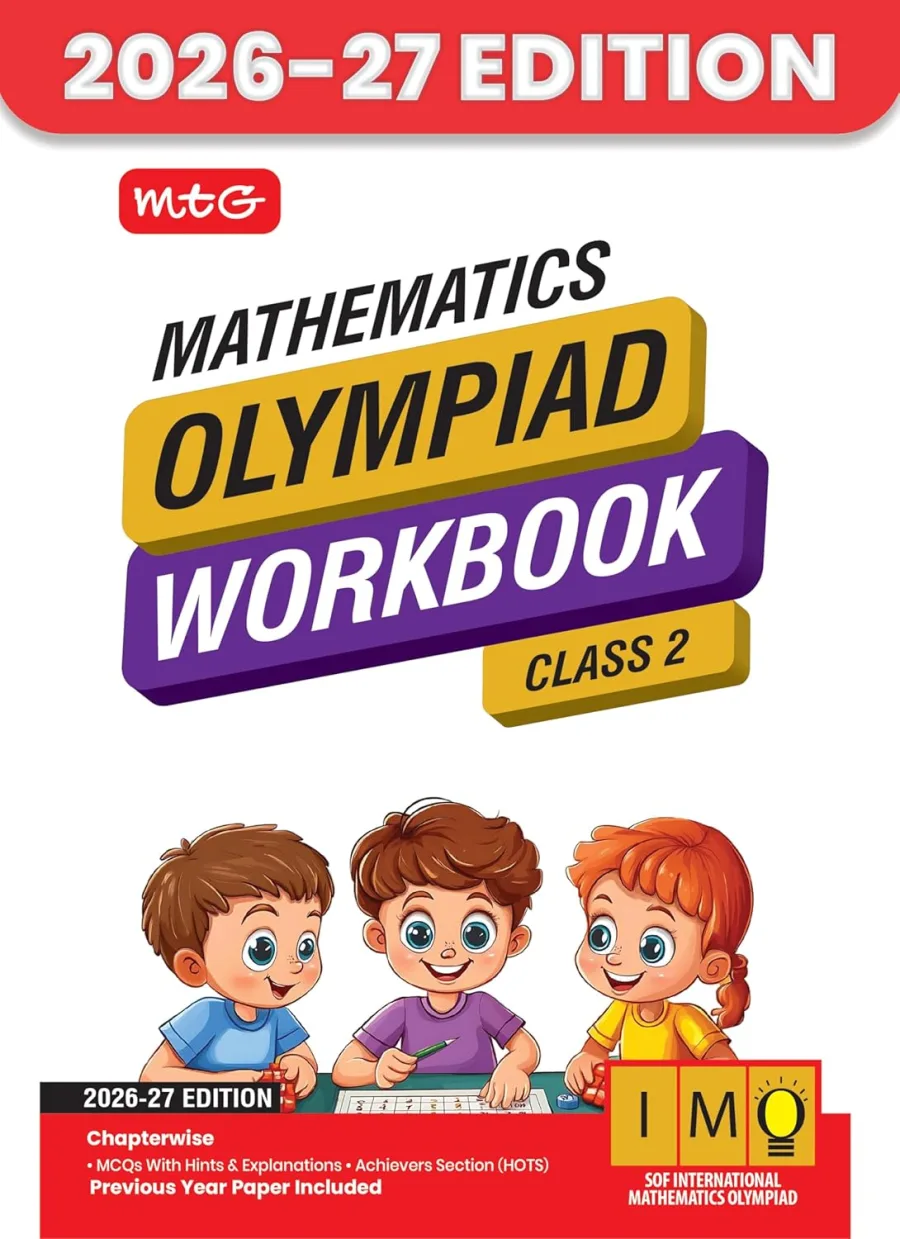
MTG International Mathematics Olympiad (IMO) Workbook Class 2 - Chapter-wise MCQs with Achievers Sec
Paperback
• 72 Pages
• ₹ 100.00
• English
• 9789369570027
No ratings yet
| Publisher | MTG Learning Media Pvt. Ltd. |
|---|---|
| ISBN13 | 9789369570027 |
| ASIN/SKU | 9369570020 |
| Book Format | Paperback |
| Language | English |
| Pages | 72 |
| List Price | ₹ 100.00 |
| Publishing Date | 31/03/2026 |
| Dimensions | 24 x 17 x 0.4 cm |
| Weight | 110 g |
| Book Code | BD00068036 |
Buy this Book
Amazon Stores
Ebook Stores
Other Stores
Discover MTG International Mathematics Olympiad (IMO) Workbook Class 2 - Chapter-wise MCQs with Achievers Sec by Mahabir Singh. This book is published by MTG Learning Media Pvt. Ltd. in Paperback format, ISBN 9789369570027, ASIN 9369570020, under School Books, Olympiads, NTSE.
Book Description
MTG presents the fully revised & updated “InternationalMathematics Olympiad Workbook” - the perfect companion to ace the SOF International MathematicsOlympiad (IMO) 2026-27 exam.
Who Can Benefit?
SOF IMO participants
For classes 1-12
School teachers
BOOK DESCRIPTION
MTG’s fully revised & updated IMO workbook is the perfect tool to help students prepare for their upcoming SOF IMO (2026-27) exam. Packed with an interactive question bank, this workbook is designed to keep students engaged and motivated throughout their learning process. With a focus on developing important Math skills and knowledge needed for success, this workbook is a must-have for any student looking to excel in their Olympiad exams.
Chapter-wise quick recap for thorough preparation.
Chapter-wise MCQs for extensive practice.
The MCQs are divided into general questions and the achiever’s section
Includes hints and explanations for better understanding.
HOTS section to challenge students and enhance critical thinking skills.
What Sets This Book Apart?
2025 IMO exam paper to familiarize students with the exam pattern.
OMR sheets are provided after each chapter to practice filling them out.
What Will You Learn?
Aids in better comprehension and proficiency in Math concepts.
Extensive practice will help in becoming ready for the Olympiad.
Helps students refine their Math skills and deepen their understanding.
Boosts students' ability in reasoning, analytical, and problem-solving skills.
Who Can Benefit?
SOF IMO participants
For classes 1-12
School teachers
BOOK DESCRIPTION
MTG’s fully revised & updated IMO workbook is the perfect tool to help students prepare for their upcoming SOF IMO (2026-27) exam. Packed with an interactive question bank, this workbook is designed to keep students engaged and motivated throughout their learning process. With a focus on developing important Math skills and knowledge needed for success, this workbook is a must-have for any student looking to excel in their Olympiad exams.
Chapter-wise quick recap for thorough preparation.
Chapter-wise MCQs for extensive practice.
The MCQs are divided into general questions and the achiever’s section
Includes hints and explanations for better understanding.
HOTS section to challenge students and enhance critical thinking skills.
What Sets This Book Apart?
2025 IMO exam paper to familiarize students with the exam pattern.
OMR sheets are provided after each chapter to practice filling them out.
What Will You Learn?
Aids in better comprehension and proficiency in Math concepts.
Extensive practice will help in becoming ready for the Olympiad.
Helps students refine their Math skills and deepen their understanding.
Boosts students' ability in reasoning, analytical, and problem-solving skills.
Author Biography
Author Biography will be added soon…
Editorial Reviews
Editorial Reviews will be added soon…
Book Summary
MTG International Mathematics Olympiad (IMO) Workbook Class 2 – Chapter-wise MCQs with Achievers Section by Mahabir Singh is a practice-oriented mathematics workbook designed for young learners preparing for the SOF International Mathematics Olympiad (IMO). The 2026–27 listing presents it as a Class 2 Olympiad workbook with chapter-wise multiple-choice questions and a dedicated Achievers Section. Earlier editions of the same workbook also included previous-year solved papers, hints and explanations, HOTS-style questions, and practice designed around the IMO format.
The main purpose of the book is to help Class 2 students develop mathematical confidence while becoming familiar with the kind of questions they may encounter in an Olympiad examination. At this age, Mathematics should not be limited to performing routine calculations. Children also need to learn how to observe patterns, compare quantities, think logically, identify relationships, and find solutions to problems that may look different from the examples they have already seen.
The book uses a chapter-wise structure, which makes preparation easier for young students. Instead of presenting a large collection of unrelated questions, the practice is organized around individual mathematical concepts. A child can first learn a topic at school, practise the corresponding questions from the workbook, identify mistakes, and then move forward. This approach helps create a steady learning routine.
The workbook primarily uses multiple-choice questions, an important feature because Olympiad examinations require students to select the correct answer from several options. Learning how to read each option carefully is itself an important skill. Sometimes a child may know the mathematical concept but choose the wrong option because of a calculation mistake or because the question was not read carefully.
The book's earlier editions are described as containing a general question section and a separate Achievers Section. The Achievers Section is intended to provide more challenging questions that require additional thinking and problem-solving ability. This creates a progression from basic understanding toward higher-level reasoning.
For a Class 2 student, this progression is particularly useful. Children should first become comfortable with fundamental mathematical ideas before attempting complicated questions. Once they understand the basic method, more challenging problems can encourage them to think independently rather than simply follow a fixed procedure.
The workbook covers the kinds of mathematical skills that form the foundation of elementary-level Olympiad preparation. These include numbers, arithmetic operations, comparisons, patterns, shapes, measurement, and logical problem solving, depending on the specific syllabus and edition. The objective is not simply to make children calculate faster but to encourage them to understand how numbers and mathematical relationships work.
Number concepts are particularly important at this stage. Children need to become comfortable with reading, writing, comparing, and arranging numbers. They also need to understand place value and recognize how numbers change when digits are added, removed, or rearranged.
Arithmetic operations such as addition, subtraction, multiplication, and division form another important foundation. Regular practice can improve accuracy and speed, but Olympiad questions often require students to use these operations in less direct ways. A problem may present a small situation and ask the child to determine which operation is appropriate.
This helps develop problem interpretation. Instead of immediately calculating, children learn to ask what the question is actually asking. They may need to identify important information, ignore unnecessary details, and decide which mathematical operation or strategy will solve the problem.
Patterns are another valuable area for young learners. Pattern questions encourage children to identify what changes and what remains constant. A sequence may involve numbers, shapes, objects, or other visual arrangements. Once the child identifies the underlying rule, they can predict what comes next.
Pattern recognition develops an important form of mathematical thinking. It teaches children to look for relationships instead of treating every question as a completely new problem. This ability becomes increasingly useful as Mathematics becomes more advanced.
The workbook also helps children develop logical reasoning. Some questions cannot be solved simply by remembering a formula. Children may have to compare possibilities, eliminate incorrect options, arrange objects in a particular order, or identify a relationship between different pieces of information.
These activities encourage children to slow down and think carefully. This is important because Olympiad questions are often designed to test understanding and reasoning rather than straightforward textbook repetition.
The Achievers Section is particularly valuable for children who are ready for additional challenges. These questions can require more than one step of thinking and may introduce a familiar concept in an unfamiliar form. Such problems help children learn that knowing a mathematical rule is only the beginning; they must also know how to apply it.
Earlier editions of the workbook included HOTS questions, meaning higher-order thinking questions, along with hints and explanations. These features are designed to help students understand not only the correct answer but also the reasoning behind it.
Hints can be especially helpful for young learners because they provide guidance without immediately giving away the entire solution. A parent or teacher can encourage the child to attempt a problem independently first and use the hint only when necessary.
The explanation stage is equally important. When a child makes a mistake, simply telling them the correct answer does not necessarily teach them how to avoid the same mistake later. Understanding the reasoning behind the answer helps develop stronger mathematical habits.
The workbook can also help children become familiar with the Olympiad examination pattern. Previous editions included an actual previous-year IMO paper, allowing students to see how questions are presented in the examination. This type of practice can reduce anxiety because children know what to expect when they eventually sit for the examination.
Another feature reported in earlier editions is the inclusion of OMR sheets for chapter-wise practice. These allow students to become familiar with marking answers in an objective examination format. While filling an OMR sheet may seem like a small skill, practising it early can help children become more comfortable with the mechanics of competitive examinations.
The workbook can also improve speed and accuracy. Children preparing for an Olympiad need to solve questions within a limited period. Repeated practice allows them to recognize familiar mathematical patterns more quickly. At the same time, they learn that speed should not come at the cost of accuracy.
Parents should encourage children to solve questions carefully rather than simply racing through them. It is better for a child to understand ten questions properly than to complete thirty questions without understanding the mistakes.
The book can be used alongside the child's regular school Mathematics textbook. The school curriculum provides the basic concepts, while the Olympiad workbook provides additional practice and more challenging applications. This combination can be especially useful because Olympiad questions may require students to apply ordinary school concepts in unfamiliar ways.
For example, a child may learn addition and subtraction in school through direct calculations. An Olympiad problem may then present those same operations through a puzzle or a word problem. The child must recognize the underlying mathematical idea before solving it.
This approach helps children develop transferable mathematical skills. They begin to understand that one concept can be used in many different situations.
The book can also be used for self-practice at home. Parents do not necessarily need to teach every question. They can allow the child to attempt problems independently and intervene only when the child becomes genuinely stuck. This encourages confidence and independent thinking.
At the same time, children at this age benefit from encouragement. A difficult question should be presented as a challenge rather than as a failure. Parents can ask guiding questions such as, “What information do we know?”, “What is the question asking?”, or “Can you find a pattern?” Such prompts help children develop their own problem-solving process.
The main purpose of the book is to help Class 2 students develop mathematical confidence while becoming familiar with the kind of questions they may encounter in an Olympiad examination. At this age, Mathematics should not be limited to performing routine calculations. Children also need to learn how to observe patterns, compare quantities, think logically, identify relationships, and find solutions to problems that may look different from the examples they have already seen.
The book uses a chapter-wise structure, which makes preparation easier for young students. Instead of presenting a large collection of unrelated questions, the practice is organized around individual mathematical concepts. A child can first learn a topic at school, practise the corresponding questions from the workbook, identify mistakes, and then move forward. This approach helps create a steady learning routine.
The workbook primarily uses multiple-choice questions, an important feature because Olympiad examinations require students to select the correct answer from several options. Learning how to read each option carefully is itself an important skill. Sometimes a child may know the mathematical concept but choose the wrong option because of a calculation mistake or because the question was not read carefully.
The book's earlier editions are described as containing a general question section and a separate Achievers Section. The Achievers Section is intended to provide more challenging questions that require additional thinking and problem-solving ability. This creates a progression from basic understanding toward higher-level reasoning.
For a Class 2 student, this progression is particularly useful. Children should first become comfortable with fundamental mathematical ideas before attempting complicated questions. Once they understand the basic method, more challenging problems can encourage them to think independently rather than simply follow a fixed procedure.
The workbook covers the kinds of mathematical skills that form the foundation of elementary-level Olympiad preparation. These include numbers, arithmetic operations, comparisons, patterns, shapes, measurement, and logical problem solving, depending on the specific syllabus and edition. The objective is not simply to make children calculate faster but to encourage them to understand how numbers and mathematical relationships work.
Number concepts are particularly important at this stage. Children need to become comfortable with reading, writing, comparing, and arranging numbers. They also need to understand place value and recognize how numbers change when digits are added, removed, or rearranged.
Arithmetic operations such as addition, subtraction, multiplication, and division form another important foundation. Regular practice can improve accuracy and speed, but Olympiad questions often require students to use these operations in less direct ways. A problem may present a small situation and ask the child to determine which operation is appropriate.
This helps develop problem interpretation. Instead of immediately calculating, children learn to ask what the question is actually asking. They may need to identify important information, ignore unnecessary details, and decide which mathematical operation or strategy will solve the problem.
Patterns are another valuable area for young learners. Pattern questions encourage children to identify what changes and what remains constant. A sequence may involve numbers, shapes, objects, or other visual arrangements. Once the child identifies the underlying rule, they can predict what comes next.
Pattern recognition develops an important form of mathematical thinking. It teaches children to look for relationships instead of treating every question as a completely new problem. This ability becomes increasingly useful as Mathematics becomes more advanced.
The workbook also helps children develop logical reasoning. Some questions cannot be solved simply by remembering a formula. Children may have to compare possibilities, eliminate incorrect options, arrange objects in a particular order, or identify a relationship between different pieces of information.
These activities encourage children to slow down and think carefully. This is important because Olympiad questions are often designed to test understanding and reasoning rather than straightforward textbook repetition.
The Achievers Section is particularly valuable for children who are ready for additional challenges. These questions can require more than one step of thinking and may introduce a familiar concept in an unfamiliar form. Such problems help children learn that knowing a mathematical rule is only the beginning; they must also know how to apply it.
Earlier editions of the workbook included HOTS questions, meaning higher-order thinking questions, along with hints and explanations. These features are designed to help students understand not only the correct answer but also the reasoning behind it.
Hints can be especially helpful for young learners because they provide guidance without immediately giving away the entire solution. A parent or teacher can encourage the child to attempt a problem independently first and use the hint only when necessary.
The explanation stage is equally important. When a child makes a mistake, simply telling them the correct answer does not necessarily teach them how to avoid the same mistake later. Understanding the reasoning behind the answer helps develop stronger mathematical habits.
The workbook can also help children become familiar with the Olympiad examination pattern. Previous editions included an actual previous-year IMO paper, allowing students to see how questions are presented in the examination. This type of practice can reduce anxiety because children know what to expect when they eventually sit for the examination.
Another feature reported in earlier editions is the inclusion of OMR sheets for chapter-wise practice. These allow students to become familiar with marking answers in an objective examination format. While filling an OMR sheet may seem like a small skill, practising it early can help children become more comfortable with the mechanics of competitive examinations.
The workbook can also improve speed and accuracy. Children preparing for an Olympiad need to solve questions within a limited period. Repeated practice allows them to recognize familiar mathematical patterns more quickly. At the same time, they learn that speed should not come at the cost of accuracy.
Parents should encourage children to solve questions carefully rather than simply racing through them. It is better for a child to understand ten questions properly than to complete thirty questions without understanding the mistakes.
The book can be used alongside the child's regular school Mathematics textbook. The school curriculum provides the basic concepts, while the Olympiad workbook provides additional practice and more challenging applications. This combination can be especially useful because Olympiad questions may require students to apply ordinary school concepts in unfamiliar ways.
For example, a child may learn addition and subtraction in school through direct calculations. An Olympiad problem may then present those same operations through a puzzle or a word problem. The child must recognize the underlying mathematical idea before solving it.
This approach helps children develop transferable mathematical skills. They begin to understand that one concept can be used in many different situations.
The book can also be used for self-practice at home. Parents do not necessarily need to teach every question. They can allow the child to attempt problems independently and intervene only when the child becomes genuinely stuck. This encourages confidence and independent thinking.
At the same time, children at this age benefit from encouragement. A difficult question should be presented as a challenge rather than as a failure. Parents can ask guiding questions such as, “What information do we know?”, “What is the question asking?”, or “Can you find a pattern?” Such prompts help children develop their own problem-solving process.
Sample Chapters
Sample Chapters will be added soon…
Reader Reviews
No reviews yet.
MTG International Mathematics Olympiad (IMO) Workbook Class 2 - Chapter-wise MCQs with Achievers Sec
Download Cover Image
Do you want to download the full cover image for MTG International Mathematics Olympiad (IMO) Workbook Class 2 - Chapter-wise MCQs with Achievers Sec?