
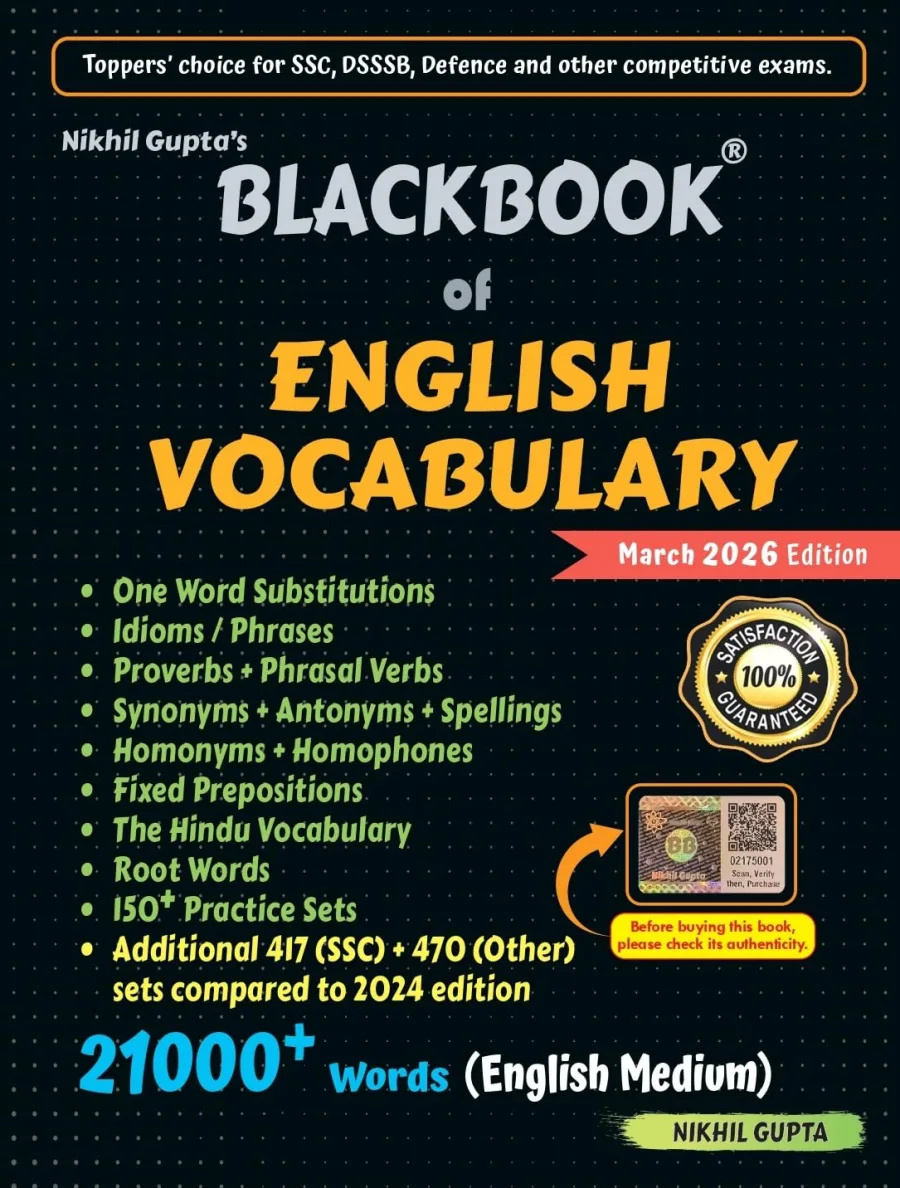
Blackbook of English vocabulary 2026 Edition (English Medium) by Nikhil Gupta
Paperback
• 704 Pages
• ₹ 443.97
• English
• 9788195645756
No ratings yet
| Publisher | Gupta Edutech |
|---|---|
| ISBN13 | 9788195645756 |
| ASIN/SKU | 8195645755 |
| Book Format | Paperback |
| Language | English |
| Pages | 704 |
| List Price | ₹ 443.97 |
| Publishing Date | 09/04/2026 |
| Dimensions | 24.1 x 18.4 x 3.2 cm |
| Weight | 1 kg 30 g |
| Book Code | BD00068035 |
Buy this Book
Amazon Stores
Ebook Stores
Other Stores
Discover Blackbook of English vocabulary 2026 Edition (English Medium) by Nikhil Gupta by Nikhil Gupta. This book is published by Gupta Edutech in Paperback format, ISBN 9788195645756, ASIN 8195645755, under Exam Preparation, SSC Exam.
Book Description
The Blackbook of English Vocabulary (2026 Edition), 4th Edition | English Medium The most comprehensive vocabulary resource for competitive exam aspirants, trusted by toppers including AIR 1. Now in its 4th edition, the Blackbook brings thoroughly verified vocabulary compiled from SSC exam papers since 1997, updated with the latest papers through February 2026. Over 21,000 words with clear meanings, all in one place. Why Toppers Recommend This Book • Vocabulary from actual exam papers, not textbooks • No duplicates, no filler • #R frequency indicator shows how often each word appeared in exams • Study what matters, skip what doesn't What's Inside • Synonyms, Antonyms, One Word Substitutions, Idioms and Phrases • Phrasal Verbs, Spelling Corrections, Homonyms, Fixed Prepositions • The Hindu editorial vocabulary • Roots, Prefixes and Suffixes • 24 specialised wordlists • Practice sets in every chapter • English definitions with Example Sentences • Star (*) and tilde (~) symbols for quick word relevance What's New in the 4th Edition • 887 new exam papers added (417 SSC shifts + 470 other exams) • New chapters on Fixed Prepositions, Homonyms, Additional Vocabulary • English definitions added throughout • Improved frequency marking system Covers - SSC CGL, CHSL, MTS, CPO, Steno, DSSSB, IBPS, SBI, RRB, NDA, CDS, AFCAT, MBA entrance, TET and all government competitive examinations
Author Biography
Nikhil Gupta, a distinguished name in the realm of competitive exam preparation, has earned acclaim for his insightful and meticulously crafted resources that have guided lakhs of aspirants to success. With a deep understanding of the challenges faced by students, he has dedicated his career to creating comprehensive study materials that cater to various competitive exams such as SSC, Railways, Banking, and other government examinations.
Author of the celebrated "Blackbook of English Vocabulary" and the "Blackbook of General Awareness", Nikhil Gupta's books are hailed for their precision, relevance, and ability to demystify complex concepts. His work is characterized by an innovative approach that blends thorough research with practical insights, making daunting subjects accessible to all levels of learners.
Nikhil Gupta's background in education and his passion for teaching shines through in his writing, which is both informative and engaging. His commitment to excellence and continuous improvement has made his publications indispensable for candidates aiming for top scores in competitive exams.
Beyond his books, Nikhil Gupta is an active contributor to the educational community, offering mentorship and guidance through various platforms. His dedication to empowering students extends to his presence on social media and educational forums, where he shares updates, study tips, and motivational advice.
As an author, educator, and mentor, Nikhil Gupta remains a beacon of hope and inspiration for countless competitive exam aspirants, continually striving to enrich their learning experience and maximize their potential.
Author of the celebrated "Blackbook of English Vocabulary" and the "Blackbook of General Awareness", Nikhil Gupta's books are hailed for their precision, relevance, and ability to demystify complex concepts. His work is characterized by an innovative approach that blends thorough research with practical insights, making daunting subjects accessible to all levels of learners.
Nikhil Gupta's background in education and his passion for teaching shines through in his writing, which is both informative and engaging. His commitment to excellence and continuous improvement has made his publications indispensable for candidates aiming for top scores in competitive exams.
Beyond his books, Nikhil Gupta is an active contributor to the educational community, offering mentorship and guidance through various platforms. His dedication to empowering students extends to his presence on social media and educational forums, where he shares updates, study tips, and motivational advice.
As an author, educator, and mentor, Nikhil Gupta remains a beacon of hope and inspiration for countless competitive exam aspirants, continually striving to enrich their learning experience and maximize their potential.
Editorial Reviews
Editorial Reviews will be added soon…
Book Summary
Blackbook of English Vocabulary 2026 Edition by Nikhil Gupta is an exam-oriented vocabulary book designed primarily for students and aspirants preparing for competitive examinations in India. The 2026 edition is the fourth edition and was published in March 2026 by Gupta Edutech. The English-medium edition contains about 704 pages and focuses on vocabulary that has actually appeared in competitive examinations rather than presenting an ordinary dictionary-style collection of words. The book is particularly relevant for SSC examinations and also covers vocabulary useful for banking, railways, defence, teaching, MBA entrance examinations, and other government and competitive exams.
The central idea behind the book is that vocabulary preparation becomes much more effective when students concentrate on words that have actually been asked in examinations. Instead of spending months memorizing thousands of unrelated words, aspirants can use previous-year examination vocabulary to identify recurring and important words. The 2026 edition contains more than 21,000 words and has been updated with vocabulary from SSC papers through February 2026. It also incorporates material from hundreds of additional competitive-exam sets.
A major strength of the book is its previous-year-question-based approach. Vocabulary is not presented merely as a collection of difficult English words. The material is connected with actual examination trends, allowing students to understand which words have appeared repeatedly and which areas deserve greater attention. The book uses a frequency indicator, represented by #R, to show how many times a particular vocabulary item has appeared in examinations. This allows students to prioritize high-frequency words during revision.
The book begins with One Word Substitutions, an important area for examinations such as SSC. One Word Substitution questions require students to identify a single word that expresses a longer phrase or description. For example, instead of remembering a lengthy definition, students learn the precise word that represents the idea. The book includes extensive lists of such expressions along with practice material. It also highlights frequently repeated One Word Substitutions so that students can concentrate on words that have demonstrated examination relevance.
The Idioms and Phrases section is another important component. Idioms can be difficult because their meanings cannot always be understood by translating the individual words. A phrase may have a figurative meaning that is completely different from its literal interpretation. The book helps students become familiar with common idioms and their meanings and, in the newer edition, provides example sentences for One Word Substitutions and idioms to make their usage clearer.
The book also covers Synonyms and Antonyms, which are among the most common vocabulary-based question types in competitive examinations. Students learn groups of words with similar or opposite meanings. Rather than learning vocabulary in isolation, understanding related words can help students expand their vocabulary more efficiently. A single word can lead to several associated words, allowing students to improve their overall command of English.
The book separates and organizes different synonym and antonym lists according to examination relevance. It also provides highly repeated words and practice sets. This structure can be particularly useful during revision because students can first study the complete material and later concentrate on the most frequently tested vocabulary.
Spelling correction is another area addressed by the book. Competitive examinations frequently test whether candidates can recognize the correct spelling of an English word. A student may understand a word's meaning but still lose marks because of an incorrect spelling. By including commonly tested spelling patterns and corrections, the book helps students become more attentive to written English.
The 2026 edition has also expanded its coverage of Homonyms and Homophones. These words can cause confusion because they may sound alike or have similar forms while having different meanings or spellings. Understanding these distinctions is important not only for examinations but also for accurate written communication. The newer edition divides parts of this material into previous-year-question-based and non-PYQ-based sections.
Another important addition is the expanded Phrasal Verbs section. Phrasal verbs combine a verb with one or more additional words and often have meanings that cannot be predicted simply from the main verb. They are common in everyday English and can appear in competitive examinations. The 2026 edition expands this area and organizes it around examination relevance.
The book also introduces or expands Fixed Prepositions. Prepositions can be difficult because certain words naturally take particular prepositions in standard English. Students preparing for competitive examinations often encounter these combinations in error-detection, fill-in-the-blank, and sentence-correction questions. The 2026 edition adds important usage rules and memory aids to make these combinations easier to remember.
The The Hindu Vocabulary section provides another vocabulary source for aspirants. It focuses on words encountered in editorial-style English and helps students become familiar with the kind of vocabulary commonly found in newspapers and serious written material. In the 2026 edition, this section has been refreshed and duplicate words already covered elsewhere have been removed.
Root Words, Prefixes, and Suffixes form another useful part of the book. Instead of memorizing every word independently, students can learn common roots and word-building elements. Once a student understands the meaning of a root, prefix, or suffix, unfamiliar words can sometimes become easier to understand. This approach can make vocabulary learning more systematic and can help students infer meanings when they encounter new words in an examination.
The book also includes Foreign Words, which have been revised and expanded in the 2026 edition to cover 197 important words. Such words often appear in English vocabulary sections and general competitive examinations. Learning their meanings can help students recognize expressions that originate from languages other than English.
A notable feature of the book is the inclusion of practice sets. Vocabulary memorization becomes much more useful when students actually test themselves. Practice questions help them discover whether they can recognize a word when it appears in a different context rather than simply remembering its definition. The 2026 edition contains practice sets throughout its chapters, including a large collection of examination-oriented exercises.
The book also includes Top 200 and other high-priority vocabulary lists. These lists are particularly useful for students who have limited preparation time. A student preparing close to an examination may not be able to revise all 21,000-plus words. Prioritized lists allow the student to concentrate first on highly repeated and important vocabulary before moving to broader material.
Another useful feature is the 90-day study plan. Vocabulary requires repetition because simply reading a word once is rarely enough to remember it permanently. A structured study plan encourages students to divide the material into manageable daily portions. Instead of attempting to memorize hundreds of words in one sitting, students can develop a consistent routine and revise previously learned vocabulary at regular intervals. The official product description specifically highlights the 90-day plan as a feature of the edition.
The book also uses symbols such as the star (*) and tilde (~) to provide additional relevance or prioritization information. These visual markers can help students identify words that deserve particular attention during quick revision. Such features are especially helpful when the book is being used repeatedly over several months.
The 2026 edition represents a substantial update over the earlier version. According to the published description, it adds vocabulary from 417 SSC sets that appeared after the previous edition and from 470 sets of other competitive examinations. It also expands Phrasal Verbs and Homonyms, adds examples to One Word Substitutions and Idioms, revises the newspaper vocabulary section, expands foreign words and root-word material, and introduces the Fixed Prepositions section.
These updates make the book particularly useful for aspirants who want current examination-oriented vocabulary rather than relying entirely on older editions. Competitive-exam vocabulary can change over time, and new papers may introduce words that were not emphasized in earlier books.
The central idea behind the book is that vocabulary preparation becomes much more effective when students concentrate on words that have actually been asked in examinations. Instead of spending months memorizing thousands of unrelated words, aspirants can use previous-year examination vocabulary to identify recurring and important words. The 2026 edition contains more than 21,000 words and has been updated with vocabulary from SSC papers through February 2026. It also incorporates material from hundreds of additional competitive-exam sets.
A major strength of the book is its previous-year-question-based approach. Vocabulary is not presented merely as a collection of difficult English words. The material is connected with actual examination trends, allowing students to understand which words have appeared repeatedly and which areas deserve greater attention. The book uses a frequency indicator, represented by #R, to show how many times a particular vocabulary item has appeared in examinations. This allows students to prioritize high-frequency words during revision.
The book begins with One Word Substitutions, an important area for examinations such as SSC. One Word Substitution questions require students to identify a single word that expresses a longer phrase or description. For example, instead of remembering a lengthy definition, students learn the precise word that represents the idea. The book includes extensive lists of such expressions along with practice material. It also highlights frequently repeated One Word Substitutions so that students can concentrate on words that have demonstrated examination relevance.
The Idioms and Phrases section is another important component. Idioms can be difficult because their meanings cannot always be understood by translating the individual words. A phrase may have a figurative meaning that is completely different from its literal interpretation. The book helps students become familiar with common idioms and their meanings and, in the newer edition, provides example sentences for One Word Substitutions and idioms to make their usage clearer.
The book also covers Synonyms and Antonyms, which are among the most common vocabulary-based question types in competitive examinations. Students learn groups of words with similar or opposite meanings. Rather than learning vocabulary in isolation, understanding related words can help students expand their vocabulary more efficiently. A single word can lead to several associated words, allowing students to improve their overall command of English.
The book separates and organizes different synonym and antonym lists according to examination relevance. It also provides highly repeated words and practice sets. This structure can be particularly useful during revision because students can first study the complete material and later concentrate on the most frequently tested vocabulary.
Spelling correction is another area addressed by the book. Competitive examinations frequently test whether candidates can recognize the correct spelling of an English word. A student may understand a word's meaning but still lose marks because of an incorrect spelling. By including commonly tested spelling patterns and corrections, the book helps students become more attentive to written English.
The 2026 edition has also expanded its coverage of Homonyms and Homophones. These words can cause confusion because they may sound alike or have similar forms while having different meanings or spellings. Understanding these distinctions is important not only for examinations but also for accurate written communication. The newer edition divides parts of this material into previous-year-question-based and non-PYQ-based sections.
Another important addition is the expanded Phrasal Verbs section. Phrasal verbs combine a verb with one or more additional words and often have meanings that cannot be predicted simply from the main verb. They are common in everyday English and can appear in competitive examinations. The 2026 edition expands this area and organizes it around examination relevance.
The book also introduces or expands Fixed Prepositions. Prepositions can be difficult because certain words naturally take particular prepositions in standard English. Students preparing for competitive examinations often encounter these combinations in error-detection, fill-in-the-blank, and sentence-correction questions. The 2026 edition adds important usage rules and memory aids to make these combinations easier to remember.
The The Hindu Vocabulary section provides another vocabulary source for aspirants. It focuses on words encountered in editorial-style English and helps students become familiar with the kind of vocabulary commonly found in newspapers and serious written material. In the 2026 edition, this section has been refreshed and duplicate words already covered elsewhere have been removed.
Root Words, Prefixes, and Suffixes form another useful part of the book. Instead of memorizing every word independently, students can learn common roots and word-building elements. Once a student understands the meaning of a root, prefix, or suffix, unfamiliar words can sometimes become easier to understand. This approach can make vocabulary learning more systematic and can help students infer meanings when they encounter new words in an examination.
The book also includes Foreign Words, which have been revised and expanded in the 2026 edition to cover 197 important words. Such words often appear in English vocabulary sections and general competitive examinations. Learning their meanings can help students recognize expressions that originate from languages other than English.
A notable feature of the book is the inclusion of practice sets. Vocabulary memorization becomes much more useful when students actually test themselves. Practice questions help them discover whether they can recognize a word when it appears in a different context rather than simply remembering its definition. The 2026 edition contains practice sets throughout its chapters, including a large collection of examination-oriented exercises.
The book also includes Top 200 and other high-priority vocabulary lists. These lists are particularly useful for students who have limited preparation time. A student preparing close to an examination may not be able to revise all 21,000-plus words. Prioritized lists allow the student to concentrate first on highly repeated and important vocabulary before moving to broader material.
Another useful feature is the 90-day study plan. Vocabulary requires repetition because simply reading a word once is rarely enough to remember it permanently. A structured study plan encourages students to divide the material into manageable daily portions. Instead of attempting to memorize hundreds of words in one sitting, students can develop a consistent routine and revise previously learned vocabulary at regular intervals. The official product description specifically highlights the 90-day plan as a feature of the edition.
The book also uses symbols such as the star (*) and tilde (~) to provide additional relevance or prioritization information. These visual markers can help students identify words that deserve particular attention during quick revision. Such features are especially helpful when the book is being used repeatedly over several months.
The 2026 edition represents a substantial update over the earlier version. According to the published description, it adds vocabulary from 417 SSC sets that appeared after the previous edition and from 470 sets of other competitive examinations. It also expands Phrasal Verbs and Homonyms, adds examples to One Word Substitutions and Idioms, revises the newspaper vocabulary section, expands foreign words and root-word material, and introduces the Fixed Prepositions section.
These updates make the book particularly useful for aspirants who want current examination-oriented vocabulary rather than relying entirely on older editions. Competitive-exam vocabulary can change over time, and new papers may introduce words that were not emphasized in earlier books.
Sample Chapters
Sample Chapters will be added soon…
Reader Reviews
No reviews yet.
Blackbook of English vocabulary 2026 Edition (English Medium) by Nikhil Gupta
Download Cover Image
Do you want to download the full cover image for Blackbook of English vocabulary 2026 Edition (English Medium) by Nikhil Gupta?