
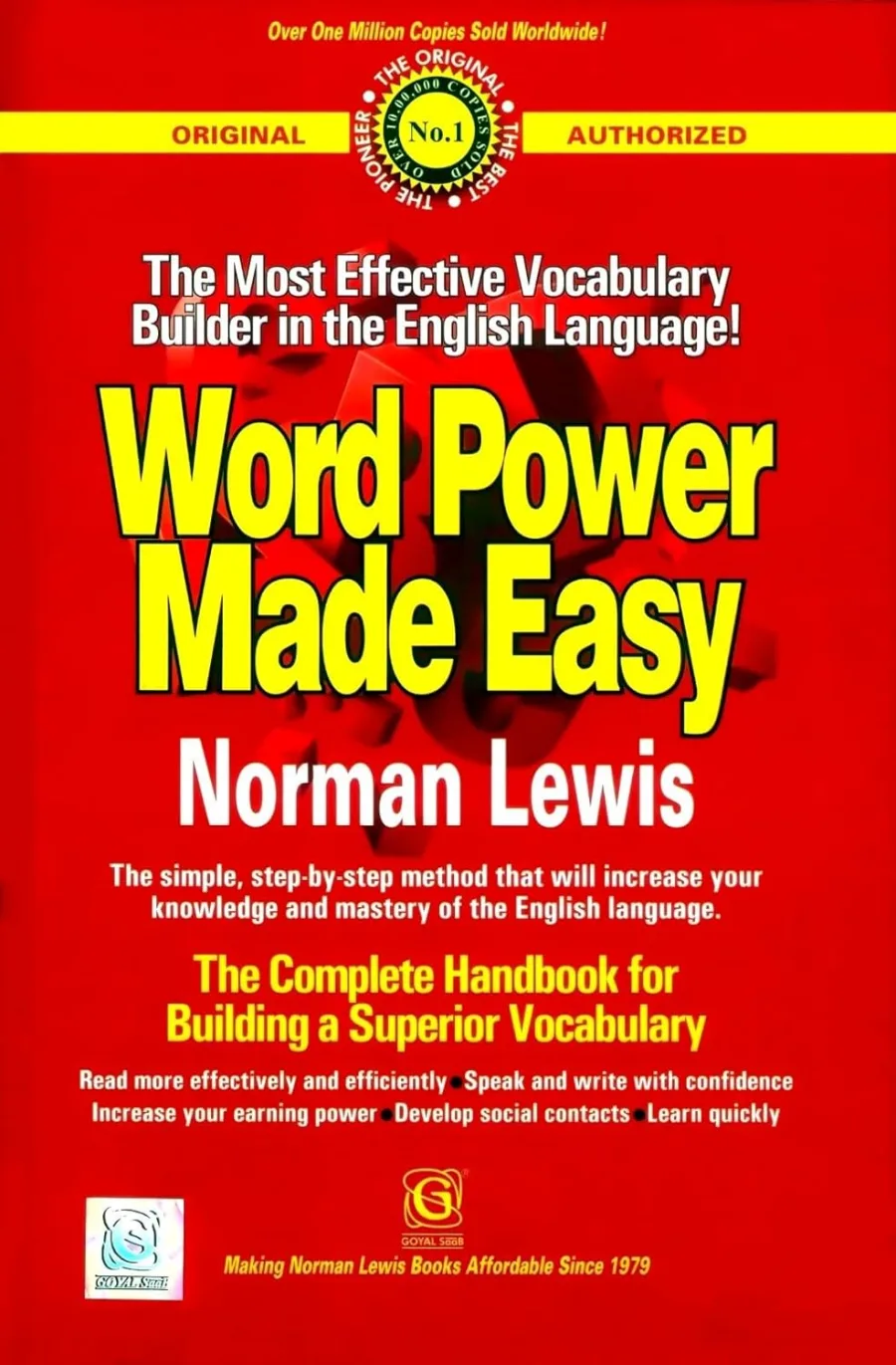
Word Power Made Easy
Paperback
• 514 Pages
• ₹ 199.00
• English
No ratings yet
| Publisher | Goyal Saab |
|---|---|
| ASIN/SKU | B09LV1KHKV |
| Book Format | Paperback |
| Language | English |
| Pages | 514 |
| List Price | ₹ 199.00 |
| Publishing Date | 01/11/1997 |
| Dimensions | 12 x 3.8 x 18 cm |
| Weight | 430 g |
| Book Code | BD00068034 |
Buy this Book
Amazon Stores
Ebook Stores
Other Stores
Discover Word Power Made Easy by Norman Lewis. This book is published by Goyal Saab in Paperback format, ASIN B09LV1KHKV, under Exam Preparation.
Book Description
In the English Language • Over One Millions Copies sold worldwide • With Self Preparation Test, useful for all English exams • Latest 2024 Edition.
Author Biography
Author Biography will be added soon…
Editorial Reviews
Editorial Reviews will be added soon…
Book Summary
Word Power Made Easy by Norman Lewis is far more than a dry, academic vocabulary textbook; it is a meticulously crafted guide designed to help readers achieve a sophisticated command of the English language. Rather than relying on the tedious, traditional method of rote memorization, Lewis employs a dynamic, etymological approach. He believes that the most effective way to expand one's vocabulary is to understand the roots, prefixes, and suffixes that form the building blocks of the language. By teaching the reader the "genetic code" of words, Lewis empowers them to decipher the meanings of thousands of words they may have never encountered before, effectively turning the process of learning into an act of intellectual investigation.
The book is structured to take the reader on a logical journey through the human experience, organizing chapters by broad thematic categories. Lewis starts by exploring how we talk about different types of personalities—words like "egotist," "introvert," and "misanthrope"—before moving into discussions on doctors, scientists, and other professions. This thematic grouping is deliberate; by associating new vocabulary with real-world concepts and character types, Lewis ensures that the definitions are not just memorized but deeply understood. The reader is encouraged to engage actively with the material through interactive exercises, completion tests, and pronunciation guides, which reinforce the learning process and ensure that the vocabulary moves from passive recognition to active, daily usage.
A standout aspect of the book is its focus on the "why" behind language. Lewis frequently delves into the historical and cultural origins of words, pulling from Greek and Latin roots to show the logic behind the spelling and meaning. For example, by learning the root "pathos" (feeling or suffering), a reader can suddenly unlock the meaning behind "empathy," "apathy," "sympathy," and "telepathy." This creates a "snowball effect" in learning, where one root can bridge the gap to a dozen new words. Lewis strips away the intimidation factor often associated with "big" words, showing that they are not arbitrary collections of letters but logical constructs with specific, traceable histories.
Beyond just vocabulary, Word Power Made Easy places a strong emphasis on the nuance of communication. Lewis acknowledges that knowing a word is useless if you don't know how to use it precisely. He often compares synonyms to show how subtle differences in meaning can change the tone or impact of a sentence. This attention to detail is vital for anyone looking to improve their professional writing or public speaking. He challenges the reader to move beyond vague, colloquial language and instead embrace words that are precise and impactful. This creates a sense of confidence in the reader; when you understand the exact shade of meaning a word carries, you are much more likely to use it effectively in your own speech and writing.
The book also addresses the common fear of mispronunciation. In our modern world, we often encounter new words in writing long before we hear them spoken. Lewis provides phonetic guidance to ensure that as your vocabulary grows, your ability to articulate those words correctly keeps pace. This holistic approach—covering spelling, etymology, definition, nuance, and pronunciation—makes the book an all-encompassing tool for linguistic self-improvement. He treats the reader as an adult learner capable of rigorous study, which gives the book a tone of respect and intellectual partnership that is rarely found in standard self-help or study guides.
Throughout the text, Lewis’s writing style is engaging, witty, and surprisingly conversational. He understands that learning can be taxing, so he peppers his lessons with humor and insightful commentary on human nature. He doesn't just want you to be a walking dictionary; he wants you to be a more articulate, thoughtful human being. He emphasizes that a command of language is ultimately a command of thought. By refining the tools we use to describe our world, we gain a clearer understanding of the world itself. If we lack the words to describe an emotion or a complex situation, we are limited in our ability to process or communicate that experience. Therefore, vocabulary expansion is not just about showing off; it is about expanding the boundaries of our own thinking.
By the end of the book, the reader is left with more than just a list of high-level terms. They are equipped with a permanent framework for language acquisition that will serve them for the rest of their lives. The fear of "difficult" words is replaced by the excitement of encountering something new, as the reader now has the internal toolkit to break down any unfamiliar word into its constituent parts. Word Power Made Easy remains a classic because it focuses on the underlying principles of the language rather than the fleeting trends of contemporary slang. It is a timeless resource for anyone who believes that clear, precise communication is the bedrock of professional success and intellectual growth.
As you look at your own way of communicating, do you feel like there are specific situations—like in meetings, writing, or social settings—where having a more precise vocabulary would significantly change how people perceive you or how well you get your point across?
The book is structured to take the reader on a logical journey through the human experience, organizing chapters by broad thematic categories. Lewis starts by exploring how we talk about different types of personalities—words like "egotist," "introvert," and "misanthrope"—before moving into discussions on doctors, scientists, and other professions. This thematic grouping is deliberate; by associating new vocabulary with real-world concepts and character types, Lewis ensures that the definitions are not just memorized but deeply understood. The reader is encouraged to engage actively with the material through interactive exercises, completion tests, and pronunciation guides, which reinforce the learning process and ensure that the vocabulary moves from passive recognition to active, daily usage.
A standout aspect of the book is its focus on the "why" behind language. Lewis frequently delves into the historical and cultural origins of words, pulling from Greek and Latin roots to show the logic behind the spelling and meaning. For example, by learning the root "pathos" (feeling or suffering), a reader can suddenly unlock the meaning behind "empathy," "apathy," "sympathy," and "telepathy." This creates a "snowball effect" in learning, where one root can bridge the gap to a dozen new words. Lewis strips away the intimidation factor often associated with "big" words, showing that they are not arbitrary collections of letters but logical constructs with specific, traceable histories.
Beyond just vocabulary, Word Power Made Easy places a strong emphasis on the nuance of communication. Lewis acknowledges that knowing a word is useless if you don't know how to use it precisely. He often compares synonyms to show how subtle differences in meaning can change the tone or impact of a sentence. This attention to detail is vital for anyone looking to improve their professional writing or public speaking. He challenges the reader to move beyond vague, colloquial language and instead embrace words that are precise and impactful. This creates a sense of confidence in the reader; when you understand the exact shade of meaning a word carries, you are much more likely to use it effectively in your own speech and writing.
The book also addresses the common fear of mispronunciation. In our modern world, we often encounter new words in writing long before we hear them spoken. Lewis provides phonetic guidance to ensure that as your vocabulary grows, your ability to articulate those words correctly keeps pace. This holistic approach—covering spelling, etymology, definition, nuance, and pronunciation—makes the book an all-encompassing tool for linguistic self-improvement. He treats the reader as an adult learner capable of rigorous study, which gives the book a tone of respect and intellectual partnership that is rarely found in standard self-help or study guides.
Throughout the text, Lewis’s writing style is engaging, witty, and surprisingly conversational. He understands that learning can be taxing, so he peppers his lessons with humor and insightful commentary on human nature. He doesn't just want you to be a walking dictionary; he wants you to be a more articulate, thoughtful human being. He emphasizes that a command of language is ultimately a command of thought. By refining the tools we use to describe our world, we gain a clearer understanding of the world itself. If we lack the words to describe an emotion or a complex situation, we are limited in our ability to process or communicate that experience. Therefore, vocabulary expansion is not just about showing off; it is about expanding the boundaries of our own thinking.
By the end of the book, the reader is left with more than just a list of high-level terms. They are equipped with a permanent framework for language acquisition that will serve them for the rest of their lives. The fear of "difficult" words is replaced by the excitement of encountering something new, as the reader now has the internal toolkit to break down any unfamiliar word into its constituent parts. Word Power Made Easy remains a classic because it focuses on the underlying principles of the language rather than the fleeting trends of contemporary slang. It is a timeless resource for anyone who believes that clear, precise communication is the bedrock of professional success and intellectual growth.
As you look at your own way of communicating, do you feel like there are specific situations—like in meetings, writing, or social settings—where having a more precise vocabulary would significantly change how people perceive you or how well you get your point across?
Sample Chapters
Sample Chapters will be added soon…
Reader Reviews
No reviews yet.
Word Power Made Easy
Download Cover Image
Do you want to download the full cover image for Word Power Made Easy?