
Don't Believe Everything You Think (English)
Paperback
• 168 Pages
• ₹ 299.00
• English
• 9789355431356
No ratings yet
| Publisher | Amaryllis (An Imprint of Manjul Publishing House) |
|---|---|
| ISBN13 | 9789355431356 |
| ASIN/SKU | 935543135X |
| Book Format | Paperback |
| Language | English |
| Pages | 168 |
| List Price | ₹ 299.00 |
| Publishing Date | 25/11/2022 |
| Dimensions | 12.85 x 0.99 x 19.84 cm |
| Weight | 150 g |
| Book Code | BD00068033 |
Buy this Book
Amazon Stores
Ebook Stores
Other Stores
Discover Don't Believe Everything You Think (English) by Joseph Nguyen. This book is published by Amaryllis (An Imprint of Manjul Publishing House) in Paperback format, ISBN 9789355431356, ASIN 935543135X, under Self-Help, Self-Help for Anxieties and Phobias, Emotional Self Help.
Book Description
Discover how to conquer anxiety, self-doubt, and self-sabotage without depending on motivation or willpower. 'Don't Believe Everything You Think' uncovers the core of psychological suffering and offers insights to effortlessly shape the life you crave. Learn to detach from negativity, embrace love and joy, escape negative thought cycles, and tap into inner wisdom. The message is clear: anyone can attain peace, love, and fulfillment, irrespective of their history. It's not about rewiring your brain, but expanding your consciousness for lasting transformation. Within this book, delve into the core of emotional suffering and receive insights on effortlessly curating the life you aspire to.
Author Biography
Joseph Nguyen is a spiritual thought leader who has a mission of helping others realize their divine purpose, unlock the infinite potential of their own mind, and live an abundant life free from psychological suffering. He spends most of his time writing, coaching, teaching, speaking, and sharing timeless wisdom to help people discover their own divinity from within and how they are the answer they’ve been looking for their entire lives.
Editorial Reviews
Joseph Nguyen is a spiritual thought leader who has a mission of helping others realize their divine purpose, unlock the infinite potential of their own mind, and live an abundant life free from psychological suffering. He spends most of his time writing, coaching, teaching, speaking, and sharing timeless wisdom to help people discover their own divinity from within and how they are the answer they’ve been looking for their entire lives.
Book Summary
Don't Believe Everything You Think: Why Your Thinking Is the Beginning & End of Suffering by Joseph Nguyen is a concise self-help and personal-growth book about overthinking, mental suffering, mindfulness, and the possibility of finding greater peace by changing our relationship with our thoughts. First published in 2022, the book presents a simple but powerful central idea: many of the painful experiences people carry are intensified not by events themselves but by the stories, judgments, fears, and interpretations the mind creates around those events. Nguyen encourages readers to recognize that thoughts are not automatically facts and that they do not have to believe or follow every thought that appears in their minds.
The book begins with a familiar problem: mental exhaustion. People often spend much of their day thinking about what happened yesterday, what someone meant by a particular comment, what might happen tomorrow, whether they made the right decision, or how others perceive them. This constant mental activity can make even ordinary situations feel overwhelming. Nguyen argues that people can become trapped in their own thinking without realizing that the thinking itself has become a source of suffering. Instead of experiencing life directly, they experience a continuous mental interpretation of life.
One of the book's most important distinctions is between pain and suffering. Pain can be a natural part of life. People experience disappointment, loss, rejection, illness, failure, conflict, and other difficult circumstances. Nguyen's argument is that suffering often grows when the mind adds layers of interpretation to the original experience. A painful event may happen once, but the mind can replay it hundreds of times, imagine additional negative outcomes, or construct stories about what it supposedly means about the future or about one's worth. In this way, the original pain can become much larger through repeated thinking.
Nguyen therefore asks readers to examine the role of thought in their emotional experience. Two people can experience the same event and respond very differently because they interpret it differently. One person may see a setback as temporary, while another may see it as proof that everything is going wrong. The external event is similar, but the internal narrative changes the emotional experience. The book uses this idea to encourage readers to question whether the conclusions produced by their minds are necessarily true.
This does not mean that Nguyen argues that external circumstances never matter. His central point is about the additional suffering created by habitual thinking. A difficult situation can be genuinely difficult, but repeatedly arguing with reality inside one's head does not necessarily make the situation better. Instead, it can keep a person emotionally trapped in an experience that has already happened or in a future that has not happened yet.
The title itself expresses the book's central lesson. Not every thought deserves to be believed. Thoughts appear automatically, and some can be useful while others can be repetitive, fearful, exaggerated, or self-critical. The mere fact that something appears in the mind does not make it an objective description of reality. Learning to notice this difference creates distance between the person and the thought.
Nguyen makes an important distinction between thoughts and thinking. In his framework, thoughts can arise naturally and spontaneously, while “thinking” refers more to the effortful process of analyzing, judging, interpreting, and attaching stories to those thoughts. The problem is not that the human mind produces thoughts. Rather, suffering can increase when people continuously engage with those thoughts and treat their interpretations as absolute truth.
This leads to the book's idea of non-thinking. Non-thinking does not mean becoming unconscious, unintelligent, or incapable of making decisions. It means stepping out of compulsive mental analysis and allowing the mind to settle. Instead of constantly asking what everything means, what could go wrong, or how to control the future, a person can sometimes stop and experience the present directly.
For Nguyen, peace is not necessarily something that must be created from scratch. He suggests that peace, joy, and clarity are natural states that become difficult to experience when the mind is crowded by excessive thinking. When people stop feeding destructive thought patterns, they can reconnect with a calmer state that was already present beneath the mental noise.
The book also discusses the relationship between thoughts and emotions. When people feel anxious, angry, fearful, or overwhelmed, they often try to solve the emotion by thinking about it even more. They analyze why they feel that way, what caused it, what might happen next, and what they should do. Nguyen suggests that this can create a cycle in which thinking produces more emotional distress, which then produces more thinking.
Instead of fighting every uncomfortable emotion, readers are encouraged to observe it. An emotion can be allowed to exist without immediately turning it into a story. This approach is connected to mindfulness: noticing what is happening in the present without constantly judging or interpreting it. By allowing feelings to move through naturally rather than continually analyzing them, a person may find that they become less overwhelming.
The book also challenges the assumption that positive thinking is always the answer. Nguyen does not simply tell readers to replace every negative thought with a positive statement. His approach is more fundamental. Instead of trying to control the content of the mind all the time, he encourages people to recognize that they do not have to engage with every thought in the first place. The goal is not to create a permanently positive mental environment but to become less dependent on thought for one's sense of peace.
This is especially relevant to overthinking. A person may repeatedly think about an argument with a friend, a mistake at work, a relationship problem, or an uncertain future. Each time the mind returns to the subject, it may produce another interpretation. The person may believe that continued analysis will eventually provide certainty, but the process often creates more questions. Nguyen encourages readers to recognize when thinking has stopped being useful and has become repetitive mental activity.
The book also explores the idea that people often confuse their thoughts with their identity. Someone may think, “I am a failure,” “Nobody likes me,” or “I always make bad decisions.” These are not objective identities but interpretations produced by the mind. When a person believes such thoughts completely, they can begin behaving according to them. By recognizing thoughts as temporary mental events rather than permanent truths, people can create greater freedom.
This creates an important distinction between having a thought and believing a thought. A person cannot necessarily control which thoughts appear, but they can become more selective about which ones they give attention and authority. This is one of the book's most empowering ideas because it shifts the focus away from trying to control every mental event.
Nguyen also emphasizes intuition and clarity. Once the constant noise of overthinking becomes quieter, people may find it easier to recognize what they genuinely want or what action feels appropriate. The book suggests that not every decision needs to be solved through endless analysis. Sometimes clarity emerges when the mind becomes quiet enough to notice what is already known internally.
This idea connects with the book's broader spiritual dimension. Nguyen draws from ideas associated with mindfulness, Buddhism, spirituality, and the concept of a deeper consciousness. He presents the human mind as part of a larger field of awareness and suggests that peace, love, and fulfillment can be accessed by moving beyond excessive identification with the thinking mind. The book is therefore not purely psychological; it combines self-help with a spiritual philosophy of consciousness and inner freedom.
Unconditional love is another important part of this philosophy. Nguyen encourages readers to move away from the idea that happiness must depend on particular external conditions. If someone believes, “I will be happy only when I get this job,” “I will be peaceful only when this person changes,” or “I will feel complete only after I achieve a certain goal,” they make their emotional well-being dependent on circumstances. The book encourages a different approach in which peace is treated as something that can be experienced in the present rather than postponed until life becomes perfect.
The book begins with a familiar problem: mental exhaustion. People often spend much of their day thinking about what happened yesterday, what someone meant by a particular comment, what might happen tomorrow, whether they made the right decision, or how others perceive them. This constant mental activity can make even ordinary situations feel overwhelming. Nguyen argues that people can become trapped in their own thinking without realizing that the thinking itself has become a source of suffering. Instead of experiencing life directly, they experience a continuous mental interpretation of life.
One of the book's most important distinctions is between pain and suffering. Pain can be a natural part of life. People experience disappointment, loss, rejection, illness, failure, conflict, and other difficult circumstances. Nguyen's argument is that suffering often grows when the mind adds layers of interpretation to the original experience. A painful event may happen once, but the mind can replay it hundreds of times, imagine additional negative outcomes, or construct stories about what it supposedly means about the future or about one's worth. In this way, the original pain can become much larger through repeated thinking.
Nguyen therefore asks readers to examine the role of thought in their emotional experience. Two people can experience the same event and respond very differently because they interpret it differently. One person may see a setback as temporary, while another may see it as proof that everything is going wrong. The external event is similar, but the internal narrative changes the emotional experience. The book uses this idea to encourage readers to question whether the conclusions produced by their minds are necessarily true.
This does not mean that Nguyen argues that external circumstances never matter. His central point is about the additional suffering created by habitual thinking. A difficult situation can be genuinely difficult, but repeatedly arguing with reality inside one's head does not necessarily make the situation better. Instead, it can keep a person emotionally trapped in an experience that has already happened or in a future that has not happened yet.
The title itself expresses the book's central lesson. Not every thought deserves to be believed. Thoughts appear automatically, and some can be useful while others can be repetitive, fearful, exaggerated, or self-critical. The mere fact that something appears in the mind does not make it an objective description of reality. Learning to notice this difference creates distance between the person and the thought.
Nguyen makes an important distinction between thoughts and thinking. In his framework, thoughts can arise naturally and spontaneously, while “thinking” refers more to the effortful process of analyzing, judging, interpreting, and attaching stories to those thoughts. The problem is not that the human mind produces thoughts. Rather, suffering can increase when people continuously engage with those thoughts and treat their interpretations as absolute truth.
This leads to the book's idea of non-thinking. Non-thinking does not mean becoming unconscious, unintelligent, or incapable of making decisions. It means stepping out of compulsive mental analysis and allowing the mind to settle. Instead of constantly asking what everything means, what could go wrong, or how to control the future, a person can sometimes stop and experience the present directly.
For Nguyen, peace is not necessarily something that must be created from scratch. He suggests that peace, joy, and clarity are natural states that become difficult to experience when the mind is crowded by excessive thinking. When people stop feeding destructive thought patterns, they can reconnect with a calmer state that was already present beneath the mental noise.
The book also discusses the relationship between thoughts and emotions. When people feel anxious, angry, fearful, or overwhelmed, they often try to solve the emotion by thinking about it even more. They analyze why they feel that way, what caused it, what might happen next, and what they should do. Nguyen suggests that this can create a cycle in which thinking produces more emotional distress, which then produces more thinking.
Instead of fighting every uncomfortable emotion, readers are encouraged to observe it. An emotion can be allowed to exist without immediately turning it into a story. This approach is connected to mindfulness: noticing what is happening in the present without constantly judging or interpreting it. By allowing feelings to move through naturally rather than continually analyzing them, a person may find that they become less overwhelming.
The book also challenges the assumption that positive thinking is always the answer. Nguyen does not simply tell readers to replace every negative thought with a positive statement. His approach is more fundamental. Instead of trying to control the content of the mind all the time, he encourages people to recognize that they do not have to engage with every thought in the first place. The goal is not to create a permanently positive mental environment but to become less dependent on thought for one's sense of peace.
This is especially relevant to overthinking. A person may repeatedly think about an argument with a friend, a mistake at work, a relationship problem, or an uncertain future. Each time the mind returns to the subject, it may produce another interpretation. The person may believe that continued analysis will eventually provide certainty, but the process often creates more questions. Nguyen encourages readers to recognize when thinking has stopped being useful and has become repetitive mental activity.
The book also explores the idea that people often confuse their thoughts with their identity. Someone may think, “I am a failure,” “Nobody likes me,” or “I always make bad decisions.” These are not objective identities but interpretations produced by the mind. When a person believes such thoughts completely, they can begin behaving according to them. By recognizing thoughts as temporary mental events rather than permanent truths, people can create greater freedom.
This creates an important distinction between having a thought and believing a thought. A person cannot necessarily control which thoughts appear, but they can become more selective about which ones they give attention and authority. This is one of the book's most empowering ideas because it shifts the focus away from trying to control every mental event.
Nguyen also emphasizes intuition and clarity. Once the constant noise of overthinking becomes quieter, people may find it easier to recognize what they genuinely want or what action feels appropriate. The book suggests that not every decision needs to be solved through endless analysis. Sometimes clarity emerges when the mind becomes quiet enough to notice what is already known internally.
This idea connects with the book's broader spiritual dimension. Nguyen draws from ideas associated with mindfulness, Buddhism, spirituality, and the concept of a deeper consciousness. He presents the human mind as part of a larger field of awareness and suggests that peace, love, and fulfillment can be accessed by moving beyond excessive identification with the thinking mind. The book is therefore not purely psychological; it combines self-help with a spiritual philosophy of consciousness and inner freedom.
Unconditional love is another important part of this philosophy. Nguyen encourages readers to move away from the idea that happiness must depend on particular external conditions. If someone believes, “I will be happy only when I get this job,” “I will be peaceful only when this person changes,” or “I will feel complete only after I achieve a certain goal,” they make their emotional well-being dependent on circumstances. The book encourages a different approach in which peace is treated as something that can be experienced in the present rather than postponed until life becomes perfect.
Sample Chapters
Sample Chapters will be added soon…
Reader Reviews
No reviews yet.
Don't Believe Everything You Think (English)
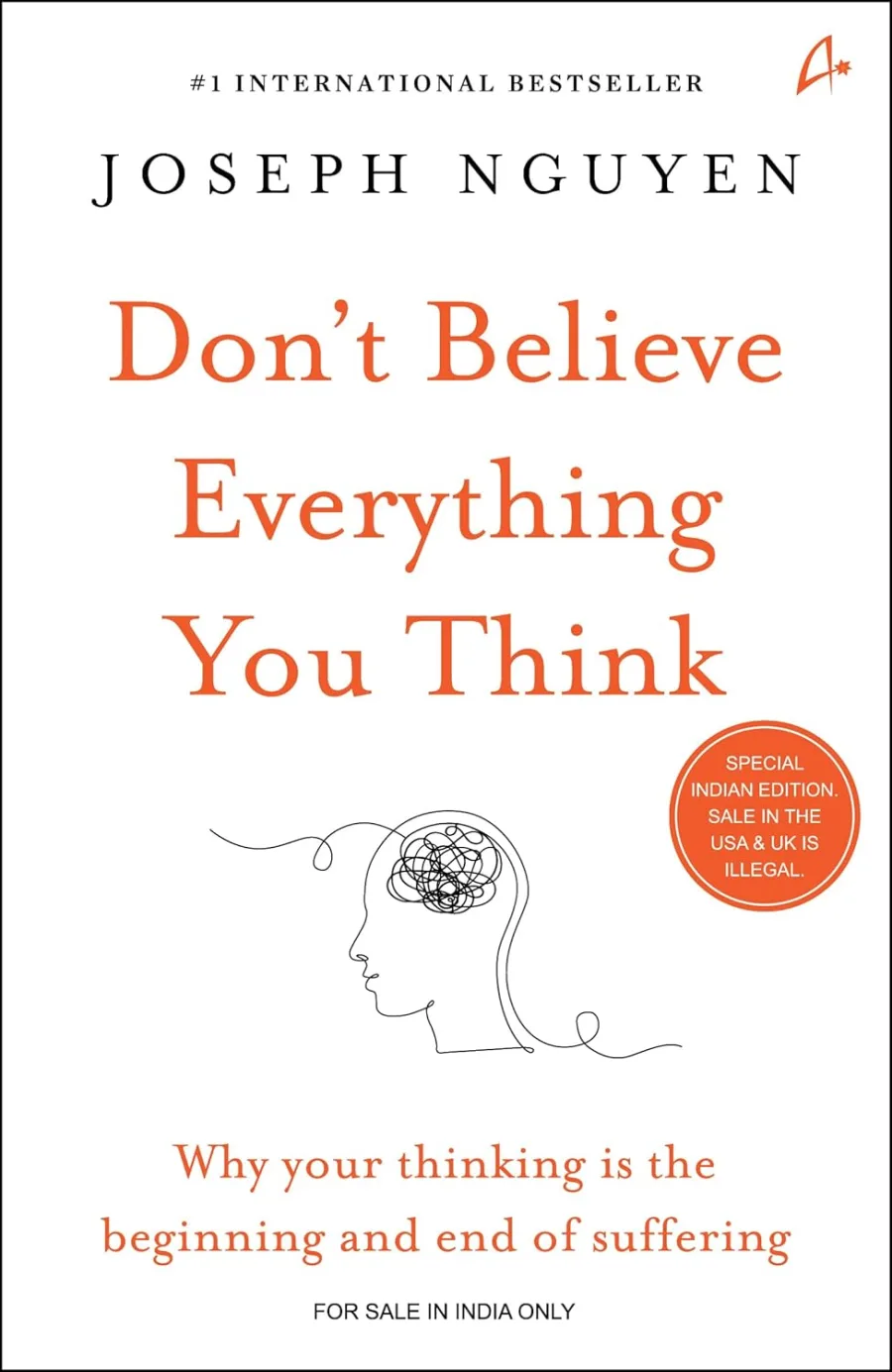
Download Cover Image
Do you want to download the full cover image for Don't Believe Everything You Think (English)?