
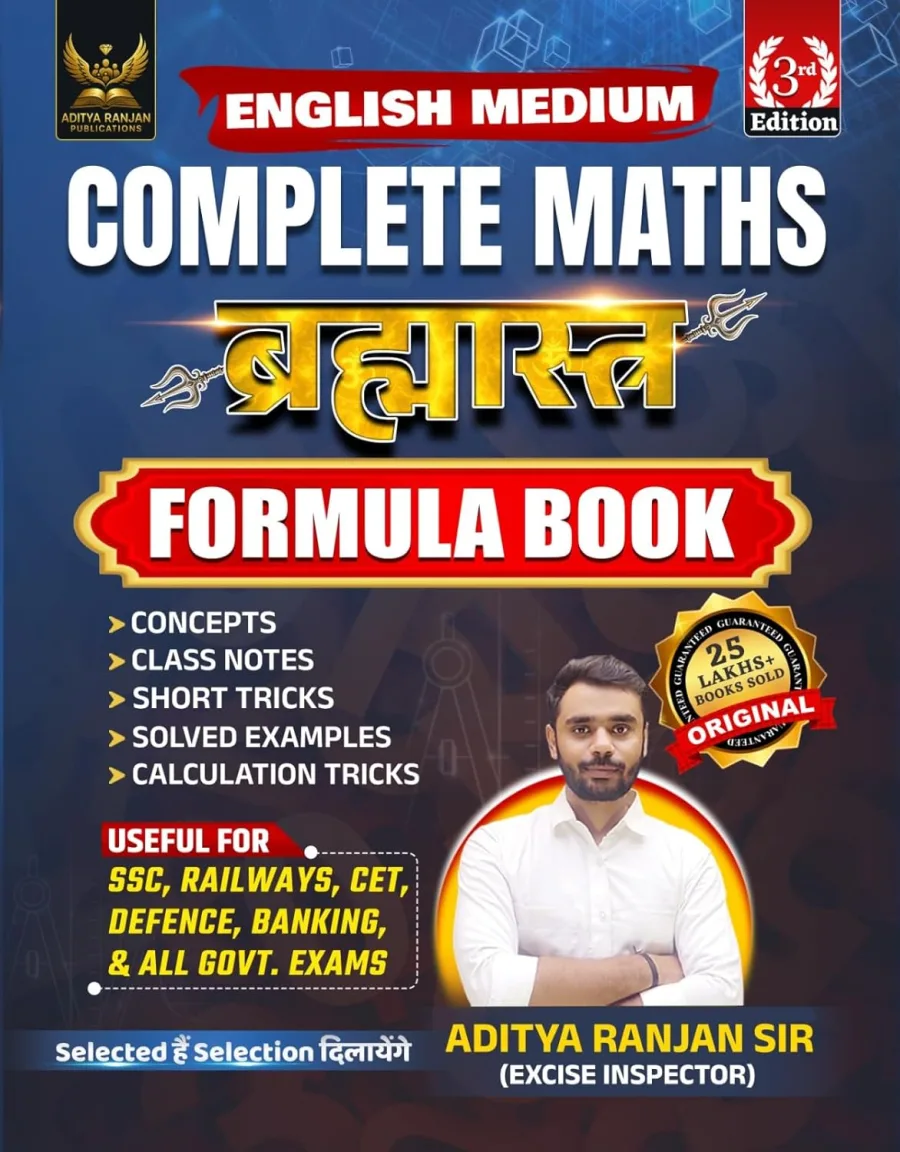
Brahmastra Complete Maths Multicolored Formula Book | English Medium | 3rd Edition
Paperback
• 304 Pages
• ₹ 300.00
• English
No ratings yet
| Publisher | Aditya Ranjan Publication |
|---|---|
| ASIN/SKU | B0FRFMCFB3 |
| Book Format | Paperback |
| Language | English |
| Pages | 304 |
| List Price | ₹ 300.00 |
| Publishing Date | 16/09/2025 |
| Dimensions | 28 x 24 x 2 cm |
| Weight | 450 g |
| Book Code | BD00068029 |
Buy this Book
Amazon Stores
Ebook Stores
Other Stores
Discover Brahmastra Complete Maths Multicolored Formula Book | English Medium | 3rd Edition by Aditya Ranja. This book is published by Aditya Ranjan Publication in Paperback format, ASIN B0FRFMCFB3, under Exam Preparation, SSC Exam.
Book Description
BRAHMASTRA Complete Maths Multicolored Formula Book – 3rd Edition
Created & Crafted by Renowned Maths Faculty Aditya Ranjan
We are proud to present the third edition of the BRAHMASTRA Complete Maths Multicolored Formula Book, a powerful resource designed specifically for aspirants preparing for all major government exams in India.
This book has been meticulously curated by Aditya Ranjan, a well-known mathematics educator famous for his short tricks, innovative teaching style, and strong presence on YouTube. With years of experience guiding lakhs of students, Aditya Ranjan brings his expertise into this visually engaging, multicolored format to make learning faster, smarter, and more effective.
🔹 Key Features:
Comprehensive coverage of formulas from all major topics in quantitative aptitude
Multicolored layout for better memory retention and quick revision
Includes short tricks and techniques to boost speed and accuracy
Ideal for SSC, Banking, Railway, Defence, and other government exams
Whether you're a beginner or revising before exams, this book is your ultimate revision companion to crack competitive exams with confidence.
Created & Crafted by Renowned Maths Faculty Aditya Ranjan
We are proud to present the third edition of the BRAHMASTRA Complete Maths Multicolored Formula Book, a powerful resource designed specifically for aspirants preparing for all major government exams in India.
This book has been meticulously curated by Aditya Ranjan, a well-known mathematics educator famous for his short tricks, innovative teaching style, and strong presence on YouTube. With years of experience guiding lakhs of students, Aditya Ranjan brings his expertise into this visually engaging, multicolored format to make learning faster, smarter, and more effective.
🔹 Key Features:
Comprehensive coverage of formulas from all major topics in quantitative aptitude
Multicolored layout for better memory retention and quick revision
Includes short tricks and techniques to boost speed and accuracy
Ideal for SSC, Banking, Railway, Defence, and other government exams
Whether you're a beginner or revising before exams, this book is your ultimate revision companion to crack competitive exams with confidence.
Author Biography
Author Biography will be added soon…
Editorial Reviews
Editorial Reviews will be added soon…
Book Summary
Brahmastra Complete Maths Multicolored Formula Book by Aditya Ranjan is an exam-oriented mathematics reference and revision book designed mainly for students preparing for competitive examinations in India. The 3rd Edition is presented as part of the Brahmastra Competitive Maths Series and is intended to bring important mathematical formulas, concepts, short tricks, solved examples, and calculation techniques together in a compact format. The book is particularly useful for aspirants preparing for SSC, Railways, Banking, Defence, CET, and other government recruitment examinations. Current listings describe the edition as an English-medium paperback published by Aditya Ranjan Publication for the 2026–27 cycle, with around 304 pages.
The basic purpose of the book is to make mathematics revision faster and more organized. Competitive examinations often contain a large number of mathematical concepts, formulas, identities, shortcuts, and calculation methods. Students may understand these topics during detailed study but forget important formulas when they need to revise quickly. This book is designed to serve as a compact reference that allows aspirants to revisit important mathematical information without going through lengthy chapters or complete theory books.
The multicolored presentation is one of the noticeable features of the book. Different colors can help separate formulas, concepts, examples, and important points visually. This makes the pages easier to scan during revision. Instead of seeing a long collection of black-and-white mathematical text, students can identify important information more quickly through visual organization. The publisher and booksellers describe the multicolored format as useful for quick revision and memory retention.
The book covers the major areas of quantitative aptitude that students commonly encounter in government and competitive examinations. These areas include arithmetic as well as advanced mathematics. The goal is not simply to provide formulas but to help students recognize which formula or technique is appropriate when they encounter a particular type of question.
Arithmetic forms an important part of competitive mathematics. Topics such as percentages, profit and loss, discount, ratio and proportion, averages, time and work, time and distance, simple and compound interest, mixtures, partnerships, and related concepts frequently require students to remember specific relationships and calculation methods. A formula-oriented resource can make revision of these areas considerably quicker.
For example, percentage-based questions often form the foundation for several other topics. Profit and loss, discount, successive changes, population problems, and many data-based questions can involve percentages. Having important percentage relationships and shortcuts collected together helps students refresh the topic quickly before attempting practice questions.
Ratio and proportion are another important part of quantitative aptitude. These concepts appear directly in examination questions and also support other areas such as mixtures, partnerships, averages, and work-related problems. A good formula book helps students remember the basic relationships while also providing methods that can reduce calculation time.
The same applies to average-based problems. Students need to understand basic average formulas and relationships involving changes in the number or value of observations. Short methods can be useful in timed examinations where lengthy calculations may reduce the time available for other questions.
Topics involving time and work require students to understand rates of work and relationships between workers and the amount of work completed. Similarly, time-and-distance questions involve relationships between speed, distance, and time. The book brings the important formulas and shortcuts associated with such topics into a revision-friendly format.
Simple and compound interest also require familiarity with standard formulas and calculation techniques. Students preparing for competitive examinations often need to solve interest questions quickly, particularly when different time periods, rates, or principal amounts are involved. A concise reference book can help reinforce these formulas before practice sessions.
The book also addresses areas of advanced mathematics. These may include algebra, geometry, mensuration, trigonometry, number-related concepts, and other quantitative topics that appear in competitive examinations. Advanced mathematics often contains numerous identities, properties, and formulas, so having them organized in one place can be particularly useful.
Geometry, for example, requires students to remember properties of lines, angles, triangles, quadrilaterals, circles, and other figures. Mensuration adds formulas for areas, perimeters, surface areas, and volumes. These formulas can be difficult to recall when a student has not practiced them for some time. Regular revision from a formula book can help keep them accessible.
Trigonometry is another area where formula recall is important. Students may need to remember standard values, identities, relationships between trigonometric functions, and methods for simplifying expressions. Instead of repeatedly searching through a detailed textbook, they can use a formula-oriented reference to refresh these relationships.
The book's focus on short tricks is particularly relevant to competitive examinations. In a school examination, students may have more time to show a complete calculation, but competitive tests often impose strict time limits. A method that takes several steps may be correct but inefficient. Short tricks can reduce calculation time when used appropriately and can help students improve speed without sacrificing accuracy. Current descriptions of the book specifically highlight short tricks and calculation techniques.
However, shortcuts are most useful when the underlying concept is already understood. A student who memorizes a trick without understanding the basic mathematics may struggle when a question is presented in an unfamiliar form. The book therefore works best as a revision companion rather than as the only source for learning mathematics from the beginning.
The inclusion of solved examples is another useful feature. Formulas can sometimes look abstract when presented alone. A solved example shows students how a formula or shortcut is applied to an actual problem. It can help answer practical questions such as which values should be substituted, which method should be selected, and how the calculation should be organized.
These examples can also help students identify common patterns. Competitive-exam questions often change their wording while testing the same underlying concept. Once students recognize the structure of a problem, they can select an appropriate method more quickly.
Another important purpose of the book is quick revision before examinations. A student may spend months studying mathematics through detailed books, classes, videos, and practice sets. As the examination approaches, however, there may not be enough time to revisit every explanation. A compact formula book allows students to review important material in a shorter period.
This makes the book useful not only immediately before an examination but also during regular preparation. Students can revise a few topics every day, review formulas before attempting a practice set, and return to the book whenever they encounter a forgotten concept. Repeated exposure is particularly useful for formulas because remembering them requires more than reading them once.
The visual structure may also support memory retention. When important formulas and concepts are separated through colors, headings, examples, and other visual cues, students can sometimes recall where a particular formula appeared on the page. Visual memory can become an additional aid alongside mathematical understanding.
The book is especially relevant to SSC aspirants. Listings categorize it under SSC preparation and identify it as useful for major government examinations. The same mathematical concepts are also relevant to many Railway, Banking, Defence, CET, and other competitive examinations, although the exact difficulty and question pattern can vary from one examination to another.
For a student preparing for SSC CGL or similar examinations, the book can fit naturally into a larger study routine. A student might first learn a chapter from a detailed mathematics textbook or class, then use Brahmastra to revise its formulas and shortcuts, and finally solve previous-year questions or mock tests. This three-step process—understanding, revising, and practicing—can be more effective than relying on formulas alone.
The basic purpose of the book is to make mathematics revision faster and more organized. Competitive examinations often contain a large number of mathematical concepts, formulas, identities, shortcuts, and calculation methods. Students may understand these topics during detailed study but forget important formulas when they need to revise quickly. This book is designed to serve as a compact reference that allows aspirants to revisit important mathematical information without going through lengthy chapters or complete theory books.
The multicolored presentation is one of the noticeable features of the book. Different colors can help separate formulas, concepts, examples, and important points visually. This makes the pages easier to scan during revision. Instead of seeing a long collection of black-and-white mathematical text, students can identify important information more quickly through visual organization. The publisher and booksellers describe the multicolored format as useful for quick revision and memory retention.
The book covers the major areas of quantitative aptitude that students commonly encounter in government and competitive examinations. These areas include arithmetic as well as advanced mathematics. The goal is not simply to provide formulas but to help students recognize which formula or technique is appropriate when they encounter a particular type of question.
Arithmetic forms an important part of competitive mathematics. Topics such as percentages, profit and loss, discount, ratio and proportion, averages, time and work, time and distance, simple and compound interest, mixtures, partnerships, and related concepts frequently require students to remember specific relationships and calculation methods. A formula-oriented resource can make revision of these areas considerably quicker.
For example, percentage-based questions often form the foundation for several other topics. Profit and loss, discount, successive changes, population problems, and many data-based questions can involve percentages. Having important percentage relationships and shortcuts collected together helps students refresh the topic quickly before attempting practice questions.
Ratio and proportion are another important part of quantitative aptitude. These concepts appear directly in examination questions and also support other areas such as mixtures, partnerships, averages, and work-related problems. A good formula book helps students remember the basic relationships while also providing methods that can reduce calculation time.
The same applies to average-based problems. Students need to understand basic average formulas and relationships involving changes in the number or value of observations. Short methods can be useful in timed examinations where lengthy calculations may reduce the time available for other questions.
Topics involving time and work require students to understand rates of work and relationships between workers and the amount of work completed. Similarly, time-and-distance questions involve relationships between speed, distance, and time. The book brings the important formulas and shortcuts associated with such topics into a revision-friendly format.
Simple and compound interest also require familiarity with standard formulas and calculation techniques. Students preparing for competitive examinations often need to solve interest questions quickly, particularly when different time periods, rates, or principal amounts are involved. A concise reference book can help reinforce these formulas before practice sessions.
The book also addresses areas of advanced mathematics. These may include algebra, geometry, mensuration, trigonometry, number-related concepts, and other quantitative topics that appear in competitive examinations. Advanced mathematics often contains numerous identities, properties, and formulas, so having them organized in one place can be particularly useful.
Geometry, for example, requires students to remember properties of lines, angles, triangles, quadrilaterals, circles, and other figures. Mensuration adds formulas for areas, perimeters, surface areas, and volumes. These formulas can be difficult to recall when a student has not practiced them for some time. Regular revision from a formula book can help keep them accessible.
Trigonometry is another area where formula recall is important. Students may need to remember standard values, identities, relationships between trigonometric functions, and methods for simplifying expressions. Instead of repeatedly searching through a detailed textbook, they can use a formula-oriented reference to refresh these relationships.
The book's focus on short tricks is particularly relevant to competitive examinations. In a school examination, students may have more time to show a complete calculation, but competitive tests often impose strict time limits. A method that takes several steps may be correct but inefficient. Short tricks can reduce calculation time when used appropriately and can help students improve speed without sacrificing accuracy. Current descriptions of the book specifically highlight short tricks and calculation techniques.
However, shortcuts are most useful when the underlying concept is already understood. A student who memorizes a trick without understanding the basic mathematics may struggle when a question is presented in an unfamiliar form. The book therefore works best as a revision companion rather than as the only source for learning mathematics from the beginning.
The inclusion of solved examples is another useful feature. Formulas can sometimes look abstract when presented alone. A solved example shows students how a formula or shortcut is applied to an actual problem. It can help answer practical questions such as which values should be substituted, which method should be selected, and how the calculation should be organized.
These examples can also help students identify common patterns. Competitive-exam questions often change their wording while testing the same underlying concept. Once students recognize the structure of a problem, they can select an appropriate method more quickly.
Another important purpose of the book is quick revision before examinations. A student may spend months studying mathematics through detailed books, classes, videos, and practice sets. As the examination approaches, however, there may not be enough time to revisit every explanation. A compact formula book allows students to review important material in a shorter period.
This makes the book useful not only immediately before an examination but also during regular preparation. Students can revise a few topics every day, review formulas before attempting a practice set, and return to the book whenever they encounter a forgotten concept. Repeated exposure is particularly useful for formulas because remembering them requires more than reading them once.
The visual structure may also support memory retention. When important formulas and concepts are separated through colors, headings, examples, and other visual cues, students can sometimes recall where a particular formula appeared on the page. Visual memory can become an additional aid alongside mathematical understanding.
The book is especially relevant to SSC aspirants. Listings categorize it under SSC preparation and identify it as useful for major government examinations. The same mathematical concepts are also relevant to many Railway, Banking, Defence, CET, and other competitive examinations, although the exact difficulty and question pattern can vary from one examination to another.
For a student preparing for SSC CGL or similar examinations, the book can fit naturally into a larger study routine. A student might first learn a chapter from a detailed mathematics textbook or class, then use Brahmastra to revise its formulas and shortcuts, and finally solve previous-year questions or mock tests. This three-step process—understanding, revising, and practicing—can be more effective than relying on formulas alone.
Sample Chapters
Sample Chapters will be added soon…
Reader Reviews
No reviews yet.
Brahmastra Complete Maths Multicolored Formula Book | English Medium | 3rd Edition
Download Cover Image
Do you want to download the full cover image for Brahmastra Complete Maths Multicolored Formula Book | English Medium | 3rd Edition?