
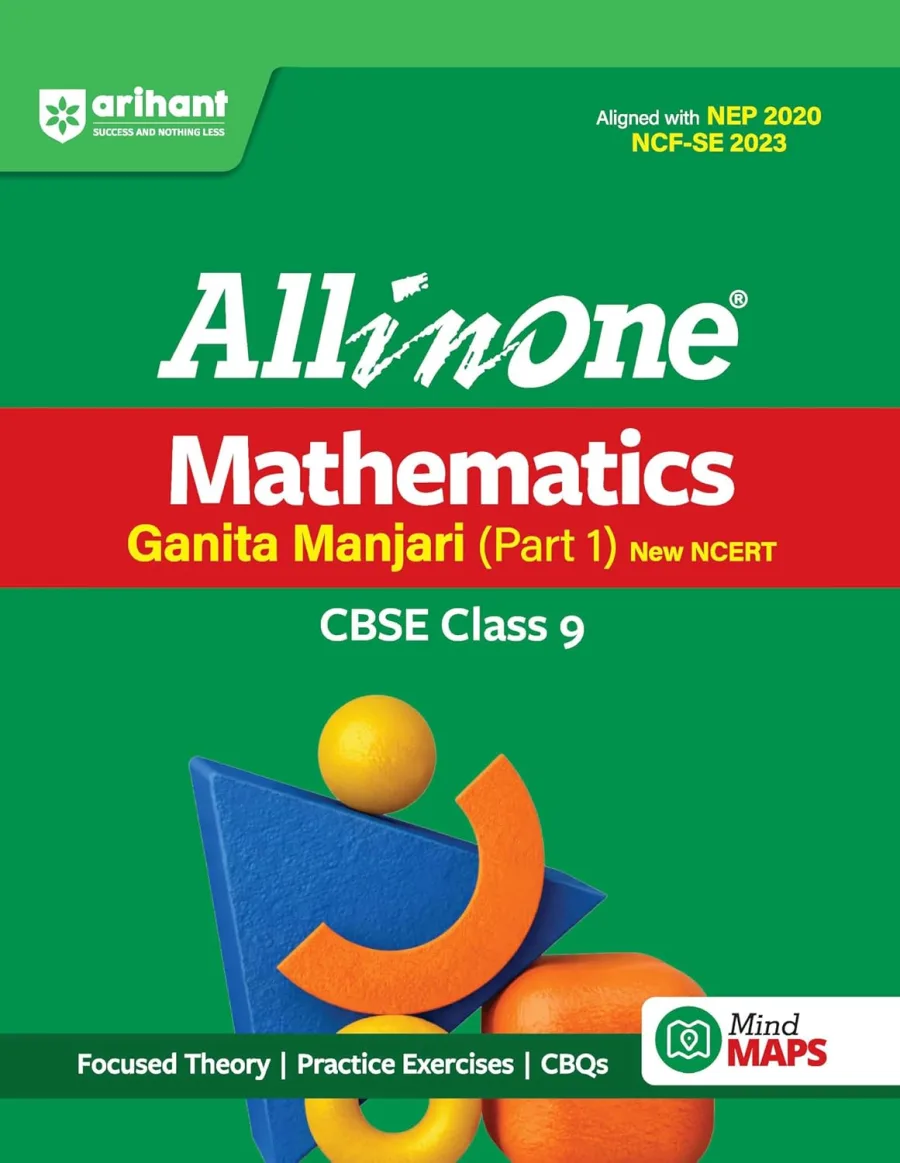
Arihant All in One Mathematics Ganita Manjari (Part 1) for CBSE Class 9 | New NCERT Based 2026
Paperback
• 365 Pages
• ₹ 475.00
• English
• 9789378160028
No ratings yet
| Publisher | Arihant Publications India Limited |
|---|---|
| ISBN13 | 9789378160028 |
| ASIN/SKU | 9378160026 |
| Book Format | Paperback |
| Language | English |
| Pages | 365 |
| List Price | ₹ 475.00 |
| Publishing Date | 14/05/2026 |
| Dimensions | 27 x 21 x 4 cm |
| Weight | 584 g |
| Book Code | BD00068028 |
Buy this Book
Amazon Stores
Ebook Stores
Other Stores
Discover Arihant All in One Mathematics Ganita Manjari (Part 1) for CBSE Class 9 | New NCERT Based 2026 by Rakesh Pandey. This book is published by Arihant Publications India Limited in Paperback format, ISBN 9789378160028, ASIN 9378160026, under School Books, CBSE Reference Books.
Book Description
Book Intro
All in One Mathematics Ganita Manjari (Part 1) for CBSE Class 9 is a complete study and practice book designed according to the latest CBSE syllabus, NEP 2020, and NCF-SE 2023 guidelines
Who Can Benefit
CBSE Class 9 students preparing Mathematics based on the new NCERT textbook Ganita Manjari (Part 1)
• Students looking for concept clarity, practice exercises, competency-based questions, mind maps, and exam-oriented preparation support
Book Description
All in One Mathematics Ganita Manjari (Part 1) by Arihant Publications is designed to strengthen conceptual understanding through simplified theory, solved examples, practice exercises, competency-based questions, and self-assessment support. The book covers important Class 9 Mathematics topics according to the latest CBSE pattern and curriculum structure
Includes focused theory, practice exercises, competency-based questions, and self-assessment exercises
• Covers NCERT Folder, exam-style questions, mind maps, periodic tests, and revision support
• Based on the latest CBSE syllabus aligned with NEP 2020 and NCF-SE 2023 guidelines
What Sets This Book Apart
Covers complete chapterwise preparation including Number System, Introduction to Polynomials, Coordinate Geometry, Geometry, Mensuration, Statistics, Probability, and Sequences and Progressions in a structured format
• Includes interactive Mind Maps for quick revision and better concept retention before examinations
• Exam Style Questions section includes Multiple Choice Questions, Assertion-Reason Questions, Case-Based Questions, Very Short Answer Questions, Short Answer Questions, and Long Answer Questions for exam-oriented preparation
• Includes competency-based learning support with analytical, application-based, and conceptual questions according to the latest CBSE assessment pattern
All in One Mathematics Ganita Manjari (Part 1) for CBSE Class 9 is a complete study and practice book designed according to the latest CBSE syllabus, NEP 2020, and NCF-SE 2023 guidelines
Who Can Benefit
CBSE Class 9 students preparing Mathematics based on the new NCERT textbook Ganita Manjari (Part 1)
• Students looking for concept clarity, practice exercises, competency-based questions, mind maps, and exam-oriented preparation support
Book Description
All in One Mathematics Ganita Manjari (Part 1) by Arihant Publications is designed to strengthen conceptual understanding through simplified theory, solved examples, practice exercises, competency-based questions, and self-assessment support. The book covers important Class 9 Mathematics topics according to the latest CBSE pattern and curriculum structure
Includes focused theory, practice exercises, competency-based questions, and self-assessment exercises
• Covers NCERT Folder, exam-style questions, mind maps, periodic tests, and revision support
• Based on the latest CBSE syllabus aligned with NEP 2020 and NCF-SE 2023 guidelines
What Sets This Book Apart
Covers complete chapterwise preparation including Number System, Introduction to Polynomials, Coordinate Geometry, Geometry, Mensuration, Statistics, Probability, and Sequences and Progressions in a structured format
• Includes interactive Mind Maps for quick revision and better concept retention before examinations
• Exam Style Questions section includes Multiple Choice Questions, Assertion-Reason Questions, Case-Based Questions, Very Short Answer Questions, Short Answer Questions, and Long Answer Questions for exam-oriented preparation
• Includes competency-based learning support with analytical, application-based, and conceptual questions according to the latest CBSE assessment pattern
Author Biography
Author Biography will be added soon…
Editorial Reviews
Editorial Reviews will be added soon…
Book Summary
Arihant All in One Mathematics Ganita Manjari (Part 1) for CBSE Class 9 by Rakesh Pandey and Mandvi Agarwal is a comprehensive study and practice book designed to help Class 9 CBSE students understand and prepare Mathematics according to the new NCERT-based curriculum for 2026. The book is particularly useful because it brings together explanation, practice, revision, and examination preparation in one organized resource. Rather than treating mathematics as a subject based only on memorizing formulas, it encourages students to understand concepts and then apply them through different types of questions.
The book is based on the new NCERT curriculum, making it relevant for students studying under the updated Class 9 Mathematics framework. The “Ganita Manjari” title reflects the newer NCERT approach to mathematics education, which places importance on conceptual understanding, mathematical reasoning, problem-solving, and the practical use of mathematical ideas. For students, this means that simply remembering a formula may not always be enough. They need to understand why a method works and how it can be used in different situations.
One of the main purposes of the book is to make the transition into Class 9 Mathematics smoother. Class 9 is an important stage because mathematical concepts become more detailed and interconnected than they were in earlier classes. Students encounter more abstract ideas, new forms of algebra, geometry, number concepts, data handling, and mathematical reasoning. A clear and structured study resource can help students build confidence before these topics become more difficult.
The book presents mathematical concepts in an organized manner so that students can study one topic at a time. Each topic can be approached through explanation, examples, and practice. This structure is useful because mathematics cannot be mastered by reading theory alone. A student may understand a formula while reading it but still struggle when asked to solve a question independently. Regular practice is therefore an essential part of the learning process.
The number system is one of the fundamental areas of school mathematics. Students need to understand different types of numbers and the relationships between them. Instead of treating numbers simply as symbols used for calculations, the study of number systems helps students understand how mathematical quantities are classified and represented. Strong understanding of these concepts also supports later topics in algebra and higher mathematics.
Algebra becomes increasingly important in Class 9. Students begin working with expressions, variables, identities, equations, and relationships between quantities. Algebra can initially seem difficult because letters are used in place of known or unknown numbers. The book helps students approach these concepts systematically so that they can understand how expressions are formed and manipulated.
Mathematical identities are particularly important because they provide shortcuts for simplifying and transforming expressions. However, students should not learn them only through memorization. Understanding how identities work makes it easier to recognize when they should be applied. The book's combination of explanations and examples can help students make this connection between theory and problem solving.
Geometry forms another major part of school mathematics. Unlike arithmetic, where students often calculate directly, geometry requires them to understand figures, relationships, properties, and logical reasoning. Lines, angles, triangles, and other geometric concepts require careful observation and sometimes step-by-step proofs. The book provides a structured way for students to revise definitions and properties before applying them to questions.
Geometry also helps students develop logical thinking. When students prove a statement, they are not simply calculating an answer. They are constructing a sequence of logical steps that leads from known information to a conclusion. This habit of reasoning is useful beyond mathematics because it teaches students to support conclusions with evidence.
Another important area is mensuration and measurement-related concepts. Students need to understand how mathematical formulas relate to real objects and measurements. Areas, lengths, and other quantities can be connected to practical situations such as designing spaces, measuring materials, or comparing objects. Learning the formulas becomes easier when students understand what each quantity represents.
The book also supports data handling and interpretation. Students increasingly encounter information in the form of tables, graphs, charts, and numerical data. Mathematics helps them interpret such information rather than simply perform calculations. This is an important everyday skill because people regularly encounter statistics and numerical information in newspapers, advertisements, reports, and digital media.
The newer NCERT approach also places importance on competency-based learning. This means students may be asked to apply concepts in unfamiliar situations instead of simply repeating a definition. A question might provide a real-life situation and require the student to decide which mathematical concept should be used. The book's practice-oriented structure helps students become more comfortable with such applications.
One of the strongest features of an All in One resource is its combination of concept learning and practice. Students do not have to depend on a separate guide for every stage of preparation. They can study the explanation, examine examples, solve practice questions, and revise important points from the same book. This can make their study routine more organized.
The solved examples are particularly helpful for students who are learning how to approach mathematical problems. A worked solution demonstrates not only the final answer but also the sequence of steps used to reach it. Students can compare their own method with the example and identify where they made a mistake.
The practice questions then allow students to work independently. This is essential because mathematics requires active participation. A student can read an explanation several times and still struggle to solve a question without assistance. Independent practice reveals whether the concept has genuinely been understood.
The book can also help students develop accuracy. Mathematical errors are not always caused by a lack of understanding. Sometimes students know the correct method but make mistakes while calculating, copying numbers, applying signs, or simplifying expressions. Repeated practice helps students identify these habits and become more careful.
Another benefit is improved problem-solving ability. Many mathematical questions cannot be solved by immediately applying one formula. Students must first understand what the question is asking, identify the relevant information, choose an appropriate method, and then carry out the calculation. Regular exposure to different question types gradually develops this ability.
The book can be particularly useful for students who find Mathematics intimidating. Difficulty with one topic can sometimes make students lose confidence in the entire subject. A structured resource allows them to move step by step, beginning with basic concepts and gradually attempting more complex questions. Success with smaller problems can build confidence for more challenging ones.
At the same time, the book should not encourage students to rely only on memorization. Mathematics becomes much easier when students understand the logic behind the methods. Formulas are useful tools, but knowing when and why to use them is even more important. Students should therefore read the explanations carefully and attempt questions without immediately looking at the solutions.
The book is also suitable for revision. Before a school test or examination, students can revisit completed chapters and solve selected questions. Regular revision prevents concepts from being forgotten and makes it easier to identify areas that still require attention.
For students preparing for school examinations, the book can be used alongside the original NCERT textbook. The NCERT book should remain an important foundation because it contains the official curriculum material, examples, activities, and exercises. The Arihant book can then provide additional explanation, structured practice, and revision support.
The resource can also be useful for parents and teachers. Parents can use the exercises to understand what their children are studying and identify topics where additional practice may be required. Teachers can use selected questions for homework, revision, or classroom discussion.
The book is based on the new NCERT curriculum, making it relevant for students studying under the updated Class 9 Mathematics framework. The “Ganita Manjari” title reflects the newer NCERT approach to mathematics education, which places importance on conceptual understanding, mathematical reasoning, problem-solving, and the practical use of mathematical ideas. For students, this means that simply remembering a formula may not always be enough. They need to understand why a method works and how it can be used in different situations.
One of the main purposes of the book is to make the transition into Class 9 Mathematics smoother. Class 9 is an important stage because mathematical concepts become more detailed and interconnected than they were in earlier classes. Students encounter more abstract ideas, new forms of algebra, geometry, number concepts, data handling, and mathematical reasoning. A clear and structured study resource can help students build confidence before these topics become more difficult.
The book presents mathematical concepts in an organized manner so that students can study one topic at a time. Each topic can be approached through explanation, examples, and practice. This structure is useful because mathematics cannot be mastered by reading theory alone. A student may understand a formula while reading it but still struggle when asked to solve a question independently. Regular practice is therefore an essential part of the learning process.
The number system is one of the fundamental areas of school mathematics. Students need to understand different types of numbers and the relationships between them. Instead of treating numbers simply as symbols used for calculations, the study of number systems helps students understand how mathematical quantities are classified and represented. Strong understanding of these concepts also supports later topics in algebra and higher mathematics.
Algebra becomes increasingly important in Class 9. Students begin working with expressions, variables, identities, equations, and relationships between quantities. Algebra can initially seem difficult because letters are used in place of known or unknown numbers. The book helps students approach these concepts systematically so that they can understand how expressions are formed and manipulated.
Mathematical identities are particularly important because they provide shortcuts for simplifying and transforming expressions. However, students should not learn them only through memorization. Understanding how identities work makes it easier to recognize when they should be applied. The book's combination of explanations and examples can help students make this connection between theory and problem solving.
Geometry forms another major part of school mathematics. Unlike arithmetic, where students often calculate directly, geometry requires them to understand figures, relationships, properties, and logical reasoning. Lines, angles, triangles, and other geometric concepts require careful observation and sometimes step-by-step proofs. The book provides a structured way for students to revise definitions and properties before applying them to questions.
Geometry also helps students develop logical thinking. When students prove a statement, they are not simply calculating an answer. They are constructing a sequence of logical steps that leads from known information to a conclusion. This habit of reasoning is useful beyond mathematics because it teaches students to support conclusions with evidence.
Another important area is mensuration and measurement-related concepts. Students need to understand how mathematical formulas relate to real objects and measurements. Areas, lengths, and other quantities can be connected to practical situations such as designing spaces, measuring materials, or comparing objects. Learning the formulas becomes easier when students understand what each quantity represents.
The book also supports data handling and interpretation. Students increasingly encounter information in the form of tables, graphs, charts, and numerical data. Mathematics helps them interpret such information rather than simply perform calculations. This is an important everyday skill because people regularly encounter statistics and numerical information in newspapers, advertisements, reports, and digital media.
The newer NCERT approach also places importance on competency-based learning. This means students may be asked to apply concepts in unfamiliar situations instead of simply repeating a definition. A question might provide a real-life situation and require the student to decide which mathematical concept should be used. The book's practice-oriented structure helps students become more comfortable with such applications.
One of the strongest features of an All in One resource is its combination of concept learning and practice. Students do not have to depend on a separate guide for every stage of preparation. They can study the explanation, examine examples, solve practice questions, and revise important points from the same book. This can make their study routine more organized.
The solved examples are particularly helpful for students who are learning how to approach mathematical problems. A worked solution demonstrates not only the final answer but also the sequence of steps used to reach it. Students can compare their own method with the example and identify where they made a mistake.
The practice questions then allow students to work independently. This is essential because mathematics requires active participation. A student can read an explanation several times and still struggle to solve a question without assistance. Independent practice reveals whether the concept has genuinely been understood.
The book can also help students develop accuracy. Mathematical errors are not always caused by a lack of understanding. Sometimes students know the correct method but make mistakes while calculating, copying numbers, applying signs, or simplifying expressions. Repeated practice helps students identify these habits and become more careful.
Another benefit is improved problem-solving ability. Many mathematical questions cannot be solved by immediately applying one formula. Students must first understand what the question is asking, identify the relevant information, choose an appropriate method, and then carry out the calculation. Regular exposure to different question types gradually develops this ability.
The book can be particularly useful for students who find Mathematics intimidating. Difficulty with one topic can sometimes make students lose confidence in the entire subject. A structured resource allows them to move step by step, beginning with basic concepts and gradually attempting more complex questions. Success with smaller problems can build confidence for more challenging ones.
At the same time, the book should not encourage students to rely only on memorization. Mathematics becomes much easier when students understand the logic behind the methods. Formulas are useful tools, but knowing when and why to use them is even more important. Students should therefore read the explanations carefully and attempt questions without immediately looking at the solutions.
The book is also suitable for revision. Before a school test or examination, students can revisit completed chapters and solve selected questions. Regular revision prevents concepts from being forgotten and makes it easier to identify areas that still require attention.
For students preparing for school examinations, the book can be used alongside the original NCERT textbook. The NCERT book should remain an important foundation because it contains the official curriculum material, examples, activities, and exercises. The Arihant book can then provide additional explanation, structured practice, and revision support.
The resource can also be useful for parents and teachers. Parents can use the exercises to understand what their children are studying and identify topics where additional practice may be required. Teachers can use selected questions for homework, revision, or classroom discussion.
Sample Chapters
Sample Chapters will be added soon…
Reader Reviews
No reviews yet.
Arihant All in One Mathematics Ganita Manjari (Part 1) for CBSE Class 9 | New NCERT Based 2026
Download Cover Image
Do you want to download the full cover image for Arihant All in One Mathematics Ganita Manjari (Part 1) for CBSE Class 9 | New NCERT Based 2026?