
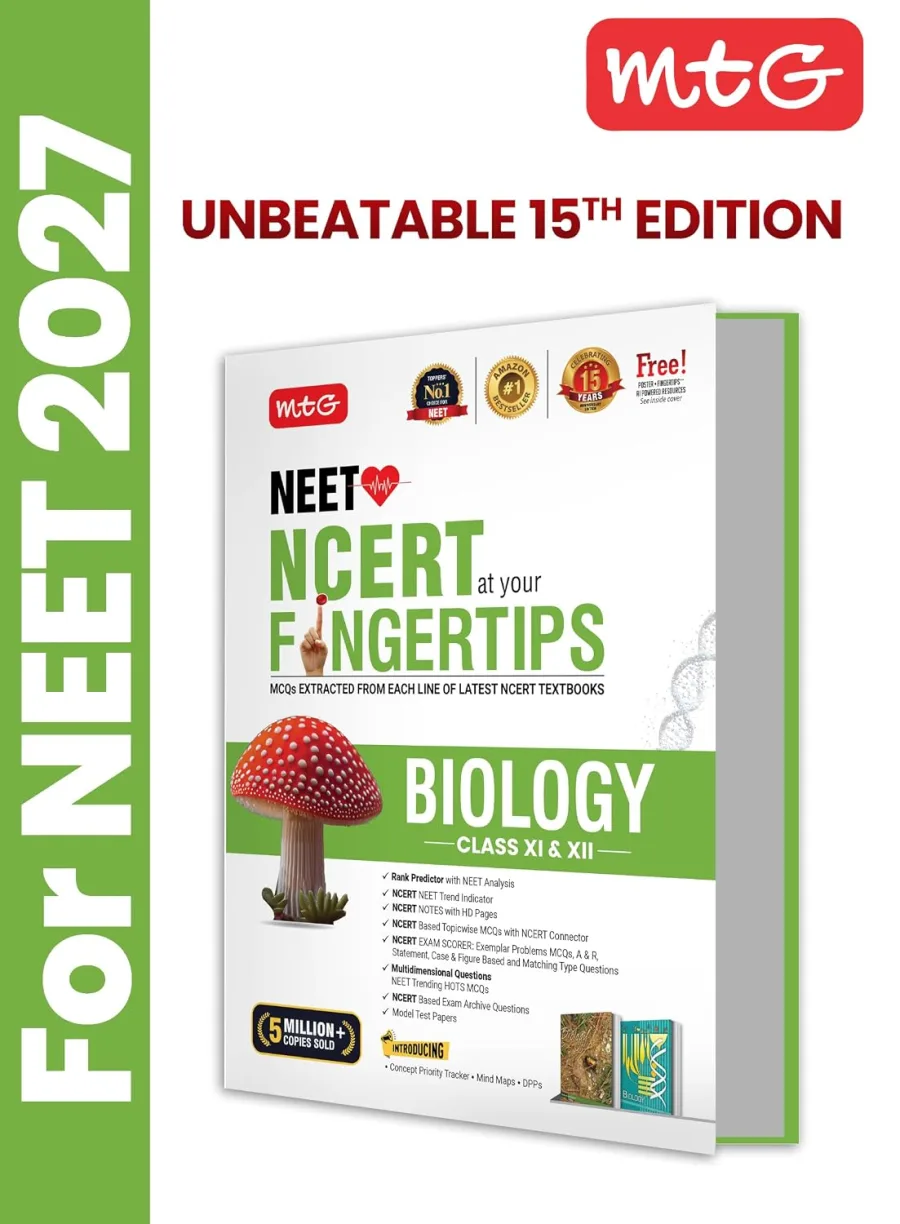
MTG NCERT at your FINGERTIPS Biology For NEET Exam 2026-2027 | NCERT Exam Scorer, Concept Priority
Paperback
• 1248 Pages
• ₹ 1099.00
• English
• 9789375446385
No ratings yet
| Publisher | MTG Learning Media Pvt. Ltd. |
|---|---|
| ISBN13 | 9789375446385 |
| ASIN/SKU | 9375446387 |
| Book Format | Paperback |
| Language | English |
| Pages | 1248 |
| List Price | ₹ 1099.00 |
| Publishing Date | 30/06/2026 |
| Dimensions | 28 x 21 x 3.5 cm |
| Weight | 1 kg 800 g |
| Book Code | BD00068027 |
Buy this Book
Amazon Stores
Ebook Stores
Other Stores
Discover MTG NCERT at your FINGERTIPS Biology For NEET Exam 2026-2027 | NCERT Exam Scorer, Concept Priority by MTG Editorial Board. This book is published by MTG Learning Media Pvt. Ltd. in Paperback format, ISBN 9789375446385, ASIN 9375446387, under School Books, AIIMS and NEET Exams.
Book Description
MTG is back with the latest edition of one of its most loved books - Objective NCERT at Your Fingertips. For last 15 years, this book has been Topper’s No. 1 choice for NEET. Consistently ranked Amazon No. 1 bestseller, it is a one-of-a-kind book based on the 11th and 12th NCERT and NEET syllabus for session 2026-27. On the special occasion of its 15th anniversary edition, students can avail free poster and AI powered resources to make their learning journey even more satisfying and successful.
Who Can Benefit?
CBSE Students
Aspiring NEET Students
CUET, Board & All University Entrance Exams Aspirants
NEET, CBSE and CUET Educators
Book Description
The latest edition of your most awaited book - MTG Objective NCERT at Your Fingertips is finally here. Having already sold more than 5 million copies, this unparalleled book is based on the 11th and 12th NCERT syllabus for session 2026-27 is power-packed with multiple features and benefits for students. This time, you also get to benefit with Concept Priority Tracker, Mind Maps, and Daily Practice Papers (DPPs). Along with theory, it consists of MCQs extracted from each line of the latest NCERT textbook. This makes it the leading choice of Toppers and the pinnacle for NEET exams. This book is a must for the NEET exam.
NCERT notes with HD pages for quick yet thorough & impactful revisions.
NCERT Exemplar Problem MCQs to develop a strong base & go in-depth.
NCERT-based exam archive questions for thorough preparation.
Model Test Papers to put the final practice touch to your preparation.
Answer keys, hints and explanations for micro-level understanding.
NCERT based Topicwise MCQs with NCERT Connector.
What Sets This Book Apart?
Rank Predictor with NEET analysis to assess your exam readiness
Topic-wise MCQs from each line of the NCERT to get a firm grip on concepts.
Assertion Reason, Case-Based Questions & HOTS to cover all question typologies.
NEET Trend Indicator for understanding the analysis of NEET questions.
All Question Typologies with Case & Graph-based, statements, matching and numerical value type.
Multidimensional questions of NEET trending HOTS MCQs.
What Will You Learn?
This book helps in strengthening and clarifying every NEET concept.
Structured and simplified content for quick revision and refreshing memory.
Visual aids given in the book support active learning and deep retention of information.
It helps in developing critical thinking and reasoning skills for higher-level assessments.
Identifying trends and repeated concepts to be one step ahead of your competition.
Enable students to assess progress and identify areas of improvement.
Learn time management skills with practice and build confidence.
Who Can Benefit?
CBSE Students
Aspiring NEET Students
CUET, Board & All University Entrance Exams Aspirants
NEET, CBSE and CUET Educators
Book Description
The latest edition of your most awaited book - MTG Objective NCERT at Your Fingertips is finally here. Having already sold more than 5 million copies, this unparalleled book is based on the 11th and 12th NCERT syllabus for session 2026-27 is power-packed with multiple features and benefits for students. This time, you also get to benefit with Concept Priority Tracker, Mind Maps, and Daily Practice Papers (DPPs). Along with theory, it consists of MCQs extracted from each line of the latest NCERT textbook. This makes it the leading choice of Toppers and the pinnacle for NEET exams. This book is a must for the NEET exam.
NCERT notes with HD pages for quick yet thorough & impactful revisions.
NCERT Exemplar Problem MCQs to develop a strong base & go in-depth.
NCERT-based exam archive questions for thorough preparation.
Model Test Papers to put the final practice touch to your preparation.
Answer keys, hints and explanations for micro-level understanding.
NCERT based Topicwise MCQs with NCERT Connector.
What Sets This Book Apart?
Rank Predictor with NEET analysis to assess your exam readiness
Topic-wise MCQs from each line of the NCERT to get a firm grip on concepts.
Assertion Reason, Case-Based Questions & HOTS to cover all question typologies.
NEET Trend Indicator for understanding the analysis of NEET questions.
All Question Typologies with Case & Graph-based, statements, matching and numerical value type.
Multidimensional questions of NEET trending HOTS MCQs.
What Will You Learn?
This book helps in strengthening and clarifying every NEET concept.
Structured and simplified content for quick revision and refreshing memory.
Visual aids given in the book support active learning and deep retention of information.
It helps in developing critical thinking and reasoning skills for higher-level assessments.
Identifying trends and repeated concepts to be one step ahead of your competition.
Enable students to assess progress and identify areas of improvement.
Learn time management skills with practice and build confidence.
Author Biography
Author Biography will be added soon…
Editorial Reviews
Editorial Reviews will be added soon…
Book Summary
MTG NCERT at Your FINGERTIPS Biology for NEET Exam 2026–2027 by the MTG Editorial Board is an exam-focused Biology preparation book designed specifically for students preparing for the NEET examination. Its central purpose is to make NCERT Biology easier to study, revise, and convert into examination-ready knowledge. Since NEET Biology is strongly connected with the NCERT syllabus, the book places the NCERT text at the centre of preparation and organizes important concepts, facts, diagrams, and question patterns around it.
The book is particularly useful for students who understand that NEET preparation is not simply about reading a large number of reference books. Biology contains an enormous amount of information, and students need to know which concepts and statements deserve the greatest attention. The “Concept Priority” approach helps direct preparation toward important areas while retaining the detailed information needed for objective questions. The book therefore works primarily as a structured NCERT-based learning and revision resource rather than as a conventional biology textbook.
One of its most important features is its close connection with NCERT. Students preparing for NEET are expected to know the prescribed material in considerable detail, including definitions, examples, diagrams, classifications, processes, terminology, and factual statements. NCERT at Your FINGERTIPS is designed to help students study this material more efficiently. Instead of requiring learners to repeatedly move between different sources, it brings important NCERT-oriented information into an examination-focused format.
The Biology syllabus covered by the book spans the major areas of Class 11 and Class 12 Biology. The early portion introduces students to the diversity of living organisms and the principles used to classify them. Topics involving biological classification, plant groups, animal groups, and the characteristics of different organisms require careful attention to terminology and distinguishing features. The book helps students organize these details so that similarities and differences can be revised systematically.
Structural organization in plants and animals forms another important part of the syllabus. Students study plant morphology, anatomy, tissues, and the structural features of different plant organs. Animal tissues and structural organization are also covered. These topics contain many terms that can appear directly in NEET questions, making precise NCERT-based revision particularly important.
Cell biology is a major foundation of the book. Students learn about the structure and function of cells, cell organelles, biomolecules, cell division, and related processes. Understanding the cell is essential because many later Biology chapters depend on concepts introduced here. Mitosis and meiosis, for example, are important not only for understanding cell reproduction but also for later topics involving genetics and reproduction.
The book also gives substantial attention to plant physiology. Students study processes such as transport in plants, mineral nutrition, photosynthesis, respiration, and plant growth and development. These chapters require both conceptual understanding and careful memorization of important details. Photosynthesis, for example, involves relationships among light, carbon dioxide, water, pigments, chloroplast structures, and biochemical pathways. Students need to understand the overall process while also remembering the precise terminology and facts emphasized by NCERT.
Plant physiology is followed by human and animal physiology, which forms one of the most important areas of NEET Biology. Students study digestion, breathing and respiration, circulation, excretion, locomotion, neural control, coordination, and chemical coordination. These chapters require an understanding of interconnected body systems rather than isolated facts. The book helps students revise the structures, functions, hormones, processes, and important biological relationships that frequently appear in objective examinations.
Human circulation, for example, requires students to understand how blood moves through the heart, lungs, and body. Rather than simply memorizing the names of chambers and blood vessels, students benefit from understanding the sequence of circulation and the distinction between pulmonary and systemic pathways.
Reproduction is another major area covered in the preparation material. Students study reproduction in flowering plants, human reproduction, reproductive health, and related biological processes. The chapters require careful attention because NEET questions can test small details about reproductive structures, gamete formation, fertilization, hormonal regulation, and developmental processes. Clear organization and repeated revision are therefore particularly valuable.
Genetics and evolution form another highly important section. Students learn about inheritance, Mendelian principles, chromosomes, DNA, molecular genetics, gene expression, mutations, and evolutionary concepts. These subjects can initially seem difficult because they involve abstract mechanisms and relationships between molecular processes and observable characteristics. An NCERT-focused approach helps students remain closely aligned with the terminology and explanations expected in the examination.
The genetics section also introduces processes involved in the transmission and expression of genetic information. Understanding how DNA carries information, how that information is expressed, and how genetic variation can arise is essential for connecting several chapters together.
Biology and human welfare is another broad area. Students encounter information about diseases, pathogens, immunity, vaccines, useful microorganisms, and biotechnology-related applications. These chapters contain many factual details that are especially suitable for objective questions. The book's emphasis on NCERT statements can therefore be useful for students who need to remember precise information rather than only broad concepts.
Biotechnology forms another important part of the preparation. Students learn about recombinant DNA technology, genetic engineering, applications of biotechnology, and related processes. These topics combine Biology with laboratory techniques and molecular concepts. Students must understand both the basic principles and the terminology used to describe the processes.
Ecology and environment complete a major part of the Biology syllabus. Students study organisms and populations, ecosystems, biodiversity, environmental issues, energy flow, food chains, ecological relationships, and conservation. These topics require students to understand how living organisms interact with each other and with their physical surroundings. The book helps organize important definitions, examples, relationships, and factual information for revision.
A major strength of the NCERT at Your FINGERTIPS approach is its focus on priority. Not every sentence in a large syllabus carries the same examination importance. Students need to identify concepts that are frequently tested or particularly important for understanding other chapters. Concept prioritization can help them allocate study time more intelligently, especially during revision periods when the entire syllabus must be reviewed within a limited amount of time.
The book also supports repeated revision. NEET Biology requires a large amount of information to remain accessible under examination conditions. Reading a chapter once is rarely enough. Students need to revisit concepts several times and test whether they can recall details without looking at the material. An organized reference such as this can serve as a compact revision source after students have studied the corresponding NCERT chapters carefully.
Another important advantage is its examination-oriented perspective. NEET questions can sometimes be based on very specific wording, examples, diagrams, or distinctions. Therefore, students need to develop the habit of reading Biology carefully rather than relying only on broad conceptual summaries. The NCERT-centred structure encourages students to pay attention to the details that may otherwise be overlooked.
At the same time, students should not treat any guidebook as a substitute for the official NCERT textbooks. The original NCERT books remain the fundamental source for the prescribed content. NCERT at Your FINGERTIPS is most effective when used alongside them: first understand the NCERT material, then use the guide to organize, reinforce, revise, and test that knowledge.
The book is particularly useful during different stages of NEET preparation. During the initial stage, students can use it to reinforce concepts after studying the relevant NCERT chapter. During the middle stage, it can help identify weak topics and strengthen factual recall.
The book is particularly useful for students who understand that NEET preparation is not simply about reading a large number of reference books. Biology contains an enormous amount of information, and students need to know which concepts and statements deserve the greatest attention. The “Concept Priority” approach helps direct preparation toward important areas while retaining the detailed information needed for objective questions. The book therefore works primarily as a structured NCERT-based learning and revision resource rather than as a conventional biology textbook.
One of its most important features is its close connection with NCERT. Students preparing for NEET are expected to know the prescribed material in considerable detail, including definitions, examples, diagrams, classifications, processes, terminology, and factual statements. NCERT at Your FINGERTIPS is designed to help students study this material more efficiently. Instead of requiring learners to repeatedly move between different sources, it brings important NCERT-oriented information into an examination-focused format.
The Biology syllabus covered by the book spans the major areas of Class 11 and Class 12 Biology. The early portion introduces students to the diversity of living organisms and the principles used to classify them. Topics involving biological classification, plant groups, animal groups, and the characteristics of different organisms require careful attention to terminology and distinguishing features. The book helps students organize these details so that similarities and differences can be revised systematically.
Structural organization in plants and animals forms another important part of the syllabus. Students study plant morphology, anatomy, tissues, and the structural features of different plant organs. Animal tissues and structural organization are also covered. These topics contain many terms that can appear directly in NEET questions, making precise NCERT-based revision particularly important.
Cell biology is a major foundation of the book. Students learn about the structure and function of cells, cell organelles, biomolecules, cell division, and related processes. Understanding the cell is essential because many later Biology chapters depend on concepts introduced here. Mitosis and meiosis, for example, are important not only for understanding cell reproduction but also for later topics involving genetics and reproduction.
The book also gives substantial attention to plant physiology. Students study processes such as transport in plants, mineral nutrition, photosynthesis, respiration, and plant growth and development. These chapters require both conceptual understanding and careful memorization of important details. Photosynthesis, for example, involves relationships among light, carbon dioxide, water, pigments, chloroplast structures, and biochemical pathways. Students need to understand the overall process while also remembering the precise terminology and facts emphasized by NCERT.
Plant physiology is followed by human and animal physiology, which forms one of the most important areas of NEET Biology. Students study digestion, breathing and respiration, circulation, excretion, locomotion, neural control, coordination, and chemical coordination. These chapters require an understanding of interconnected body systems rather than isolated facts. The book helps students revise the structures, functions, hormones, processes, and important biological relationships that frequently appear in objective examinations.
Human circulation, for example, requires students to understand how blood moves through the heart, lungs, and body. Rather than simply memorizing the names of chambers and blood vessels, students benefit from understanding the sequence of circulation and the distinction between pulmonary and systemic pathways.
Reproduction is another major area covered in the preparation material. Students study reproduction in flowering plants, human reproduction, reproductive health, and related biological processes. The chapters require careful attention because NEET questions can test small details about reproductive structures, gamete formation, fertilization, hormonal regulation, and developmental processes. Clear organization and repeated revision are therefore particularly valuable.
Genetics and evolution form another highly important section. Students learn about inheritance, Mendelian principles, chromosomes, DNA, molecular genetics, gene expression, mutations, and evolutionary concepts. These subjects can initially seem difficult because they involve abstract mechanisms and relationships between molecular processes and observable characteristics. An NCERT-focused approach helps students remain closely aligned with the terminology and explanations expected in the examination.
The genetics section also introduces processes involved in the transmission and expression of genetic information. Understanding how DNA carries information, how that information is expressed, and how genetic variation can arise is essential for connecting several chapters together.
Biology and human welfare is another broad area. Students encounter information about diseases, pathogens, immunity, vaccines, useful microorganisms, and biotechnology-related applications. These chapters contain many factual details that are especially suitable for objective questions. The book's emphasis on NCERT statements can therefore be useful for students who need to remember precise information rather than only broad concepts.
Biotechnology forms another important part of the preparation. Students learn about recombinant DNA technology, genetic engineering, applications of biotechnology, and related processes. These topics combine Biology with laboratory techniques and molecular concepts. Students must understand both the basic principles and the terminology used to describe the processes.
Ecology and environment complete a major part of the Biology syllabus. Students study organisms and populations, ecosystems, biodiversity, environmental issues, energy flow, food chains, ecological relationships, and conservation. These topics require students to understand how living organisms interact with each other and with their physical surroundings. The book helps organize important definitions, examples, relationships, and factual information for revision.
A major strength of the NCERT at Your FINGERTIPS approach is its focus on priority. Not every sentence in a large syllabus carries the same examination importance. Students need to identify concepts that are frequently tested or particularly important for understanding other chapters. Concept prioritization can help them allocate study time more intelligently, especially during revision periods when the entire syllabus must be reviewed within a limited amount of time.
The book also supports repeated revision. NEET Biology requires a large amount of information to remain accessible under examination conditions. Reading a chapter once is rarely enough. Students need to revisit concepts several times and test whether they can recall details without looking at the material. An organized reference such as this can serve as a compact revision source after students have studied the corresponding NCERT chapters carefully.
Another important advantage is its examination-oriented perspective. NEET questions can sometimes be based on very specific wording, examples, diagrams, or distinctions. Therefore, students need to develop the habit of reading Biology carefully rather than relying only on broad conceptual summaries. The NCERT-centred structure encourages students to pay attention to the details that may otherwise be overlooked.
At the same time, students should not treat any guidebook as a substitute for the official NCERT textbooks. The original NCERT books remain the fundamental source for the prescribed content. NCERT at Your FINGERTIPS is most effective when used alongside them: first understand the NCERT material, then use the guide to organize, reinforce, revise, and test that knowledge.
The book is particularly useful during different stages of NEET preparation. During the initial stage, students can use it to reinforce concepts after studying the relevant NCERT chapter. During the middle stage, it can help identify weak topics and strengthen factual recall.
Sample Chapters
Sample Chapters will be added soon…
Reader Reviews
No reviews yet.
MTG NCERT at your FINGERTIPS Biology For NEET Exam 2026-2027 | NCERT Exam Scorer, Concept Priority
Download Cover Image
Do you want to download the full cover image for MTG NCERT at your FINGERTIPS Biology For NEET Exam 2026-2027 | NCERT Exam Scorer, Concept Priority?