
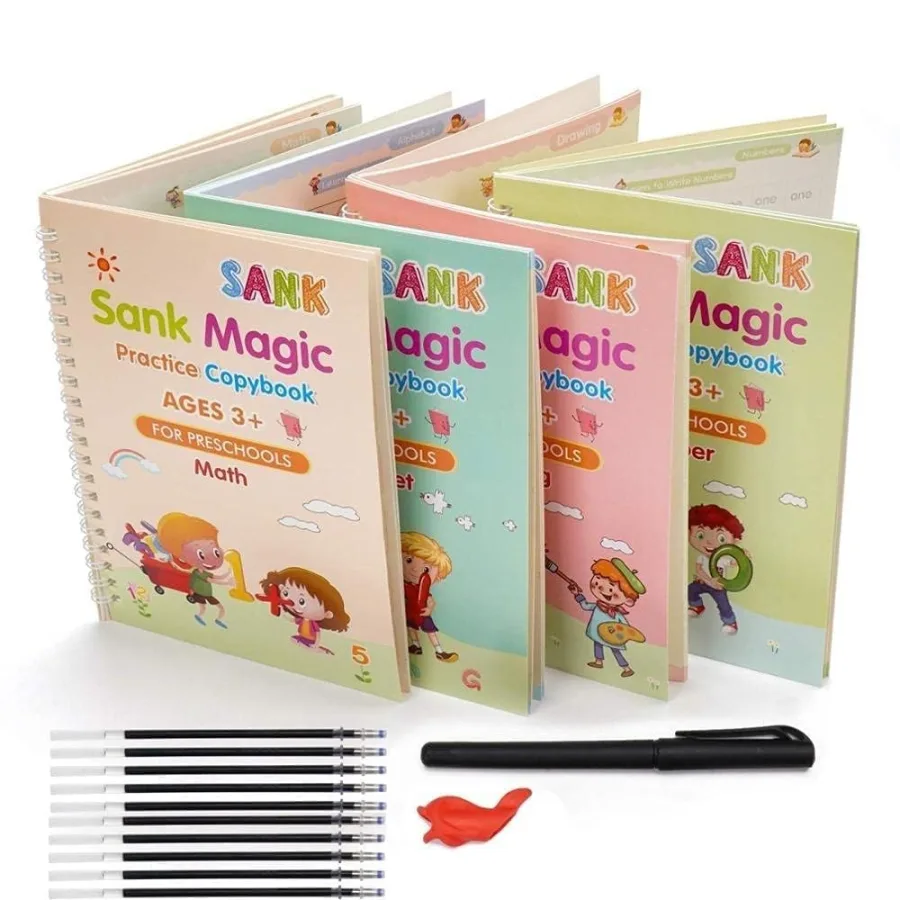
Shnmn Sank Magic Practice Copybook, (4 Book +1 Pen + 10 Refill) Number Tracing Book for Preschoolers
Spiral-Bound
• 16 Pages
• ₹ 999.00
• English
No ratings yet
| Publisher | Shnmn |
|---|---|
| ASIN/SKU | B09HY85DF7 |
| Book Format | Spiral-Bound |
| Language | English |
| Pages | 16 |
| List Price | ₹ 999.00 |
| Publishing Date | 01/02/2023 |
| Dimensions | 19 x 13 x 2 cm |
| Weight | 232 g |
| Book Code | BD00067827 |
Buy this Book
Amazon Stores
Ebook Stores
Other Stores
Discover Shnmn Sank Magic Practice Copybook, (4 Book +1 Pen + 10 Refill) Number Tracing Book for Preschoolers by Shnmn. This book is published by Shnmn in Spiral-Bound format, ASIN B09HY85DF7, under Children's Books, Teen and Young Adult, Children's Early Learning.
Book Description
SHNMN Sank Magic Practice Copybook, (4 BOOK +1 PEN + 10 REFILL) Number Tracing Book for Preschoolers with Pen, Magic calligraphy books for kids Reusable Writing Tool
Author Biography
Author Biography will be added soon…
Editorial Reviews
Editorial Reviews will be added soon…
Book Summary
Shnmn Sank Magic Practice Copybook is a reusable early-learning writing and tracing set designed to help preschool children develop basic handwriting, number recognition, pencil control, and other foundational writing skills. The set contains four practice books along with a special magic pen and ten refills. Product listings describe the four books as covering English letters, numbers, addition and subtraction, and drawing, making the set broader than a simple number-tracing workbook. It is intended for young beginners who are learning how to form letters and numbers and become comfortable with controlled writing movements.
The main idea behind the books is repeated practice. Young children often need to write the same letters, numbers, and shapes many times before they become comfortable with them. Ordinary workbooks can quickly become filled with writing, meaning parents have to purchase new books when children need more practice. The magic-copybook system addresses this by using special ink that gradually fades after writing. Once the writing disappears, the pages can be used again. One product description says the writing gradually fades after drying, while another specifies that the special ink can fade within roughly 30 minutes.
The number-tracing component is particularly useful for preschoolers who are beginning to recognize and write numerals. Instead of asking a child to reproduce a number without guidance, the pages provide grooves or tracing paths that show how the writing movement should be made. The child follows these paths with the magic pen, repeatedly practicing the correct form. This helps transform number writing from an abstract task into a physical activity that the child can see and repeat.
The books use a three-dimensional groove design to guide the writing movement. These grooves give the child a physical path to follow, helping them understand where the pen should move and how a particular letter, number, or shape is formed. This type of guided practice can be especially helpful for beginners who have not yet developed strong pencil control.
The set is not limited to numbers. The four-book format is described as including English letters, numbers, addition and subtraction, and drawing. This gives children exposure to several early-learning activities in one package. The alphabet book can help children become familiar with letter shapes, while the numbers book introduces numeral formation. The mathematics component provides an early introduction to simple addition and subtraction, and the drawing section gives children an opportunity to practice lines, shapes, and creative movements.
The drawing activities are particularly helpful because writing readiness begins before children can form complete words or sentences. Children first need to develop control over lines, curves, directions, and shapes. Following drawing patterns helps them practice the hand movements that later contribute to handwriting. The activity therefore connects play with the development of basic pre-writing skills.
Another important purpose of the set is fine motor development. Holding a pen and moving it along a specific path requires small and controlled movements of the fingers, hand, and wrist. Preschool children are still developing these abilities, so repeated tracing can provide useful practice. The product descriptions specifically identify handwriting and motor-skill development as benefits of the copybooks.
The included pen grip is another feature intended to support proper writing posture. Some versions of the product list a soft pencil grip along with the pen and refills. The grip is designed to make holding the writing instrument more comfortable and to encourage a more appropriate hand position. For children who are just beginning to learn how to hold a writing tool, this can make practice easier and less tiring.
The reusable nature of the books can also make learning less wasteful. A child can practice a particular number or letter, allow the marks to disappear, and then repeat the exercise. Instead of treating mistakes as permanent marks on a page, the child can simply try again. This creates a relaxed learning environment in which mistakes become part of the practice process.
This is especially important for preschool children because handwriting can initially be frustrating. A child may form a number backward, make a line too long, stop at the wrong point, or struggle to stay within a tracing groove. With an ordinary workbook, the page remains marked by these attempts. With a reusable copybook, the child can try repeatedly without worrying about running out of practice space. The emphasis shifts from producing a perfect answer immediately to improving through repetition.
The set can also help develop hand-eye coordination. Children have to look at the printed pattern while simultaneously controlling the pen. Their eyes guide the hand as it moves through curves, corners, lines, and numbers. Over time, this coordination can become more natural and can support later activities such as handwriting, drawing, coloring, cutting, and other classroom tasks.
The books are also designed to make practice more engaging. The product descriptions mention colorful or engaging illustrations, and the overall format combines writing with pictures and activities. This can make the experience feel less like repetitive homework and more like an interactive learning activity. For preschoolers, maintaining interest is important because they generally learn more effectively when an activity feels enjoyable.
The compact format is another practical feature. One listing gives the practice-book dimensions as approximately 19 × 13 cm, making the books relatively small and easy for children to handle. Their size can also make them convenient for carrying during travel or taking them between home and preschool.
Parents can use the books in short daily sessions rather than expecting children to complete a large amount of work at once. A few minutes of focused tracing can be more appropriate for a young child than a long writing session. Parents can begin with simple patterns and numbers, encourage the child to follow the grooves slowly, and gradually introduce more difficult exercises as the child's control improves.
The set can also be used in a preschool or homeschooling environment. Teachers can use individual exercises to reinforce lessons about letters and numbers, while parents can use the books for additional practice at home. Because the pages can be reused, children can repeat exercises that they find difficult instead of moving immediately to a new worksheet.
The mathematics book adds another useful dimension. Early addition and subtraction practice can help children begin connecting written numbers with simple mathematical operations. At the preschool stage, the emphasis should remain on familiarity and confidence rather than speed. Writing numbers correctly and understanding simple numerical relationships provide a foundation for more advanced mathematics later.
The alphabet practice similarly prepares children for formal literacy. Before children can write words independently, they need to recognize and reproduce individual letters. Repeated tracing helps them become familiar with letter shapes and directional movements. Over time, this can make the transition toward independent writing less intimidating.
The reusable pen system also encourages children to become comfortable with repeated correction. When a child makes a mistake, there is no need to discard the page. The child can simply wait for the marks to fade and begin again. This can subtly encourage patience and persistence. Instead of viewing an incorrect attempt as failure, children can learn that practice is a normal part of learning.
However, the book is best viewed as a practice tool rather than a complete preschool curriculum. Tracing numbers and letters can strengthen writing readiness, but children also benefit from reading aloud, conversations, physical play, creative activities, counting objects, puzzles, and other forms of learning. The copybooks work most effectively when they are one part of a wider early-learning routine.
Overall, Shnmn Sank Magic Practice Copybook is a practical reusable learning set for preschoolers who are beginning to develop writing and number skills. Its combination of four practice books, a magic pen, refills, grooves, and a grip gives children repeated opportunities to trace letters, numbers, mathematical symbols, and drawings. The reusable pages are the central attraction because children can practice the same skills multiple times without continuously using new paper.
The main idea behind the books is repeated practice. Young children often need to write the same letters, numbers, and shapes many times before they become comfortable with them. Ordinary workbooks can quickly become filled with writing, meaning parents have to purchase new books when children need more practice. The magic-copybook system addresses this by using special ink that gradually fades after writing. Once the writing disappears, the pages can be used again. One product description says the writing gradually fades after drying, while another specifies that the special ink can fade within roughly 30 minutes.
The number-tracing component is particularly useful for preschoolers who are beginning to recognize and write numerals. Instead of asking a child to reproduce a number without guidance, the pages provide grooves or tracing paths that show how the writing movement should be made. The child follows these paths with the magic pen, repeatedly practicing the correct form. This helps transform number writing from an abstract task into a physical activity that the child can see and repeat.
The books use a three-dimensional groove design to guide the writing movement. These grooves give the child a physical path to follow, helping them understand where the pen should move and how a particular letter, number, or shape is formed. This type of guided practice can be especially helpful for beginners who have not yet developed strong pencil control.
The set is not limited to numbers. The four-book format is described as including English letters, numbers, addition and subtraction, and drawing. This gives children exposure to several early-learning activities in one package. The alphabet book can help children become familiar with letter shapes, while the numbers book introduces numeral formation. The mathematics component provides an early introduction to simple addition and subtraction, and the drawing section gives children an opportunity to practice lines, shapes, and creative movements.
The drawing activities are particularly helpful because writing readiness begins before children can form complete words or sentences. Children first need to develop control over lines, curves, directions, and shapes. Following drawing patterns helps them practice the hand movements that later contribute to handwriting. The activity therefore connects play with the development of basic pre-writing skills.
Another important purpose of the set is fine motor development. Holding a pen and moving it along a specific path requires small and controlled movements of the fingers, hand, and wrist. Preschool children are still developing these abilities, so repeated tracing can provide useful practice. The product descriptions specifically identify handwriting and motor-skill development as benefits of the copybooks.
The included pen grip is another feature intended to support proper writing posture. Some versions of the product list a soft pencil grip along with the pen and refills. The grip is designed to make holding the writing instrument more comfortable and to encourage a more appropriate hand position. For children who are just beginning to learn how to hold a writing tool, this can make practice easier and less tiring.
The reusable nature of the books can also make learning less wasteful. A child can practice a particular number or letter, allow the marks to disappear, and then repeat the exercise. Instead of treating mistakes as permanent marks on a page, the child can simply try again. This creates a relaxed learning environment in which mistakes become part of the practice process.
This is especially important for preschool children because handwriting can initially be frustrating. A child may form a number backward, make a line too long, stop at the wrong point, or struggle to stay within a tracing groove. With an ordinary workbook, the page remains marked by these attempts. With a reusable copybook, the child can try repeatedly without worrying about running out of practice space. The emphasis shifts from producing a perfect answer immediately to improving through repetition.
The set can also help develop hand-eye coordination. Children have to look at the printed pattern while simultaneously controlling the pen. Their eyes guide the hand as it moves through curves, corners, lines, and numbers. Over time, this coordination can become more natural and can support later activities such as handwriting, drawing, coloring, cutting, and other classroom tasks.
The books are also designed to make practice more engaging. The product descriptions mention colorful or engaging illustrations, and the overall format combines writing with pictures and activities. This can make the experience feel less like repetitive homework and more like an interactive learning activity. For preschoolers, maintaining interest is important because they generally learn more effectively when an activity feels enjoyable.
The compact format is another practical feature. One listing gives the practice-book dimensions as approximately 19 × 13 cm, making the books relatively small and easy for children to handle. Their size can also make them convenient for carrying during travel or taking them between home and preschool.
Parents can use the books in short daily sessions rather than expecting children to complete a large amount of work at once. A few minutes of focused tracing can be more appropriate for a young child than a long writing session. Parents can begin with simple patterns and numbers, encourage the child to follow the grooves slowly, and gradually introduce more difficult exercises as the child's control improves.
The set can also be used in a preschool or homeschooling environment. Teachers can use individual exercises to reinforce lessons about letters and numbers, while parents can use the books for additional practice at home. Because the pages can be reused, children can repeat exercises that they find difficult instead of moving immediately to a new worksheet.
The mathematics book adds another useful dimension. Early addition and subtraction practice can help children begin connecting written numbers with simple mathematical operations. At the preschool stage, the emphasis should remain on familiarity and confidence rather than speed. Writing numbers correctly and understanding simple numerical relationships provide a foundation for more advanced mathematics later.
The alphabet practice similarly prepares children for formal literacy. Before children can write words independently, they need to recognize and reproduce individual letters. Repeated tracing helps them become familiar with letter shapes and directional movements. Over time, this can make the transition toward independent writing less intimidating.
The reusable pen system also encourages children to become comfortable with repeated correction. When a child makes a mistake, there is no need to discard the page. The child can simply wait for the marks to fade and begin again. This can subtly encourage patience and persistence. Instead of viewing an incorrect attempt as failure, children can learn that practice is a normal part of learning.
However, the book is best viewed as a practice tool rather than a complete preschool curriculum. Tracing numbers and letters can strengthen writing readiness, but children also benefit from reading aloud, conversations, physical play, creative activities, counting objects, puzzles, and other forms of learning. The copybooks work most effectively when they are one part of a wider early-learning routine.
Overall, Shnmn Sank Magic Practice Copybook is a practical reusable learning set for preschoolers who are beginning to develop writing and number skills. Its combination of four practice books, a magic pen, refills, grooves, and a grip gives children repeated opportunities to trace letters, numbers, mathematical symbols, and drawings. The reusable pages are the central attraction because children can practice the same skills multiple times without continuously using new paper.
Sample Chapters
Sample Chapters will be added soon…
Reader Reviews
No reviews yet.
Shnmn Sank Magic Practice Copybook, (4 Book +1 Pen + 10 Refill) Number Tracing Book for Preschoolers
Download Cover Image
Do you want to download the full cover image for Shnmn Sank Magic Practice Copybook, (4 Book +1 Pen + 10 Refill) Number Tracing Book for Preschoolers?