
NCERT CLASS 8 Exploring Society – India and Beyond Textbook of Social Science for Grade Part 2 882
Paperback
• 230 Pages
• ₹ 65.00
• English
• 9789357291026
No ratings yet
| Publisher | National Council of Educational Research and Training |
|---|---|
| ISBN13 | 9789357291026 |
| ASIN/SKU | 9357291024 |
| Book Format | Paperback |
| Language | English |
| Pages | 230 |
| List Price | ₹ 65.00 |
| Publishing Date | 04/02/2026 |
| Dimensions | 22 x 28 x 3 cm |
| Weight | 650 g |
| Book Code | BD00067513 |
Buy this Book
Amazon Stores
Ebook Stores
Other Stores
Discover NCERT CLASS 8 Exploring Society – India and Beyond Textbook of Social Science for Grade Part 2 882 by NCERT. This book is published by National Council of Educational Research and Training in Paperback format, ISBN 9789357291026, ASIN 9357291024, under School Books.
Book Description
NCERT CLASS 8 Exploring Society – India and Beyond Textbook of Social Science for Grade Part 2 882 2026-27 Edition By Studyupindia
Author Biography
National Council of Educational Research and Training (NCERT)
Established in 1961 by the Government of India, the National Council of Educational Research and Training (NCERT) is the apex autonomous organization shaping the landscape of Indian school education. Its core mandate is to assist and advise the Central and State Governments on policies and academic programs designed to drive qualitative improvement in schooling across the nation.
The Institute
NCERT is the architectural cornerstone of India’s educational framework. It is globally recognized for developing the National Curriculum Framework (NCF) and publishing standardized, highly acclaimed textbooks used by millions of students in CBSE-affiliated and state-board schools. Beyond publishing, the institute is a hub of innovation. It conducts extensive educational research, develops supplementary learning materials, designs multimedia and digital resources, and pioneers new pedagogical methods. NCERT operates through a robust network of constituent units, including the National Institute of Education (NIE), the Central Institute of Educational Technology (CIET), and several Regional Institutes of Education (RIEs) located across the country.
The Team
The true strength of NCERT lies in its multidisciplinary team of eminent academicians, seasoned pedagogues, researchers, and subject-matter experts. This diverse faculty works collaboratively to bridge the gap between educational theory and everyday classroom practice. The team includes curriculum designers who align syllabi with modern national goals—such as the National Education Policy (NEP)—and master trainers who lead capacity-building and specialized training programs for teachers nationwide. Their rigorous, research-backed approach ensures that all educational materials remain inclusive, scientifically accurate, and developmentally appropriate.
Vision and Impact
Driven by a commitment to holistic, learner-centric, and equitable education, the NCERT team continuously adapts to meet contemporary global challenges. Through decades of relentless dedication, the institute has shaped the intellectual foundation of generations of Indians, remaining the gold standard for educational excellence and progressive learning ecosystems in the country.
Established in 1961 by the Government of India, the National Council of Educational Research and Training (NCERT) is the apex autonomous organization shaping the landscape of Indian school education. Its core mandate is to assist and advise the Central and State Governments on policies and academic programs designed to drive qualitative improvement in schooling across the nation.
The Institute
NCERT is the architectural cornerstone of India’s educational framework. It is globally recognized for developing the National Curriculum Framework (NCF) and publishing standardized, highly acclaimed textbooks used by millions of students in CBSE-affiliated and state-board schools. Beyond publishing, the institute is a hub of innovation. It conducts extensive educational research, develops supplementary learning materials, designs multimedia and digital resources, and pioneers new pedagogical methods. NCERT operates through a robust network of constituent units, including the National Institute of Education (NIE), the Central Institute of Educational Technology (CIET), and several Regional Institutes of Education (RIEs) located across the country.
The Team
The true strength of NCERT lies in its multidisciplinary team of eminent academicians, seasoned pedagogues, researchers, and subject-matter experts. This diverse faculty works collaboratively to bridge the gap between educational theory and everyday classroom practice. The team includes curriculum designers who align syllabi with modern national goals—such as the National Education Policy (NEP)—and master trainers who lead capacity-building and specialized training programs for teachers nationwide. Their rigorous, research-backed approach ensures that all educational materials remain inclusive, scientifically accurate, and developmentally appropriate.
Vision and Impact
Driven by a commitment to holistic, learner-centric, and equitable education, the NCERT team continuously adapts to meet contemporary global challenges. Through decades of relentless dedication, the institute has shaped the intellectual foundation of generations of Indians, remaining the gold standard for educational excellence and progressive learning ecosystems in the country.
Editorial Reviews
Editorial Reviews will be added soon…
Book Summary
Exploring Society – India and Beyond, the new NCERT Social Science textbook for Grade 8, was developed under NEP 2020 and guided by the National Curriculum Framework for School Education 2023. The book takes an integrated approach to Social Science, bringing together history, geography, governance, democracy, and economic life rather than treating them as completely separate subjects. NCERT says the Grade 8 course is intended to help students develop a broad multidisciplinary understanding of India's past, geography, economy, and governance while avoiding an excessive load of disconnected facts.
Part 2 continues this broader approach and deals with important questions about India's natural resources, changing political boundaries, historical developments, colonialism, democracy, elections, Parliament, and economic activity. The available edition was organized around seven major chapters: Natural Resources and Their Use, Reshaping India's Political Map, The Rise of the Marathas, The Colonial Era in India, Universal Franchise and India's Electoral System, The Parliamentary System: Legislature and Executive, and Factors of Production.
The opening chapter, Natural Resources and Their Use, introduces students to the relationship between human beings and the natural environment. Natural resources such as land, water, forests, minerals, and energy are essential for human life and economic activity, but they are not unlimited. The chapter encourages students to think about how resources are used and what happens when human consumption becomes excessive. Instead of treating natural resources simply as things that people can extract and consume, the book encourages a more responsible understanding of their use.
This leads to the broader idea of sustainability. Human societies need resources for agriculture, industries, transportation, housing, and everyday life, but future generations also depend on the same natural systems. Students are therefore encouraged to think about conservation, responsible consumption, regeneration, and the consequences of environmental degradation. The topic connects geography with economics because decisions about resources influence production, livelihoods, and development.
The next major section moves into history with Reshaping India's Political Map. This chapter examines how the political geography of the Indian subcontinent changed over time. Students learn that India's present-day political boundaries were not created all at once. They developed through the rise and fall of kingdoms, empires, colonial rule, Independence, and the subsequent reorganization of states. The chapter therefore teaches students to see a political map as the result of historical processes rather than as something permanent and unchanging.
This historical perspective helps students understand why modern India has its present states and territories. Political boundaries have often been influenced by language, administration, political movements, historical identities, and the practical requirements of governance. The chapter encourages students to connect maps with historical events and to understand that geography and history constantly influence one another.
The Rise of the Marathas continues the historical journey. It examines the emergence of Maratha power and the important role played by Chhatrapati Shivaji and later Maratha leaders. Students learn about political organization, military strategy, administration, expansion, and the development of Maratha influence. The chapter provides an opportunity to understand how political power can emerge under changing historical circumstances and how regional forces can eventually have wider influence.
The story of the Marathas also helps students understand the complexity of eighteenth-century India. Political power was not simply concentrated in one place. Different regional powers interacted, competed, negotiated, and formed alliances. Studying these developments allows students to move beyond a simplistic understanding of history in which one ruler or empire is treated as the only important force.
The chapter The Colonial Era in India then examines the development and consequences of British colonial rule. Students are introduced to the expansion of British power and the transformation of India's political and economic systems. The chapter explores colonial administration, economic exploitation, social changes, resistance, and the gradual growth of Indian nationalism. The purpose is not merely to memorize dates but to understand how colonial rule affected Indian society and contributed to the political developments that eventually resulted in Independence.
Colonialism is also connected with economic life. British policies influenced agriculture, trade, industries, taxation, and the use of India's resources. Understanding these economic changes helps students see that political control and economic interests were closely connected. The chapter also introduces different forms of resistance, including local and regional movements, helping students understand that opposition to colonial rule developed in many parts of India and took different forms.
The book then shifts from history to governance and democracy with Universal Franchise and India's Electoral System. Universal adult franchise is presented as a fundamental feature of Indian democracy. It means that eligible citizens can participate in elections without discrimination based on factors such as wealth, education, caste, religion, or gender. The chapter explains why universal franchise is important and how it gives citizens a role in choosing representatives.
Students learn about the scale and complexity of elections in India. With a very large electorate and enormous geographical and social diversity, conducting elections requires extensive organization. The Election Commission of India plays a central role in conducting elections and ensuring that the electoral process functions according to established rules. The chapter introduces students to the Commission's responsibilities, voter registration, polling procedures, constituencies, and other basic features of the electoral system.
The discussion also highlights the importance of making elections accessible. India has voters living in remote areas and citizens with different physical and practical needs. Electoral arrangements therefore need to reduce barriers to participation. This helps students understand that democracy is not simply about holding elections; it also requires creating conditions in which eligible citizens can meaningfully exercise their right to vote.
The chapter further introduces the Lok Sabha and Rajya Sabha and explains how representatives are chosen. Students encounter concepts such as constituencies, elected representatives, reserved constituencies, and the different methods used for various elections. This provides a foundation for understanding India's representative system.
The next chapter, The Parliamentary System: Legislature and Executive, develops this understanding further. Students learn about Parliament, law-making, and the relationship between the legislature and executive. Parliament represents the people and performs important functions such as making laws, discussing public issues, approving government expenditure, and holding the executive accountable.
The executive is responsible for implementing laws and running the administration. The chapter helps students understand the distinction between making laws and implementing them, while also explaining how the political executive operates within India's parliamentary system. The Prime Minister and Council of Ministers play central roles in the Union executive, while Parliament provides democratic oversight.
The chapter also introduces the principle of checks and balances. No single institution should possess unlimited power. The legislature makes laws, the executive implements them, and the judiciary interprets laws and protects the constitutional framework. This separation of responsibilities helps prevent the concentration of power and provides mechanisms for accountability. The original textbook included a discussion of the judiciary's role in checking legislative and executive action.
The final major chapter, Factors of Production, introduces students to basic economic concepts. Production requires different inputs, and these are commonly understood through factors such as land, labour, capital, and entrepreneurship. Students learn how these factors work together to produce goods and services.
Land represents natural resources used in production, while labour refers to human effort. Capital includes tools, machinery, buildings, and other resources used to produce goods and services.
Part 2 continues this broader approach and deals with important questions about India's natural resources, changing political boundaries, historical developments, colonialism, democracy, elections, Parliament, and economic activity. The available edition was organized around seven major chapters: Natural Resources and Their Use, Reshaping India's Political Map, The Rise of the Marathas, The Colonial Era in India, Universal Franchise and India's Electoral System, The Parliamentary System: Legislature and Executive, and Factors of Production.
The opening chapter, Natural Resources and Their Use, introduces students to the relationship between human beings and the natural environment. Natural resources such as land, water, forests, minerals, and energy are essential for human life and economic activity, but they are not unlimited. The chapter encourages students to think about how resources are used and what happens when human consumption becomes excessive. Instead of treating natural resources simply as things that people can extract and consume, the book encourages a more responsible understanding of their use.
This leads to the broader idea of sustainability. Human societies need resources for agriculture, industries, transportation, housing, and everyday life, but future generations also depend on the same natural systems. Students are therefore encouraged to think about conservation, responsible consumption, regeneration, and the consequences of environmental degradation. The topic connects geography with economics because decisions about resources influence production, livelihoods, and development.
The next major section moves into history with Reshaping India's Political Map. This chapter examines how the political geography of the Indian subcontinent changed over time. Students learn that India's present-day political boundaries were not created all at once. They developed through the rise and fall of kingdoms, empires, colonial rule, Independence, and the subsequent reorganization of states. The chapter therefore teaches students to see a political map as the result of historical processes rather than as something permanent and unchanging.
This historical perspective helps students understand why modern India has its present states and territories. Political boundaries have often been influenced by language, administration, political movements, historical identities, and the practical requirements of governance. The chapter encourages students to connect maps with historical events and to understand that geography and history constantly influence one another.
The Rise of the Marathas continues the historical journey. It examines the emergence of Maratha power and the important role played by Chhatrapati Shivaji and later Maratha leaders. Students learn about political organization, military strategy, administration, expansion, and the development of Maratha influence. The chapter provides an opportunity to understand how political power can emerge under changing historical circumstances and how regional forces can eventually have wider influence.
The story of the Marathas also helps students understand the complexity of eighteenth-century India. Political power was not simply concentrated in one place. Different regional powers interacted, competed, negotiated, and formed alliances. Studying these developments allows students to move beyond a simplistic understanding of history in which one ruler or empire is treated as the only important force.
The chapter The Colonial Era in India then examines the development and consequences of British colonial rule. Students are introduced to the expansion of British power and the transformation of India's political and economic systems. The chapter explores colonial administration, economic exploitation, social changes, resistance, and the gradual growth of Indian nationalism. The purpose is not merely to memorize dates but to understand how colonial rule affected Indian society and contributed to the political developments that eventually resulted in Independence.
Colonialism is also connected with economic life. British policies influenced agriculture, trade, industries, taxation, and the use of India's resources. Understanding these economic changes helps students see that political control and economic interests were closely connected. The chapter also introduces different forms of resistance, including local and regional movements, helping students understand that opposition to colonial rule developed in many parts of India and took different forms.
The book then shifts from history to governance and democracy with Universal Franchise and India's Electoral System. Universal adult franchise is presented as a fundamental feature of Indian democracy. It means that eligible citizens can participate in elections without discrimination based on factors such as wealth, education, caste, religion, or gender. The chapter explains why universal franchise is important and how it gives citizens a role in choosing representatives.
Students learn about the scale and complexity of elections in India. With a very large electorate and enormous geographical and social diversity, conducting elections requires extensive organization. The Election Commission of India plays a central role in conducting elections and ensuring that the electoral process functions according to established rules. The chapter introduces students to the Commission's responsibilities, voter registration, polling procedures, constituencies, and other basic features of the electoral system.
The discussion also highlights the importance of making elections accessible. India has voters living in remote areas and citizens with different physical and practical needs. Electoral arrangements therefore need to reduce barriers to participation. This helps students understand that democracy is not simply about holding elections; it also requires creating conditions in which eligible citizens can meaningfully exercise their right to vote.
The chapter further introduces the Lok Sabha and Rajya Sabha and explains how representatives are chosen. Students encounter concepts such as constituencies, elected representatives, reserved constituencies, and the different methods used for various elections. This provides a foundation for understanding India's representative system.
The next chapter, The Parliamentary System: Legislature and Executive, develops this understanding further. Students learn about Parliament, law-making, and the relationship between the legislature and executive. Parliament represents the people and performs important functions such as making laws, discussing public issues, approving government expenditure, and holding the executive accountable.
The executive is responsible for implementing laws and running the administration. The chapter helps students understand the distinction between making laws and implementing them, while also explaining how the political executive operates within India's parliamentary system. The Prime Minister and Council of Ministers play central roles in the Union executive, while Parliament provides democratic oversight.
The chapter also introduces the principle of checks and balances. No single institution should possess unlimited power. The legislature makes laws, the executive implements them, and the judiciary interprets laws and protects the constitutional framework. This separation of responsibilities helps prevent the concentration of power and provides mechanisms for accountability. The original textbook included a discussion of the judiciary's role in checking legislative and executive action.
The final major chapter, Factors of Production, introduces students to basic economic concepts. Production requires different inputs, and these are commonly understood through factors such as land, labour, capital, and entrepreneurship. Students learn how these factors work together to produce goods and services.
Land represents natural resources used in production, while labour refers to human effort. Capital includes tools, machinery, buildings, and other resources used to produce goods and services.
Sample Chapters
Sample Chapters will be added soon…
Reader Reviews
No reviews yet.
NCERT CLASS 8 Exploring Society – India and Beyond Textbook of Social Science for Grade Part 2 882
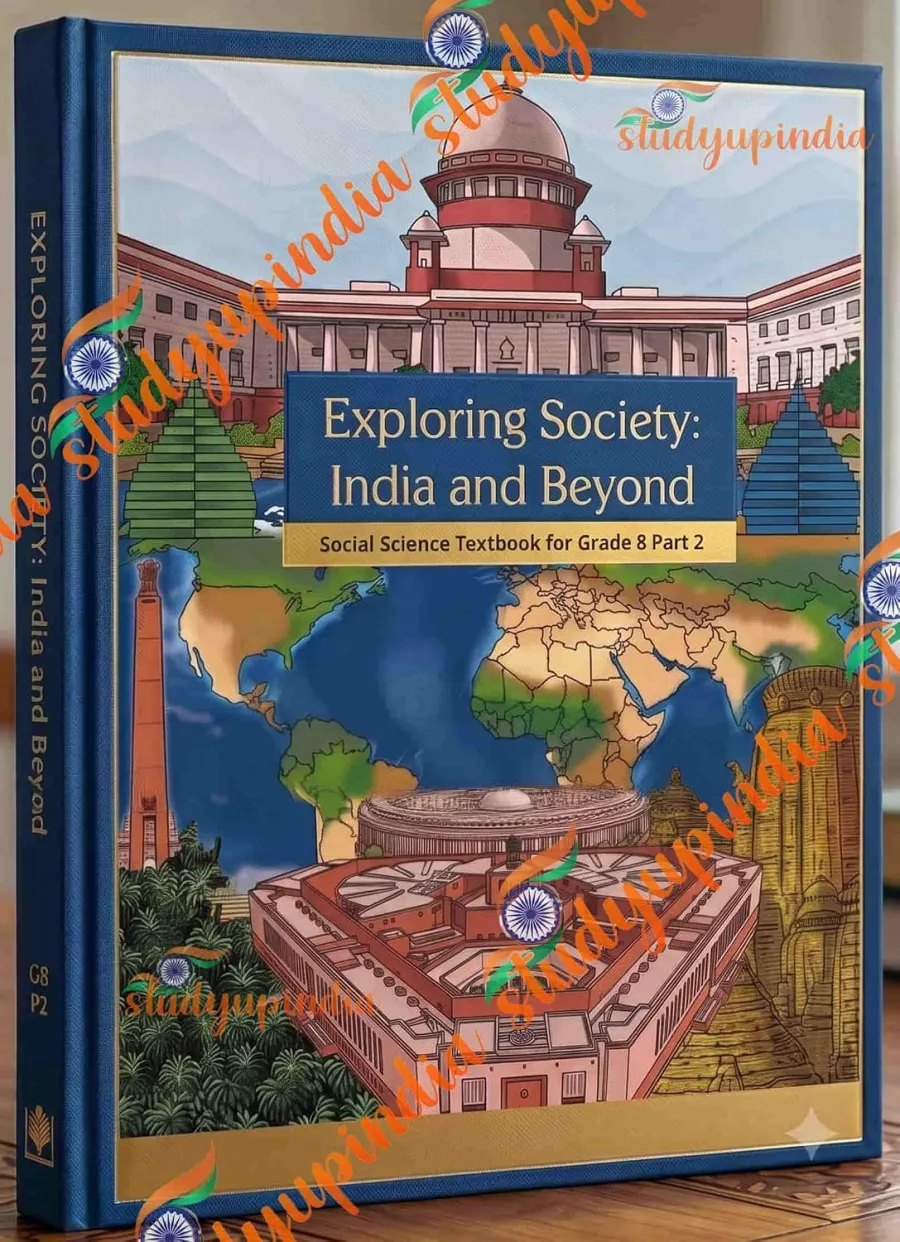
Download Cover Image
Do you want to download the full cover image for NCERT CLASS 8 Exploring Society – India and Beyond Textbook of Social Science for Grade Part 2 882?