
NCERT CLASS 9 Understanding Society – India and Beyond, Textbook of Social Science for Grade 9, Part
Paperback
• 260 Pages
• ₹ 175.00
• English
• 9789357291002
No ratings yet
| Publisher | National Council of Educational Research and Training |
|---|---|
| ISBN13 | 9789357291002 |
| ASIN/SKU | 9357291008 |
| Book Format | Paperback |
| Language | English |
| Pages | 260 |
| List Price | ₹ 175.00 |
| Publishing Date | 20/04/2026 |
| Dimensions | 22 x 28 x 2 cm |
| Weight | 600 g |
| Book Code | BD00067504 |
Buy this Book
Amazon Stores
Ebook Stores
Other Stores
Discover NCERT CLASS 9 Understanding Society – India and Beyond, Textbook of Social Science for Grade 9, Part by NCERT. This book is published by National Council of Educational Research and Training in Paperback format, ISBN 9789357291002, ASIN 9357291008, under School Books.
Book Description
NCERT CLASS 9 Understanding Society – India and Beyond, Textbook of Social Science for Grade 9, Part 1 908 (ENG MED) By Studyupindia.com
Author Biography
National Council of Educational Research and Training (NCERT)
Established in 1961 by the Government of India, the National Council of Educational Research and Training (NCERT) is the apex autonomous organization shaping the landscape of Indian school education. Its core mandate is to assist and advise the Central and State Governments on policies and academic programs designed to drive qualitative improvement in schooling across the nation.
The Institute
NCERT is the architectural cornerstone of India’s educational framework. It is globally recognized for developing the National Curriculum Framework (NCF) and publishing standardized, highly acclaimed textbooks used by millions of students in CBSE-affiliated and state-board schools. Beyond publishing, the institute is a hub of innovation. It conducts extensive educational research, develops supplementary learning materials, designs multimedia and digital resources, and pioneers new pedagogical methods. NCERT operates through a robust network of constituent units, including the National Institute of Education (NIE), the Central Institute of Educational Technology (CIET), and several Regional Institutes of Education (RIEs) located across the country.
The Team
The true strength of NCERT lies in its multidisciplinary team of eminent academicians, seasoned pedagogues, researchers, and subject-matter experts. This diverse faculty works collaboratively to bridge the gap between educational theory and everyday classroom practice. The team includes curriculum designers who align syllabi with modern national goals—such as the National Education Policy (NEP)—and master trainers who lead capacity-building and specialized training programs for teachers nationwide. Their rigorous, research-backed approach ensures that all educational materials remain inclusive, scientifically accurate, and developmentally appropriate.
Vision and Impact
Driven by a commitment to holistic, learner-centric, and equitable education, the NCERT team continuously adapts to meet contemporary global challenges. Through decades of relentless dedication, the institute has shaped the intellectual foundation of generations of Indians, remaining the gold standard for educational excellence and progressive learning ecosystems in the country.
Established in 1961 by the Government of India, the National Council of Educational Research and Training (NCERT) is the apex autonomous organization shaping the landscape of Indian school education. Its core mandate is to assist and advise the Central and State Governments on policies and academic programs designed to drive qualitative improvement in schooling across the nation.
The Institute
NCERT is the architectural cornerstone of India’s educational framework. It is globally recognized for developing the National Curriculum Framework (NCF) and publishing standardized, highly acclaimed textbooks used by millions of students in CBSE-affiliated and state-board schools. Beyond publishing, the institute is a hub of innovation. It conducts extensive educational research, develops supplementary learning materials, designs multimedia and digital resources, and pioneers new pedagogical methods. NCERT operates through a robust network of constituent units, including the National Institute of Education (NIE), the Central Institute of Educational Technology (CIET), and several Regional Institutes of Education (RIEs) located across the country.
The Team
The true strength of NCERT lies in its multidisciplinary team of eminent academicians, seasoned pedagogues, researchers, and subject-matter experts. This diverse faculty works collaboratively to bridge the gap between educational theory and everyday classroom practice. The team includes curriculum designers who align syllabi with modern national goals—such as the National Education Policy (NEP)—and master trainers who lead capacity-building and specialized training programs for teachers nationwide. Their rigorous, research-backed approach ensures that all educational materials remain inclusive, scientifically accurate, and developmentally appropriate.
Vision and Impact
Driven by a commitment to holistic, learner-centric, and equitable education, the NCERT team continuously adapts to meet contemporary global challenges. Through decades of relentless dedication, the institute has shaped the intellectual foundation of generations of Indians, remaining the gold standard for educational excellence and progressive learning ecosystems in the country.
Editorial Reviews
Editorial Reviews will be added soon…
Book Summary
Understanding Society: India and Beyond, Grade 9 – Part 1 is the new integrated Social Science textbook published by the National Council of Educational Research and Training (NCERT) for Grade 9 students. Unlike the older Class 9 arrangement, where History, Geography, Political Science, and Economics were taught through separate books, this textbook brings the four disciplines together in a single volume. The idea behind the book is to help students understand society as a connected whole rather than as four unrelated school subjects. The official NCERT ePathshala listing identifies nine chapters in Part 1, covering Social Science, geography, early human history, political systems, democracy, elections, and basic economic ideas.
The book begins by asking students to think about what Social Science actually means. Instead of treating the subject as a collection of facts to memorize, it introduces students to different ways of understanding human beings and the societies they create. Geography helps explain the relationship between people and the Earth, History helps us understand change over time, Political Science examines government and power, and Economics studies how people make choices when resources are limited. The book emphasizes that these areas overlap in real life. A change in climate can affect agriculture and markets; political decisions can influence economic opportunities; and historical events can shape present-day societies. This integrated approach encourages students to look for connections rather than studying every topic in isolation.
The second chapter, Shaping of the Earth's Surface, moves into geography and explains how the physical world around us is formed and transformed. Students are encouraged to understand landscapes not simply as things they see on a map but as the results of natural processes operating over long periods. The chapter introduces the idea that Earth's surface is continually changing and that mountains, valleys, plains, rivers, and other landforms have stories of their own. Understanding these processes helps students see how the physical environment influences human settlement, agriculture, transportation, and ways of life.
The third chapter, Atmosphere and Climate, continues the geographical exploration by focusing on the atmosphere and climate. Students learn about the conditions that shape weather and longer-term climate patterns and begin to understand why different parts of the world experience different environmental conditions. Climate is presented as something closely connected with human life. Rainfall, temperature, winds, and seasonal changes affect food production, water availability, settlement patterns, and economic activity. The chapter therefore connects geographical knowledge with everyday experiences and broader social questions.
The fourth chapter, Early Humans and Beginning of Civilisation, turns to history. It follows the development of human communities from early stages of human existence toward settled life and civilisation. The chapter encourages students to think about how humans adapted to their surroundings, developed tools, organized communities, and gradually changed their relationship with nature. The emergence of agriculture and settled societies becomes an important turning point because it affected food production, population, occupations, social organization, and the development of more complex communities. History here is not simply a list of rulers and dates; it is an attempt to understand how human societies developed.
The fifth chapter, State and Society up to 1000 CE, takes students deeper into the history of the Indian subcontinent. It examines how states and societies developed and changed over time, including important political, social, cultural, and intellectual developments. The chapter covers periods and traditions stretching from the Vedic period through the rise of the mahajanapadas and other major developments before 1000 CE. It asks questions about how political authority was organized, how societies were structured, and how different forms of culture and knowledge developed.
The sixth chapter introduces Democracy. Here the book shifts from the study of the past to the organization of political life in the present. Students are encouraged to understand democracy not merely as a system in which people vote, but as a broader idea involving participation, representation, decision-making, rights, responsibilities, and the relationship between citizens and institutions. The chapter helps students think about why societies need systems of governance and why the participation of citizens matters.
The seventh chapter, Elections, develops these ideas further. Elections are presented as an important mechanism through which citizens participate in democratic government. Students learn why elections are needed, how representatives are chosen, and how electoral processes connect citizens with political institutions. The subject also encourages students to think about the responsibilities of voters and the importance of informed participation. In this way, the chapter connects an institutional process with the everyday role of citizens.
The final two chapters introduce economics. Building Blocks in Economics: The Problem of Choice explains a basic economic reality: human wants are many, while available resources are limited. Because people cannot have everything they want at the same time, they must make choices. These choices involve priorities, alternatives, costs, and consequences. By beginning with such an ordinary experience, the book makes economics easier to understand and shows students that economic thinking is relevant to everyday decisions.
The ninth chapter, The Price Puzzle: What Drives the Market, explores how prices are influenced by the interaction of different forces in markets. Students begin to see that the price of a product does not appear randomly. It can be affected by demand, availability, production, consumer choices, and other market conditions. This provides an introduction to the way markets coordinate economic activity and helps students connect economic concepts with things they encounter in daily life.
Overall, Understanding Society: India and Beyond, Part 1 aims to make Social Science more connected, practical, and inquiry-based. Instead of asking students only to remember information, it encourages them to observe, question, compare, analyse, and relate ideas to the world around them. The nine chapters move from understanding the disciplines themselves to the Earth, climate, human history, Indian society, democracy, elections, choice, and markets. The result is a broad introduction to how people, places, institutions, resources, and historical developments influence one another. As a Grade 9 textbook, its larger purpose is not simply to prepare students for examinations but to give them a foundation for understanding society with greater curiosity, awareness, and critical thinking.
The book begins by asking students to think about what Social Science actually means. Instead of treating the subject as a collection of facts to memorize, it introduces students to different ways of understanding human beings and the societies they create. Geography helps explain the relationship between people and the Earth, History helps us understand change over time, Political Science examines government and power, and Economics studies how people make choices when resources are limited. The book emphasizes that these areas overlap in real life. A change in climate can affect agriculture and markets; political decisions can influence economic opportunities; and historical events can shape present-day societies. This integrated approach encourages students to look for connections rather than studying every topic in isolation.
The second chapter, Shaping of the Earth's Surface, moves into geography and explains how the physical world around us is formed and transformed. Students are encouraged to understand landscapes not simply as things they see on a map but as the results of natural processes operating over long periods. The chapter introduces the idea that Earth's surface is continually changing and that mountains, valleys, plains, rivers, and other landforms have stories of their own. Understanding these processes helps students see how the physical environment influences human settlement, agriculture, transportation, and ways of life.
The third chapter, Atmosphere and Climate, continues the geographical exploration by focusing on the atmosphere and climate. Students learn about the conditions that shape weather and longer-term climate patterns and begin to understand why different parts of the world experience different environmental conditions. Climate is presented as something closely connected with human life. Rainfall, temperature, winds, and seasonal changes affect food production, water availability, settlement patterns, and economic activity. The chapter therefore connects geographical knowledge with everyday experiences and broader social questions.
The fourth chapter, Early Humans and Beginning of Civilisation, turns to history. It follows the development of human communities from early stages of human existence toward settled life and civilisation. The chapter encourages students to think about how humans adapted to their surroundings, developed tools, organized communities, and gradually changed their relationship with nature. The emergence of agriculture and settled societies becomes an important turning point because it affected food production, population, occupations, social organization, and the development of more complex communities. History here is not simply a list of rulers and dates; it is an attempt to understand how human societies developed.
The fifth chapter, State and Society up to 1000 CE, takes students deeper into the history of the Indian subcontinent. It examines how states and societies developed and changed over time, including important political, social, cultural, and intellectual developments. The chapter covers periods and traditions stretching from the Vedic period through the rise of the mahajanapadas and other major developments before 1000 CE. It asks questions about how political authority was organized, how societies were structured, and how different forms of culture and knowledge developed.
The sixth chapter introduces Democracy. Here the book shifts from the study of the past to the organization of political life in the present. Students are encouraged to understand democracy not merely as a system in which people vote, but as a broader idea involving participation, representation, decision-making, rights, responsibilities, and the relationship between citizens and institutions. The chapter helps students think about why societies need systems of governance and why the participation of citizens matters.
The seventh chapter, Elections, develops these ideas further. Elections are presented as an important mechanism through which citizens participate in democratic government. Students learn why elections are needed, how representatives are chosen, and how electoral processes connect citizens with political institutions. The subject also encourages students to think about the responsibilities of voters and the importance of informed participation. In this way, the chapter connects an institutional process with the everyday role of citizens.
The final two chapters introduce economics. Building Blocks in Economics: The Problem of Choice explains a basic economic reality: human wants are many, while available resources are limited. Because people cannot have everything they want at the same time, they must make choices. These choices involve priorities, alternatives, costs, and consequences. By beginning with such an ordinary experience, the book makes economics easier to understand and shows students that economic thinking is relevant to everyday decisions.
The ninth chapter, The Price Puzzle: What Drives the Market, explores how prices are influenced by the interaction of different forces in markets. Students begin to see that the price of a product does not appear randomly. It can be affected by demand, availability, production, consumer choices, and other market conditions. This provides an introduction to the way markets coordinate economic activity and helps students connect economic concepts with things they encounter in daily life.
Overall, Understanding Society: India and Beyond, Part 1 aims to make Social Science more connected, practical, and inquiry-based. Instead of asking students only to remember information, it encourages them to observe, question, compare, analyse, and relate ideas to the world around them. The nine chapters move from understanding the disciplines themselves to the Earth, climate, human history, Indian society, democracy, elections, choice, and markets. The result is a broad introduction to how people, places, institutions, resources, and historical developments influence one another. As a Grade 9 textbook, its larger purpose is not simply to prepare students for examinations but to give them a foundation for understanding society with greater curiosity, awareness, and critical thinking.
Sample Chapters
Sample Chapters will be added soon…
Reader Reviews
No reviews yet.
NCERT CLASS 9 Understanding Society – India and Beyond, Textbook of Social Science for Grade 9, Part
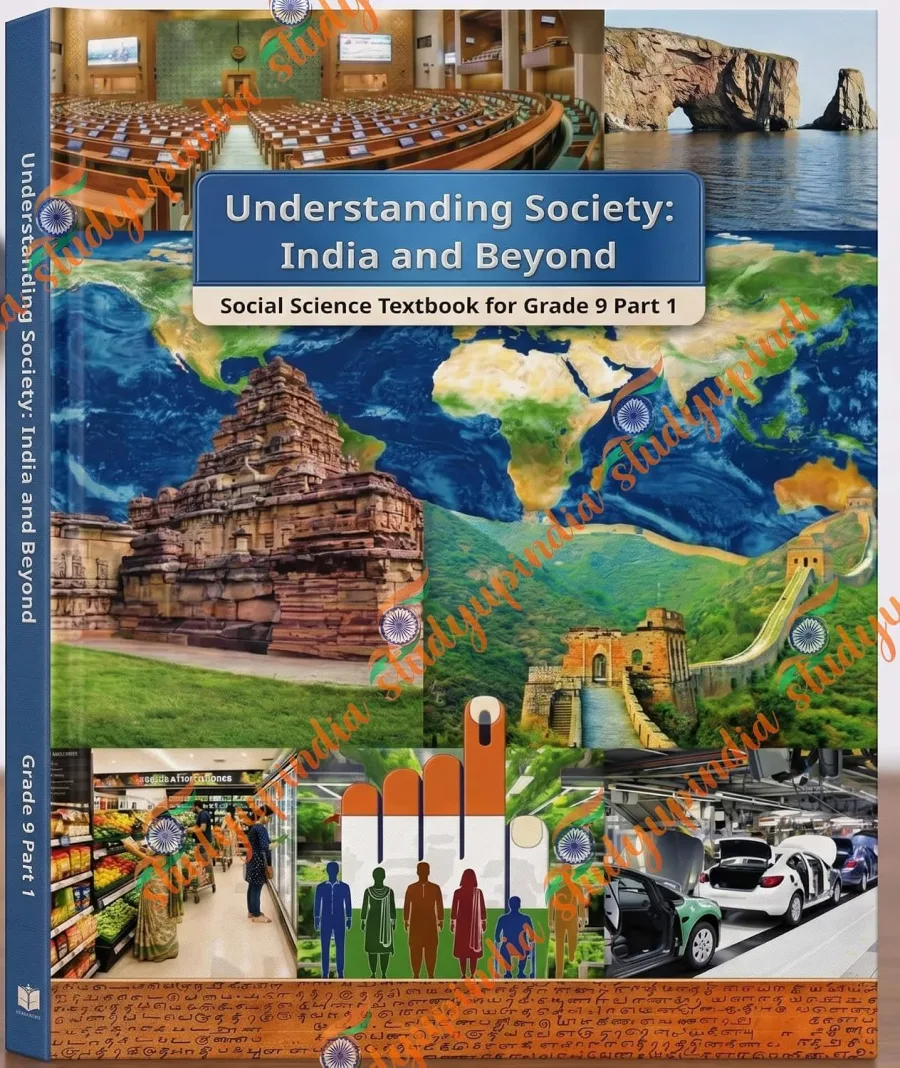
Download Cover Image
Do you want to download the full cover image for NCERT CLASS 9 Understanding Society – India and Beyond, Textbook of Social Science for Grade 9, Part?