
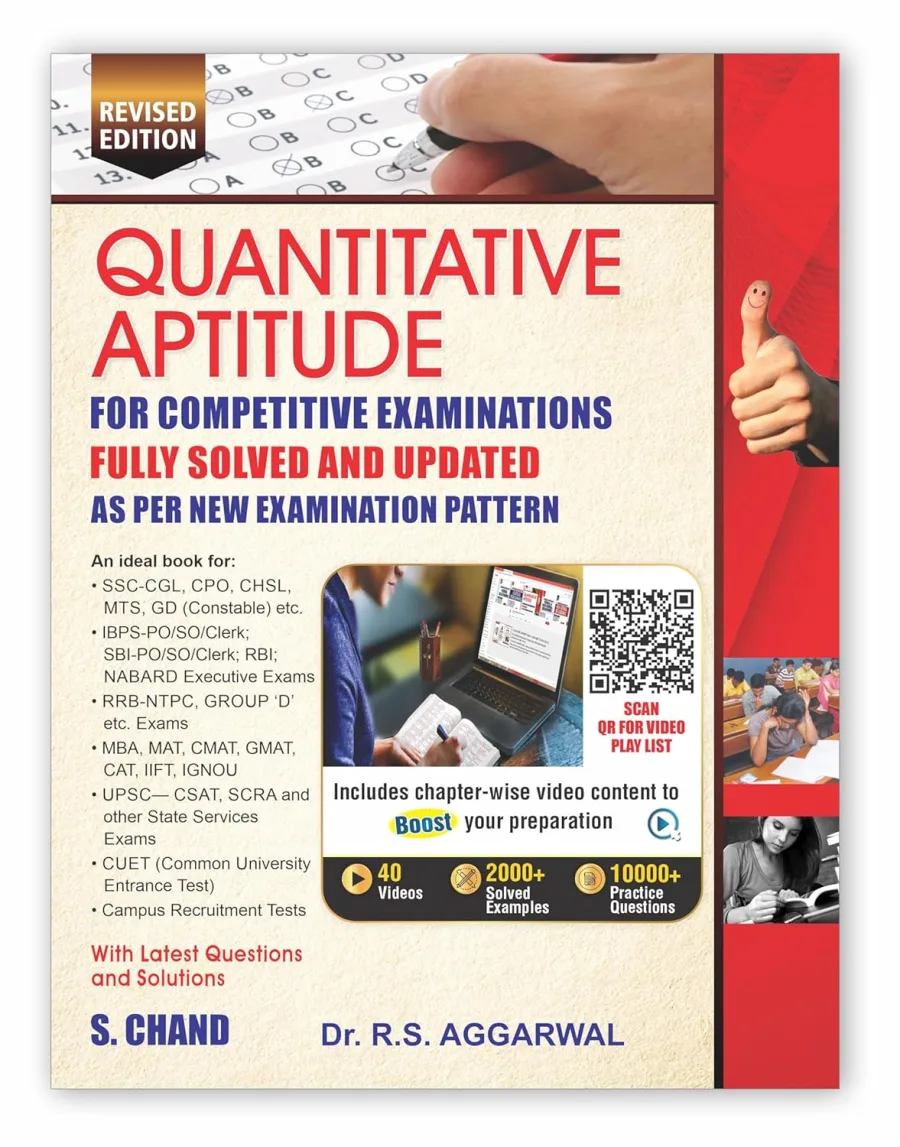
Quantitative Aptitude Book (New Edition 2026 - 2027): For All Competitive Examinations for Banking
Paperback
• 824 Pages
• INR 799.00
• English
• 9789358705010
No ratings yet
| Publisher | S Chand and Company Ltd |
|---|---|
| ISBN13 | 9789358705010 |
| ASIN/SKU | B0D6VFV3ZP |
| Book Format | Paperback |
| Language | English |
| Pages | 824 |
| List Price | INR 799.00 |
| Publishing Date | 20/09/2024 |
| Dimensions | 26.4 x 20.4 x 2.5 cm |
| Weight | 1 kg 280 g |
| Book Code | BD00066576 |
Buy this Book
Amazon Stores
Ebook Stores
Other Stores
Discover Quantitative Aptitude Book (New Edition 2026 - 2027): For All Competitive Examinations for Banking by Dr. R.S. Aggarwal. This book is published by S Chand and Company Ltd in Paperback format, ISBN 9789358705010, ASIN B0D6VFV3ZP, under School Books, CBSE Question Papers, CBSE Books.
Book Description
"Quantitative Aptitude for Competitive Examinations (Latest Edition 2024-2025)" by Dr. R.S. Aggarwal is a trusted resource for those aiming to excel in competitive exams. It covers arithmetic, algebra, geometry, data interpretation, and statistical analysis, providing comprehensive explanations, solved examples, and practice exercises. The book focuses on strategies, shortcuts, and problem-solving techniques to efficiently tackle quantitative aptitude questions, boosting problem-solving abilities and confidence. With its wide coverage and practical approach, it is an invaluable tool for success in quantitative aptitude sections of competitive exams.
What You’ll Find Inside:
✍ Comprehensive Coverage: Includes arithmetic, algebra, geometry, data interpretation, and statistical analysis.
✍ Detailed Explanations: Step-by-step solutions and thorough explanations.
✍ Practice and Preparation: Over 2000 solved examples and 10,000+ practice questions.
✍ Strategic Problem-Solving: Focuses on shortcuts and techniques for quick, accurate solutions.
✍ Supplementary Learning Tools: Includes 40 videos for visual and auditory learning.
✍ Confidence Building: Ample practice material to boost confidence and identify weak areas.
✍ Practical Approach: Real-life examples and applications of mathematical concepts.
✍ User-Friendly Layout: Organized for easy navigation from basic to advanced topics.
40 Videos | 2000+ Solved Examples | 10000+ Practice Questions
Useful For:
S Chand's Book for UPSC, SSC CHSL, GD, MTS, CGL, Railway, Police, IBPS, MBA, MAT, CMAT, RRB and Other Competitive Exams.
What You’ll Find Inside:
✍ Comprehensive Coverage: Includes arithmetic, algebra, geometry, data interpretation, and statistical analysis.
✍ Detailed Explanations: Step-by-step solutions and thorough explanations.
✍ Practice and Preparation: Over 2000 solved examples and 10,000+ practice questions.
✍ Strategic Problem-Solving: Focuses on shortcuts and techniques for quick, accurate solutions.
✍ Supplementary Learning Tools: Includes 40 videos for visual and auditory learning.
✍ Confidence Building: Ample practice material to boost confidence and identify weak areas.
✍ Practical Approach: Real-life examples and applications of mathematical concepts.
✍ User-Friendly Layout: Organized for easy navigation from basic to advanced topics.
40 Videos | 2000+ Solved Examples | 10000+ Practice Questions
Useful For:
S Chand's Book for UPSC, SSC CHSL, GD, MTS, CGL, Railway, Police, IBPS, MBA, MAT, CMAT, RRB and Other Competitive Exams.
Author Biography
Author Biography will be added soon…
Editorial Reviews
Editorial Reviews will be added soon…
Book Summary
Quantitative Aptitude for Competitive Examinations by Dr. R.S. Aggarwal is one of the most trusted and widely used mathematics books for competitive examination preparation in India. For decades, it has served as a standard reference for aspirants preparing for banking examinations such as IBPS PO, IBPS Clerk, SBI PO, SBI Clerk, RBI Assistant, NABARD, as well as SSC, Railways, UPSC, defence services, insurance, and numerous state-level recruitment examinations. The 2026–2027 edition has been updated to reflect current examination patterns while retaining its systematic approach, comprehensive coverage, and extensive practice material. Rather than functioning as a simple question bank, the book acts as a complete guide that helps readers understand mathematical concepts, develop logical thinking, and improve speed and accuracy in solving problems.
The primary objective of the book is to build a strong foundation in quantitative aptitude. Dr. Aggarwal believes that success in competitive examinations depends not only on memorizing formulas but also on understanding the reasoning behind mathematical concepts. Therefore, each chapter begins with clear explanations of fundamental principles before introducing formulas, shortcuts, solved examples, and practice exercises. This gradual progression allows beginners to strengthen their basics while enabling advanced learners to improve speed and problem-solving efficiency.
The book covers nearly every topic commonly tested in competitive examinations. Arithmetic forms the core of the syllabus, including subjects such as percentages, profit and loss, simple and compound interest, ratio and proportion, averages, partnership, mixtures and allegations, time and work, pipes and cisterns, time, speed and distance, boats and streams, and problems based on ages. These topics are explained using practical examples that connect mathematical concepts with everyday situations, making them easier to understand and remember.
Another major section focuses on algebra, geometry, mensuration, trigonometry, and coordinate geometry. Instead of presenting these subjects as highly theoretical, the author simplifies them through step-by-step explanations and carefully selected examples. Readers gradually learn how mathematical principles can be applied to solve objective-type questions efficiently under examination conditions. The book also includes topics such as permutations and combinations, probability, statistics, and data interpretation, which have become increasingly important in modern competitive examinations.
One of the greatest strengths of the book is its emphasis on problem-solving techniques. Every chapter contains a large number of solved examples that demonstrate different methods of approaching the same type of question. After understanding these examples, readers are provided with extensive unsolved exercises arranged from easy to difficult levels. This structure enables learners to build confidence gradually while improving both conceptual understanding and calculation speed. The wide variety of questions ensures that students become familiar with multiple examination patterns and difficulty levels.
The author also recognizes the importance of speed and accuracy, particularly for banking and government examinations where candidates must solve numerous questions within limited time. Throughout the book, readers are introduced to shortcut methods, approximation techniques, and logical strategies that reduce calculation time without sacrificing accuracy. However, Dr. Aggarwal consistently emphasizes that shortcuts should be used only after mastering the underlying concepts. Strong fundamentals remain the key to solving unfamiliar questions confidently.
Another notable feature is the book's organized presentation. Each chapter follows a consistent structure beginning with theoretical explanations, followed by illustrative examples, objective questions, multiple-choice exercises, and answer keys. This systematic arrangement makes the book suitable for self-study, classroom learning, and revision. Students can easily identify weak areas, practice specific topics repeatedly, and monitor their progress over time.
The book encourages logical thinking rather than mechanical memorization. Many questions require readers to analyze information carefully, identify relationships, eliminate incorrect options, and choose the most efficient solution. As a result, learners develop analytical reasoning alongside mathematical ability. This skill proves valuable not only in competitive examinations but also in higher education, professional work, and everyday decision-making.
Another important aspect of the book is its adaptability to different competitive examinations. Although banking examinations remain one of its primary audiences, the concepts and practice questions are equally useful for SSC, Railways, Insurance, Defence, MBA entrance tests, campus recruitment, and various public service examinations. Because quantitative aptitude forms a common component across many competitive tests, mastering the material in this book prepares students for a broad range of opportunities.
The 2026–2027 edition reflects changing examination trends by incorporating updated objective questions and practice exercises based on recent competitive exam patterns. The content has been revised to ensure continued relevance while preserving the clear explanations and extensive practice material that have made the book popular for decades. Aspirants therefore receive both conceptual learning and exposure to modern question formats.
One of the book's greatest strengths is its accessibility. The language is simple, direct, and suitable even for students who may not have a strong mathematical background. Difficult concepts are broken into smaller steps, making them less intimidating. Beginners can build confidence gradually, while experienced candidates can use the extensive exercises for intensive revision and timed practice. The clear presentation makes the book equally useful for independent learners and coaching institute students.
Beyond examination preparation, the book helps readers develop valuable life skills. Quantitative reasoning improves logical analysis, numerical confidence, decision-making, accuracy, and problem-solving ability. Everyday activities such as budgeting, financial planning, interpreting statistics, comparing data, and evaluating percentages become easier when mathematical thinking is strengthened. Thus, the knowledge gained from the book extends beyond examination success into practical daily life.
In conclusion, Quantitative Aptitude for Competitive Examinations (New Edition 2026–2027) by Dr. R.S. Aggarwal remains one of the most comprehensive and dependable guides for mastering quantitative aptitude. Through clear explanations, systematic organization, abundant solved examples, extensive practice exercises, and exam-oriented strategies, the book equips aspirants with both conceptual understanding and practical problem-solving skills. Its balanced focus on fundamentals, logical reasoning, speed, and accuracy makes it an indispensable resource for banking and other competitive examinations. More importantly, it encourages disciplined practice, analytical thinking, and confidence—qualities that contribute not only to examination success but also to lifelong mathematical competence.
The primary objective of the book is to build a strong foundation in quantitative aptitude. Dr. Aggarwal believes that success in competitive examinations depends not only on memorizing formulas but also on understanding the reasoning behind mathematical concepts. Therefore, each chapter begins with clear explanations of fundamental principles before introducing formulas, shortcuts, solved examples, and practice exercises. This gradual progression allows beginners to strengthen their basics while enabling advanced learners to improve speed and problem-solving efficiency.
The book covers nearly every topic commonly tested in competitive examinations. Arithmetic forms the core of the syllabus, including subjects such as percentages, profit and loss, simple and compound interest, ratio and proportion, averages, partnership, mixtures and allegations, time and work, pipes and cisterns, time, speed and distance, boats and streams, and problems based on ages. These topics are explained using practical examples that connect mathematical concepts with everyday situations, making them easier to understand and remember.
Another major section focuses on algebra, geometry, mensuration, trigonometry, and coordinate geometry. Instead of presenting these subjects as highly theoretical, the author simplifies them through step-by-step explanations and carefully selected examples. Readers gradually learn how mathematical principles can be applied to solve objective-type questions efficiently under examination conditions. The book also includes topics such as permutations and combinations, probability, statistics, and data interpretation, which have become increasingly important in modern competitive examinations.
One of the greatest strengths of the book is its emphasis on problem-solving techniques. Every chapter contains a large number of solved examples that demonstrate different methods of approaching the same type of question. After understanding these examples, readers are provided with extensive unsolved exercises arranged from easy to difficult levels. This structure enables learners to build confidence gradually while improving both conceptual understanding and calculation speed. The wide variety of questions ensures that students become familiar with multiple examination patterns and difficulty levels.
The author also recognizes the importance of speed and accuracy, particularly for banking and government examinations where candidates must solve numerous questions within limited time. Throughout the book, readers are introduced to shortcut methods, approximation techniques, and logical strategies that reduce calculation time without sacrificing accuracy. However, Dr. Aggarwal consistently emphasizes that shortcuts should be used only after mastering the underlying concepts. Strong fundamentals remain the key to solving unfamiliar questions confidently.
Another notable feature is the book's organized presentation. Each chapter follows a consistent structure beginning with theoretical explanations, followed by illustrative examples, objective questions, multiple-choice exercises, and answer keys. This systematic arrangement makes the book suitable for self-study, classroom learning, and revision. Students can easily identify weak areas, practice specific topics repeatedly, and monitor their progress over time.
The book encourages logical thinking rather than mechanical memorization. Many questions require readers to analyze information carefully, identify relationships, eliminate incorrect options, and choose the most efficient solution. As a result, learners develop analytical reasoning alongside mathematical ability. This skill proves valuable not only in competitive examinations but also in higher education, professional work, and everyday decision-making.
Another important aspect of the book is its adaptability to different competitive examinations. Although banking examinations remain one of its primary audiences, the concepts and practice questions are equally useful for SSC, Railways, Insurance, Defence, MBA entrance tests, campus recruitment, and various public service examinations. Because quantitative aptitude forms a common component across many competitive tests, mastering the material in this book prepares students for a broad range of opportunities.
The 2026–2027 edition reflects changing examination trends by incorporating updated objective questions and practice exercises based on recent competitive exam patterns. The content has been revised to ensure continued relevance while preserving the clear explanations and extensive practice material that have made the book popular for decades. Aspirants therefore receive both conceptual learning and exposure to modern question formats.
One of the book's greatest strengths is its accessibility. The language is simple, direct, and suitable even for students who may not have a strong mathematical background. Difficult concepts are broken into smaller steps, making them less intimidating. Beginners can build confidence gradually, while experienced candidates can use the extensive exercises for intensive revision and timed practice. The clear presentation makes the book equally useful for independent learners and coaching institute students.
Beyond examination preparation, the book helps readers develop valuable life skills. Quantitative reasoning improves logical analysis, numerical confidence, decision-making, accuracy, and problem-solving ability. Everyday activities such as budgeting, financial planning, interpreting statistics, comparing data, and evaluating percentages become easier when mathematical thinking is strengthened. Thus, the knowledge gained from the book extends beyond examination success into practical daily life.
In conclusion, Quantitative Aptitude for Competitive Examinations (New Edition 2026–2027) by Dr. R.S. Aggarwal remains one of the most comprehensive and dependable guides for mastering quantitative aptitude. Through clear explanations, systematic organization, abundant solved examples, extensive practice exercises, and exam-oriented strategies, the book equips aspirants with both conceptual understanding and practical problem-solving skills. Its balanced focus on fundamentals, logical reasoning, speed, and accuracy makes it an indispensable resource for banking and other competitive examinations. More importantly, it encourages disciplined practice, analytical thinking, and confidence—qualities that contribute not only to examination success but also to lifelong mathematical competence.
Sample Chapters
Sample Chapters will be added soon…
Reader Reviews
No reviews yet.
Quantitative Aptitude Book (New Edition 2026 - 2027): For All Competitive Examinations for Banking
Download Cover Image
Do you want to download the full cover image for Quantitative Aptitude Book (New Edition 2026 - 2027): For All Competitive Examinations for Banking?