
Harry Potter and the Philosopher's Stone
eBook
• 337 Pages
• ₹ 420.00
• English
• 9781781100219
No ratings yet
| Publisher | Pottermore Publishing |
|---|---|
| ISBN13 | 9781781100219 |
| ASIN/SKU | B019PIOJYU |
| Book Format | eBook |
| Language | English |
| Pages | 337 |
| List Price | ₹ 420.00 |
| Publishing Date | 08/12/2015 |
| Book Code | BD00066215 |
Buy this Book
Amazon Stores
Ebook Stores
Other Stores
Discover Harry Potter and the Philosopher's Stone by J.K. Rowling. This book is published by Pottermore Publishing in eBook format, ISBN 9781781100219, ASIN B019PIOJYU, under Children's Books, Children's Action and Adventure, Fantasy for Children.
Book Description
Turning the envelope over, his hand trembling, Harry saw a purple wax seal bearing a coat of arms; a lion, an eagle, a badger and a snake surrounding a large letter 'H'.
Harry Potter has never even heard of Hogwarts when the letters start dropping on the doormat at number four, Privet Drive. Addressed in green ink on yellowish parchment with a purple seal, they are swiftly confiscated by his grisly aunt and uncle. Then, on Harry's eleventh birthday, a great beetle-eyed giant of a man called Rubeus Hagrid bursts in with some astonishing news: Harry Potter is a wizard, and he has a place at Hogwarts School of Witchcraft and Wizardry. An incredible adventure is about to begin!
Having become classics of our time, the Harry Potter eBooks never fail to bring comfort and escapism. With their message of hope, belonging and the enduring power of truth and love, the story of the Boy Who Lived continues to delight generations of new readers.
Harry Potter has never even heard of Hogwarts when the letters start dropping on the doormat at number four, Privet Drive. Addressed in green ink on yellowish parchment with a purple seal, they are swiftly confiscated by his grisly aunt and uncle. Then, on Harry's eleventh birthday, a great beetle-eyed giant of a man called Rubeus Hagrid bursts in with some astonishing news: Harry Potter is a wizard, and he has a place at Hogwarts School of Witchcraft and Wizardry. An incredible adventure is about to begin!
Having become classics of our time, the Harry Potter eBooks never fail to bring comfort and escapism. With their message of hope, belonging and the enduring power of truth and love, the story of the Boy Who Lived continues to delight generations of new readers.
Author Biography
J.K. Rowling is the author of the enduringly popular, era-defining Harry Potter book series, as well as several stand-alone novels and a crime fiction series written under the pen name Robert Galbraith.
After the idea for Harry Potter came to her on a delayed train journey in 1990, she plotted out and wrote the series of seven books and the first, Harry Potter and the Philosopher's Stone, was published in the UK in 1997. Smash hit movie adaptations followed, with the last of the eight films, Deathly Hallows Part 2, released in 2011. The Harry Potter books have now sold over 600 million copies worldwide and been translated into over 80 languages. They continue to be discovered and loved by new generations of readers.
To accompany the Harry Potter series, J.K. Rowling wrote three short volumes for charity: Quidditch Through the Ages and Fantastic Beasts and Where to Find Them in aid of Comic Relief and Lumos; and The Tales of Beedle the Bard in aid of her non-profit children's organisation Lumos.
One of these companion volumes inspired the Fantastic Beasts film series, begun in 2016, with screenplays written or co-written by Rowling.
Also in 2016, she collaborated with playwright Jack Thorne and director John Tiffany to continue Harry's story in a stage play, Harry Potter and the Cursed Child.
J.K. Rowling's stand-alone novels include The Casual Vacancy, which was published in 2012. Writing under the pseudonym Robert Galbraith, she is the author of the highly acclaimed 'Strike' series, featuring private detectives Cormoran Strike and Robin Ellacott.
In 2020 she returned to publishing for younger children with her fairy tale The Ickabog, which was initially serialised for free online for children during the Covid-19 pandemic. The Christmas Pig, an adventure story about a boy's love for his most treasured toy and how far he will go to find it, was published in 2021 and was a bestseller in the UK, USA and Europe.
As well as receiving an OBE and Companion of Honour for services to children's literature, J. K. Rowling has received many other awards and honours, including France's Legion d'Honneur, Spain's Prince of Asturias Award and Denmark's Hans Christian Andersen Award. In 2020, Jo received a British Book Award, recognising Harry Potter and the Philosopher's Stone as the most important book of the last thirty years.
She supports humanitarian causes through her charitable trust, Volant, and is also the founder and president of Lumos, an international children's charity fighting for every child's right to a family by transforming care systems around the world.
After the idea for Harry Potter came to her on a delayed train journey in 1990, she plotted out and wrote the series of seven books and the first, Harry Potter and the Philosopher's Stone, was published in the UK in 1997. Smash hit movie adaptations followed, with the last of the eight films, Deathly Hallows Part 2, released in 2011. The Harry Potter books have now sold over 600 million copies worldwide and been translated into over 80 languages. They continue to be discovered and loved by new generations of readers.
To accompany the Harry Potter series, J.K. Rowling wrote three short volumes for charity: Quidditch Through the Ages and Fantastic Beasts and Where to Find Them in aid of Comic Relief and Lumos; and The Tales of Beedle the Bard in aid of her non-profit children's organisation Lumos.
One of these companion volumes inspired the Fantastic Beasts film series, begun in 2016, with screenplays written or co-written by Rowling.
Also in 2016, she collaborated with playwright Jack Thorne and director John Tiffany to continue Harry's story in a stage play, Harry Potter and the Cursed Child.
J.K. Rowling's stand-alone novels include The Casual Vacancy, which was published in 2012. Writing under the pseudonym Robert Galbraith, she is the author of the highly acclaimed 'Strike' series, featuring private detectives Cormoran Strike and Robin Ellacott.
In 2020 she returned to publishing for younger children with her fairy tale The Ickabog, which was initially serialised for free online for children during the Covid-19 pandemic. The Christmas Pig, an adventure story about a boy's love for his most treasured toy and how far he will go to find it, was published in 2021 and was a bestseller in the UK, USA and Europe.
As well as receiving an OBE and Companion of Honour for services to children's literature, J. K. Rowling has received many other awards and honours, including France's Legion d'Honneur, Spain's Prince of Asturias Award and Denmark's Hans Christian Andersen Award. In 2020, Jo received a British Book Award, recognising Harry Potter and the Philosopher's Stone as the most important book of the last thirty years.
She supports humanitarian causes through her charitable trust, Volant, and is also the founder and president of Lumos, an international children's charity fighting for every child's right to a family by transforming care systems around the world.
Editorial Reviews
'I can honestly say I can't remember the last time I encountered an author who has had this effect on me. For the first time in years the book lives up to the hype ... perfection' Daily Express 'Extraordinarily vivid and exceptionally well-imagined' Independent on Sunday 'Rowling deserves all the plaudits that are being heaped upon her. For once, the word phenomenon is an understatement' Scotland on Sunday 'The most remarkable publishing sensation for a generation ... the story is told with such momentum, imagination and irrepressible humour that it can captivate both adults and children' Sunday Express
Book Summary
Harry Potter and the Philosopher's Stone by J.K. Rowling is one of the most celebrated fantasy novels of modern literature and the first book in the globally popular Harry Potter series. First published in 1997, the novel introduces readers to Harry Potter, a seemingly ordinary boy who discovers that he is actually a wizard and that his life is connected to one of the darkest figures in the magical world.
Blending fantasy, adventure, mystery, friendship, coming-of-age, humor, and magical storytelling, the novel takes readers into an imaginative world filled with spells, enchanted objects, magical creatures, wizarding schools, secret passages, flying broomsticks, and hidden dangers. Yet beneath its magical surface, the story is deeply human. It explores loneliness, belonging, courage, friendship, identity, family, prejudice, temptation, and the importance of personal choices.
The extraordinary appeal of Harry Potter and the Philosopher's Stone comes from the way Rowling combines a richly imagined magical world with emotions that readers of almost any age can recognize.
The Story of Harry Potter
At the beginning of the novel, Harry Potter is an unhappy young boy living with his aunt, uncle, and cousin, the Dursleys. His parents died when he was an infant, and Harry has grown up without knowing much about them. The Dursleys treat him as an unwanted member of the household, and he is made to feel that he is strange, troublesome, and unimportant.
Harry has no idea that his life is about to change completely.
Shortly before his eleventh birthday, mysterious letters begin arriving for him. His uncle attempts to prevent Harry from reading them, but eventually a giant named Hagrid arrives and reveals the truth: Harry is a wizard.
Even more astonishingly, Harry is already famous in the wizarding world.
His parents were also wizards, and they were killed by the powerful dark wizard Lord Voldemort. Voldemort attempted to kill Harry as a baby, but the attack failed. Harry survived, while Voldemort lost his physical power.
The lightning-shaped scar on Harry's forehead is the visible reminder of that extraordinary night.
For Harry, learning that he is a wizard is not simply an exciting discovery. It gives him the opportunity to understand his parents, his own identity, and the mysterious past that has been hidden from him.
Entering the Wizarding World
Harry's admission to Hogwarts School of Witchcraft and Wizardry marks the beginning of his real adventure.
For the first time, he enters a place where the things that made him seem different in his previous life are completely normal. Magic is part of everyday existence. Students study spells and potions, travel by magical means, play Quidditch, encounter enchanted objects, and learn about a history that is completely different from the ordinary world.
Hogwarts quickly becomes much more than a school for Harry. It becomes a place where he begins to feel that he belongs.
He also discovers that being famous does not necessarily make life easier. Many people know his name, but Harry still has to discover who he really is for himself.
Harry, Ron, and Hermione
One of the greatest strengths of the novel is the friendship between Harry Potter, Ron Weasley, and Hermione Granger.
Harry meets Ron during his journey to Hogwarts, and the two quickly develop a close friendship. Ron comes from a large wizarding family and brings humor, warmth, and loyalty to the group.
Hermione initially appears very different from the two boys. She is exceptionally intelligent, hardworking, well-read, and determined to follow the rules. At first, the three do not immediately become close friends, but circumstances gradually bring them together.
Their friendship becomes one of the central forces of the story.
Harry provides courage and determination. Ron contributes loyalty and emotional strength. Hermione brings knowledge, logic, and resourcefulness. Their different qualities complement one another, showing that people do not need to be alike to form a strong friendship.
The novel repeatedly demonstrates that courage becomes more powerful when people stand together.
The Mystery of the Philosopher's Stone
The central mystery of the novel concerns the Philosopher's Stone, a magical object with extraordinary powers.
Harry and his friends gradually discover that the Stone is being protected inside Hogwarts. They also begin to suspect that someone is attempting to steal it.
What begins as curiosity eventually becomes a serious adventure.
Harry, Ron, and Hermione follow clues, investigate suspicious events, and discover that the secrets surrounding the Stone may be connected to Voldemort.
Their investigation takes them through a series of magical challenges. Each challenge tests a different quality: knowledge, logic, courage, loyalty, and self-sacrifice.
The mystery therefore becomes more than a traditional adventure. It becomes a test of the characters themselves.
Good and Evil
The conflict between good and evil is one of the novel's most recognizable themes.
Lord Voldemort represents the destructive pursuit of power and immortality. His desire to control others and overcome death contrasts with Harry's gradual understanding that power is not what defines a person's worth.
However, Rowling does not present every character in simple terms.
The novel encourages readers to question appearances. Some characters who initially seem frightening may have more complicated motivations, while others who appear trustworthy may not be as straightforward as they seem.
This creates one of the book's important moral ideas: a person's character is shaped by choices, not simply by reputation, background, or ability.
The Importance of Choice
Harry's journey is fundamentally a story about choice.
He has inherited a complicated history. His parents were famous, Voldemort has a connection to him, and many people already have expectations about who Harry is supposed to be.
Yet Harry gradually discovers that he can decide what kind of person he wants to become.
This idea is particularly important in a coming-of-age story. Harry cannot control everything that has happened to him, but he can control how he responds to it.
The novel therefore suggests that identity is not simply something we inherit. It is something we create through our decisions.
Friendship as a Source of Strength
Friendship is arguably the emotional heart of Harry Potter and the Philosopher's Stone.
Harry begins the story almost completely alone. He has little affection or encouragement from the people raising him. At Hogwarts, however, he discovers the value of genuine friendship.
Ron and Hermione are not simply companions for his adventures. They become people who challenge him, support him, argue with him, and stand beside him when things become dangerous.
Their relationship demonstrates that friendship involves more than having fun together. True friendship requires loyalty, trust, honesty, and sometimes the courage to make sacrifices for someone else.
The book's message about friendship is one reason it continues to resonate strongly with younger readers.
Family and Belonging
Family is another important theme.
Harry's childhood with the Dursleys shows what it feels like to live in a place where you are technically part of a family but do not feel loved or accepted.
Hogwarts offers him something different. Through his friendships, teachers, and connections with the wizarding community, Harry begins to discover a sense of belonging.
The novel therefore suggests that family is not always defined solely by blood. The people who care for us, believe in us, and stand beside us can become just as important.
This emotional idea gives the fantasy story a strong human foundation.
Harry's Search for Identity
At the beginning of the book, Harry does not know who he is.
He knows only the version of himself that the Dursleys have created: an unwanted boy who lives under the stairs and is expected to stay out of the way.
The wizarding world gives him another identity. Suddenly he is famous, talented, and connected to a remarkable history.
But Harry eventually learns that neither identity completely defines him.
His true character is revealed through what he chooses to do.
This makes the novel an effective coming-of-age story. Harry is not simply learning magic; he is learning about himself.
The Magical World of Hogwarts
One of Rowling's greatest achievements is the creation of Hogwarts and the larger wizarding world.
Hogwarts feels like a place with its own history, traditions, rules, personalities, mysteries, and secrets. Moving staircases, enchanted paintings, magical classrooms, hidden rooms, ghosts, mythical creatures, and Quidditch matches make the school feel alive.
The setting encourages readers to imagine what it would be like to receive a Hogwarts letter, purchase school supplies in the magical world, travel to school on the Hogwarts Express, and attend classes in magic.
This imaginative richness is one of the novel's greatest strengths.
The magical world is not simply decorative. It creates the environment through which Harry discovers friendship, danger, responsibility, and his own identity.
Courage Does Not Mean Having No Fear
Harry is often described as brave, but the novel presents an important distinction between bravery and fearlessness.
Harry experiences fear repeatedly.
What makes him courageous is his willingness to act despite that fear.
Ron and Hermione also have moments when they are frightened but choose to continue. Their courage becomes especially meaningful because they understand the risks involved.
The novel therefore presents courage as a decision rather than a personality trait. A person does not have to be fearless to be brave.
The Meaning of the Philosopher's Stone
The Philosopher's Stone itself represents the temptation of extraordinary power.
Its connection with wealth, transformation, and the possibility of defeating death makes it extremely desirable. Yet the story raises an important question: What would a person do if they had access to something that could radically change their life?
The Stone becomes part of the larger conflict between those who seek power for selfish reasons and those who understand that some things should not be possessed simply because they can be obtained.
Through this, the novel explores ambition and the dangers of allowing the desire for power to overcome moral judgment.
Why the Story Continues to Appeal to Readers
The enduring popularity of Harry Potter and the Philosopher's Stone comes from its combination of fantasy and emotional realism.
The magic is extraordinary, but the emotions are familiar.
Harry's loneliness is real.
Ron's insecurity is real.
Hermione's desire to prove herself is real.
The fear of being different is real.
The need for friendship and acceptance is real.
The excitement of discovering a new world is something almost every reader can understand.
The fantasy therefore becomes a way of exploring ordinary human experiences from an extraordinary perspective.
A Book for Young Readers and Adults
Although the novel is often categorized as children's or young adult fantasy, its themes have a much wider appeal.
Young readers may be drawn to the magic, school adventures, Quidditch, friendship, and mystery. Older readers may appreciate the deeper ideas about identity, morality, loneliness, family, power, and choice.
The book also works as an introduction to longer fantasy series because its first story is relatively self-contained while establishing a much larger world and a continuing conflict.
Why Read Harry Potter and the Philosopher's Stone?
This novel is especially suitable for readers who enjoy:
Fantasy novels and magical worlds
Young adult and children's literature
Adventure and mystery stories
Coming-of-age fiction
Stories about friendship and loyalty
School-based fantasy
Magical creatures and spells
Good-versus-evil adventures
Stories about courage and self-discovery
Fiction involving secret identities and hidden histories
Books with strong imaginative world-building
Long-running fantasy series
It is also an excellent starting point for readers who want to explore the complete Harry Potter series, because it introduces the principal characters, magical institutions, major themes, and central conflict that develop throughout the later books.
Final Thoughts
Harry Potter and the Philosopher's Stone is ultimately a story about discovering where you belong and deciding who you want to become.
Harry begins life believing that he is ordinary and unwanted. Then he discovers that he belongs to an entirely different world. But becoming a wizard does not magically solve all his problems. Instead, it gives him new questions, new responsibilities, new friendships, and new dangers.
His journey through Hogwarts introduces him to magic, but more importantly, it introduces him to friendship and courage.
J.K. Rowling's storytelling succeeds because the magical elements never overwhelm the human story. The spells, enchanted objects, flying broomsticks, magical creatures, and mysterious castle provide wonder and excitement, but the emotional core remains simple and powerful: a lonely child discovers friendship, finds a place where he belongs, learns about his past, and begins to understand the importance of his own choices.
That combination of fantasy, adventure, mystery, friendship, humor, and emotional storytelling makes Harry Potter and the Philosopher's Stone much more than an entertaining children's novel. It is a coming-of-age story about identity, belonging, courage, and the people who help us discover our own strength.
For readers searching for Harry Potter and the Philosopher's Stone, Harry Potter first book, J.K. Rowling books, Harry Potter fantasy novel, Harry Potter story, Harry Potter summary, Hogwarts fantasy, magical school books, children's fantasy novels, young adult fantasy books, books about friendship and magic, fantasy adventure novels, or the beginning of the Harry Potter series, this book remains one of the defining works of modern popular fantasy.
Its greatest invitation is simple: imagine receiving a mysterious letter, discovering that another world exists alongside your own, and finding out that you have a place in it.
That is where Harry's adventure begins—and where one of the most influential fantasy journeys in contemporary literature starts.
Blending fantasy, adventure, mystery, friendship, coming-of-age, humor, and magical storytelling, the novel takes readers into an imaginative world filled with spells, enchanted objects, magical creatures, wizarding schools, secret passages, flying broomsticks, and hidden dangers. Yet beneath its magical surface, the story is deeply human. It explores loneliness, belonging, courage, friendship, identity, family, prejudice, temptation, and the importance of personal choices.
The extraordinary appeal of Harry Potter and the Philosopher's Stone comes from the way Rowling combines a richly imagined magical world with emotions that readers of almost any age can recognize.
The Story of Harry Potter
At the beginning of the novel, Harry Potter is an unhappy young boy living with his aunt, uncle, and cousin, the Dursleys. His parents died when he was an infant, and Harry has grown up without knowing much about them. The Dursleys treat him as an unwanted member of the household, and he is made to feel that he is strange, troublesome, and unimportant.
Harry has no idea that his life is about to change completely.
Shortly before his eleventh birthday, mysterious letters begin arriving for him. His uncle attempts to prevent Harry from reading them, but eventually a giant named Hagrid arrives and reveals the truth: Harry is a wizard.
Even more astonishingly, Harry is already famous in the wizarding world.
His parents were also wizards, and they were killed by the powerful dark wizard Lord Voldemort. Voldemort attempted to kill Harry as a baby, but the attack failed. Harry survived, while Voldemort lost his physical power.
The lightning-shaped scar on Harry's forehead is the visible reminder of that extraordinary night.
For Harry, learning that he is a wizard is not simply an exciting discovery. It gives him the opportunity to understand his parents, his own identity, and the mysterious past that has been hidden from him.
Entering the Wizarding World
Harry's admission to Hogwarts School of Witchcraft and Wizardry marks the beginning of his real adventure.
For the first time, he enters a place where the things that made him seem different in his previous life are completely normal. Magic is part of everyday existence. Students study spells and potions, travel by magical means, play Quidditch, encounter enchanted objects, and learn about a history that is completely different from the ordinary world.
Hogwarts quickly becomes much more than a school for Harry. It becomes a place where he begins to feel that he belongs.
He also discovers that being famous does not necessarily make life easier. Many people know his name, but Harry still has to discover who he really is for himself.
Harry, Ron, and Hermione
One of the greatest strengths of the novel is the friendship between Harry Potter, Ron Weasley, and Hermione Granger.
Harry meets Ron during his journey to Hogwarts, and the two quickly develop a close friendship. Ron comes from a large wizarding family and brings humor, warmth, and loyalty to the group.
Hermione initially appears very different from the two boys. She is exceptionally intelligent, hardworking, well-read, and determined to follow the rules. At first, the three do not immediately become close friends, but circumstances gradually bring them together.
Their friendship becomes one of the central forces of the story.
Harry provides courage and determination. Ron contributes loyalty and emotional strength. Hermione brings knowledge, logic, and resourcefulness. Their different qualities complement one another, showing that people do not need to be alike to form a strong friendship.
The novel repeatedly demonstrates that courage becomes more powerful when people stand together.
The Mystery of the Philosopher's Stone
The central mystery of the novel concerns the Philosopher's Stone, a magical object with extraordinary powers.
Harry and his friends gradually discover that the Stone is being protected inside Hogwarts. They also begin to suspect that someone is attempting to steal it.
What begins as curiosity eventually becomes a serious adventure.
Harry, Ron, and Hermione follow clues, investigate suspicious events, and discover that the secrets surrounding the Stone may be connected to Voldemort.
Their investigation takes them through a series of magical challenges. Each challenge tests a different quality: knowledge, logic, courage, loyalty, and self-sacrifice.
The mystery therefore becomes more than a traditional adventure. It becomes a test of the characters themselves.
Good and Evil
The conflict between good and evil is one of the novel's most recognizable themes.
Lord Voldemort represents the destructive pursuit of power and immortality. His desire to control others and overcome death contrasts with Harry's gradual understanding that power is not what defines a person's worth.
However, Rowling does not present every character in simple terms.
The novel encourages readers to question appearances. Some characters who initially seem frightening may have more complicated motivations, while others who appear trustworthy may not be as straightforward as they seem.
This creates one of the book's important moral ideas: a person's character is shaped by choices, not simply by reputation, background, or ability.
The Importance of Choice
Harry's journey is fundamentally a story about choice.
He has inherited a complicated history. His parents were famous, Voldemort has a connection to him, and many people already have expectations about who Harry is supposed to be.
Yet Harry gradually discovers that he can decide what kind of person he wants to become.
This idea is particularly important in a coming-of-age story. Harry cannot control everything that has happened to him, but he can control how he responds to it.
The novel therefore suggests that identity is not simply something we inherit. It is something we create through our decisions.
Friendship as a Source of Strength
Friendship is arguably the emotional heart of Harry Potter and the Philosopher's Stone.
Harry begins the story almost completely alone. He has little affection or encouragement from the people raising him. At Hogwarts, however, he discovers the value of genuine friendship.
Ron and Hermione are not simply companions for his adventures. They become people who challenge him, support him, argue with him, and stand beside him when things become dangerous.
Their relationship demonstrates that friendship involves more than having fun together. True friendship requires loyalty, trust, honesty, and sometimes the courage to make sacrifices for someone else.
The book's message about friendship is one reason it continues to resonate strongly with younger readers.
Family and Belonging
Family is another important theme.
Harry's childhood with the Dursleys shows what it feels like to live in a place where you are technically part of a family but do not feel loved or accepted.
Hogwarts offers him something different. Through his friendships, teachers, and connections with the wizarding community, Harry begins to discover a sense of belonging.
The novel therefore suggests that family is not always defined solely by blood. The people who care for us, believe in us, and stand beside us can become just as important.
This emotional idea gives the fantasy story a strong human foundation.
Harry's Search for Identity
At the beginning of the book, Harry does not know who he is.
He knows only the version of himself that the Dursleys have created: an unwanted boy who lives under the stairs and is expected to stay out of the way.
The wizarding world gives him another identity. Suddenly he is famous, talented, and connected to a remarkable history.
But Harry eventually learns that neither identity completely defines him.
His true character is revealed through what he chooses to do.
This makes the novel an effective coming-of-age story. Harry is not simply learning magic; he is learning about himself.
The Magical World of Hogwarts
One of Rowling's greatest achievements is the creation of Hogwarts and the larger wizarding world.
Hogwarts feels like a place with its own history, traditions, rules, personalities, mysteries, and secrets. Moving staircases, enchanted paintings, magical classrooms, hidden rooms, ghosts, mythical creatures, and Quidditch matches make the school feel alive.
The setting encourages readers to imagine what it would be like to receive a Hogwarts letter, purchase school supplies in the magical world, travel to school on the Hogwarts Express, and attend classes in magic.
This imaginative richness is one of the novel's greatest strengths.
The magical world is not simply decorative. It creates the environment through which Harry discovers friendship, danger, responsibility, and his own identity.
Courage Does Not Mean Having No Fear
Harry is often described as brave, but the novel presents an important distinction between bravery and fearlessness.
Harry experiences fear repeatedly.
What makes him courageous is his willingness to act despite that fear.
Ron and Hermione also have moments when they are frightened but choose to continue. Their courage becomes especially meaningful because they understand the risks involved.
The novel therefore presents courage as a decision rather than a personality trait. A person does not have to be fearless to be brave.
The Meaning of the Philosopher's Stone
The Philosopher's Stone itself represents the temptation of extraordinary power.
Its connection with wealth, transformation, and the possibility of defeating death makes it extremely desirable. Yet the story raises an important question: What would a person do if they had access to something that could radically change their life?
The Stone becomes part of the larger conflict between those who seek power for selfish reasons and those who understand that some things should not be possessed simply because they can be obtained.
Through this, the novel explores ambition and the dangers of allowing the desire for power to overcome moral judgment.
Why the Story Continues to Appeal to Readers
The enduring popularity of Harry Potter and the Philosopher's Stone comes from its combination of fantasy and emotional realism.
The magic is extraordinary, but the emotions are familiar.
Harry's loneliness is real.
Ron's insecurity is real.
Hermione's desire to prove herself is real.
The fear of being different is real.
The need for friendship and acceptance is real.
The excitement of discovering a new world is something almost every reader can understand.
The fantasy therefore becomes a way of exploring ordinary human experiences from an extraordinary perspective.
A Book for Young Readers and Adults
Although the novel is often categorized as children's or young adult fantasy, its themes have a much wider appeal.
Young readers may be drawn to the magic, school adventures, Quidditch, friendship, and mystery. Older readers may appreciate the deeper ideas about identity, morality, loneliness, family, power, and choice.
The book also works as an introduction to longer fantasy series because its first story is relatively self-contained while establishing a much larger world and a continuing conflict.
Why Read Harry Potter and the Philosopher's Stone?
This novel is especially suitable for readers who enjoy:
Fantasy novels and magical worlds
Young adult and children's literature
Adventure and mystery stories
Coming-of-age fiction
Stories about friendship and loyalty
School-based fantasy
Magical creatures and spells
Good-versus-evil adventures
Stories about courage and self-discovery
Fiction involving secret identities and hidden histories
Books with strong imaginative world-building
Long-running fantasy series
It is also an excellent starting point for readers who want to explore the complete Harry Potter series, because it introduces the principal characters, magical institutions, major themes, and central conflict that develop throughout the later books.
Final Thoughts
Harry Potter and the Philosopher's Stone is ultimately a story about discovering where you belong and deciding who you want to become.
Harry begins life believing that he is ordinary and unwanted. Then he discovers that he belongs to an entirely different world. But becoming a wizard does not magically solve all his problems. Instead, it gives him new questions, new responsibilities, new friendships, and new dangers.
His journey through Hogwarts introduces him to magic, but more importantly, it introduces him to friendship and courage.
J.K. Rowling's storytelling succeeds because the magical elements never overwhelm the human story. The spells, enchanted objects, flying broomsticks, magical creatures, and mysterious castle provide wonder and excitement, but the emotional core remains simple and powerful: a lonely child discovers friendship, finds a place where he belongs, learns about his past, and begins to understand the importance of his own choices.
That combination of fantasy, adventure, mystery, friendship, humor, and emotional storytelling makes Harry Potter and the Philosopher's Stone much more than an entertaining children's novel. It is a coming-of-age story about identity, belonging, courage, and the people who help us discover our own strength.
For readers searching for Harry Potter and the Philosopher's Stone, Harry Potter first book, J.K. Rowling books, Harry Potter fantasy novel, Harry Potter story, Harry Potter summary, Hogwarts fantasy, magical school books, children's fantasy novels, young adult fantasy books, books about friendship and magic, fantasy adventure novels, or the beginning of the Harry Potter series, this book remains one of the defining works of modern popular fantasy.
Its greatest invitation is simple: imagine receiving a mysterious letter, discovering that another world exists alongside your own, and finding out that you have a place in it.
That is where Harry's adventure begins—and where one of the most influential fantasy journeys in contemporary literature starts.
Sample Chapters
Sample Chapters will be added soon…
Reader Reviews
No reviews yet.
Harry Potter and the Philosopher's Stone
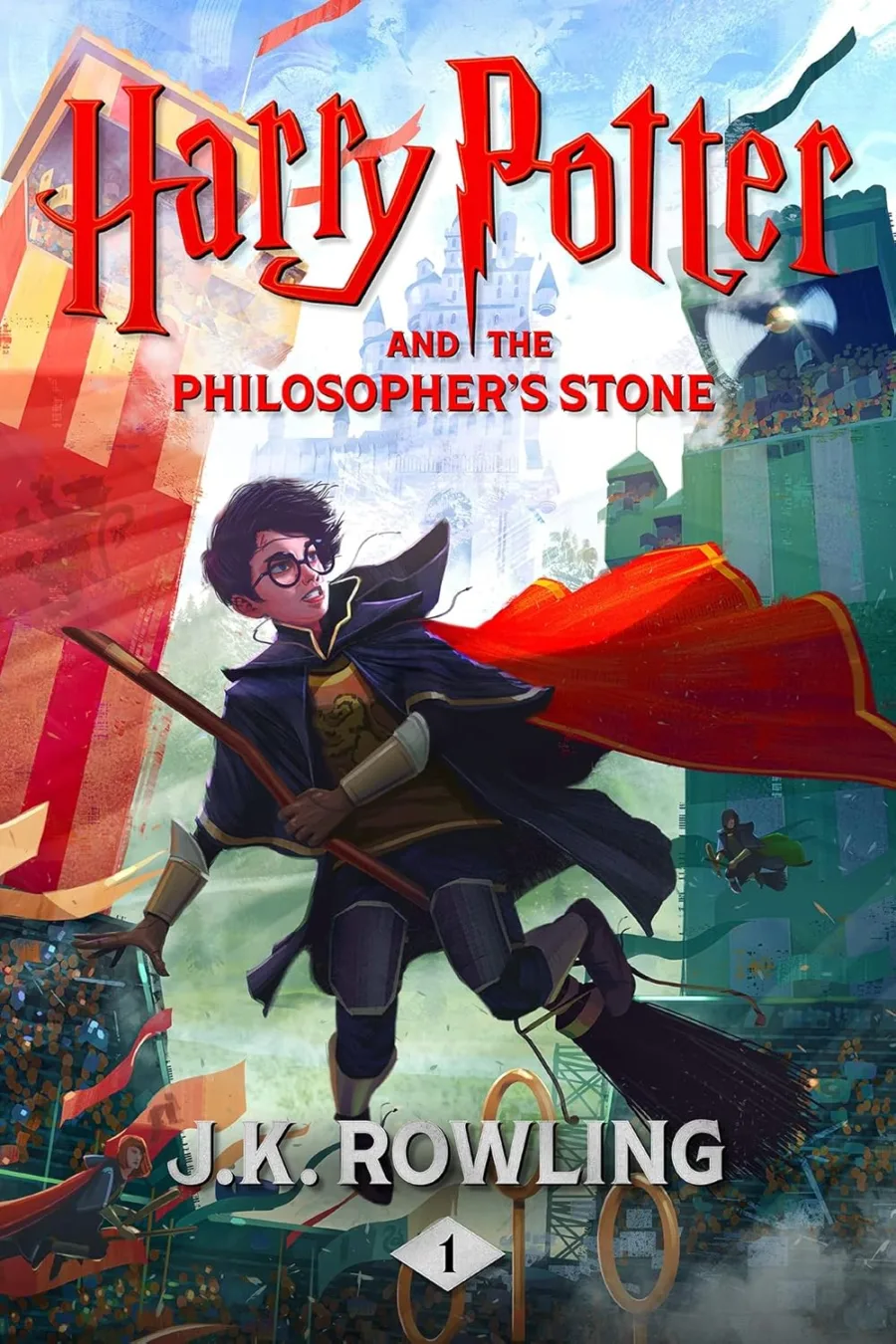
Download Cover Image
Do you want to download the full cover image for Harry Potter and the Philosopher's Stone?