
Cursive Handwriting for Kids: Sentence Workbook (Ages 6–10) | Bestseller for Fluent Handwriting
Paperback
• 32 Pages
• ₹ 129.00
• English
• 9789390183791
No ratings yet
| Publisher | Wonder House Books |
|---|---|
| ISBN13 | 9789390183791 |
| ASIN/SKU | 9390183790 |
| Book Format | Paperback |
| Language | English |
| Pages | 32 |
| List Price | ₹ 129.00 |
| Publishing Date | 01/01/2020 |
| Dimensions | 21.59 x 0.36 x 27.94 cm |
| Weight | 150 g |
| Book Code | BD00066212 |
Buy this Book
Amazon Stores
Ebook Stores
Other Stores
Discover Cursive Handwriting for Kids: Sentence Workbook (Ages 6–10) | Bestseller for Fluent Handwriting by Wonder House Books. This book is published by Wonder House Books in Paperback format, ISBN 9789390183791, ASIN 9390183790, under Children's Books, Workbooks, Study Guides.
Book Description
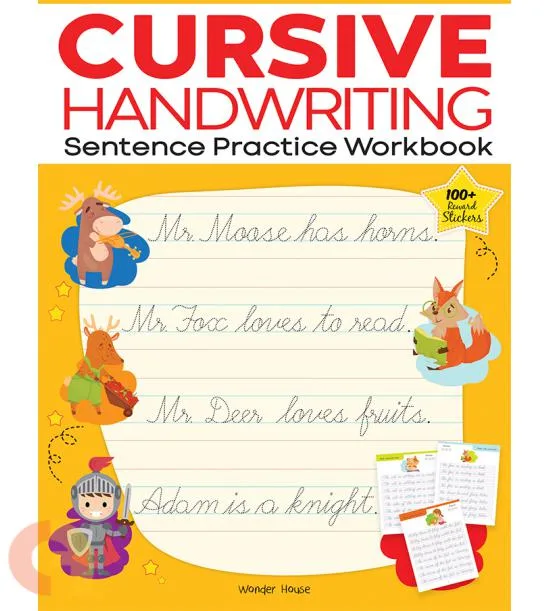
Prepare your child for School by teaching them how to make sentences with this amazing practice workbook! The trace and write exercises accompanied with vibrant images enable the child to practice sentence formation and improve their Cursive handwriting. Plus, it comes with 100+ reward stickers that keep the child motivated to perform better. The book is a great addition to your child’s pre-school library.
Author Biography
Wonder House has a dedicated team of editors and designers involved in the development of magnificent and enriching children books. The team pays special attention to develop age appropriate content and does extensive research on every topic included in the book. Our mission is to develop highly informative content which will help the children to master different skills. At Wonder House, we strive to make learning a joy.
Editorial Reviews
Editorial Reviews will be added soon…
Book Summary
Cursive Handwriting for Kids: Sentence Workbook (Ages 6–10) | Bestseller for Fluent Handwriting by Wonder House Books is a practice-focused workbook designed to help children between the ages of six and ten develop clear, smooth, and confident cursive handwriting. At this stage of childhood, students are moving beyond basic letter formation and beginning to write longer words, sentences, answers, and short pieces of their own writing. The book provides structured practice that can help children become more comfortable with cursive writing while also improving their pencil control, writing speed, spacing, and overall presentation.
The main purpose of the workbook is to make handwriting practice regular and manageable. Cursive handwriting requires children to connect letters smoothly rather than writing each letter separately. This can initially feel difficult because children have to remember the shape of individual letters while also maintaining a continuous movement of the pencil. With repeated practice, however, these movements can become more natural and automatic.
The sentence-based format is particularly useful because it moves children beyond isolated letters and words. Practising individual letters is an important first step, but real handwriting requires children to connect several words together into meaningful sentences. By practising complete sentences, children learn how letters connect within words and how words are separated while maintaining consistent spacing.
The book is aimed at children between 6 and 10 years old, an age range in which handwriting habits are still developing. Some children may already have basic cursive skills but need greater fluency, while others may still be learning how to form and connect letters. The workbook can therefore be used at different levels depending on the child's existing ability.
One of the most important skills developed through cursive practice is fine motor control. Writing requires the small muscles of the fingers, hand, and wrist to work together. Children need to control the direction, pressure, size, and movement of the pencil. Repeated tracing and writing exercises can strengthen this coordination.
Handwriting also develops hand-eye coordination. Children must constantly look at the letters they are forming while controlling the pencil. They need to judge where a letter should begin, how far it should extend, and where the next letter should connect. Over time, this coordination can make writing more fluid.
The workbook's focus on sentences also helps children practise writing rhythm. Good cursive handwriting is not simply about producing attractive individual letters. It involves maintaining a consistent pace and movement across an entire word or sentence. Children learn to connect letters without stopping unnecessarily between every character.
This can eventually improve writing speed. Students who spend too much time thinking about how to form each letter may struggle to keep up with classroom work. Regular cursive practice can help make common letter formations more automatic, allowing children to concentrate more on what they are writing.
Another important aspect is letter consistency. Children sometimes write the same letter differently each time. One version may be tall, another short, and another tilted. A handwriting workbook provides repeated examples that encourage children to develop a consistent style.
Consistency also applies to word spacing. Children need to learn how much space to leave between words so that sentences remain easy to read. Too little spacing makes words appear joined together, while excessive spacing can make writing look disconnected. Sentence practice provides natural opportunities to develop appropriate spacing.
The workbook can also improve line awareness. Children learn to keep letters aligned with the writing line and understand which letters extend upward or downward. This is particularly important in cursive writing, where letter shapes can change depending on their position and connection with neighboring letters.
Another benefit is improved legibility. Handwriting does not need to be artistic or decorative to be good. The most important quality is that another person can read it easily. Clear letter formation, consistent size, appropriate spacing, and proper alignment all contribute to legibility.
For schoolchildren, this is especially important because handwriting is still used for classwork, homework, examinations, worksheets, and notes. Even when students increasingly use digital devices, the ability to write clearly by hand remains useful.
The sentence-based exercises can also support language learning. Children are not only practising handwriting; they are repeatedly seeing correctly structured English sentences. This exposure can reinforce vocabulary, spelling, punctuation, and basic sentence construction.
For example, while copying a sentence, a child has to pay attention to the spelling of each word, the position of capital letters, spaces between words, and punctuation at the end. This makes handwriting practice an opportunity for language reinforcement.
The workbook can therefore be used alongside regular English study. Parents can ask children to read each sentence aloud before writing it. This simple step combines reading, pronunciation, comprehension, and handwriting practice.
Another useful activity is to ask children about the meaning of the sentence after they have written it. This prevents handwriting from becoming a purely mechanical exercise and encourages children to understand what they are copying.
The book can also contribute to spelling development. Writing a word several times creates visual and motor familiarity with its spelling. While copying should not replace active spelling practice, it can reinforce commonly used words and patterns.
Children can also gradually move from copying sentences to creating their own sentences. Once they become comfortable with cursive writing, parents or teachers can ask them to use a particular word in an original sentence. This combines handwriting fluency with independent language use.
One of the most important factors in handwriting improvement is regularity. Children do not need to complete many pages in a single day. A short daily practice session can be more effective because it gives the child repeated opportunities to develop the required movements.
For younger children in the six-to-eight age range, parents may begin with shorter sentences and focus primarily on letter formation, connections, spacing, and alignment. Older children can gradually practise longer sentences and more complex writing.
The workbook can also help children develop patience and concentration. Handwriting requires attention to small details. A child has to remain focused on the page and continue following the correct letter shapes. Completing a sentence neatly teaches the value of sustained attention.
This can be especially useful for children who tend to rush their written work. Parents can encourage them to focus on quality rather than simply finishing quickly. The goal is not to make every letter perfect but to develop a controlled and readable handwriting style.
Another important lesson is self-correction. Children can be encouraged to compare their writing with the model and identify differences. They can ask themselves whether their letters are the correct size, whether they are touching the line properly, and whether the spaces between words are consistent.
This develops self-monitoring skills that can eventually be applied to other forms of schoolwork.
The workbook is also suitable for home practice. Parents do not necessarily need advanced handwriting expertise to support a child. They can simply ensure that the child sits comfortably, holds the pencil appropriately, follows the model, and practises consistently.
A comfortable writing posture is important. Children should sit with their feet supported, keep the workbook at a suitable angle, and avoid gripping the pencil excessively tightly. Relaxed hand movement can make cursive writing easier and reduce unnecessary fatigue.
Teachers can also use the workbook for classroom handwriting sessions. Students can practise a sentence together while the teacher demonstrates letter connections on the board. The teacher can then identify common problems such as inconsistent size, poor spacing, incorrect joins, or writing above or below the line.
The sentence format can make classroom practice more meaningful because students are writing actual language rather than meaningless strings of letters. This can help maintain interest.
The book may also be useful for children who have developed uneven handwriting habits. Some children can form letters correctly but write very quickly and inconsistently.
The main purpose of the workbook is to make handwriting practice regular and manageable. Cursive handwriting requires children to connect letters smoothly rather than writing each letter separately. This can initially feel difficult because children have to remember the shape of individual letters while also maintaining a continuous movement of the pencil. With repeated practice, however, these movements can become more natural and automatic.
The sentence-based format is particularly useful because it moves children beyond isolated letters and words. Practising individual letters is an important first step, but real handwriting requires children to connect several words together into meaningful sentences. By practising complete sentences, children learn how letters connect within words and how words are separated while maintaining consistent spacing.
The book is aimed at children between 6 and 10 years old, an age range in which handwriting habits are still developing. Some children may already have basic cursive skills but need greater fluency, while others may still be learning how to form and connect letters. The workbook can therefore be used at different levels depending on the child's existing ability.
One of the most important skills developed through cursive practice is fine motor control. Writing requires the small muscles of the fingers, hand, and wrist to work together. Children need to control the direction, pressure, size, and movement of the pencil. Repeated tracing and writing exercises can strengthen this coordination.
Handwriting also develops hand-eye coordination. Children must constantly look at the letters they are forming while controlling the pencil. They need to judge where a letter should begin, how far it should extend, and where the next letter should connect. Over time, this coordination can make writing more fluid.
The workbook's focus on sentences also helps children practise writing rhythm. Good cursive handwriting is not simply about producing attractive individual letters. It involves maintaining a consistent pace and movement across an entire word or sentence. Children learn to connect letters without stopping unnecessarily between every character.
This can eventually improve writing speed. Students who spend too much time thinking about how to form each letter may struggle to keep up with classroom work. Regular cursive practice can help make common letter formations more automatic, allowing children to concentrate more on what they are writing.
Another important aspect is letter consistency. Children sometimes write the same letter differently each time. One version may be tall, another short, and another tilted. A handwriting workbook provides repeated examples that encourage children to develop a consistent style.
Consistency also applies to word spacing. Children need to learn how much space to leave between words so that sentences remain easy to read. Too little spacing makes words appear joined together, while excessive spacing can make writing look disconnected. Sentence practice provides natural opportunities to develop appropriate spacing.
The workbook can also improve line awareness. Children learn to keep letters aligned with the writing line and understand which letters extend upward or downward. This is particularly important in cursive writing, where letter shapes can change depending on their position and connection with neighboring letters.
Another benefit is improved legibility. Handwriting does not need to be artistic or decorative to be good. The most important quality is that another person can read it easily. Clear letter formation, consistent size, appropriate spacing, and proper alignment all contribute to legibility.
For schoolchildren, this is especially important because handwriting is still used for classwork, homework, examinations, worksheets, and notes. Even when students increasingly use digital devices, the ability to write clearly by hand remains useful.
The sentence-based exercises can also support language learning. Children are not only practising handwriting; they are repeatedly seeing correctly structured English sentences. This exposure can reinforce vocabulary, spelling, punctuation, and basic sentence construction.
For example, while copying a sentence, a child has to pay attention to the spelling of each word, the position of capital letters, spaces between words, and punctuation at the end. This makes handwriting practice an opportunity for language reinforcement.
The workbook can therefore be used alongside regular English study. Parents can ask children to read each sentence aloud before writing it. This simple step combines reading, pronunciation, comprehension, and handwriting practice.
Another useful activity is to ask children about the meaning of the sentence after they have written it. This prevents handwriting from becoming a purely mechanical exercise and encourages children to understand what they are copying.
The book can also contribute to spelling development. Writing a word several times creates visual and motor familiarity with its spelling. While copying should not replace active spelling practice, it can reinforce commonly used words and patterns.
Children can also gradually move from copying sentences to creating their own sentences. Once they become comfortable with cursive writing, parents or teachers can ask them to use a particular word in an original sentence. This combines handwriting fluency with independent language use.
One of the most important factors in handwriting improvement is regularity. Children do not need to complete many pages in a single day. A short daily practice session can be more effective because it gives the child repeated opportunities to develop the required movements.
For younger children in the six-to-eight age range, parents may begin with shorter sentences and focus primarily on letter formation, connections, spacing, and alignment. Older children can gradually practise longer sentences and more complex writing.
The workbook can also help children develop patience and concentration. Handwriting requires attention to small details. A child has to remain focused on the page and continue following the correct letter shapes. Completing a sentence neatly teaches the value of sustained attention.
This can be especially useful for children who tend to rush their written work. Parents can encourage them to focus on quality rather than simply finishing quickly. The goal is not to make every letter perfect but to develop a controlled and readable handwriting style.
Another important lesson is self-correction. Children can be encouraged to compare their writing with the model and identify differences. They can ask themselves whether their letters are the correct size, whether they are touching the line properly, and whether the spaces between words are consistent.
This develops self-monitoring skills that can eventually be applied to other forms of schoolwork.
The workbook is also suitable for home practice. Parents do not necessarily need advanced handwriting expertise to support a child. They can simply ensure that the child sits comfortably, holds the pencil appropriately, follows the model, and practises consistently.
A comfortable writing posture is important. Children should sit with their feet supported, keep the workbook at a suitable angle, and avoid gripping the pencil excessively tightly. Relaxed hand movement can make cursive writing easier and reduce unnecessary fatigue.
Teachers can also use the workbook for classroom handwriting sessions. Students can practise a sentence together while the teacher demonstrates letter connections on the board. The teacher can then identify common problems such as inconsistent size, poor spacing, incorrect joins, or writing above or below the line.
The sentence format can make classroom practice more meaningful because students are writing actual language rather than meaningless strings of letters. This can help maintain interest.
The book may also be useful for children who have developed uneven handwriting habits. Some children can form letters correctly but write very quickly and inconsistently.
Sample Chapters
Sample Chapters will be added soon…
Reader Reviews
No reviews yet.
Cursive Handwriting for Kids: Sentence Workbook (Ages 6–10) | Bestseller for Fluent Handwriting
Download Cover Image
Do you want to download the full cover image for Cursive Handwriting for Kids: Sentence Workbook (Ages 6–10) | Bestseller for Fluent Handwriting?