
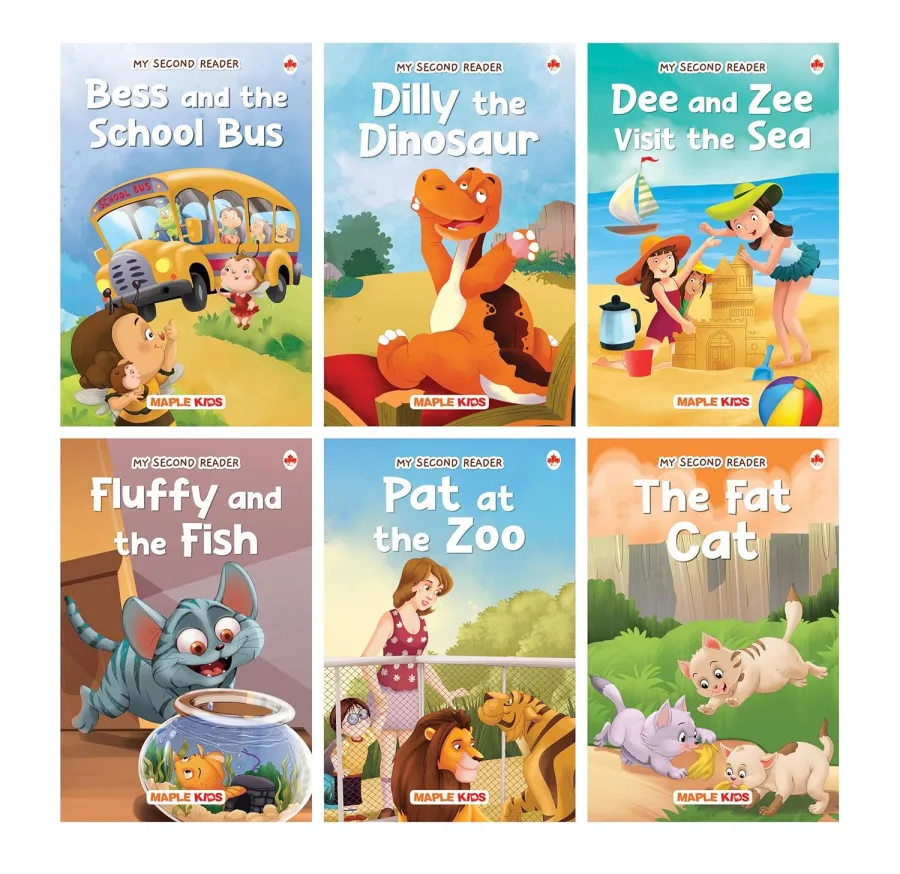
Story Books for Kids - Second Reader (Illustrated) (Set of 6 Books) - Phonic stories
Paperback
• 96 Pages
• ₹ 240.00
• English
• 9788119099399
No ratings yet
| Publisher | Maple Press Pvt Ltd |
|---|---|
| ISBN13 | 9788119099399 |
| ASIN/SKU | 8119099397 |
| Book Format | Paperback |
| Language | English |
| Pages | 96 |
| List Price | ₹ 240.00 |
| Publishing Date | 28/08/2023 |
| Dimensions | 20.3 x 25.4 x 4.7 cm |
| Weight | 350 g |
| Book Code | BD00066203 |
Buy this Book
Amazon Stores
Ebook Stores
Other Stores
Discover Story Books for Kids - Second Reader (Illustrated) (Set of 6 Books) - Phonic stories by Maple Press. This book is published by Maple Press Pvt Ltd in Paperback format, ISBN 9788119099399, ASIN 8119099397, under Reference, Readers.
Book Description
Phonic readers aid young learners in enhancing their reading skills by introducing them to the connection between sounds and letters. These books teach kids to the fundamental building blocks of reading, such as letter sounds, word blending and phonetic patterns.
This set of 6 books has been designed to engage kids in developing reading skills through exciting stories coupled with colourful illustrations. The stories incorporate words that follow phonetic and rhyming patterns allowing kids to practise and reinforce their understanding of different sounds and letter combinations. The stories included here are "Bess and the School Bus," "Dee and Zee Visit the Sea," "Dilly the Dinosaur," "Fluffy and the Fish," "Pat at the Zoo" and "The Fat Cat."
This phonic reader is a set of 6 books introducing kids to phonetic patterns to help expand their reading skills and vocabulary.
These phonic storybooks keep kids engaged and excited as they go through pages filled with colourful illustrations and fun stories.
The phonic and rhyming patterns in the stories help kids read and identify words and improve memory and concentration.
The stories are made up of short sentences with themes from everyday activities, letting kids identify and understand the story better.
Finally, these books will let kids develop a love for books from an early age.
This set of 6 books has been designed to engage kids in developing reading skills through exciting stories coupled with colourful illustrations. The stories incorporate words that follow phonetic and rhyming patterns allowing kids to practise and reinforce their understanding of different sounds and letter combinations. The stories included here are "Bess and the School Bus," "Dee and Zee Visit the Sea," "Dilly the Dinosaur," "Fluffy and the Fish," "Pat at the Zoo" and "The Fat Cat."
This phonic reader is a set of 6 books introducing kids to phonetic patterns to help expand their reading skills and vocabulary.
These phonic storybooks keep kids engaged and excited as they go through pages filled with colourful illustrations and fun stories.
The phonic and rhyming patterns in the stories help kids read and identify words and improve memory and concentration.
The stories are made up of short sentences with themes from everyday activities, letting kids identify and understand the story better.
Finally, these books will let kids develop a love for books from an early age.
Author Biography
Maple Press is an independent family-run book publishing house launched in 2014 to inspire, inform, and excite the children of today and the future and develop children’s literature by publishing high-quality, affordable books in print, electronic and audio formats.
The current catalogue has over 1000+ titles consisting of yesteryear classics, illustrated storybooks of folklore, mythology, and history depicted in new and contemporary formats, beginner’s writing books, picture books, colouring books, activity books, biographies, and complete book sets for pre-primary schools.
Maple Press supports various charities, including Share-a-book India, Awaaz Foundation and Thinksharp Foundation and has donated tens of thousands of books to help improve literacy and promote reading in India.
The current catalogue has over 1000+ titles consisting of yesteryear classics, illustrated storybooks of folklore, mythology, and history depicted in new and contemporary formats, beginner’s writing books, picture books, colouring books, activity books, biographies, and complete book sets for pre-primary schools.
Maple Press supports various charities, including Share-a-book India, Awaaz Foundation and Thinksharp Foundation and has donated tens of thousands of books to help improve literacy and promote reading in India.
Editorial Reviews
Editorial Reviews will be added soon…
Book Summary
Story Books for Kids – Second Reader (Illustrated) (Set of 6 Books) – Phonic Stories by Maple Press is a collection created to help young children develop early reading skills through short, enjoyable stories, simple sentences, phonetic patterns, rhyming words, and colorful illustrations. The set contains six individual books and is designed as a step beyond the earliest stage of reading. According to Maple Press, the series is intended to engage children in developing their reading abilities through exciting stories and colorful pictures. The books use words based on phonetic and rhyming patterns so that children can practise recognizing sounds and letter combinations while enjoying the stories.
The six stories included in the set are Bess and the School Bus, Dee and Zee Visit the Sea, Dilly the Dinosaur, Fluffy and the Fish, Pat at the Zoo, and The Fat Cat. Each story uses a simple theme and short sentences, making the books approachable for children who are moving from basic letter and sound recognition toward reading complete sentences independently. The stories are supported by colorful illustrations, which help children understand the events and remain interested in the pages.
The central purpose of the collection is to make learning to read enjoyable. Early reading can sometimes feel difficult because children have to manage several skills at the same time. They need to recognize letters, connect letters with sounds, blend sounds together, identify words, and understand what those words mean. A phonic storybook breaks this process into smaller steps. Instead of practising sounds through isolated exercises alone, children encounter those sounds inside simple stories.
Phonics is based on the connection between letters and sounds. When children understand these connections, they become better equipped to decode unfamiliar words. The book uses repeated sound patterns and familiar word structures so that children can gradually recognize words more confidently. Maple Press describes phonic readers as books that introduce young learners to the connection between sounds and letters, including letter sounds, word blending, and phonetic patterns.
The second-reader level is particularly useful because children at this stage are beginning to move beyond individual words. They may already recognize many common letters and sounds, but they need practice combining them into meaningful sentences. The short stories provide that practice in a natural context.
The first story, Bess and the School Bus, uses an everyday setting that children can easily understand. A school bus is familiar to many young readers, and the story provides an opportunity to encounter simple words related to school, travel, people, and everyday activities. Because the setting is recognizable, children can concentrate more on reading the words rather than trying to understand an unfamiliar world.
Dee and Zee Visit the Sea introduces a different setting and makes use of sound patterns that can help children practise pronunciation and word recognition. The sea also provides opportunities for visual learning because children can identify things such as water, animals, boats, and other objects associated with the setting.
Dilly the Dinosaur brings imagination into the collection. A dinosaur is an exciting subject for young children, and the character can make reading practice feel like an adventure. By connecting phonics practice with an imaginative character, the story helps demonstrate that learning to read can open the door to fictional worlds.
Fluffy and the Fish uses animal characters to create another engaging reading experience. Animal stories are particularly effective for early readers because children are often naturally interested in animals. The combination of familiar vocabulary, simple sentences, and colorful pictures can make it easier for children to follow the story while practising reading.
Pat at the Zoo introduces children to another familiar environment. A zoo provides many opportunities to recognize animals and simple descriptive words. Children can look at the pictures, name the animals, and then connect those spoken words with the written text. This makes the reading experience interactive rather than passive.
The Fat Cat is built around a simple, memorable phrase and a familiar animal. Stories with repeated sound patterns can be particularly useful for phonics because children begin to notice similarities between words. When several words share related sounds or letter combinations, children can use what they already know to decode new words.
The use of rhyming patterns is one of the strongest features of the set. Rhyming helps children notice similarities between words and become more aware of the sounds within language. When children hear or read words that sound alike at the end, they begin to recognize patterns that can help them decode unfamiliar words.
Rhyming also makes stories more memorable. Children often enjoy repeating words that sound similar, and this repetition can turn reading practice into a playful activity. A parent can pause before a rhyming word and allow the child to guess what comes next.
The stories use short sentences, which reduces the difficulty for beginning readers. Long and complicated sentences can overwhelm children who are still learning to decode words. Short sentences allow them to focus on one small piece of information at a time. Once they become comfortable, they can gradually move toward longer and more complex texts.
The illustrations provide another important layer of support. A child who encounters an unfamiliar word can sometimes understand its meaning from the picture. For example, if a page contains an animal illustration, the visual context may help the child identify what the sentence is discussing. This combination of text and image makes the books accessible to early readers.
Colorful illustrations also encourage visual engagement. Young children often respond strongly to pictures, and attractive illustrations can motivate them to turn the pages and continue reading. The illustrations make the stories feel more like adventures than lessons.
The collection can help develop vocabulary as children encounter new words in meaningful contexts. Learning vocabulary through stories is often more memorable than learning isolated word lists because the child can connect a word with an action, character, object, or event.
For example, a child may learn a word related to a school bus while reading about Bess, an animal-related word while reading about Fluffy or the cat, or a place-related word while reading about the sea or zoo. The story provides context that helps the child understand what the word means.
Another important benefit is reading comprehension. Phonics is only one part of becoming a good reader. Children also need to understand what they are reading. After decoding a sentence, they should be able to understand who is doing something, what is happening, and why it matters.
These stories encourage comprehension because they have simple plots with clear sequences of events. Parents can ask questions after reading, such as “Where did Pat go?”, “Who is Fluffy?”, or “What happened at the sea?” Such questions encourage children to remember details and explain the story in their own words.
The books can also strengthen memory and concentration. Maple Press notes that the phonetic and rhyming patterns help children identify words and improve memory and concentration. When children repeatedly encounter similar sounds and words, they gradually become more familiar with those patterns.
Repeated reading can be especially useful. A child does not have to read each story only once. Reading the same story several times can improve fluency because the child becomes familiar with the vocabulary and sentence structure. During the first reading, the child may need significant help. During later readings, they may recognize more words independently.
The set also encourages confidence. Early readers can become discouraged when every page contains unfamiliar words. Short stories with manageable vocabulary give them opportunities to experience success. Completing an entire story can provide a sense of achievement and motivate them to attempt the next one.
Parents can make the experience even more effective by reading together. They can first read a sentence aloud, then invite the child to repeat it. Later, the child can attempt the sentence independently. This gradual transition from supported reading to independent reading can help children become more confident.
The books are also suitable for read-aloud sessions. Even if a child cannot read every word independently, listening to an adult read the story exposes them to pronunciation, rhythm, sentence structure, and vocabulary.
The six stories included in the set are Bess and the School Bus, Dee and Zee Visit the Sea, Dilly the Dinosaur, Fluffy and the Fish, Pat at the Zoo, and The Fat Cat. Each story uses a simple theme and short sentences, making the books approachable for children who are moving from basic letter and sound recognition toward reading complete sentences independently. The stories are supported by colorful illustrations, which help children understand the events and remain interested in the pages.
The central purpose of the collection is to make learning to read enjoyable. Early reading can sometimes feel difficult because children have to manage several skills at the same time. They need to recognize letters, connect letters with sounds, blend sounds together, identify words, and understand what those words mean. A phonic storybook breaks this process into smaller steps. Instead of practising sounds through isolated exercises alone, children encounter those sounds inside simple stories.
Phonics is based on the connection between letters and sounds. When children understand these connections, they become better equipped to decode unfamiliar words. The book uses repeated sound patterns and familiar word structures so that children can gradually recognize words more confidently. Maple Press describes phonic readers as books that introduce young learners to the connection between sounds and letters, including letter sounds, word blending, and phonetic patterns.
The second-reader level is particularly useful because children at this stage are beginning to move beyond individual words. They may already recognize many common letters and sounds, but they need practice combining them into meaningful sentences. The short stories provide that practice in a natural context.
The first story, Bess and the School Bus, uses an everyday setting that children can easily understand. A school bus is familiar to many young readers, and the story provides an opportunity to encounter simple words related to school, travel, people, and everyday activities. Because the setting is recognizable, children can concentrate more on reading the words rather than trying to understand an unfamiliar world.
Dee and Zee Visit the Sea introduces a different setting and makes use of sound patterns that can help children practise pronunciation and word recognition. The sea also provides opportunities for visual learning because children can identify things such as water, animals, boats, and other objects associated with the setting.
Dilly the Dinosaur brings imagination into the collection. A dinosaur is an exciting subject for young children, and the character can make reading practice feel like an adventure. By connecting phonics practice with an imaginative character, the story helps demonstrate that learning to read can open the door to fictional worlds.
Fluffy and the Fish uses animal characters to create another engaging reading experience. Animal stories are particularly effective for early readers because children are often naturally interested in animals. The combination of familiar vocabulary, simple sentences, and colorful pictures can make it easier for children to follow the story while practising reading.
Pat at the Zoo introduces children to another familiar environment. A zoo provides many opportunities to recognize animals and simple descriptive words. Children can look at the pictures, name the animals, and then connect those spoken words with the written text. This makes the reading experience interactive rather than passive.
The Fat Cat is built around a simple, memorable phrase and a familiar animal. Stories with repeated sound patterns can be particularly useful for phonics because children begin to notice similarities between words. When several words share related sounds or letter combinations, children can use what they already know to decode new words.
The use of rhyming patterns is one of the strongest features of the set. Rhyming helps children notice similarities between words and become more aware of the sounds within language. When children hear or read words that sound alike at the end, they begin to recognize patterns that can help them decode unfamiliar words.
Rhyming also makes stories more memorable. Children often enjoy repeating words that sound similar, and this repetition can turn reading practice into a playful activity. A parent can pause before a rhyming word and allow the child to guess what comes next.
The stories use short sentences, which reduces the difficulty for beginning readers. Long and complicated sentences can overwhelm children who are still learning to decode words. Short sentences allow them to focus on one small piece of information at a time. Once they become comfortable, they can gradually move toward longer and more complex texts.
The illustrations provide another important layer of support. A child who encounters an unfamiliar word can sometimes understand its meaning from the picture. For example, if a page contains an animal illustration, the visual context may help the child identify what the sentence is discussing. This combination of text and image makes the books accessible to early readers.
Colorful illustrations also encourage visual engagement. Young children often respond strongly to pictures, and attractive illustrations can motivate them to turn the pages and continue reading. The illustrations make the stories feel more like adventures than lessons.
The collection can help develop vocabulary as children encounter new words in meaningful contexts. Learning vocabulary through stories is often more memorable than learning isolated word lists because the child can connect a word with an action, character, object, or event.
For example, a child may learn a word related to a school bus while reading about Bess, an animal-related word while reading about Fluffy or the cat, or a place-related word while reading about the sea or zoo. The story provides context that helps the child understand what the word means.
Another important benefit is reading comprehension. Phonics is only one part of becoming a good reader. Children also need to understand what they are reading. After decoding a sentence, they should be able to understand who is doing something, what is happening, and why it matters.
These stories encourage comprehension because they have simple plots with clear sequences of events. Parents can ask questions after reading, such as “Where did Pat go?”, “Who is Fluffy?”, or “What happened at the sea?” Such questions encourage children to remember details and explain the story in their own words.
The books can also strengthen memory and concentration. Maple Press notes that the phonetic and rhyming patterns help children identify words and improve memory and concentration. When children repeatedly encounter similar sounds and words, they gradually become more familiar with those patterns.
Repeated reading can be especially useful. A child does not have to read each story only once. Reading the same story several times can improve fluency because the child becomes familiar with the vocabulary and sentence structure. During the first reading, the child may need significant help. During later readings, they may recognize more words independently.
The set also encourages confidence. Early readers can become discouraged when every page contains unfamiliar words. Short stories with manageable vocabulary give them opportunities to experience success. Completing an entire story can provide a sense of achievement and motivate them to attempt the next one.
Parents can make the experience even more effective by reading together. They can first read a sentence aloud, then invite the child to repeat it. Later, the child can attempt the sentence independently. This gradual transition from supported reading to independent reading can help children become more confident.
The books are also suitable for read-aloud sessions. Even if a child cannot read every word independently, listening to an adult read the story exposes them to pronunciation, rhythm, sentence structure, and vocabulary.
Sample Chapters
Sample Chapters will be added soon…
Reader Reviews
No reviews yet.
Story Books for Kids - Second Reader (Illustrated) (Set of 6 Books) - Phonic stories
Download Cover Image
Do you want to download the full cover image for Story Books for Kids - Second Reader (Illustrated) (Set of 6 Books) - Phonic stories?