
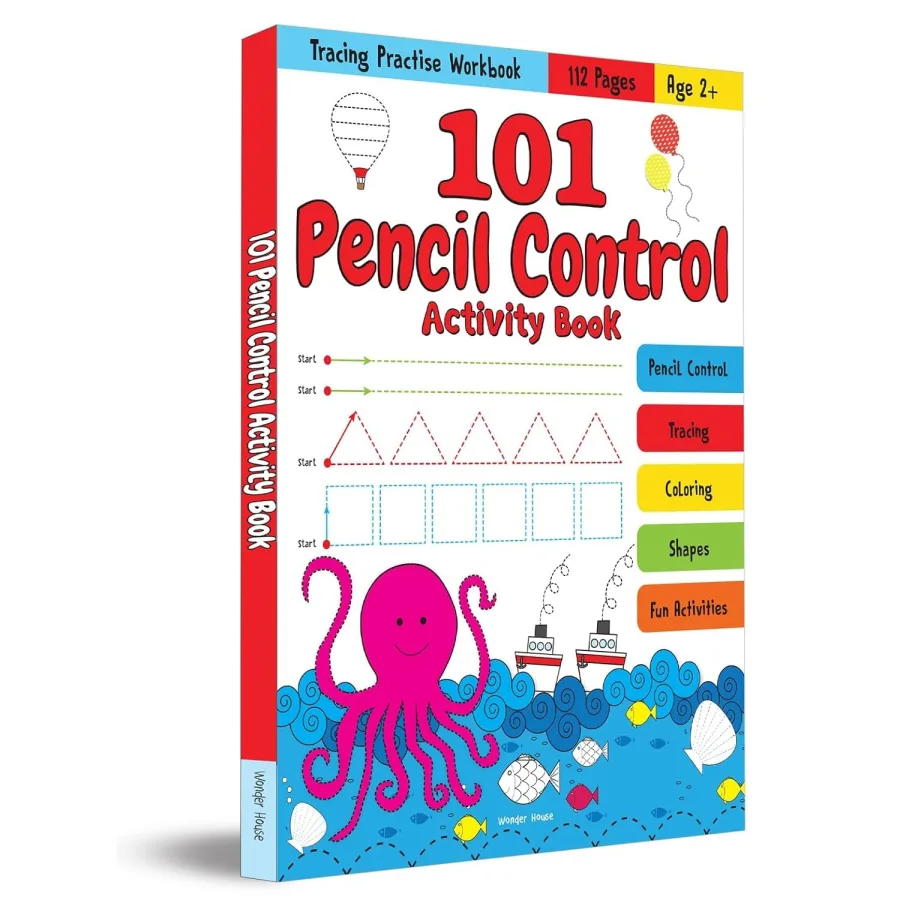
101 Pencil Control Activity Book For Kids: Tracing Practise Book | Age 2+ and up
Paperback
• 112 Pages
• ₹ 298.99
• English
• 9789354405112
No ratings yet
Children's Books
Children's Early Learning Books on Sense & Sensation
Children's Early Learning Books on the Alphabet
| Publisher | Wonder House Books |
|---|---|
| ISBN13 | 9789354405112 |
| ASIN/SKU | 9354405118 |
| Book Format | Paperback |
| Language | English |
| Pages | 112 |
| List Price | ₹ 298.99 |
| Publishing Date | 28/02/2022 |
| Dimensions | 27.9 x 21.5 x 0.3 cm |
| Weight | 340 g |
| Book Code | BD00056100 |
Buy this Book
Amazon Stores
Ebook Stores
Other Stores
Discover 101 Pencil Control Activity Book For Kids: Tracing Practise Book | Age 2+ and up by Wonder House Books. This book is published by Wonder House Books in Paperback format, ISBN 9789354405112, ASIN 9354405118, under Children's Books, Children's Early Learning Books on Sense and Sensation, Children's Early Learning Books on the Alphabet.
Book Description
Follow the patterns in this fun activity book especially designed to engage young scholars as they learn to write for the first time. Follow the arrows and trace the dotted lines, indulge in engaging and fun activities while developing hand-eye coordination and stimulate your motor skills. 101 Pencil Control Activity Book is sure to keep the beginners engaged as they learn through play.
Author Biography
Wonder House has a dedicated team of editors and designers involved in the development of magnificent and enriching children books. The team pays special attention to develop age appropriate content and does extensive research on every topic included in the book. Our mission is to develop highly informative content which will help the children to master different skills. At Wonder House, we strive to make learning a joy.
Editorial Reviews
Editorial Reviews will be added soon…
Book Summary
101 Pencil Control Activity Book for Kids by Wonder House Books is an early-learning activity book designed to help young children develop the basic hand movements and coordination needed for writing. Intended for children aged two and above, the book focuses on tracing and pencil-control exercises rather than formal writing. Its purpose is to give children a gentle introduction to using a pencil while helping them improve fine motor skills, hand-eye coordination, concentration, and confidence.
At around two years of age, children are only beginning to gain control over the small movements of their hands and fingers. Holding a pencil and guiding it accurately across a page can therefore be challenging. A child may press too hard, move the pencil in an uncontrolled direction, or lose track of a line. These are normal parts of early development. A pencil-control activity book provides structured opportunities to practice these movements without expecting children to immediately produce letters or numbers.
The central activity in the book is tracing. Children are given lines, curves, paths, patterns, and other guided shapes to follow with a pencil. These exercises encourage them to look carefully at a path and move their hand along it. Through repeated practice, children can gradually become more comfortable controlling the direction and speed of their pencil movements.
Tracing is an important preparation for handwriting because letters and numbers are made from basic strokes and movements. Straight lines, curves, loops, zigzags, waves, and other patterns appear in many letters and numerals. Before a child can confidently write an alphabet letter, they need to develop the ability to make these basic movements. The book therefore focuses on foundational skills rather than asking young learners to begin with complicated writing.
The 101 activities provide variety and repetition at the same time. Repetition is essential for developing motor skills because children need to perform the same types of movements many times before they become comfortable. However, repeating exactly the same exercise can become boring. By including different patterns and tracing challenges, the book can keep practice more interesting while still reinforcing the underlying skills.
Some activities may require children to trace simple horizontal or vertical lines, while others introduce curves, waves, loops, or more complex paths. The progression from simpler movements toward more controlled patterns can help children gradually develop their abilities. Parents can allow children to spend extra time on easier exercises if they are not yet ready for more complicated ones.
The book also supports hand-eye coordination. Writing requires the eyes and hands to work together continuously. A child must see where the pencil is, understand where it needs to go, and adjust the movement accordingly. Tracing exercises provide an uncomplicated way to practice this connection. With time, children can become better at following visual paths and controlling their pencil movements.
Fine motor development is another important benefit. Fine motor skills involve the controlled use of small muscles in the hands and fingers. These skills are needed not only for writing but also for activities such as buttoning clothes, using utensils, drawing, coloring, cutting with child-safe scissors, and manipulating small objects. Pencil-control activities can therefore contribute to a wider set of everyday abilities.
The book is also designed to encourage concentration. Young children often have short attention spans, and sitting still for a long writing lesson can be difficult. Short tracing exercises provide manageable tasks with a clear objective. The child knows what needs to be done: follow the line or complete the pattern. Finishing an activity can provide a small sense of achievement and encourage the child to continue.
For children aged two and above, the experience should remain playful rather than pressured. At this age, the goal is not perfect handwriting. Some lines will be uneven, some patterns will be incomplete, and the pencil may occasionally move outside the intended path. These mistakes are part of the learning process. Parents can encourage careful effort without repeatedly correcting every small error.
The activity book can also help develop familiarity with the physical process of writing. Children learn how a pencil feels in their hands, how much pressure is needed, and how different movements affect the marks on paper. These experiences gradually prepare them for more formal handwriting practice when they are older.
Parents and caregivers can make the exercises more interactive by sitting with the child during practice. They can demonstrate how to begin a tracing activity, show the direction of movement, and encourage the child to follow along. Rather than taking over the activity, adults can allow the child to make the movements independently. This gives children an opportunity to develop confidence and learn from their own attempts.
The book can also be incorporated into a broader preschool routine. A child might spend a few minutes tracing before moving on to coloring, picture books, puzzles, or other activities. There is no need to complete many pages in one sitting. Young children generally benefit more from short, enjoyable practice sessions than from being required to work for long periods.
Another useful feature of tracing practice is that it introduces children to the idea of following directions. A pattern provides a beginning and an intended path. The child needs to observe the visual information and respond accordingly. This basic ability to follow a sequence is useful later in school when children need to follow written instructions, complete worksheets, reproduce shapes, and write letters correctly.
The activities can also encourage patience. A child may initially find a particular pattern difficult. With encouragement, they can try again and gradually improve. Learning that a difficult task can become easier with practice is an important early lesson. It helps children develop persistence without making learning feel like a test.
It is also useful to combine pencil-control practice with other forms of physical and creative activity. Drawing with crayons, coloring, playing with clay, building with blocks, and using age-appropriate puzzles can all provide additional opportunities to strengthen hand and finger control. The tracing book can therefore be one part of a larger early-learning routine.
The book's age recommendation of two years and above makes it suitable for children who are at different stages of development. Some two-year-olds may be ready to trace simple paths, while others may need more time to develop basic pencil control. Parents should therefore focus on the child's individual progress rather than expecting every child to complete the activities in exactly the same way.
Overall, 101 Pencil Control Activity Book for Kids by Wonder House Books is a practical introduction to tracing and early pencil skills. Its 101 activities give young children repeated opportunities to practice lines, curves, patterns, and controlled movements. The book is not primarily about teaching children to write words; instead, it builds the physical and visual foundations that make later handwriting easier.
The greatest value of the book lies in its simple approach. Young children do not need complicated lessons to begin developing writing skills. They need opportunities to hold a pencil, make marks, follow paths, experiment with movement, and gradually gain control. Through regular and enjoyable tracing practice, children can strengthen hand-eye coordination, fine motor skills, concentration, patience, and confidence.
Ultimately, 101 Pencil Control Activity Book for Kids provides a gentle bridge between early childhood play and formal handwriting. By turning basic pencil movements into simple activities, it allows children to practice important skills without the pressure of traditional writing exercises. With patient guidance and regular practice, the activities can help young learners become more comfortable with pencils and prepare them for the next stages of drawing, letter formation, number writing, and handwriting.
At around two years of age, children are only beginning to gain control over the small movements of their hands and fingers. Holding a pencil and guiding it accurately across a page can therefore be challenging. A child may press too hard, move the pencil in an uncontrolled direction, or lose track of a line. These are normal parts of early development. A pencil-control activity book provides structured opportunities to practice these movements without expecting children to immediately produce letters or numbers.
The central activity in the book is tracing. Children are given lines, curves, paths, patterns, and other guided shapes to follow with a pencil. These exercises encourage them to look carefully at a path and move their hand along it. Through repeated practice, children can gradually become more comfortable controlling the direction and speed of their pencil movements.
Tracing is an important preparation for handwriting because letters and numbers are made from basic strokes and movements. Straight lines, curves, loops, zigzags, waves, and other patterns appear in many letters and numerals. Before a child can confidently write an alphabet letter, they need to develop the ability to make these basic movements. The book therefore focuses on foundational skills rather than asking young learners to begin with complicated writing.
The 101 activities provide variety and repetition at the same time. Repetition is essential for developing motor skills because children need to perform the same types of movements many times before they become comfortable. However, repeating exactly the same exercise can become boring. By including different patterns and tracing challenges, the book can keep practice more interesting while still reinforcing the underlying skills.
Some activities may require children to trace simple horizontal or vertical lines, while others introduce curves, waves, loops, or more complex paths. The progression from simpler movements toward more controlled patterns can help children gradually develop their abilities. Parents can allow children to spend extra time on easier exercises if they are not yet ready for more complicated ones.
The book also supports hand-eye coordination. Writing requires the eyes and hands to work together continuously. A child must see where the pencil is, understand where it needs to go, and adjust the movement accordingly. Tracing exercises provide an uncomplicated way to practice this connection. With time, children can become better at following visual paths and controlling their pencil movements.
Fine motor development is another important benefit. Fine motor skills involve the controlled use of small muscles in the hands and fingers. These skills are needed not only for writing but also for activities such as buttoning clothes, using utensils, drawing, coloring, cutting with child-safe scissors, and manipulating small objects. Pencil-control activities can therefore contribute to a wider set of everyday abilities.
The book is also designed to encourage concentration. Young children often have short attention spans, and sitting still for a long writing lesson can be difficult. Short tracing exercises provide manageable tasks with a clear objective. The child knows what needs to be done: follow the line or complete the pattern. Finishing an activity can provide a small sense of achievement and encourage the child to continue.
For children aged two and above, the experience should remain playful rather than pressured. At this age, the goal is not perfect handwriting. Some lines will be uneven, some patterns will be incomplete, and the pencil may occasionally move outside the intended path. These mistakes are part of the learning process. Parents can encourage careful effort without repeatedly correcting every small error.
The activity book can also help develop familiarity with the physical process of writing. Children learn how a pencil feels in their hands, how much pressure is needed, and how different movements affect the marks on paper. These experiences gradually prepare them for more formal handwriting practice when they are older.
Parents and caregivers can make the exercises more interactive by sitting with the child during practice. They can demonstrate how to begin a tracing activity, show the direction of movement, and encourage the child to follow along. Rather than taking over the activity, adults can allow the child to make the movements independently. This gives children an opportunity to develop confidence and learn from their own attempts.
The book can also be incorporated into a broader preschool routine. A child might spend a few minutes tracing before moving on to coloring, picture books, puzzles, or other activities. There is no need to complete many pages in one sitting. Young children generally benefit more from short, enjoyable practice sessions than from being required to work for long periods.
Another useful feature of tracing practice is that it introduces children to the idea of following directions. A pattern provides a beginning and an intended path. The child needs to observe the visual information and respond accordingly. This basic ability to follow a sequence is useful later in school when children need to follow written instructions, complete worksheets, reproduce shapes, and write letters correctly.
The activities can also encourage patience. A child may initially find a particular pattern difficult. With encouragement, they can try again and gradually improve. Learning that a difficult task can become easier with practice is an important early lesson. It helps children develop persistence without making learning feel like a test.
It is also useful to combine pencil-control practice with other forms of physical and creative activity. Drawing with crayons, coloring, playing with clay, building with blocks, and using age-appropriate puzzles can all provide additional opportunities to strengthen hand and finger control. The tracing book can therefore be one part of a larger early-learning routine.
The book's age recommendation of two years and above makes it suitable for children who are at different stages of development. Some two-year-olds may be ready to trace simple paths, while others may need more time to develop basic pencil control. Parents should therefore focus on the child's individual progress rather than expecting every child to complete the activities in exactly the same way.
Overall, 101 Pencil Control Activity Book for Kids by Wonder House Books is a practical introduction to tracing and early pencil skills. Its 101 activities give young children repeated opportunities to practice lines, curves, patterns, and controlled movements. The book is not primarily about teaching children to write words; instead, it builds the physical and visual foundations that make later handwriting easier.
The greatest value of the book lies in its simple approach. Young children do not need complicated lessons to begin developing writing skills. They need opportunities to hold a pencil, make marks, follow paths, experiment with movement, and gradually gain control. Through regular and enjoyable tracing practice, children can strengthen hand-eye coordination, fine motor skills, concentration, patience, and confidence.
Ultimately, 101 Pencil Control Activity Book for Kids provides a gentle bridge between early childhood play and formal handwriting. By turning basic pencil movements into simple activities, it allows children to practice important skills without the pressure of traditional writing exercises. With patient guidance and regular practice, the activities can help young learners become more comfortable with pencils and prepare them for the next stages of drawing, letter formation, number writing, and handwriting.
Sample Chapters
Sample Chapters will be added soon…
Reader Reviews
No reviews yet.
101 Pencil Control Activity Book For Kids: Tracing Practise Book | Age 2+ and up
Download Cover Image
Do you want to download the full cover image for 101 Pencil Control Activity Book For Kids: Tracing Practise Book | Age 2+ and up?