
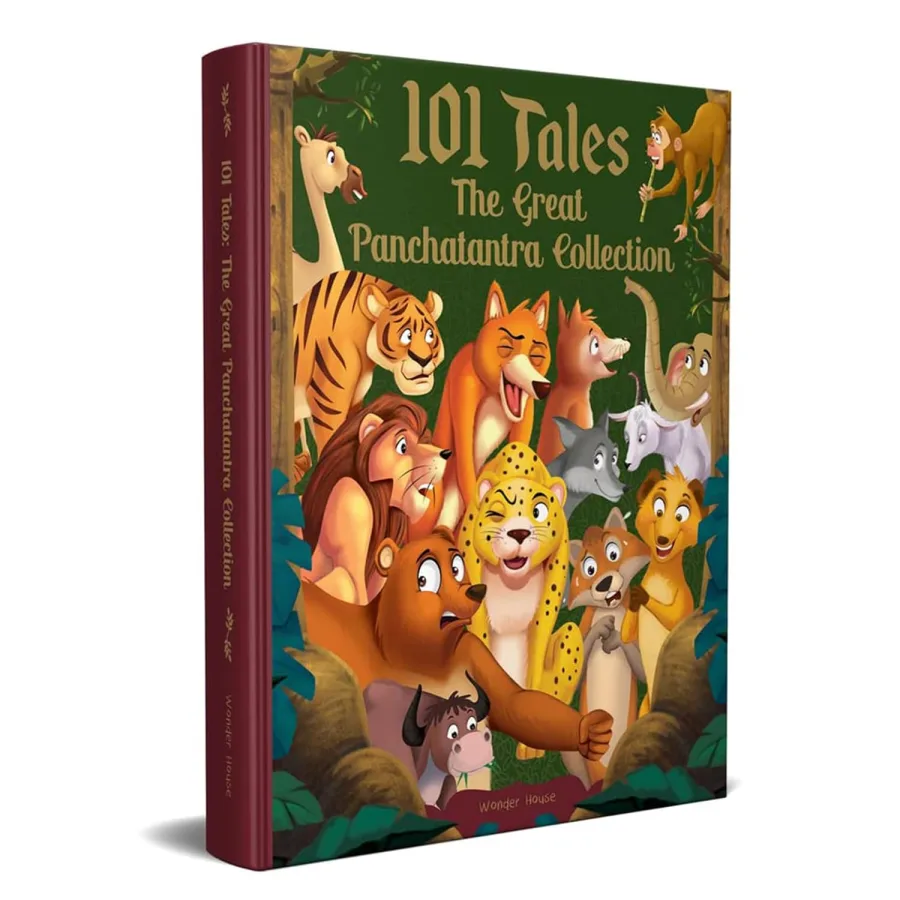
101 Tales The Great Panchatantra Collection - Collection of Witty Moral Stories For Kids For Persona
Hardcover
• 160 Pages
• ₹ 349.00
• English
• 9789390093953
No ratings yet
Children's Books
Children's Traditional Stories
Children's Fairy Tales, Folklore, Legends & Mythology Comics & Graphic Novels
| Publisher | Wonder House Books |
|---|---|
| ISBN13 | 9789390093953 |
| ASIN/SKU | 9390093953 |
| Book Format | Hardcover |
| Language | English |
| Pages | 160 |
| List Price | ₹ 349.00 |
| Publishing Date | 12/10/2020 |
| Dimensions | 21.59 x 27.94 x 1.2 cm |
| Weight | 800 g |
| Book Code | BD00056096 |
Buy this Book
Amazon Stores
Ebook Stores
Other Stores
Discover 101 Tales The Great Panchatantra Collection - Collection of Witty Moral Stories For Kids For Persona by Wonder House Books. This book is published by Wonder House Books in Hardcover format, ISBN 9789390093953, ASIN 9390093953, under Children's Books, Children's Traditional Stories, Children's Fairy Tales, Folklore, Legends and Mythology Comics and Graphic Novels.
Book Description
101 Tales The Great Panchatantra Collection - Collection of Witty Moral Stories For Kids For Personality Development (Hardback)
This compilation of 101 tales from the Panchatantra aims to guide the young readers about wise conduct, human nature, and the right path for attaining success in life. The stories are written in simple language, which makes them easily understandable and keeps the child glued to the book for hours. Each story in the book gives advice that can be followed by children, as well as adults.
Journey Through Classic Tales of Panchatantra!
Imparts valuable life lessons
Entertaining and engaging stories
Develops early reading skills
Features vibrant and detailed illustrations
Provides hours of screen-free entertainment and learning
This compilation of 101 tales from the Panchatantra aims to guide the young readers about wise conduct, human nature, and the right path for attaining success in life. The stories are written in simple language, which makes them easily understandable and keeps the child glued to the book for hours. Each story in the book gives advice that can be followed by children, as well as adults.
Journey Through Classic Tales of Panchatantra!
Imparts valuable life lessons
Entertaining and engaging stories
Develops early reading skills
Features vibrant and detailed illustrations
Provides hours of screen-free entertainment and learning
Author Biography
Wonder House has a dedicated team of editors and designers involved in the development of magnificent and enriching children books. The team pays special attention to develop age appropriate content and does extensive research on every topic included in the book. Our mission is to develop highly informative content which will help the children to master different skills. At Wonder House, we strive to make learning a joy.
Editorial Reviews
Editorial Reviews will be added soon…
Book Summary
101 Tales: The Great Panchatantra Collection by Wonder House Books is a colorful collection of 101 traditional Panchatantra-inspired stories created for young readers. The book brings together short tales featuring clever animals, kings, villagers, friends, enemies, travelers, and other memorable characters. Its main purpose is to entertain children while quietly teaching them about wisdom, friendship, honesty, courage, good judgment, and human nature. The publisher describes the collection as a guide to wise conduct and the right path toward success, with simple language and illustrations intended to make the stories accessible to children. The edition contains 160 pages and is aimed broadly at young readers around the early-school years.
The Panchatantra is one of India's best-known traditions of moral storytelling. Its stories frequently use animals who behave like people. A clever animal may outsmart a stronger opponent, a foolish character may suffer because of poor judgment, and friends may discover the importance of loyalty and cooperation. This combination of humor, adventure, and practical wisdom makes the stories enjoyable while giving children lessons that can be applied to everyday life.
Rather than presenting one continuous story, the book is made up of many short tales. Each story has its own characters, situation, problem, and conclusion. This structure makes the collection easy to read in small portions. A child can read one story at bedtime, during a quiet afternoon, or as part of a regular reading routine without needing to remember a complicated plot from one chapter to the next.
Many of the stories begin with a simple situation that gradually develops into a problem. A character may become too confident, trust the wrong person, act out of greed, ignore good advice, or make a decision without thinking about its consequences. The resulting situation gives the reader an opportunity to see why careful judgment matters.
One of the strongest themes throughout the collection is wisdom over physical strength. The strongest character is not always the winner. A small animal with intelligence and courage can sometimes defeat or escape from a much more powerful opponent. These stories encourage children to understand that intelligence, observation, patience, and clever thinking can be more useful than strength alone.
The stories also teach children to think before acting. Characters who make decisions impulsively often create unnecessary problems for themselves. In contrast, those who stop, observe the situation, and consider the consequences are more likely to find a successful solution. This is a simple but valuable lesson for young readers because children are gradually learning how their choices affect themselves and others.
Friendship is another recurring theme. Some tales show characters who depend on one another during difficult situations, while others warn about choosing friends carelessly. A trustworthy friend can provide support during danger, whereas a selfish or dishonest companion can create serious trouble. Through these stories, children learn that friendship involves trust, loyalty, cooperation, and mutual respect.
The collection also explores the importance of keeping promises and being trustworthy. Characters who lie or break agreements may gain something temporarily, but their actions often lead to larger problems. Honest characters, on the other hand, are more likely to maintain the trust of those around them. These stories introduce children to the idea that reputation is built through repeated choices.
Greed is another common weakness presented in the tales. A character may already have enough but become dissatisfied and attempt to obtain more. The desire for additional wealth, food, power, or possessions can lead to careless decisions. The resulting consequences show children that wanting more without considering the risks can cause them to lose what they already have.
The stories also emphasize contentment. This does not mean that children should never have ambitions or try to improve their circumstances. Instead, the tales suggest that people should appreciate what they have and avoid allowing endless desire to control their decisions. A character who is grateful and sensible often fares better than someone who is constantly dissatisfied.
Honesty is closely connected with these lessons. Some stories show characters attempting to deceive others for personal benefit. Their temporary success usually does not last because lies eventually become difficult to maintain. The moral structure of these tales encourages children to understand that truthfulness creates trust, while dishonesty can damage relationships and lead to unexpected consequences.
The collection also teaches courage, but courage is not always portrayed as physical bravery. Sometimes a character must speak the truth, admit a mistake, face a difficult situation, or stand up to someone more powerful. These examples help children understand that courage can involve making the right decision even when doing so is uncomfortable.
Another important lesson is patience. Characters who rush into action without understanding the situation can make serious mistakes. Those who wait, observe, and choose the right moment often succeed. For children, this can become a useful everyday lesson: not every problem needs to be solved immediately, and sometimes waiting and thinking can produce a better result.
The stories frequently explore human nature through animal characters. Animals may display jealousy, pride, fear, generosity, cleverness, selfishness, or loyalty. Because these characteristics are presented through fictional animals, children can recognize familiar human behaviors without feeling that they are being directly lectured about their own mistakes.
The use of talking animals is also important for imagination. A lion can become a ruler, a fox can become a clever strategist, a crow can become an observant character, and a small mouse can play an important role in solving a problem. This imaginative world allows children to enjoy storytelling while simultaneously thinking about real human qualities.
The book's illustrations make the stories more appealing to young readers. The publisher highlights the use of illustrations alongside simple storytelling, while the edition is positioned for young children and early readers. The pictures help children visualize the characters and settings and can make it easier for beginning readers to remain engaged with the stories.
The simple language is another useful feature. Panchatantra stories contain ideas about morality and human behavior that can sometimes be complex, but this collection presents them in a way intended to be easy for children to follow. This allows young readers to focus on the characters and events rather than struggling with complicated vocabulary.
The collection can also support reading development. Short stories encourage children to read independently because each tale has a manageable length. Completing a story provides a sense of achievement and may encourage the child to continue reading. Repeated exposure to simple narrative structures can also help children become familiar with characters, settings, actions, dialogue, and story conclusions.
Parents and teachers can use the book as more than a reading resource. After a story, they can ask children questions such as why a character made a particular decision, whether the character could have acted differently, or what the child would have done in the same situation. Such conversations can strengthen comprehension and encourage children to explain their reasoning.
The moral lessons also make the collection suitable for family storytelling. Adults can read the stories aloud and discuss them with children. Because the stories are short, they can easily become part of a bedtime routine or classroom storytelling session. The publisher and other book descriptions specifically position the collection for both independent reading and read-aloud use.
Another strength of the collection is that the morals are connected to actions and consequences. Instead of simply telling a child, “Do not be greedy,” a story can show a greedy character making a poor decision and facing the consequences. Instead of saying, “Be careful about whom you trust,” a story can demonstrate what happens when a character ignores warning signs. This makes the lessons easier to understand and remember.
The stories also show that intelligence involves understanding other people. A clever character does not merely know facts. They may recognize another character's intentions, identify danger, understand a hidden motive, or choose the right words at the right moment. This encourages children to develop observation and social awareness.
The Panchatantra is one of India's best-known traditions of moral storytelling. Its stories frequently use animals who behave like people. A clever animal may outsmart a stronger opponent, a foolish character may suffer because of poor judgment, and friends may discover the importance of loyalty and cooperation. This combination of humor, adventure, and practical wisdom makes the stories enjoyable while giving children lessons that can be applied to everyday life.
Rather than presenting one continuous story, the book is made up of many short tales. Each story has its own characters, situation, problem, and conclusion. This structure makes the collection easy to read in small portions. A child can read one story at bedtime, during a quiet afternoon, or as part of a regular reading routine without needing to remember a complicated plot from one chapter to the next.
Many of the stories begin with a simple situation that gradually develops into a problem. A character may become too confident, trust the wrong person, act out of greed, ignore good advice, or make a decision without thinking about its consequences. The resulting situation gives the reader an opportunity to see why careful judgment matters.
One of the strongest themes throughout the collection is wisdom over physical strength. The strongest character is not always the winner. A small animal with intelligence and courage can sometimes defeat or escape from a much more powerful opponent. These stories encourage children to understand that intelligence, observation, patience, and clever thinking can be more useful than strength alone.
The stories also teach children to think before acting. Characters who make decisions impulsively often create unnecessary problems for themselves. In contrast, those who stop, observe the situation, and consider the consequences are more likely to find a successful solution. This is a simple but valuable lesson for young readers because children are gradually learning how their choices affect themselves and others.
Friendship is another recurring theme. Some tales show characters who depend on one another during difficult situations, while others warn about choosing friends carelessly. A trustworthy friend can provide support during danger, whereas a selfish or dishonest companion can create serious trouble. Through these stories, children learn that friendship involves trust, loyalty, cooperation, and mutual respect.
The collection also explores the importance of keeping promises and being trustworthy. Characters who lie or break agreements may gain something temporarily, but their actions often lead to larger problems. Honest characters, on the other hand, are more likely to maintain the trust of those around them. These stories introduce children to the idea that reputation is built through repeated choices.
Greed is another common weakness presented in the tales. A character may already have enough but become dissatisfied and attempt to obtain more. The desire for additional wealth, food, power, or possessions can lead to careless decisions. The resulting consequences show children that wanting more without considering the risks can cause them to lose what they already have.
The stories also emphasize contentment. This does not mean that children should never have ambitions or try to improve their circumstances. Instead, the tales suggest that people should appreciate what they have and avoid allowing endless desire to control their decisions. A character who is grateful and sensible often fares better than someone who is constantly dissatisfied.
Honesty is closely connected with these lessons. Some stories show characters attempting to deceive others for personal benefit. Their temporary success usually does not last because lies eventually become difficult to maintain. The moral structure of these tales encourages children to understand that truthfulness creates trust, while dishonesty can damage relationships and lead to unexpected consequences.
The collection also teaches courage, but courage is not always portrayed as physical bravery. Sometimes a character must speak the truth, admit a mistake, face a difficult situation, or stand up to someone more powerful. These examples help children understand that courage can involve making the right decision even when doing so is uncomfortable.
Another important lesson is patience. Characters who rush into action without understanding the situation can make serious mistakes. Those who wait, observe, and choose the right moment often succeed. For children, this can become a useful everyday lesson: not every problem needs to be solved immediately, and sometimes waiting and thinking can produce a better result.
The stories frequently explore human nature through animal characters. Animals may display jealousy, pride, fear, generosity, cleverness, selfishness, or loyalty. Because these characteristics are presented through fictional animals, children can recognize familiar human behaviors without feeling that they are being directly lectured about their own mistakes.
The use of talking animals is also important for imagination. A lion can become a ruler, a fox can become a clever strategist, a crow can become an observant character, and a small mouse can play an important role in solving a problem. This imaginative world allows children to enjoy storytelling while simultaneously thinking about real human qualities.
The book's illustrations make the stories more appealing to young readers. The publisher highlights the use of illustrations alongside simple storytelling, while the edition is positioned for young children and early readers. The pictures help children visualize the characters and settings and can make it easier for beginning readers to remain engaged with the stories.
The simple language is another useful feature. Panchatantra stories contain ideas about morality and human behavior that can sometimes be complex, but this collection presents them in a way intended to be easy for children to follow. This allows young readers to focus on the characters and events rather than struggling with complicated vocabulary.
The collection can also support reading development. Short stories encourage children to read independently because each tale has a manageable length. Completing a story provides a sense of achievement and may encourage the child to continue reading. Repeated exposure to simple narrative structures can also help children become familiar with characters, settings, actions, dialogue, and story conclusions.
Parents and teachers can use the book as more than a reading resource. After a story, they can ask children questions such as why a character made a particular decision, whether the character could have acted differently, or what the child would have done in the same situation. Such conversations can strengthen comprehension and encourage children to explain their reasoning.
The moral lessons also make the collection suitable for family storytelling. Adults can read the stories aloud and discuss them with children. Because the stories are short, they can easily become part of a bedtime routine or classroom storytelling session. The publisher and other book descriptions specifically position the collection for both independent reading and read-aloud use.
Another strength of the collection is that the morals are connected to actions and consequences. Instead of simply telling a child, “Do not be greedy,” a story can show a greedy character making a poor decision and facing the consequences. Instead of saying, “Be careful about whom you trust,” a story can demonstrate what happens when a character ignores warning signs. This makes the lessons easier to understand and remember.
The stories also show that intelligence involves understanding other people. A clever character does not merely know facts. They may recognize another character's intentions, identify danger, understand a hidden motive, or choose the right words at the right moment. This encourages children to develop observation and social awareness.
Sample Chapters
Sample Chapters will be added soon…
Reader Reviews
No reviews yet.
101 Tales The Great Panchatantra Collection - Collection of Witty Moral Stories For Kids For Persona
Download Cover Image
Do you want to download the full cover image for 101 Tales The Great Panchatantra Collection - Collection of Witty Moral Stories For Kids For Persona?