
PW EaJEE Handwritten Notes For Inorganic Chemistry By Om Pandey | Chapterwise and Topicwise Question
Paperback
• 499 Pages
• ₹ 599.00
• English
• 9789371535366
No ratings yet
| Publisher | Physics Wallah Limited |
|---|---|
| ISBN13 | 9789371535366 |
| ASIN/SKU | 9371535369 |
| Book Format | Paperback |
| Language | English |
| Pages | 499 |
| List Price | ₹ 599.00 |
| Publishing Date | 05/07/2025 |
| Dimensions | 28 x 22 x 2 cm |
| Weight | 300 g |
| Book Code | BD00056070 |
Buy this Book
Amazon Stores
Ebook Stores
Other Stores
Discover PW EaJEE Handwritten Notes For Inorganic Chemistry By Om Pandey | Chapterwise and Topicwise Question by Om Pandey. This book is published by Physics Wallah Limited in Paperback format, ISBN 9789371535366, ASIN 9371535369, under Exam Preparation, JEE.
Book Description
Tackle JEE Inorganic Chemistry with Confidence – No Topic Too Tough!
Master Inorganic Chemistry for JEE Main & Advanced with ‘PW EaJEE Handwritten Notes For Inorganic Chemistry By Om Pandey’ – a powerhouse of conceptual clarity, creative learning, and exam-ready practice. Designed for aspirants who want the edge in JEE, this book combines detailed theory with multicoloured handwritten notes and integrated PYQs to bring the classroom to your desk.
How will this Book Help You?
Complete Theory + PYQs: Covers the entire syllabus for JEE Main & Advanced with Previous Year Questions integrated topic-wise for complete practice.
Jwala Concept by Om Sir: Learn through the unique Jwala Concept – a simplified and powerful learning method developed by Om Pandey to help students grasp tricky topics quickly.
Multicoloured Handwritten Notes: Visual learning made easier with colour-coded notes that enhance retention and break monotony.
Real Classroom Vibes: Experience personalized learning with notes that replicate Om Sir’s engaging classroom style.
Easy Learning of Inorganic Chemistry: Every topic is broken into digestible chunks for easier understanding and long-term retention.
Creative Core Concept Presentation: Visual representations, charts, and creative formatting for quick grasping of key principles.
NCERT Decoded in Simple Language: Complex NCERT content is simplified for better clarity and confidence in fundamentals.
PYQs Integrated with Topics: Practice exam-level questions exactly where they’re needed—right after the concept is taught.
Perfect for: JEE Main | JEE Advanced | NCERT-based Boards Prep
Master Inorganic Chemistry like never before – with the notes that bring Om Sir’s magic to life!
Master Inorganic Chemistry for JEE Main & Advanced with ‘PW EaJEE Handwritten Notes For Inorganic Chemistry By Om Pandey’ – a powerhouse of conceptual clarity, creative learning, and exam-ready practice. Designed for aspirants who want the edge in JEE, this book combines detailed theory with multicoloured handwritten notes and integrated PYQs to bring the classroom to your desk.
How will this Book Help You?
Complete Theory + PYQs: Covers the entire syllabus for JEE Main & Advanced with Previous Year Questions integrated topic-wise for complete practice.
Jwala Concept by Om Sir: Learn through the unique Jwala Concept – a simplified and powerful learning method developed by Om Pandey to help students grasp tricky topics quickly.
Multicoloured Handwritten Notes: Visual learning made easier with colour-coded notes that enhance retention and break monotony.
Real Classroom Vibes: Experience personalized learning with notes that replicate Om Sir’s engaging classroom style.
Easy Learning of Inorganic Chemistry: Every topic is broken into digestible chunks for easier understanding and long-term retention.
Creative Core Concept Presentation: Visual representations, charts, and creative formatting for quick grasping of key principles.
NCERT Decoded in Simple Language: Complex NCERT content is simplified for better clarity and confidence in fundamentals.
PYQs Integrated with Topics: Practice exam-level questions exactly where they’re needed—right after the concept is taught.
Perfect for: JEE Main | JEE Advanced | NCERT-based Boards Prep
Master Inorganic Chemistry like never before – with the notes that bring Om Sir’s magic to life!
Author Biography
Author Biography will be added soon…
Editorial Reviews
Editorial Reviews will be added soon…
Book Summary
PW EaJEE Handwritten Notes for Inorganic Chemistry by Om Pandey is a JEE-focused study and revision book designed for students preparing for both JEE Main and JEE Advanced. Published by Physics Wallah, the book combines handwritten-style explanations with chapterwise and topicwise questions, covering the complete JEE Main and Advanced inorganic chemistry syllabus. The official PW listing identifies it as a 2025 publication in English and states that it includes handpicked previous-year questions (PYQs).
The main purpose of the book is to make inorganic chemistry easier to study, revise, and retain. Inorganic chemistry can be challenging because it contains a mixture of concepts, periodic trends, chemical reactions, properties of elements and compounds, exceptions, facts, and information that students are often expected to remember accurately. Instead of requiring students to create extensive notes from lectures or textbooks, this resource presents important material in a compact handwritten-notes format.
The handwritten presentation is one of the distinctive features of the book. It is intended to give students the feeling of studying from organized classroom notes rather than reading a conventional textbook. This format can make revision quicker because important points can be visually separated and remembered more easily. Product descriptions and user feedback also highlight the book's visual presentation, concise structure, and usefulness for revision.
A major focus of the book is conceptual clarity. Inorganic chemistry is sometimes treated as a subject that can be mastered simply by memorizing facts, but that approach can become difficult when students encounter unfamiliar questions. Understanding why a trend occurs, why a compound has a particular property, or why an exception exists makes information easier to remember and apply. The notes therefore aim to provide students with the conceptual foundation needed before they begin intensive question practice.
The book is designed around the requirements of JEE Main and JEE Advanced, which means students are expected to prepare for different levels of questioning. JEE Main commonly tests fundamental concepts and their application, while JEE Advanced can require deeper reasoning, combinations of concepts, and careful interpretation of information. Preparing for both examinations therefore requires more than memorizing isolated facts.
The chapterwise organization helps students study the syllabus systematically. Rather than searching through scattered material, students can select a particular chapter, study its important concepts, and then move to related questions. This structure is especially useful when students are revising the syllabus before tests or examinations.
The topicwise question approach is equally important. A student may understand an entire chapter but still have difficulty with one particular concept. Topicwise questions make it easier to identify such weak areas. Instead of simply completing a large mixed question set, students can focus on one concept at a time and strengthen it through targeted practice.
Previous-year questions are an essential component of JEE preparation because they show students how concepts have actually been tested. The book includes handpicked PYQs, allowing students to connect the theory in the notes with real examination-style questions. The official product description specifically identifies chapterwise and topicwise questions and handpicked PYQs as part of the book.
Solving previous-year questions also helps students understand the level of difficulty expected in the examination. A topic may appear simple when read in a textbook, but examination questions can combine multiple ideas or present familiar information in an unfamiliar way. PYQs help students become comfortable with this difference.
Another important feature is the emphasis on revision. Inorganic chemistry contains a large amount of information, and students need to revisit it repeatedly. A concise handwritten resource can be particularly helpful before school tests, coaching examinations, JEE Main sessions, and JEE Advanced preparation. Instead of rereading lengthy chapters, students can use the notes to refresh important concepts and then spend more time solving questions.
The book can be especially valuable for students who are following Om Pandey's teaching approach. Handwritten notes can help students preserve the structure and style of classroom explanations in a more compact form. Some user feedback on the official PW listing describes the book as useful for understanding concepts and important questions, while another review specifically mentions that it is helpful for revision.
Inorganic chemistry requires a strong understanding of the periodic table and periodic trends. Students need to understand how properties change across periods and down groups and how factors such as atomic size, ionization energy, electron affinity, electronegativity, and effective nuclear charge influence chemical behavior. These ideas are not isolated facts; they help explain the properties of elements and their compounds.
The book's conceptual approach can help students connect these trends with actual chemical behavior. Once the underlying pattern is understood, many facts become easier to remember. This is especially useful for JEE because questions may ask students to compare elements, identify trends, or explain unusual behavior.
Another important area of inorganic chemistry is chemical bonding. Understanding how atoms form bonds and how bonding influences molecular structure and properties provides a foundation for many later topics. Concepts involving ionic bonding, covalent bonding, coordinate bonding, molecular shapes, hybridization, and related ideas can appear in both direct and application-based questions.
A strong foundation in bonding also makes later inorganic topics easier because students can use bonding principles to explain properties rather than memorize every detail independently. This is an example of how conceptual learning can reduce the amount of information that has to be memorized mechanically.
The study of coordination compounds is another important part of advanced inorganic chemistry. Students need to understand terms such as ligands, coordination number, oxidation state, coordination geometry, and related concepts. Such topics can initially appear complicated because several pieces of information have to be considered at once. Organized notes and focused questions can make the learning process more manageable.
The book is also useful for reviewing important reactions and properties. Inorganic chemistry contains many reactions that students need to recognize quickly. Repeated revision helps students remember which substances react, what products are formed, and under what conditions particular reactions occur.
Memorization still has an important role in inorganic chemistry, but it becomes more effective when supported by organization and understanding. Students can group related information, identify patterns, and create mental connections rather than trying to memorize every fact independently.
Another important aspect of JEE preparation is learning exceptions. Chemistry contains many trends that work in general but have important exceptions. Students who blindly memorize a periodic trend may make mistakes when a question presents an exceptional case. A well-organized revision resource can help students distinguish between general rules and important exceptions.
The book can also help students save time. Preparing for JEE requires students to study Physics, Chemistry, and Mathematics simultaneously. Creating detailed notes for every subject can consume considerable time. A ready-made handwritten resource allows students to focus more of their study time on understanding and question solving.
However, the book should not necessarily be treated as a complete replacement for NCERT Chemistry. For JEE inorganic chemistry, NCERT remains an important source, particularly because many questions depend on specific facts, descriptions, trends, and reactions presented in the prescribed material. The handwritten notes can work effectively as a supplementary resource for organizing and revising that knowledge.
A good study strategy is to first understand a topic through classroom teaching and NCERT, then use the handwritten notes to consolidate the important points. After that, students should solve the chapterwise and topicwise questions and finally attempt mixed or full-length examination papers.
The book can also be useful for backlog management. Students who have missed lectures or fallen behind in their preparation may find a concise set of notes more manageable than returning to several hours of lectures.
The main purpose of the book is to make inorganic chemistry easier to study, revise, and retain. Inorganic chemistry can be challenging because it contains a mixture of concepts, periodic trends, chemical reactions, properties of elements and compounds, exceptions, facts, and information that students are often expected to remember accurately. Instead of requiring students to create extensive notes from lectures or textbooks, this resource presents important material in a compact handwritten-notes format.
The handwritten presentation is one of the distinctive features of the book. It is intended to give students the feeling of studying from organized classroom notes rather than reading a conventional textbook. This format can make revision quicker because important points can be visually separated and remembered more easily. Product descriptions and user feedback also highlight the book's visual presentation, concise structure, and usefulness for revision.
A major focus of the book is conceptual clarity. Inorganic chemistry is sometimes treated as a subject that can be mastered simply by memorizing facts, but that approach can become difficult when students encounter unfamiliar questions. Understanding why a trend occurs, why a compound has a particular property, or why an exception exists makes information easier to remember and apply. The notes therefore aim to provide students with the conceptual foundation needed before they begin intensive question practice.
The book is designed around the requirements of JEE Main and JEE Advanced, which means students are expected to prepare for different levels of questioning. JEE Main commonly tests fundamental concepts and their application, while JEE Advanced can require deeper reasoning, combinations of concepts, and careful interpretation of information. Preparing for both examinations therefore requires more than memorizing isolated facts.
The chapterwise organization helps students study the syllabus systematically. Rather than searching through scattered material, students can select a particular chapter, study its important concepts, and then move to related questions. This structure is especially useful when students are revising the syllabus before tests or examinations.
The topicwise question approach is equally important. A student may understand an entire chapter but still have difficulty with one particular concept. Topicwise questions make it easier to identify such weak areas. Instead of simply completing a large mixed question set, students can focus on one concept at a time and strengthen it through targeted practice.
Previous-year questions are an essential component of JEE preparation because they show students how concepts have actually been tested. The book includes handpicked PYQs, allowing students to connect the theory in the notes with real examination-style questions. The official product description specifically identifies chapterwise and topicwise questions and handpicked PYQs as part of the book.
Solving previous-year questions also helps students understand the level of difficulty expected in the examination. A topic may appear simple when read in a textbook, but examination questions can combine multiple ideas or present familiar information in an unfamiliar way. PYQs help students become comfortable with this difference.
Another important feature is the emphasis on revision. Inorganic chemistry contains a large amount of information, and students need to revisit it repeatedly. A concise handwritten resource can be particularly helpful before school tests, coaching examinations, JEE Main sessions, and JEE Advanced preparation. Instead of rereading lengthy chapters, students can use the notes to refresh important concepts and then spend more time solving questions.
The book can be especially valuable for students who are following Om Pandey's teaching approach. Handwritten notes can help students preserve the structure and style of classroom explanations in a more compact form. Some user feedback on the official PW listing describes the book as useful for understanding concepts and important questions, while another review specifically mentions that it is helpful for revision.
Inorganic chemistry requires a strong understanding of the periodic table and periodic trends. Students need to understand how properties change across periods and down groups and how factors such as atomic size, ionization energy, electron affinity, electronegativity, and effective nuclear charge influence chemical behavior. These ideas are not isolated facts; they help explain the properties of elements and their compounds.
The book's conceptual approach can help students connect these trends with actual chemical behavior. Once the underlying pattern is understood, many facts become easier to remember. This is especially useful for JEE because questions may ask students to compare elements, identify trends, or explain unusual behavior.
Another important area of inorganic chemistry is chemical bonding. Understanding how atoms form bonds and how bonding influences molecular structure and properties provides a foundation for many later topics. Concepts involving ionic bonding, covalent bonding, coordinate bonding, molecular shapes, hybridization, and related ideas can appear in both direct and application-based questions.
A strong foundation in bonding also makes later inorganic topics easier because students can use bonding principles to explain properties rather than memorize every detail independently. This is an example of how conceptual learning can reduce the amount of information that has to be memorized mechanically.
The study of coordination compounds is another important part of advanced inorganic chemistry. Students need to understand terms such as ligands, coordination number, oxidation state, coordination geometry, and related concepts. Such topics can initially appear complicated because several pieces of information have to be considered at once. Organized notes and focused questions can make the learning process more manageable.
The book is also useful for reviewing important reactions and properties. Inorganic chemistry contains many reactions that students need to recognize quickly. Repeated revision helps students remember which substances react, what products are formed, and under what conditions particular reactions occur.
Memorization still has an important role in inorganic chemistry, but it becomes more effective when supported by organization and understanding. Students can group related information, identify patterns, and create mental connections rather than trying to memorize every fact independently.
Another important aspect of JEE preparation is learning exceptions. Chemistry contains many trends that work in general but have important exceptions. Students who blindly memorize a periodic trend may make mistakes when a question presents an exceptional case. A well-organized revision resource can help students distinguish between general rules and important exceptions.
The book can also help students save time. Preparing for JEE requires students to study Physics, Chemistry, and Mathematics simultaneously. Creating detailed notes for every subject can consume considerable time. A ready-made handwritten resource allows students to focus more of their study time on understanding and question solving.
However, the book should not necessarily be treated as a complete replacement for NCERT Chemistry. For JEE inorganic chemistry, NCERT remains an important source, particularly because many questions depend on specific facts, descriptions, trends, and reactions presented in the prescribed material. The handwritten notes can work effectively as a supplementary resource for organizing and revising that knowledge.
A good study strategy is to first understand a topic through classroom teaching and NCERT, then use the handwritten notes to consolidate the important points. After that, students should solve the chapterwise and topicwise questions and finally attempt mixed or full-length examination papers.
The book can also be useful for backlog management. Students who have missed lectures or fallen behind in their preparation may find a concise set of notes more manageable than returning to several hours of lectures.
Sample Chapters
Sample Chapters will be added soon…
Reader Reviews
No reviews yet.
PW EaJEE Handwritten Notes For Inorganic Chemistry By Om Pandey | Chapterwise and Topicwise Question
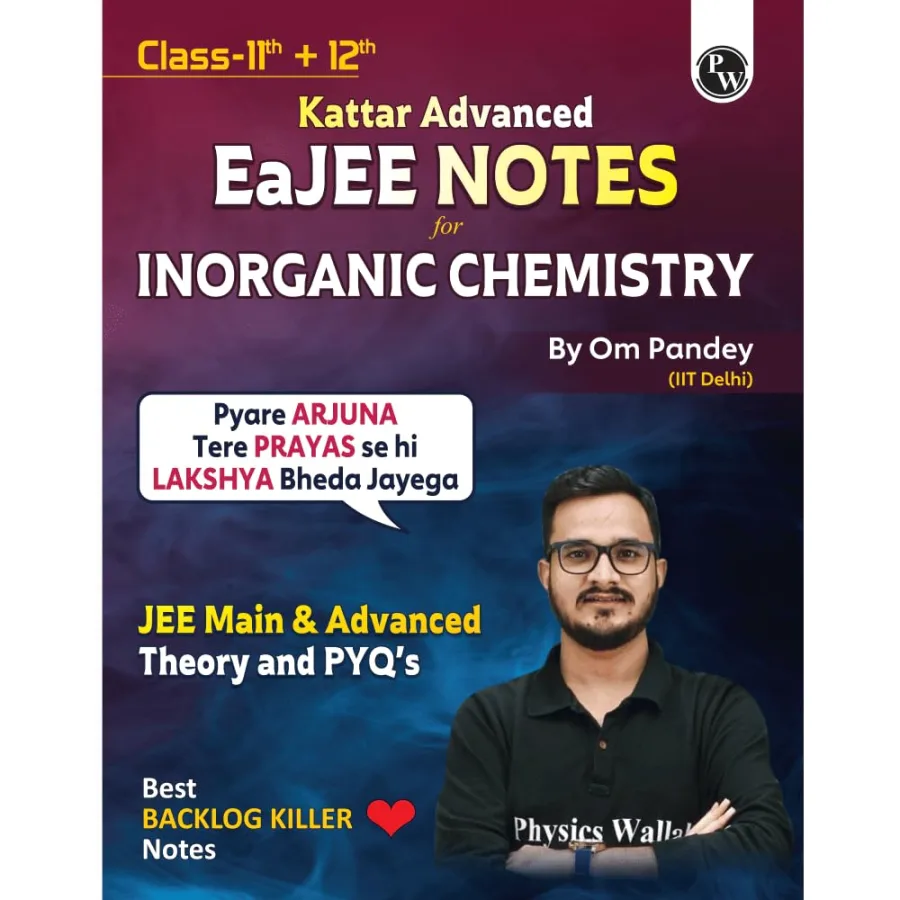
Download Cover Image
Do you want to download the full cover image for PW EaJEE Handwritten Notes For Inorganic Chemistry By Om Pandey | Chapterwise and Topicwise Question?