
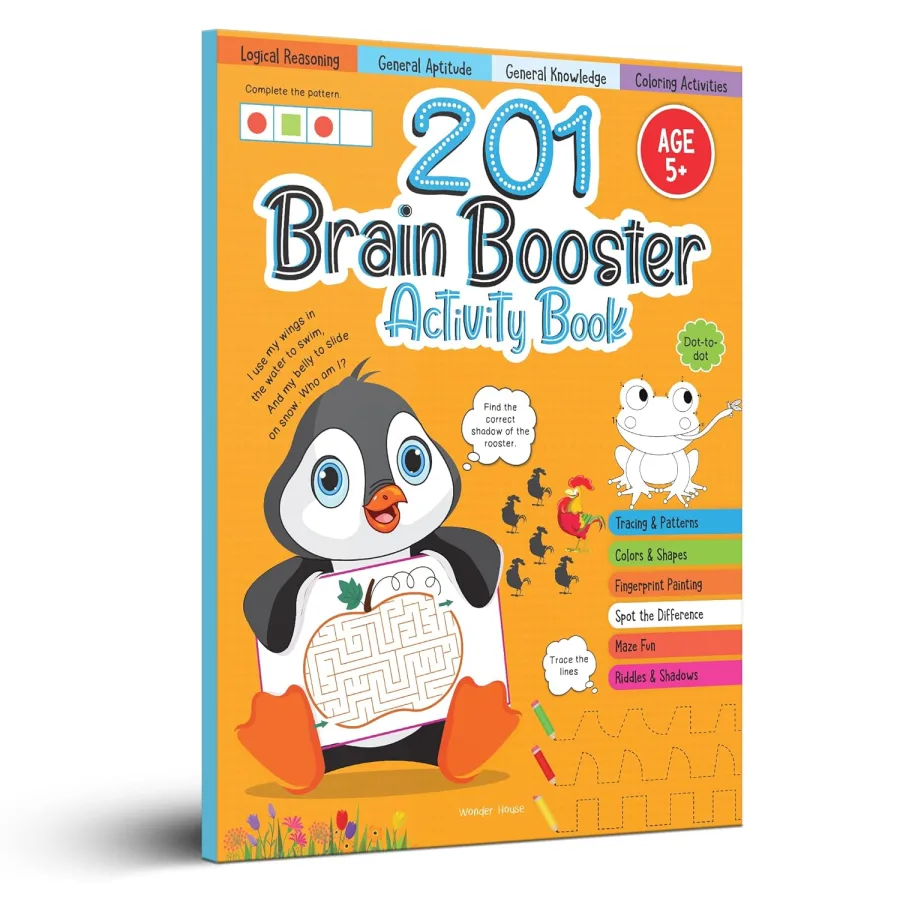
201 Brain Booster Activity Book - Fun Activities and Exercises For Children | Tracing & Pattern
Paperback
• 48 Pages
• ₹ 99.00
• English
• 9789354404603
No ratings yet
| Publisher | Wonder House Books |
|---|---|
| ISBN13 | 9789354404603 |
| ASIN/SKU | 935440460X |
| Book Format | Paperback |
| Language | English |
| Pages | 48 |
| List Price | ₹ 99.00 |
| Publishing Date | 31/08/2022 |
| Dimensions | 27.99 x 0.51 x 21.49 cm |
| Weight | 146 g |
| Book Code | BD00056047 |
Buy this Book
Amazon Stores
Ebook Stores
Other Stores
Discover 201 Brain Booster Activity Book - Fun Activities and Exercises For Children | Tracing and Pattern by Wonder House Books. This book is published by Wonder House Books in Paperback format, ISBN 9789354404603, ASIN 935440460X, under Children's Books, Children's Early Learning Books on the Alphabet, Puzzle Books for Children.
Book Description
Children learn new concepts each day and this boosts their understanding and allows them to think and reason. 201 Brain Booster Activity Book expands the horizons of young learners with over 200 engrossing activities. Gorgeous illustrations will aid in enhancing the critical thinking of young learners and will promote relaxation.
This activity book helps in:
Understanding of various topics
Develops reasoning and cognitive skills
Develops a confident learner
Learning through engaging activities
Staying productive with age-appropriate concept learning
This activity book helps in:
Understanding of various topics
Develops reasoning and cognitive skills
Develops a confident learner
Learning through engaging activities
Staying productive with age-appropriate concept learning
Author Biography
Wonder House has a dedicated team of editors and designers involved in the development of magnificent and enriching children books. The team pays special attention to develop age appropriate content and does extensive research on every topic included in the book. Our mission is to develop highly informative content which will help the children to master different skills. At Wonder House, we strive to make learning a joy.
Editorial Reviews
Arihant All in One Science (Exploration) Class 9 for CBSE Exam 2026–27 by Siddhartha Shankar is a comprehensive study and revision guide designed for students preparing for the Class 9 CBSE Science examination. Based on the NCERT curriculum, the book aims to bring together the essential theory, explanations, examples, practice questions, and examination-oriented preparation that a student needs in one place. Rather than functioning only as a supplementary question bank, it is designed to support students throughout their academic preparation, from understanding fundamental concepts to revising important material before examinations.
The main purpose of the book is to make Class 9 Science easier to study in a structured manner. Science at this level introduces students to concepts from Physics, Chemistry, and Biology that form the foundation for higher classes. Students are expected not only to remember definitions but also to understand processes, relationships, diagrams, formulas, and applications. The book therefore follows the NCERT-based syllabus while presenting concepts in a more examination-friendly format.
The Chemistry portion introduces students to the basic nature and structure of matter. One of the foundational ideas is that matter is made up of particles and that these particles have specific characteristics. Students explore the different states of matter—solid, liquid, and gas—and learn how changes in temperature and pressure can affect these states. Concepts such as melting, freezing, evaporation, condensation, and sublimation help students understand how matter changes from one form to another.
The book also develops an understanding of the physical nature of matter through concepts such as diffusion, density, and the movement of particles. These ideas are important because they provide a foundation for understanding more advanced chemistry later. Instead of treating matter as something static, students learn to see it as a system of particles that are continuously interacting and changing.
Another major area is the classification of matter. Students learn about mixtures and pure substances and the difference between homogeneous and heterogeneous mixtures. The study of solutions, suspensions, and colloids helps learners understand how substances can be combined and separated. Methods of separation, such as filtration, evaporation, centrifugation, distillation, and chromatography, demonstrate how scientific principles can be applied to everyday situations.
The Chemistry section then moves toward atoms and molecules. Students are introduced to the basic laws of chemical combination and the ideas behind atomic and molecular structure. Understanding atoms is essential because it provides the foundation for chemistry as a whole. Students learn about symbols, atomic mass, molecular mass, and the representation of substances through chemical formulae. These concepts can initially seem abstract, so a structured explanation and repeated practice are particularly useful at this stage.
The Physics section introduces students to the language and concepts used to describe the physical world. Motion is one of the major starting points. Students learn about distance, displacement, speed, velocity, acceleration, and graphical representation of motion. These concepts help students understand how objects move and how their motion can be measured and represented mathematically.
The book also introduces Newton's laws of motion and the concept of force. Students learn that forces can change the state of motion of an object and that motion depends on the interaction between objects. Newton's laws are particularly important because they form the basis for understanding many everyday phenomena. Examples involving pushing, pulling, acceleration, and changes in motion help connect abstract principles with familiar experiences.
The main purpose of the book is to make Class 9 Science easier to study in a structured manner. Science at this level introduces students to concepts from Physics, Chemistry, and Biology that form the foundation for higher classes. Students are expected not only to remember definitions but also to understand processes, relationships, diagrams, formulas, and applications. The book therefore follows the NCERT-based syllabus while presenting concepts in a more examination-friendly format.
The Chemistry portion introduces students to the basic nature and structure of matter. One of the foundational ideas is that matter is made up of particles and that these particles have specific characteristics. Students explore the different states of matter—solid, liquid, and gas—and learn how changes in temperature and pressure can affect these states. Concepts such as melting, freezing, evaporation, condensation, and sublimation help students understand how matter changes from one form to another.
The book also develops an understanding of the physical nature of matter through concepts such as diffusion, density, and the movement of particles. These ideas are important because they provide a foundation for understanding more advanced chemistry later. Instead of treating matter as something static, students learn to see it as a system of particles that are continuously interacting and changing.
Another major area is the classification of matter. Students learn about mixtures and pure substances and the difference between homogeneous and heterogeneous mixtures. The study of solutions, suspensions, and colloids helps learners understand how substances can be combined and separated. Methods of separation, such as filtration, evaporation, centrifugation, distillation, and chromatography, demonstrate how scientific principles can be applied to everyday situations.
The Chemistry section then moves toward atoms and molecules. Students are introduced to the basic laws of chemical combination and the ideas behind atomic and molecular structure. Understanding atoms is essential because it provides the foundation for chemistry as a whole. Students learn about symbols, atomic mass, molecular mass, and the representation of substances through chemical formulae. These concepts can initially seem abstract, so a structured explanation and repeated practice are particularly useful at this stage.
The Physics section introduces students to the language and concepts used to describe the physical world. Motion is one of the major starting points. Students learn about distance, displacement, speed, velocity, acceleration, and graphical representation of motion. These concepts help students understand how objects move and how their motion can be measured and represented mathematically.
The book also introduces Newton's laws of motion and the concept of force. Students learn that forces can change the state of motion of an object and that motion depends on the interaction between objects. Newton's laws are particularly important because they form the basis for understanding many everyday phenomena. Examples involving pushing, pulling, acceleration, and changes in motion help connect abstract principles with familiar experiences.
Book Summary
201 Brain Booster Activity Book by Wonder House Books is an activity-based learning book created to encourage young children to learn through puzzles, tracing exercises, patterns, observation activities, and other simple challenges. Instead of presenting learning as a traditional lesson in which children simply read information and answer questions, the book uses hands-on activities to develop important early skills. Its main purpose is to make learning enjoyable while helping children strengthen concentration, logical thinking, observation, coordination, memory, and basic problem-solving abilities.
The book contains 201 activities, giving children a large variety of exercises to work through. This variety is important because young learners can quickly lose interest when they are asked to repeat the same type of task for too long. By moving between tracing, patterns, puzzles, matching, identification, and other activities, the book gives children opportunities to use different kinds of thinking. Each activity can be treated as a small challenge that encourages the child to observe carefully, think about the answer, and complete the task independently or with limited guidance.
Tracing is one of the important elements of the book. For young children, tracing is not merely a handwriting exercise. It helps them develop the controlled hand movements needed for writing. When children follow lines, shapes, or patterns, their eyes guide their hands, helping to strengthen hand-eye coordination. Repeated tracing can also improve fine motor control and prepare children for later writing activities involving letters and numbers.
Pattern activities introduce children to the idea of repetition and sequence. A pattern may involve shapes, lines, objects, or other visual elements that follow a particular order. Children have to observe what is happening, identify the rule, and determine what should come next. This simple process develops early logical thinking. It teaches children to look for relationships rather than simply recognizing individual objects.
The book's brain-boosting approach also encourages observation. Many early-learning activities require children to look carefully at pictures and identify differences, similarities, missing elements, or matching objects. These exercises help children become more attentive to visual details. Such attention is useful in many areas of learning because children need to observe information accurately before they can understand or remember it.
Matching activities can strengthen recognition and classification skills. A child may be asked to connect related objects, identify pairs, or match pictures according to a particular characteristic. These tasks teach children to notice relationships between things. They also introduce the early idea of categorization, which becomes important later in mathematics, science, language, and everyday reasoning.
Puzzles provide another important type of challenge. A puzzle requires the child to pause and think rather than simply follow a familiar routine. Even simple puzzles can encourage children to consider several possibilities before deciding on an answer. This develops problem-solving habits and can also increase patience. When a child cannot immediately solve an activity, they learn that a problem can be approached again from a different direction.
The book also supports memory development through activities that require children to remember information or recognize previously seen patterns. Memory is closely connected with learning, and young children develop it through repeated exposure and active recall. Activities that require children to remember locations, sequences, shapes, or relationships can turn memory practice into an enjoyable game.
Another major benefit of an activity book is that it encourages children to learn by doing. Instead of passively looking at information, children must interact with the page. They may draw a line, circle an answer, trace a shape, identify an object, complete a pattern, or solve a puzzle. This active participation can make learning more engaging and can help children remember what they have practiced.
The variety of activities also allows children with different strengths to experience success. One child may enjoy tracing and drawing, while another may prefer puzzles or matching exercises. Some children may be naturally strong at visual observation, while others may need more practice with patterns and sequencing. Because the book includes many types of activities, it provides opportunities for children to develop weaker areas without making the learning experience feel like formal remediation.
The activities can also support concentration. Young children are still learning how to focus their attention on one task at a time. An activity that has a clear beginning and end gives them a manageable goal. Completing one page can provide a small sense of achievement and encourage them to continue with another activity. Parents and teachers can make this process more effective by allowing children to work at their own pace rather than expecting them to finish many pages in one sitting.
The book can be especially useful as a supplementary learning resource at home. Parents can use it during free time, after school, or as part of a structured learning routine. Because the activities are varied, the book can also be used repeatedly for different purposes. A child might focus on tracing one day and spend another day working on patterns or puzzles.
Adults can make the activities even more meaningful by discussing them with children. Instead of simply telling a child whether an answer is correct, a parent can ask questions such as, “Why do you think this comes next?” or “What is different between these two pictures?” Such questions encourage children to explain their thinking. This is valuable because the goal of brain-building activities is not only to produce correct answers but also to develop reasoning and observation.
The tracing and pattern exercises also help establish a foundation for school readiness. Before children begin formal writing and mathematics, they need basic control over their hands, an ability to follow instructions, visual discrimination, and an understanding of sequences. Activities that strengthen these skills can make the transition to structured classroom learning smoother.
At the same time, the book presents learning as something enjoyable. The phrase “brain booster” suggests challenge, but the activities are intended to feel more like games than difficult academic exercises. This is particularly appropriate for young children, who often learn best when curiosity and play are involved. When children enjoy an activity, they are more likely to repeat it and remain engaged.
Overall, 201 Brain Booster Activity Book by Wonder House Books is a broad early-learning activity collection designed to combine fun with skill development. Its 201 activities provide children with opportunities to practice tracing, patterns, observation, matching, memory, puzzles, and problem-solving. The book does not focus on one narrow academic subject; instead, it works across several foundational abilities that children need for future learning.
The greatest value of the book lies in its combination of repetition and variety. Children receive enough practice to strengthen important skills while moving through different types of activities that keep the experience interesting. Tracing supports fine motor control, patterns encourage logical thinking, puzzles develop problem-solving, and observation exercises improve attention to detail. Used regularly and with appropriate adult encouragement, the book can become a useful part of a child's early-learning routine.
Ultimately, 201 Brain Booster Activity Book encourages children to approach learning with curiosity rather than pressure. Each small activity gives them a chance to observe, think, try, make mistakes, and try again. By turning these basic learning skills into enjoyable exercises, the book helps children develop greater confidence and independence while preparing them for the more structured reading, writing, mathematics, and problem-solving tasks they will encounter as they progress through school.
The book contains 201 activities, giving children a large variety of exercises to work through. This variety is important because young learners can quickly lose interest when they are asked to repeat the same type of task for too long. By moving between tracing, patterns, puzzles, matching, identification, and other activities, the book gives children opportunities to use different kinds of thinking. Each activity can be treated as a small challenge that encourages the child to observe carefully, think about the answer, and complete the task independently or with limited guidance.
Tracing is one of the important elements of the book. For young children, tracing is not merely a handwriting exercise. It helps them develop the controlled hand movements needed for writing. When children follow lines, shapes, or patterns, their eyes guide their hands, helping to strengthen hand-eye coordination. Repeated tracing can also improve fine motor control and prepare children for later writing activities involving letters and numbers.
Pattern activities introduce children to the idea of repetition and sequence. A pattern may involve shapes, lines, objects, or other visual elements that follow a particular order. Children have to observe what is happening, identify the rule, and determine what should come next. This simple process develops early logical thinking. It teaches children to look for relationships rather than simply recognizing individual objects.
The book's brain-boosting approach also encourages observation. Many early-learning activities require children to look carefully at pictures and identify differences, similarities, missing elements, or matching objects. These exercises help children become more attentive to visual details. Such attention is useful in many areas of learning because children need to observe information accurately before they can understand or remember it.
Matching activities can strengthen recognition and classification skills. A child may be asked to connect related objects, identify pairs, or match pictures according to a particular characteristic. These tasks teach children to notice relationships between things. They also introduce the early idea of categorization, which becomes important later in mathematics, science, language, and everyday reasoning.
Puzzles provide another important type of challenge. A puzzle requires the child to pause and think rather than simply follow a familiar routine. Even simple puzzles can encourage children to consider several possibilities before deciding on an answer. This develops problem-solving habits and can also increase patience. When a child cannot immediately solve an activity, they learn that a problem can be approached again from a different direction.
The book also supports memory development through activities that require children to remember information or recognize previously seen patterns. Memory is closely connected with learning, and young children develop it through repeated exposure and active recall. Activities that require children to remember locations, sequences, shapes, or relationships can turn memory practice into an enjoyable game.
Another major benefit of an activity book is that it encourages children to learn by doing. Instead of passively looking at information, children must interact with the page. They may draw a line, circle an answer, trace a shape, identify an object, complete a pattern, or solve a puzzle. This active participation can make learning more engaging and can help children remember what they have practiced.
The variety of activities also allows children with different strengths to experience success. One child may enjoy tracing and drawing, while another may prefer puzzles or matching exercises. Some children may be naturally strong at visual observation, while others may need more practice with patterns and sequencing. Because the book includes many types of activities, it provides opportunities for children to develop weaker areas without making the learning experience feel like formal remediation.
The activities can also support concentration. Young children are still learning how to focus their attention on one task at a time. An activity that has a clear beginning and end gives them a manageable goal. Completing one page can provide a small sense of achievement and encourage them to continue with another activity. Parents and teachers can make this process more effective by allowing children to work at their own pace rather than expecting them to finish many pages in one sitting.
The book can be especially useful as a supplementary learning resource at home. Parents can use it during free time, after school, or as part of a structured learning routine. Because the activities are varied, the book can also be used repeatedly for different purposes. A child might focus on tracing one day and spend another day working on patterns or puzzles.
Adults can make the activities even more meaningful by discussing them with children. Instead of simply telling a child whether an answer is correct, a parent can ask questions such as, “Why do you think this comes next?” or “What is different between these two pictures?” Such questions encourage children to explain their thinking. This is valuable because the goal of brain-building activities is not only to produce correct answers but also to develop reasoning and observation.
The tracing and pattern exercises also help establish a foundation for school readiness. Before children begin formal writing and mathematics, they need basic control over their hands, an ability to follow instructions, visual discrimination, and an understanding of sequences. Activities that strengthen these skills can make the transition to structured classroom learning smoother.
At the same time, the book presents learning as something enjoyable. The phrase “brain booster” suggests challenge, but the activities are intended to feel more like games than difficult academic exercises. This is particularly appropriate for young children, who often learn best when curiosity and play are involved. When children enjoy an activity, they are more likely to repeat it and remain engaged.
Overall, 201 Brain Booster Activity Book by Wonder House Books is a broad early-learning activity collection designed to combine fun with skill development. Its 201 activities provide children with opportunities to practice tracing, patterns, observation, matching, memory, puzzles, and problem-solving. The book does not focus on one narrow academic subject; instead, it works across several foundational abilities that children need for future learning.
The greatest value of the book lies in its combination of repetition and variety. Children receive enough practice to strengthen important skills while moving through different types of activities that keep the experience interesting. Tracing supports fine motor control, patterns encourage logical thinking, puzzles develop problem-solving, and observation exercises improve attention to detail. Used regularly and with appropriate adult encouragement, the book can become a useful part of a child's early-learning routine.
Ultimately, 201 Brain Booster Activity Book encourages children to approach learning with curiosity rather than pressure. Each small activity gives them a chance to observe, think, try, make mistakes, and try again. By turning these basic learning skills into enjoyable exercises, the book helps children develop greater confidence and independence while preparing them for the more structured reading, writing, mathematics, and problem-solving tasks they will encounter as they progress through school.
Sample Chapters
Sample Chapters will be added soon…
Reader Reviews
No reviews yet.
201 Brain Booster Activity Book - Fun Activities and Exercises For Children | Tracing & Pattern
Download Cover Image
Do you want to download the full cover image for 201 Brain Booster Activity Book - Fun Activities and Exercises For Children | Tracing & Pattern?