
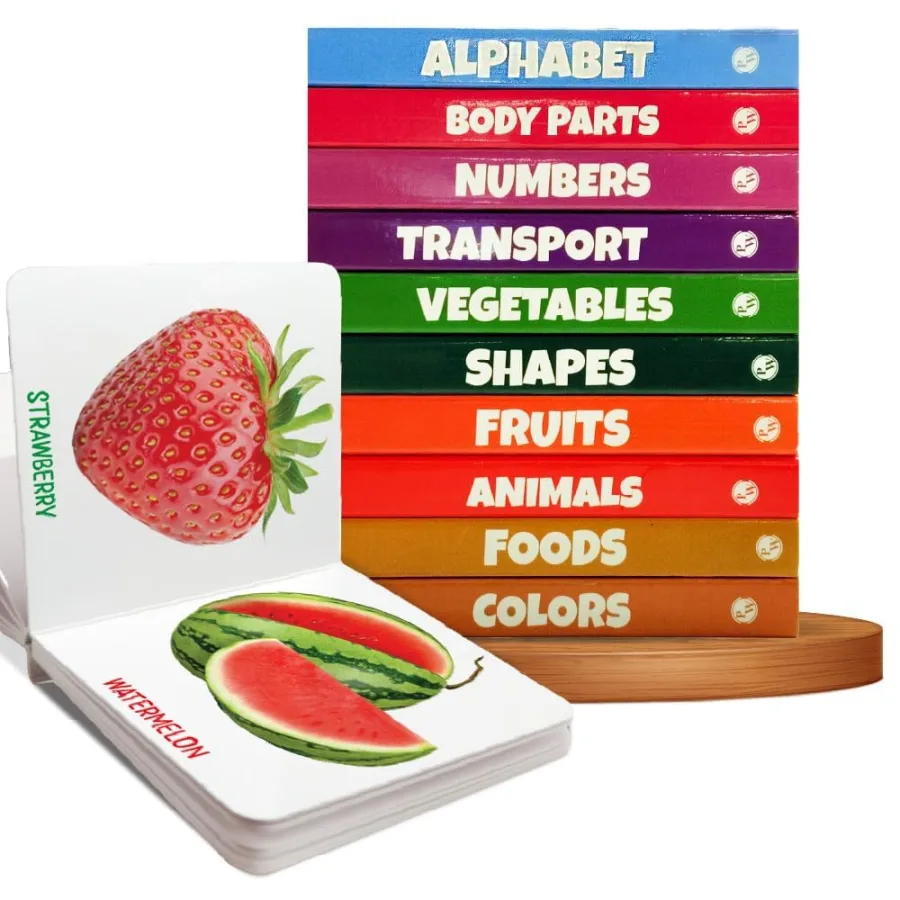
My First Library Set of 10 Board Books for Kids, Early Learning Book for Babies & Toddlers, Alphabet
Board Book
• 220 Pages
• ₹ 699.00
• English
• 9789360347987
No ratings yet
Children's Books
Children's Early Learning Books on Language
Children's Early Learning Books on the Body
| Publisher | Physics Wallah Limited |
|---|---|
| ISBN13 | 9789360347987 |
| ASIN/SKU | 9360347981 |
| Book Format | Board Book |
| Language | English |
| Pages | 220 |
| List Price | ₹ 699.00 |
| Publishing Date | 18/03/2024 |
| Dimensions | 10.9 x 10.7 x 10.4 cm |
| Weight | 300 g |
| Book Code | BD00056041 |
Buy this Book
Amazon Stores
Ebook Stores
Other Stores
Discover My First Library Set of 10 Board Books for Kids, Early Learning Book for Babies and Toddlers, Alphabet by Physics Wallah. This book is published by Physics Wallah Limited in Board Book format, ISBN 9789360347987, ASIN 9360347981, under Children's Books, Children's Early Learning Books on Language, Children's Early Learning Books on the Body.
Book Description
Give Your Child the Perfect Head Start with PW My First Library Box Set
Introduce your little one to the joy of reading with this complete collection of 10 Essential Board Books. Designed specifically for babies and toddlers aged 1-3 years, this box set creates a strong foundation for early learning through visual recognition.
Why Parents & Babies Love This Set:
1. Real-World Images (No Cartoons):
Unlike other books that use confusing cartoons, we use High-Definition Real Photos. A real apple looks like an apple! This helps your baby recognize objects in the real world faster and improves vocabulary.
2. Perfectly Sized for Little Hands:
Big books can be heavy and awkward for toddlers. Our books are Small, Lightweight, and Pocket-Sized (approx 10cm), allowing your baby to hold, flip, and carry them independently. This builds motor skills and confidence.
3. Tear-Proof & Durable Design:
We know babies love to throw and chew! That’s why these books are made with Thick Hardboard Pages that are difficult to tear. The rounded corners ensure safety for your child.
4. Complete Early Learning Topics:
This single box covers everything your child needs to learn before preschool. The set includes 10 individual books:
Alphabets (ABC): Learn A to Z with pictures.
Numbers (123): Counting made easy.
Farm Animals & Wild Animals: Meet the animal kingdom.
Birds: Colorful feathery friends.
Fruits & Vegetables: Learn about healthy food.
Vehicles: Cars, trucks, and transport.
Shapes & Colors: visual recognition.
Body Parts: Learn about themselves.
The Perfect Gift for 1st Birthdays:
Packaged in a beautiful, sturdy slipcase, this set makes a thoughtful and educational Gift for 1-3 Year Old Boys & Girls. It is a screen-free alternative that parents will appreciate.
Product Specifications:
- Age Group: 1 - 3 Years
- Material: Hardboard (Tear-Resistant)
- Includes: 10 Mini Board Books in a Gift Box
The perfect educational start for your baby's early learning journey!
Introduce your little one to the joy of reading with this complete collection of 10 Essential Board Books. Designed specifically for babies and toddlers aged 1-3 years, this box set creates a strong foundation for early learning through visual recognition.
Why Parents & Babies Love This Set:
1. Real-World Images (No Cartoons):
Unlike other books that use confusing cartoons, we use High-Definition Real Photos. A real apple looks like an apple! This helps your baby recognize objects in the real world faster and improves vocabulary.
2. Perfectly Sized for Little Hands:
Big books can be heavy and awkward for toddlers. Our books are Small, Lightweight, and Pocket-Sized (approx 10cm), allowing your baby to hold, flip, and carry them independently. This builds motor skills and confidence.
3. Tear-Proof & Durable Design:
We know babies love to throw and chew! That’s why these books are made with Thick Hardboard Pages that are difficult to tear. The rounded corners ensure safety for your child.
4. Complete Early Learning Topics:
This single box covers everything your child needs to learn before preschool. The set includes 10 individual books:
Alphabets (ABC): Learn A to Z with pictures.
Numbers (123): Counting made easy.
Farm Animals & Wild Animals: Meet the animal kingdom.
Birds: Colorful feathery friends.
Fruits & Vegetables: Learn about healthy food.
Vehicles: Cars, trucks, and transport.
Shapes & Colors: visual recognition.
Body Parts: Learn about themselves.
The Perfect Gift for 1st Birthdays:
Packaged in a beautiful, sturdy slipcase, this set makes a thoughtful and educational Gift for 1-3 Year Old Boys & Girls. It is a screen-free alternative that parents will appreciate.
Product Specifications:
- Age Group: 1 - 3 Years
- Material: Hardboard (Tear-Resistant)
- Includes: 10 Mini Board Books in a Gift Box
The perfect educational start for your baby's early learning journey!
Author Biography
PW creates thoughtfully designed books and STEM kits that turn everyday learning into a joyful adventure. From activity-filled books that boost imagination to science and electric kits that promote practical skills, our products help kids explore, create, and think independently. Safe, engaging, and educational, PW is committed to nurturing young minds through inspired learning experiences.
Editorial Reviews
Editorial Reviews will be added soon…
Book Summary
My First Library Set of 10 Board Books for Kids is an early-learning collection designed for babies and toddlers who are beginning to discover words, pictures, numbers, colors, shapes, and familiar objects. Published under the Physics Wallah name, the set is intended to introduce young children to basic concepts through short, simple board books that are easy for little hands to hold and explore. Instead of expecting very young children to follow a long story, the collection focuses on recognition, repetition, vocabulary building, and visual learning.
The idea behind a first library is to make books a natural part of a child's everyday environment. Babies and toddlers learn largely through looking, listening, touching, repeating, and connecting words with things they see around them. A collection of small board books gives parents an opportunity to introduce these experiences early. Each book can focus on a particular subject, allowing children to explore one concept at a time without being overwhelmed by too much information.
The alphabet is one of the important learning areas in the collection. An alphabet book helps children become familiar with letters and their shapes while connecting each letter with recognizable objects or words. A young child may not yet be able to read independently, but repeatedly hearing an adult say the name of a letter and seeing it alongside a picture can gradually build early letter awareness. For example, children can begin to recognize that different symbols represent different sounds and words.
The use of pictures is especially important for this age group. Babies and toddlers often respond more strongly to images than to written explanations. A colorful picture of an animal, fruit, toy, vehicle, or everyday object gives meaning to the word being introduced. Parents can point to the picture, say its name, and encourage the child to repeat it. Over time, these small interactions can help expand a child's vocabulary.
The board-book format is another important feature. Ordinary paper pages can be difficult for very young children to handle because they are thin and easy to tear. Board books use thicker pages that are more durable and easier for small hands to turn. This allows children to interact with the books more independently. They can hold them, turn pages, point at pictures, and revisit favorite pages without the book being as fragile as a conventional paperback.
The collection's ten-book format also provides variety. Young children benefit from seeing the same concepts repeatedly, but they also need different subjects to maintain curiosity. Having several small books means parents can choose a book according to the child's interest or introduce different concepts throughout the day. One session might focus on letters, while another might involve numbers, colors, shapes, animals, or familiar objects.
Numbers and counting are natural parts of early learning. A number-focused book can introduce children to the visual appearance of numerals while also encouraging them to count objects. At this age, the objective is not advanced mathematics. It is to develop familiarity with numbers and the basic idea that numbers represent quantities. Parents can make the activity interactive by counting objects in the pictures aloud and asking the child to point to them.
Colors and shapes provide another foundation for cognitive development. Children gradually learn to distinguish colors and recognize common shapes such as circles, squares, triangles, and rectangles. Picture-based books can introduce these concepts in a relaxed way. Parents can extend the learning beyond the book by asking children to find similar colors or shapes around the home.
Animals and everyday objects are also valuable subjects for toddlers because they connect directly with the child's surroundings. Children may already recognize a dog, cat, ball, car, spoon, or other familiar object before they know the written word for it. A book can strengthen the connection between the object, its picture, and its name. This is an important step in language development.
The collection can also support early communication. Reading aloud gives children repeated exposure to words, pronunciation, sentence patterns, and sounds. Even when a baby does not respond verbally, listening to an adult read helps create familiarity with language. As children grow, they may begin pointing to pictures, making sounds, repeating words, or answering simple questions. These interactions gradually become more active forms of communication.
Repetition is particularly important in early childhood. Adults may feel that reading the same simple book repeatedly is boring, but young children often enjoy repetition because familiar content gives them a sense of security. They begin to anticipate what comes next and may recognize a picture or word before the adult says it. Repeated reading can therefore strengthen memory and recognition while also building confidence.
The books can become useful tools for parent-child interaction. Instead of simply reading the words from the page, parents can ask questions such as “Where is the cat?”, “What color is this?”, “Can you find the circle?” or “What sound does the animal make?” Such questions turn a passive reading session into an interactive learning activity. They also allow parents to understand what the child already knows and which concepts need more practice.
Another strength of a first-library collection is that it can encourage children to develop a positive relationship with books. When books are introduced as enjoyable objects rather than as schoolwork, children may become more curious about them. They learn that opening a book leads to pictures, sounds, conversations, and discoveries. This early familiarity can help create a foundation for future reading habits.
The books are also suitable for short learning sessions. Babies and toddlers have relatively short attention spans, so parents do not need to complete an entire collection at once. A few pages may be enough for one sitting. The same book can be revisited later, and children can gradually spend more time looking at the pictures as their attention develops.
It is important to remember that a first-learning book is not intended to replace real-world exploration. Children learn best when books are connected with experiences. After reading about animals, parents can talk about animals the child sees outside. After learning colors, they can identify colors in clothing or toys. After looking at shapes, they can search for shapes in household objects. In this way, the book becomes a starting point for further discovery.
Overall, My First Library Set of 10 Board Books for Kids is designed as a gentle introduction to books and early learning for babies and toddlers. Its board-book format makes the collection suitable for young children, while the short, focused subjects help introduce basic vocabulary and concepts without making learning complicated. The alphabet component supports early letter recognition, while related topics such as numbers, colors, shapes, animals, and everyday objects can broaden a child's understanding of the world.
The greatest value of such a collection lies not in how quickly a child learns the alphabet or memorizes a list of words, but in the repeated interaction between child, book, picture, and parent. Each page offers an opportunity to point, name, listen, repeat, and ask questions. Over time, these simple experiences can strengthen vocabulary, recognition, memory, attention, and curiosity.
Ultimately, My First Library Set of 10 Board Books for Kids provides a simple and accessible way to make early learning part of everyday life. It encourages children to explore basic concepts through pictures and repetition while helping parents create a warm reading routine. For babies and toddlers, that combination of durable books, familiar subjects, colorful visuals, and shared reading can provide an enjoyable first step toward a lifelong interest in books and learning.
The idea behind a first library is to make books a natural part of a child's everyday environment. Babies and toddlers learn largely through looking, listening, touching, repeating, and connecting words with things they see around them. A collection of small board books gives parents an opportunity to introduce these experiences early. Each book can focus on a particular subject, allowing children to explore one concept at a time without being overwhelmed by too much information.
The alphabet is one of the important learning areas in the collection. An alphabet book helps children become familiar with letters and their shapes while connecting each letter with recognizable objects or words. A young child may not yet be able to read independently, but repeatedly hearing an adult say the name of a letter and seeing it alongside a picture can gradually build early letter awareness. For example, children can begin to recognize that different symbols represent different sounds and words.
The use of pictures is especially important for this age group. Babies and toddlers often respond more strongly to images than to written explanations. A colorful picture of an animal, fruit, toy, vehicle, or everyday object gives meaning to the word being introduced. Parents can point to the picture, say its name, and encourage the child to repeat it. Over time, these small interactions can help expand a child's vocabulary.
The board-book format is another important feature. Ordinary paper pages can be difficult for very young children to handle because they are thin and easy to tear. Board books use thicker pages that are more durable and easier for small hands to turn. This allows children to interact with the books more independently. They can hold them, turn pages, point at pictures, and revisit favorite pages without the book being as fragile as a conventional paperback.
The collection's ten-book format also provides variety. Young children benefit from seeing the same concepts repeatedly, but they also need different subjects to maintain curiosity. Having several small books means parents can choose a book according to the child's interest or introduce different concepts throughout the day. One session might focus on letters, while another might involve numbers, colors, shapes, animals, or familiar objects.
Numbers and counting are natural parts of early learning. A number-focused book can introduce children to the visual appearance of numerals while also encouraging them to count objects. At this age, the objective is not advanced mathematics. It is to develop familiarity with numbers and the basic idea that numbers represent quantities. Parents can make the activity interactive by counting objects in the pictures aloud and asking the child to point to them.
Colors and shapes provide another foundation for cognitive development. Children gradually learn to distinguish colors and recognize common shapes such as circles, squares, triangles, and rectangles. Picture-based books can introduce these concepts in a relaxed way. Parents can extend the learning beyond the book by asking children to find similar colors or shapes around the home.
Animals and everyday objects are also valuable subjects for toddlers because they connect directly with the child's surroundings. Children may already recognize a dog, cat, ball, car, spoon, or other familiar object before they know the written word for it. A book can strengthen the connection between the object, its picture, and its name. This is an important step in language development.
The collection can also support early communication. Reading aloud gives children repeated exposure to words, pronunciation, sentence patterns, and sounds. Even when a baby does not respond verbally, listening to an adult read helps create familiarity with language. As children grow, they may begin pointing to pictures, making sounds, repeating words, or answering simple questions. These interactions gradually become more active forms of communication.
Repetition is particularly important in early childhood. Adults may feel that reading the same simple book repeatedly is boring, but young children often enjoy repetition because familiar content gives them a sense of security. They begin to anticipate what comes next and may recognize a picture or word before the adult says it. Repeated reading can therefore strengthen memory and recognition while also building confidence.
The books can become useful tools for parent-child interaction. Instead of simply reading the words from the page, parents can ask questions such as “Where is the cat?”, “What color is this?”, “Can you find the circle?” or “What sound does the animal make?” Such questions turn a passive reading session into an interactive learning activity. They also allow parents to understand what the child already knows and which concepts need more practice.
Another strength of a first-library collection is that it can encourage children to develop a positive relationship with books. When books are introduced as enjoyable objects rather than as schoolwork, children may become more curious about them. They learn that opening a book leads to pictures, sounds, conversations, and discoveries. This early familiarity can help create a foundation for future reading habits.
The books are also suitable for short learning sessions. Babies and toddlers have relatively short attention spans, so parents do not need to complete an entire collection at once. A few pages may be enough for one sitting. The same book can be revisited later, and children can gradually spend more time looking at the pictures as their attention develops.
It is important to remember that a first-learning book is not intended to replace real-world exploration. Children learn best when books are connected with experiences. After reading about animals, parents can talk about animals the child sees outside. After learning colors, they can identify colors in clothing or toys. After looking at shapes, they can search for shapes in household objects. In this way, the book becomes a starting point for further discovery.
Overall, My First Library Set of 10 Board Books for Kids is designed as a gentle introduction to books and early learning for babies and toddlers. Its board-book format makes the collection suitable for young children, while the short, focused subjects help introduce basic vocabulary and concepts without making learning complicated. The alphabet component supports early letter recognition, while related topics such as numbers, colors, shapes, animals, and everyday objects can broaden a child's understanding of the world.
The greatest value of such a collection lies not in how quickly a child learns the alphabet or memorizes a list of words, but in the repeated interaction between child, book, picture, and parent. Each page offers an opportunity to point, name, listen, repeat, and ask questions. Over time, these simple experiences can strengthen vocabulary, recognition, memory, attention, and curiosity.
Ultimately, My First Library Set of 10 Board Books for Kids provides a simple and accessible way to make early learning part of everyday life. It encourages children to explore basic concepts through pictures and repetition while helping parents create a warm reading routine. For babies and toddlers, that combination of durable books, familiar subjects, colorful visuals, and shared reading can provide an enjoyable first step toward a lifelong interest in books and learning.
Sample Chapters
Sample Chapters will be added soon…
Reader Reviews
No reviews yet.
My First Library Set of 10 Board Books for Kids, Early Learning Book for Babies & Toddlers, Alphabet
Download Cover Image
Do you want to download the full cover image for My First Library Set of 10 Board Books for Kids, Early Learning Book for Babies & Toddlers, Alphabet?