
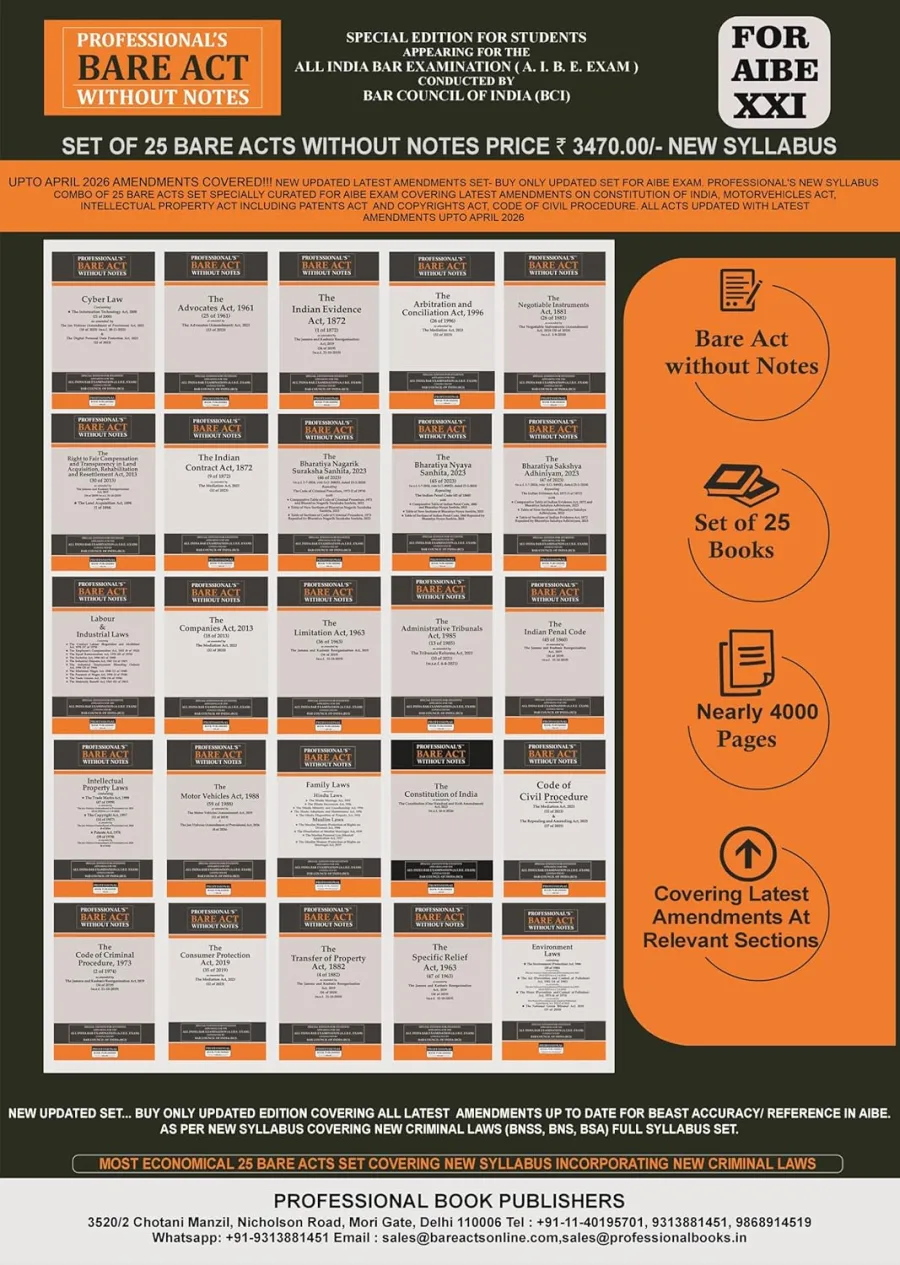
PROFESSIONAL'S AIBE Exam 25 Bare Acts Set without Notes as per New Syllabus, Complete Set of 25 Book
Professional's, Bare Acts without Notes
Paperback
• 4000 Pages
• ₹ 3470.00
• English
No ratings yet
| Publisher | Professional Book Publishers |
|---|---|
| ASIN/SKU | B0CJDVNY3L |
| Book Format | Paperback |
| Language | English |
| Pages | 4000 |
| List Price | ₹ 3470.00 |
| Publishing Date | 19/09/2023 |
| Dimensions | 23.8 x 15.6 x 15.33 cm |
| Weight | 3 kg 750 g |
| Book Code | BD00055283 |
Buy this Book
Amazon Stores
Ebook Stores
Other Stores
Discover PROFESSIONAL'S AIBE Exam 25 Bare Acts Set without Notes as per New Syllabus, Complete Set of 25 Book by Professional's. This book is published by Professional Book Publishers in Paperback format, ASIN B0CJDVNY3L, under Law, Tax Law, Bar Exams.
Book Description
LATEST NEW REVISED AND UPDATED EDITION FOR AIBE XXI
FOR AIBE XXI, PROFESSIONAL’S NEW COMPREHENSIVE EDITION FOR AIBE SET COVERS NEW SYLLABUS IN A COMBINATION OF COMPLETE SET OF 25 BOOKS. This Book Combo covers NEW CRIMINAL LAWS namely Bharatiya Nagarik Suraksha Adhiniyam, 2023 (BNSS), Bharatiya Nyaya Sanhita, 2023 (BNS), Bharatiya Sakshya Adhiniyam, 2023 (BSA) & This newly published set covers important updates and amendments in the AIBE Syllabus that have been incorporated for AIBE XXI. Recent amendments include amendments and updates in Code of Civil Procedure, Intellectual Property Laws including changes in Copyright Act and Patents Act, Constitution of India and Motor Vehicles Act and much more...
The Set includes the following 25 books with amendments as below:
Administrative Tribunals Act, 1985 (13 of 1985)
Advocates Act, 1961 (25 of 1961) as amended by The Advocates (Amendment) Act, 2023 (33 of 2023)
Arbitration and Conciliation Act, 1996 (26 of 1996) as amended by The Mediation Act, 2023 (32 of 2023)
Bhartiya Nagarik Suraksha Sanhita (BNSS), 2023 (46 of 2023) containing Comparative Table of Sections of BNSS, 2023 versus CRPC, 1973 & below each New Section in the body of BNSS, 2023 reference to comparative Section of CRPC, 1973
Bhartiya Nyaya Sanhita (BNS), 2023 (45 of 2023) containing Comparative Table of Sections of BNS, 2023 versus IPC, 1860 & below each New Section of BNS, 2023 reference to comparative Section of IPC, 1860
Bhartiya Sakshya Adhiniyam (BSA), 2023 (47 of 2023) containing Comparative Table of Sections of BSA, 2023 versus Indian Evidence Act, 1872 & below each New Section of BSA, 2023 reference to comparative Section of Indian Evidence Act, 1872
Code of Civil Procedure, 1908 as amended by The Mediation Act, 2023 (32 of 2023) & The Repealing and Amending Act, 2025 (37 of 2025)
Code of Criminal Procedure, 1973 (2 of 1974)
Constitution of India as amended by The Constitution (One Hundred and Sixth Amendment) Act, 2023 with effective date 16-4-2026
Consumer Protection Act, 2019 (35 of 2019) The Mediation Act, 2023(32 of 2023)
Indian Contract Act, 1872 (9 of 1872) as amended by The Mediation Act, 2023 (32 of 2023)
Cyber Law containing: Information Technology Act, 2000 (21 of 2000) as amended by The Jan Vishwas (Amendment of Provisions) Act, 2023 (18 of 2023) | The Digital Personal Data Protection Act, 2023 (22 of 2023)
Environment Laws containing: Environment (Protection) Act, 1986 (29 of 1986) as amended by The Jan Vishwas (Amendment of Provisions) Act, 2023 (18 of 2023) | Air (Prevention and Control of Pollution) Act, 1981 (14 of 1981) as amended by The Jan Vishwas (Amendment of Provisions) Act, 2023 (18 of 2023) | Water (Prevention and Control of Pollution) Act, 1974 (6 of 1974) as amended by The Water (Prevention and Control of Pollution) Amendment Act, 2024 (50 of 2024) | National Green Tribunal Act, 2010 (19 of 2010)
Indian Evidence Act, 1872 (1 of 1872)
Family Laws containing:
FOR AIBE XXI, PROFESSIONAL’S NEW COMPREHENSIVE EDITION FOR AIBE SET COVERS NEW SYLLABUS IN A COMBINATION OF COMPLETE SET OF 25 BOOKS. This Book Combo covers NEW CRIMINAL LAWS namely Bharatiya Nagarik Suraksha Adhiniyam, 2023 (BNSS), Bharatiya Nyaya Sanhita, 2023 (BNS), Bharatiya Sakshya Adhiniyam, 2023 (BSA) & This newly published set covers important updates and amendments in the AIBE Syllabus that have been incorporated for AIBE XXI. Recent amendments include amendments and updates in Code of Civil Procedure, Intellectual Property Laws including changes in Copyright Act and Patents Act, Constitution of India and Motor Vehicles Act and much more...
The Set includes the following 25 books with amendments as below:
Administrative Tribunals Act, 1985 (13 of 1985)
Advocates Act, 1961 (25 of 1961) as amended by The Advocates (Amendment) Act, 2023 (33 of 2023)
Arbitration and Conciliation Act, 1996 (26 of 1996) as amended by The Mediation Act, 2023 (32 of 2023)
Bhartiya Nagarik Suraksha Sanhita (BNSS), 2023 (46 of 2023) containing Comparative Table of Sections of BNSS, 2023 versus CRPC, 1973 & below each New Section in the body of BNSS, 2023 reference to comparative Section of CRPC, 1973
Bhartiya Nyaya Sanhita (BNS), 2023 (45 of 2023) containing Comparative Table of Sections of BNS, 2023 versus IPC, 1860 & below each New Section of BNS, 2023 reference to comparative Section of IPC, 1860
Bhartiya Sakshya Adhiniyam (BSA), 2023 (47 of 2023) containing Comparative Table of Sections of BSA, 2023 versus Indian Evidence Act, 1872 & below each New Section of BSA, 2023 reference to comparative Section of Indian Evidence Act, 1872
Code of Civil Procedure, 1908 as amended by The Mediation Act, 2023 (32 of 2023) & The Repealing and Amending Act, 2025 (37 of 2025)
Code of Criminal Procedure, 1973 (2 of 1974)
Constitution of India as amended by The Constitution (One Hundred and Sixth Amendment) Act, 2023 with effective date 16-4-2026
Consumer Protection Act, 2019 (35 of 2019) The Mediation Act, 2023(32 of 2023)
Indian Contract Act, 1872 (9 of 1872) as amended by The Mediation Act, 2023 (32 of 2023)
Cyber Law containing: Information Technology Act, 2000 (21 of 2000) as amended by The Jan Vishwas (Amendment of Provisions) Act, 2023 (18 of 2023) | The Digital Personal Data Protection Act, 2023 (22 of 2023)
Environment Laws containing: Environment (Protection) Act, 1986 (29 of 1986) as amended by The Jan Vishwas (Amendment of Provisions) Act, 2023 (18 of 2023) | Air (Prevention and Control of Pollution) Act, 1981 (14 of 1981) as amended by The Jan Vishwas (Amendment of Provisions) Act, 2023 (18 of 2023) | Water (Prevention and Control of Pollution) Act, 1974 (6 of 1974) as amended by The Water (Prevention and Control of Pollution) Amendment Act, 2024 (50 of 2024) | National Green Tribunal Act, 2010 (19 of 2010)
Indian Evidence Act, 1872 (1 of 1872)
Family Laws containing:
Author Biography
Author Biography will be added soon…
Editorial Reviews
Editorial Reviews will be added soon…
Book Summary
PROFESSIONAL'S AIBE Exam 25 Bare Acts Set without Notes as per New Syllabus is not a conventional book that presents legal concepts through explanations, commentary, or case analysis. Instead, it is a carefully compiled collection of twenty-five important Bare Acts prescribed under the latest syllabus for the All India Bar Examination (AIBE). The set has been designed in accordance with the Bar Council of India's guidelines, allowing candidates to carry only unannotated Bare Acts into the examination hall. It brings together the essential statutes that every law graduate is expected to know before entering legal practice. The collection includes both long-standing laws and the recently introduced criminal law reforms, making it a comprehensive reference for AIBE preparation.
The central purpose of this collection is to familiarize candidates with the exact language of the law. Since Bare Acts contain the original statutory text enacted by Parliament, they serve as the most authentic legal source. Unlike textbooks that simplify or interpret legal provisions, this set encourages readers to understand legislation as it is written. This approach is particularly valuable for the AIBE because many examination questions require candidates to identify the precise legal provision rather than rely on conceptual explanations.
One of the strongest features of the collection is its wide coverage of legal subjects. The Constitution of India forms the foundation of the set, introducing the principles of constitutional governance, fundamental rights, directive principles, duties of citizens, separation of powers, and the structure of the judiciary. Through the Constitution, readers understand the legal framework within which every other statute operates. It reinforces the importance of constitutional supremacy and the rule of law in India's democratic system.
Civil law is extensively represented through statutes such as the Code of Civil Procedure, the Indian Contract Act, the Specific Relief Act, the Transfer of Property Act, the Limitation Act, and laws relating to arbitration and consumer protection. Together, these statutes explain how civil disputes arise, how contractual obligations are enforced, how property rights are transferred, and how legal remedies are granted. By studying these Acts directly, candidates become familiar with the procedural and substantive rules governing civil litigation.
The collection also devotes significant attention to criminal law. Earlier editions of AIBE Bare Act sets focused on the Indian Penal Code, the Code of Criminal Procedure, and the Indian Evidence Act. However, the latest edition reflects India's major criminal law reforms by including the Bharatiya Nyaya Sanhita (BNS), Bharatiya Nagarik Suraksha Sanhita (BNSS), and Bharatiya Sakshya Adhiniyam (BSA), alongside other required statutes according to the updated syllabus. These new laws replace or modernize several provisions of the older criminal law framework and are essential for current legal practice. Candidates therefore gain exposure to the latest statutory language and procedural changes that now govern criminal justice in India.
Another important aspect of the set is its coverage of personal and family laws. The compilation includes major Hindu and Muslim personal law statutes governing marriage, divorce, adoption, guardianship, succession, and maintenance. These laws illustrate India's pluralistic legal system, where different personal laws continue to regulate family matters for various religious communities. By studying these provisions, readers develop an understanding of the legal rights and responsibilities that arise within family relationships.
Commercial and business laws also occupy an important place in the collection. Statutes dealing with negotiable instruments, companies, intellectual property, labour and industrial relations, and consumer protection provide a broad understanding of commercial transactions and corporate regulation. These laws are especially relevant because modern legal practice increasingly involves commercial disputes, business compliance, employment issues, and consumer rights.
The compilation further recognizes the growing importance of environmental and technology-related legislation. Environmental statutes concerning pollution control, environmental protection, and the National Green Tribunal demonstrate how the legal system seeks to balance economic development with ecological sustainability. Cyber law provisions, primarily through the Information Technology Act, introduce readers to legal issues arising from digital communication, electronic records, cybercrime, and online transactions. Together, these statutes reflect the evolving nature of law in response to technological and environmental challenges.
A defining characteristic of the publication is that it contains no explanatory notes, commentary, illustrations, or judicial interpretations. Every volume presents only the statutory provisions, section headings, schedules, and authorized legislative text. This format complies with the Bar Council of India's examination rules and encourages candidates to develop the skill of reading, interpreting, and navigating legislative language independently. Regular use of these Bare Acts also helps students locate important sections quickly during the open-book examination, an ability that can significantly improve performance.
Beyond examination preparation, the collection serves as a valuable professional resource. Law students, interns, junior advocates, judicial service aspirants, and legal researchers frequently consult Bare Acts during drafting, legal research, and courtroom practice. Since statutory provisions form the basis of every legal argument, familiarity with the exact legislative text is indispensable for competent legal work. This collection therefore bridges the gap between academic study and practical application.
Overall, PROFESSIONAL'S AIBE Exam 25 Bare Acts Set without Notes as per New Syllabus is best understood as a comprehensive statutory library rather than a traditional legal textbook. Its greatest strength lies in presenting the law in its original and unaltered form while covering nearly every major subject tested in the AIBE. By bringing together constitutional, civil, criminal, commercial, environmental, cyber, labour, family, and procedural laws in one organized set, it equips aspiring advocates with the foundational legal materials required for both examination success and professional practice. Although readers seeking conceptual explanations or analytical discussions will need supplementary textbooks, this collection remains an indispensable companion for mastering the language, structure, and practical use of India's statutory law.
The central purpose of this collection is to familiarize candidates with the exact language of the law. Since Bare Acts contain the original statutory text enacted by Parliament, they serve as the most authentic legal source. Unlike textbooks that simplify or interpret legal provisions, this set encourages readers to understand legislation as it is written. This approach is particularly valuable for the AIBE because many examination questions require candidates to identify the precise legal provision rather than rely on conceptual explanations.
One of the strongest features of the collection is its wide coverage of legal subjects. The Constitution of India forms the foundation of the set, introducing the principles of constitutional governance, fundamental rights, directive principles, duties of citizens, separation of powers, and the structure of the judiciary. Through the Constitution, readers understand the legal framework within which every other statute operates. It reinforces the importance of constitutional supremacy and the rule of law in India's democratic system.
Civil law is extensively represented through statutes such as the Code of Civil Procedure, the Indian Contract Act, the Specific Relief Act, the Transfer of Property Act, the Limitation Act, and laws relating to arbitration and consumer protection. Together, these statutes explain how civil disputes arise, how contractual obligations are enforced, how property rights are transferred, and how legal remedies are granted. By studying these Acts directly, candidates become familiar with the procedural and substantive rules governing civil litigation.
The collection also devotes significant attention to criminal law. Earlier editions of AIBE Bare Act sets focused on the Indian Penal Code, the Code of Criminal Procedure, and the Indian Evidence Act. However, the latest edition reflects India's major criminal law reforms by including the Bharatiya Nyaya Sanhita (BNS), Bharatiya Nagarik Suraksha Sanhita (BNSS), and Bharatiya Sakshya Adhiniyam (BSA), alongside other required statutes according to the updated syllabus. These new laws replace or modernize several provisions of the older criminal law framework and are essential for current legal practice. Candidates therefore gain exposure to the latest statutory language and procedural changes that now govern criminal justice in India.
Another important aspect of the set is its coverage of personal and family laws. The compilation includes major Hindu and Muslim personal law statutes governing marriage, divorce, adoption, guardianship, succession, and maintenance. These laws illustrate India's pluralistic legal system, where different personal laws continue to regulate family matters for various religious communities. By studying these provisions, readers develop an understanding of the legal rights and responsibilities that arise within family relationships.
Commercial and business laws also occupy an important place in the collection. Statutes dealing with negotiable instruments, companies, intellectual property, labour and industrial relations, and consumer protection provide a broad understanding of commercial transactions and corporate regulation. These laws are especially relevant because modern legal practice increasingly involves commercial disputes, business compliance, employment issues, and consumer rights.
The compilation further recognizes the growing importance of environmental and technology-related legislation. Environmental statutes concerning pollution control, environmental protection, and the National Green Tribunal demonstrate how the legal system seeks to balance economic development with ecological sustainability. Cyber law provisions, primarily through the Information Technology Act, introduce readers to legal issues arising from digital communication, electronic records, cybercrime, and online transactions. Together, these statutes reflect the evolving nature of law in response to technological and environmental challenges.
A defining characteristic of the publication is that it contains no explanatory notes, commentary, illustrations, or judicial interpretations. Every volume presents only the statutory provisions, section headings, schedules, and authorized legislative text. This format complies with the Bar Council of India's examination rules and encourages candidates to develop the skill of reading, interpreting, and navigating legislative language independently. Regular use of these Bare Acts also helps students locate important sections quickly during the open-book examination, an ability that can significantly improve performance.
Beyond examination preparation, the collection serves as a valuable professional resource. Law students, interns, junior advocates, judicial service aspirants, and legal researchers frequently consult Bare Acts during drafting, legal research, and courtroom practice. Since statutory provisions form the basis of every legal argument, familiarity with the exact legislative text is indispensable for competent legal work. This collection therefore bridges the gap between academic study and practical application.
Overall, PROFESSIONAL'S AIBE Exam 25 Bare Acts Set without Notes as per New Syllabus is best understood as a comprehensive statutory library rather than a traditional legal textbook. Its greatest strength lies in presenting the law in its original and unaltered form while covering nearly every major subject tested in the AIBE. By bringing together constitutional, civil, criminal, commercial, environmental, cyber, labour, family, and procedural laws in one organized set, it equips aspiring advocates with the foundational legal materials required for both examination success and professional practice. Although readers seeking conceptual explanations or analytical discussions will need supplementary textbooks, this collection remains an indispensable companion for mastering the language, structure, and practical use of India's statutory law.
Sample Chapters
Sample Chapters will be added soon…
Reader Reviews
No reviews yet.
PROFESSIONAL'S AIBE Exam 25 Bare Acts Set without Notes as per New Syllabus, Complete Set of 25 Book
Download Cover Image
Do you want to download the full cover image for PROFESSIONAL'S AIBE Exam 25 Bare Acts Set without Notes as per New Syllabus, Complete Set of 25 Book?