
Death; An Inside Story: A Book for All Those Who Shall Die
Paperback
• 376 Pages
• ₹ 299.00
• English
• 9780143450832
No ratings yet
| Publisher | Penguin |
|---|---|
| ISBN13 | 9780143450832 |
| ASIN/SKU | 0143450832 |
| Book Format | Paperback |
| Language | English |
| Pages | 376 |
| List Price | ₹ 299.00 |
| Publishing Date | 01/01/1920 |
| Dimensions | 22 x 14 x 2 cm |
| Weight | 300 g |
| Book Code | BD00055244 |
Buy this Book
Amazon Stores
Ebook Stores
Other Stores
Discover Death; An Inside Story: A Book for All Those Who Shall Die by Sadhguru. This book is published by Penguin in Paperback format, ISBN 9780143450832, ASIN 0143450832, under Health, Fitness and Dieting, Self-Help for Anxieties and Phobias, Occult and Paranormal.
Book Description
Death is a taboo in most societies in the world. But what if we have got this completely wrong? What if death was not the catastrophe it is made out to be but an essential aspect of life, rife with spiritual possibilities for transcendence? For the first time, someone is saying just that.
In this unique treatise-like exposition, Sadhguru dwells extensively upon his inner experience as he expounds on the more profound aspects of death that are rarely spoken about. From a practical standpoint, he elaborates on what preparations one can make for one's death, how best we can assist someone who is dying and how we can continue to support their journey even after death.
Whether a believer or not, a devotee or an agnostic, an accomplished seeker or a simpleton, this is truly a book for all those who shall die!
In this unique treatise-like exposition, Sadhguru dwells extensively upon his inner experience as he expounds on the more profound aspects of death that are rarely spoken about. From a practical standpoint, he elaborates on what preparations one can make for one's death, how best we can assist someone who is dying and how we can continue to support their journey even after death.
Whether a believer or not, a devotee or an agnostic, an accomplished seeker or a simpleton, this is truly a book for all those who shall die!
Author Biography
Yogi, mystic and visionary, Sadhguru is a spiritual master with a difference. Absolute clarity of perception places him in a unique space, not only in matters spiritual but in business, environmental and international affairs, and opens a new door on all that he touches.
Ranked amongst the fifty-most influential people in India, Sadhguru is known as a speaker and opinion maker of international renown. He has been conferred the Padma Vibhushan, India's highest annual civilian award, accorded for exceptional and distinguished service.
Sadhguru has initiated large-scale ecological initiatives such as Rally for Rivers and Cauvery Calling, to revitalize India's severely depleted rivers. These projects have found phenomenal support among India's people and leadership. They are internationally accredited and recognized as game changers that can establish a blueprint for global economic development that is ecologically sustainable.
Sadhguru has been a primary speaker at the United Nations General Assembly and several other UN forums. He has also been regularly invited to speak at establishments such as the World Economic Forum, the World Bank, the House of Lords, the University of Oxford, MIT, Google and Microsoft, to name a few.
With a celebratory engagement with life on all levels, Sadhguru's areas of active involvement encompass fields as diverse as architecture and visual design, poetry and painting, aviation and driving, sports and music. He is the designer of several unique buildings and consecrated spaces at the Isha Yoga Center, which have received wide attention for their combination of intense sacred power and strikingly innovative aesthetics.
Three decades ago, Sadhguru founded Isha Foundation, a non-profit human-service organization, with human well-being as its core commitment. Isha is supported by over nine million volunteers in more than 300 centres worldwide.
app.sadhguru.org
isha.sadhguru.org
facebook.com/sadhguru
twitter.com/SadhguruJV
youtube.com/sadhguru
Ranked amongst the fifty-most influential people in India, Sadhguru is known as a speaker and opinion maker of international renown. He has been conferred the Padma Vibhushan, India's highest annual civilian award, accorded for exceptional and distinguished service.
Sadhguru has initiated large-scale ecological initiatives such as Rally for Rivers and Cauvery Calling, to revitalize India's severely depleted rivers. These projects have found phenomenal support among India's people and leadership. They are internationally accredited and recognized as game changers that can establish a blueprint for global economic development that is ecologically sustainable.
Sadhguru has been a primary speaker at the United Nations General Assembly and several other UN forums. He has also been regularly invited to speak at establishments such as the World Economic Forum, the World Bank, the House of Lords, the University of Oxford, MIT, Google and Microsoft, to name a few.
With a celebratory engagement with life on all levels, Sadhguru's areas of active involvement encompass fields as diverse as architecture and visual design, poetry and painting, aviation and driving, sports and music. He is the designer of several unique buildings and consecrated spaces at the Isha Yoga Center, which have received wide attention for their combination of intense sacred power and strikingly innovative aesthetics.
Three decades ago, Sadhguru founded Isha Foundation, a non-profit human-service organization, with human well-being as its core commitment. Isha is supported by over nine million volunteers in more than 300 centres worldwide.
app.sadhguru.org
isha.sadhguru.org
facebook.com/sadhguru
twitter.com/SadhguruJV
youtube.com/sadhguru
Editorial Reviews
Editorial Reviews will be added soon…
Book Summary
Sadhguru’s Death; An Inside Story takes on what is arguably the most universal yet universally avoided topic in human existence. In most cultures, death is treated as a grim taboo, a terrifying tragedy to be fought off at all costs and spoken of only in hushed, fearful tones. However, in this profound and unsentimental book, Sadhguru systematically dismantles this fear, approaching mortality not as a morbid end, but as a deeply natural, inevitable, and even beautiful phase of the life process. Drawing on ancient yogic wisdom and his own inner experience, he offers a comprehensive manual for understanding death, removing the thick veil of cultural superstition, and replacing it with a pragmatic, spiritual clarity that empowers the reader to face the inevitable with grace.
The fundamental premise of the book is that life and death are not opposing forces, but rather two sides of the exact same coin. Sadhguru explains that we are essentially dying a little bit every single day; the inhalation is life, and the exhalation is a minor death. The root cause of our profound terror surrounding the end of life is our overwhelming, exclusive identification with the physical body and the psychological drama of our own minds. Because we mistakenly believe that we are nothing more than our flesh, our relationships, and our accumulated possessions, the prospect of losing this physical shell feels like total annihilation. Sadhguru argues that once an individual experiences a dimension of themselves beyond the physical, the paralyzing fear of death naturally evaporates.
One of the most fascinating and unique aspects of the book is its detailed explanation of the mechanics of dying. Sadhguru demystifies the biological and spiritual transition by explaining it through the framework of the pancha pranas, the five vital energies that animate the human body—Samana, Prana, Udana, Apana, and Vyana. He describes how these energies do not leave the body all at once, but rather withdraw in a specific, sequential order. This gradual unwinding explains the physical symptoms that occur during the dying process. By understanding this precise yogic anatomy, death is no longer seen as a sudden, violent switch that is flipped in the dark, but as a well-defined, systematic withdrawal of life from its temporary physical vessel.
A significant portion of the book focuses on the critical importance of dying consciously. Sadhguru emphasizes that the quality of our death dictates our post-death trajectory. How we conduct ourselves in our final moments is of paramount importance. He strongly advocates against dying in a state of fear, anger, or resistance, and raises thought-provoking questions about modern medical interventions that often prolong the agony of a failing body long after the life force has begun to naturally detach. To assist a dying person, he suggests creating an atmosphere of absolute serenity. Instead of hysterical grieving and emotional clinging, which he argues only confuses and heavily burdens the departing life, we should offer a calm, peaceful environment, perhaps by lighting a simple lamp and chanting gently, helping the individual transition with dignity and equanimity.
Sadhguru also ventures into the often-misunderstood territory of what happens after the body is discarded. He explains that without the physical body and its discerning intellect to act as a buffer, the mind operates purely on its accumulated karmic tendencies. If a person dies harboring intense anger, fear, or unfulfilled desires, those specific qualities are magnified exponentially in the disembodied state, creating what we might perceive as hellish experiences. Conversely, a peaceful death leads to a highly pleasant transition. He addresses popular concepts like ghosts and spirits with refreshing rationality, framing them not as horror movie monsters, but simply as beings that have lost their physical bodies but still retain strong, unfulfilled earthly compulsions that keep them hovering near the physical realm.
For those left behind, the book offers a deeply compassionate yet unsentimental perspective on grief. Sadhguru explains that mourning is largely rooted in our own sense of loss and the painful severing of runanubandha, the deep physical memory and energetic bond we share with the deceased. He sheds light on the actual science behind traditional death rituals, noting that their true purpose is not mere religious tradition or psychological comfort for the living. Instead, these specific rituals are designed as precise mechanisms to assist the disembodied being in dissolving its lingering earthly attachments, ensuring it can move forward on its journey swiftly rather than lingering in confusion.
Ultimately, Death; An Inside Story is not truly a book about dying; it is a profound manual on how to live. The ultimate goal presented in the yogic tradition is Mukti, or absolute liberation from the cycle of birth and death. Sadhguru repeatedly emphasizes that one can only experience a graceful, conscious death if one has lived a fully conscious life. By bringing the reality of our mortality into our everyday awareness and accepting its absolute inevitability, we paradoxically learn to live much more vibrantly, profoundly, and purposefully. The book transforms our greatest, most paralyzing fear into a tremendous spiritual opportunity, offering a path to walk out of this life as joyfully as we walked into it.
The fundamental premise of the book is that life and death are not opposing forces, but rather two sides of the exact same coin. Sadhguru explains that we are essentially dying a little bit every single day; the inhalation is life, and the exhalation is a minor death. The root cause of our profound terror surrounding the end of life is our overwhelming, exclusive identification with the physical body and the psychological drama of our own minds. Because we mistakenly believe that we are nothing more than our flesh, our relationships, and our accumulated possessions, the prospect of losing this physical shell feels like total annihilation. Sadhguru argues that once an individual experiences a dimension of themselves beyond the physical, the paralyzing fear of death naturally evaporates.
One of the most fascinating and unique aspects of the book is its detailed explanation of the mechanics of dying. Sadhguru demystifies the biological and spiritual transition by explaining it through the framework of the pancha pranas, the five vital energies that animate the human body—Samana, Prana, Udana, Apana, and Vyana. He describes how these energies do not leave the body all at once, but rather withdraw in a specific, sequential order. This gradual unwinding explains the physical symptoms that occur during the dying process. By understanding this precise yogic anatomy, death is no longer seen as a sudden, violent switch that is flipped in the dark, but as a well-defined, systematic withdrawal of life from its temporary physical vessel.
A significant portion of the book focuses on the critical importance of dying consciously. Sadhguru emphasizes that the quality of our death dictates our post-death trajectory. How we conduct ourselves in our final moments is of paramount importance. He strongly advocates against dying in a state of fear, anger, or resistance, and raises thought-provoking questions about modern medical interventions that often prolong the agony of a failing body long after the life force has begun to naturally detach. To assist a dying person, he suggests creating an atmosphere of absolute serenity. Instead of hysterical grieving and emotional clinging, which he argues only confuses and heavily burdens the departing life, we should offer a calm, peaceful environment, perhaps by lighting a simple lamp and chanting gently, helping the individual transition with dignity and equanimity.
Sadhguru also ventures into the often-misunderstood territory of what happens after the body is discarded. He explains that without the physical body and its discerning intellect to act as a buffer, the mind operates purely on its accumulated karmic tendencies. If a person dies harboring intense anger, fear, or unfulfilled desires, those specific qualities are magnified exponentially in the disembodied state, creating what we might perceive as hellish experiences. Conversely, a peaceful death leads to a highly pleasant transition. He addresses popular concepts like ghosts and spirits with refreshing rationality, framing them not as horror movie monsters, but simply as beings that have lost their physical bodies but still retain strong, unfulfilled earthly compulsions that keep them hovering near the physical realm.
For those left behind, the book offers a deeply compassionate yet unsentimental perspective on grief. Sadhguru explains that mourning is largely rooted in our own sense of loss and the painful severing of runanubandha, the deep physical memory and energetic bond we share with the deceased. He sheds light on the actual science behind traditional death rituals, noting that their true purpose is not mere religious tradition or psychological comfort for the living. Instead, these specific rituals are designed as precise mechanisms to assist the disembodied being in dissolving its lingering earthly attachments, ensuring it can move forward on its journey swiftly rather than lingering in confusion.
Ultimately, Death; An Inside Story is not truly a book about dying; it is a profound manual on how to live. The ultimate goal presented in the yogic tradition is Mukti, or absolute liberation from the cycle of birth and death. Sadhguru repeatedly emphasizes that one can only experience a graceful, conscious death if one has lived a fully conscious life. By bringing the reality of our mortality into our everyday awareness and accepting its absolute inevitability, we paradoxically learn to live much more vibrantly, profoundly, and purposefully. The book transforms our greatest, most paralyzing fear into a tremendous spiritual opportunity, offering a path to walk out of this life as joyfully as we walked into it.
Sample Chapters
Sample Chapters will be added soon…
Reader Reviews
No reviews yet.
Death; An Inside Story: A Book for All Those Who Shall Die
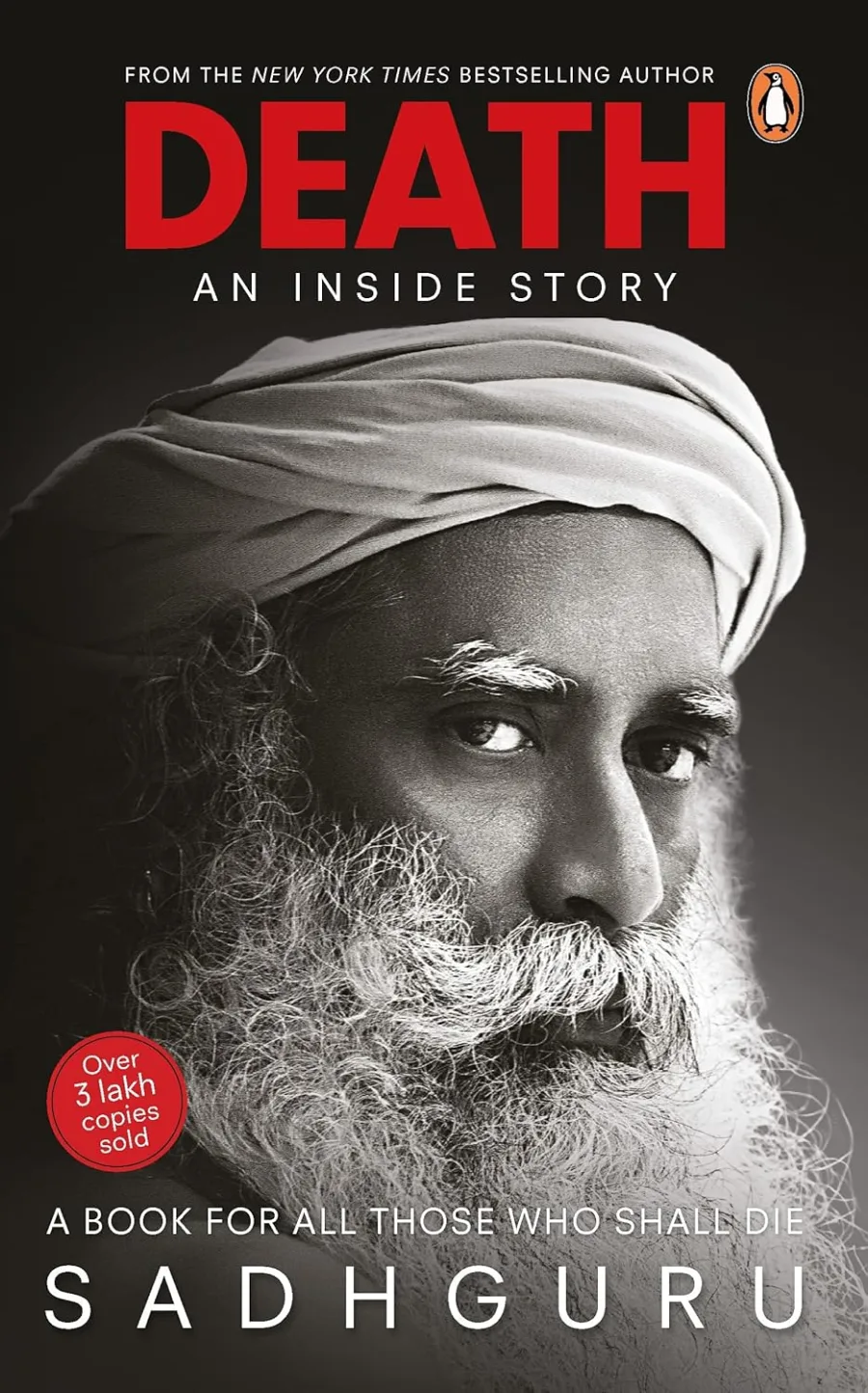
Download Cover Image
Do you want to download the full cover image for Death; An Inside Story: A Book for All Those Who Shall Die?