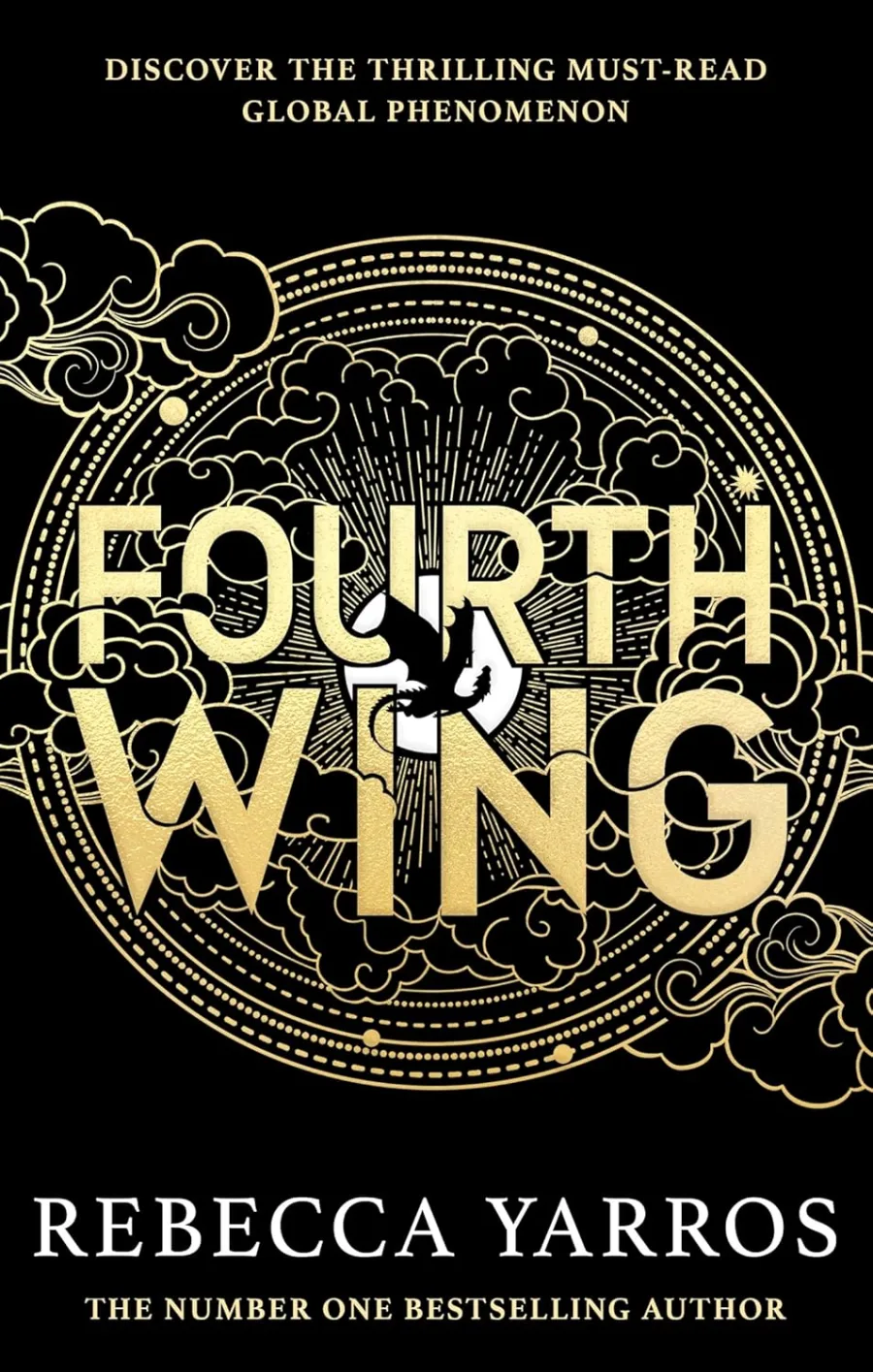
Fourth Wing
Paperback
• 576 Pages
• ₹ 499.00
• English
• 9780349437019
No ratings yet
| Publisher | Piatkus Books |
|---|---|
| ISBN13 | 9780349437019 |
| ASIN/SKU | 0349437017 |
| Book Format | Paperback |
| Language | English |
| Pages | 576 |
| List Price | ₹ 499.00 |
| Publishing Date | 19/04/2024 |
| Dimensions | 12.6 x 4.4 x 19.6 cm |
| Weight | 365 g |
| Book Code | BD00055091 |
Buy this Book
Amazon Stores
Ebook Stores
Other Stores
Discover Fourth Wing by Rebecca Yarros. This book is published by Piatkus Books in Paperback format, ISBN 9780349437019, ASIN 0349437017, under Literature and Fiction, Romantic Fantasy, Action and Adventure Fantasy.
Book Description
DON''T BE THE LAST TO DISCOVER THE SERIES THAT EVERYONE CAN''T STOP TALKING ABOUT:
''Pure escapism - think Hunger Games meets Fifty Shades'' The Sun
''We weren''t expecting to become obsessed . . . but we very much are and we''re not alone'' Sunday Times Style
''This book contains an addictive, drug like essence that will make you relinquish all responsibility'' Glamour
''Yarros had me hooked from the first chapter'' Mail on Sunday
__________________________________________
FRIENDS. ENEMIES. LOVERS . . .
EVERYONE HAS AN AGENDA
Violet Sorrengail expected to live a quiet life surrounded by books, until she was forced onto the world''s deadliest training ground. Now she must fight to join the army''s elite: dragon riders. But dragons don''t choose fragile riders, they incinerate them, and when your body breaks as easily as Violet''s does - death is only a heartbeat away.
EVERY NIGHT COULD BE YOUR LAST
Many cadets would kill Violet to better their own chances of success; the rest would kill her just because of her last name . . . including the ruthless Xaden Riorson, her family''s greatest enemy. With the odds stacked against her, Violet must use every edge her wits can give her just to see the next sunrise, because once you enter Basgiath War College, there are only two ways out:
GRADUATE OR DIE
''Pure escapism - think Hunger Games meets Fifty Shades'' The Sun
''We weren''t expecting to become obsessed . . . but we very much are and we''re not alone'' Sunday Times Style
''This book contains an addictive, drug like essence that will make you relinquish all responsibility'' Glamour
''Yarros had me hooked from the first chapter'' Mail on Sunday
__________________________________________
FRIENDS. ENEMIES. LOVERS . . .
EVERYONE HAS AN AGENDA
Violet Sorrengail expected to live a quiet life surrounded by books, until she was forced onto the world''s deadliest training ground. Now she must fight to join the army''s elite: dragon riders. But dragons don''t choose fragile riders, they incinerate them, and when your body breaks as easily as Violet''s does - death is only a heartbeat away.
EVERY NIGHT COULD BE YOUR LAST
Many cadets would kill Violet to better their own chances of success; the rest would kill her just because of her last name . . . including the ruthless Xaden Riorson, her family''s greatest enemy. With the odds stacked against her, Violet must use every edge her wits can give her just to see the next sunrise, because once you enter Basgiath War College, there are only two ways out:
GRADUATE OR DIE
Author Biography
Rebecca Yarros is the no. 1 Sunday Times and New York Times bestselling author of over twenty novels including Fourth Wing and In the Likely Event, with multiple starred Publishers Weekly reviews and a Kirkus Best Book of the Year.
She loves military heroes and has been blissfully married to hers for over twenty years. She's the mother of six children, and is currently surviving the teenage years with two of her four hockey-playing sons. When she's not writing, you can find her at the hockey rink or sneaking in some guitar time while guzzling coffee. She and her family live in Colorado with their stubborn English bulldogs, two feisty chinchillas, and a Maine Coon cat named Artemis, who rules them all.
Having fostered then adopted their youngest daughter, Rebecca is passionate about helping children in the foster system through her nonprofit, One October, which she co-founded with her husband in 2019.
She loves military heroes and has been blissfully married to hers for over twenty years. She's the mother of six children, and is currently surviving the teenage years with two of her four hockey-playing sons. When she's not writing, you can find her at the hockey rink or sneaking in some guitar time while guzzling coffee. She and her family live in Colorado with their stubborn English bulldogs, two feisty chinchillas, and a Maine Coon cat named Artemis, who rules them all.
Having fostered then adopted their youngest daughter, Rebecca is passionate about helping children in the foster system through her nonprofit, One October, which she co-founded with her husband in 2019.
Editorial Reviews
Editorial Reviews will be added soon…
Book Summary
Rebecca Yarros’s Fourth Wing is a fast-paced fantasy novel that combines military training, dragons, political secrets, romance, friendship, betrayal, and survival. Set in the brutal world of Basgiath War College, the novel follows Violet Sorrengail, a young woman who has spent most of her life preparing to become a scribe. She expects to live among books, records, and history, but her life changes when her powerful mother, General Lilith Sorrengail, orders her to enter the Riders Quadrant, the most dangerous section of the military college. There, students must survive deadly physical training, fierce competition, dragon selection, and the possibility of being killed at almost any moment. Violet’s story is ultimately about discovering strength in unexpected places and learning that courage does not always mean being physically powerful.
Violet enters Basgiath already at a disadvantage. She has a smaller, more fragile body than many of the other candidates, and a chronic physical condition makes the intense training even more difficult. Her mother believes she should become a dragon rider, however, because being a rider is a prestigious military role and because Violet belongs to one of the most influential military families in Navarre. Violet’s older siblings have already established powerful reputations. Her brother Brennan was a celebrated rider, while her older sister Mira is an experienced officer. Violet therefore enters the Riders Quadrant carrying both family expectations and the knowledge that failure could mean death.
Her first major challenge is the Parapet, a narrow stone bridge high above the ground. Candidates must cross it without falling. There are no safety measures, and the exercise is deliberately designed to eliminate those who are physically or mentally unprepared. Violet survives through intelligence and determination rather than brute strength. The scene establishes one of the novel’s central ideas: Violet cannot compete by becoming someone else. She must learn how to use the abilities she actually possesses.
Life at Basgiath is merciless. Cadets are expected to fight, endure exhausting physical exercises, and compete against one another. Some students will actively try to kill their rivals because there are limited places in the Riders Quadrant. Violet soon realizes that she cannot assume that everyone around her is a friend. At the same time, she forms important relationships that help her survive.
One of the most complicated relationships is with Xaden Riorson, the powerful and intimidating wingleader assigned to Violet’s group. Xaden is the son of Fen Riorson, a rebel leader who was executed after opposing Navarre. Violet’s mother was involved in the conflict that resulted in Fen’s death, which means Xaden has every reason to hate Violet and her family. Violet expects him to be her enemy, and he initially treats her with cold hostility.
Yet Xaden is not simply the dangerous antagonist Violet first believes him to be. He is intelligent, disciplined, observant, and fiercely protective of the people under his command. His complicated history with Violet creates one of the novel’s central tensions. They distrust each other, but circumstances repeatedly force them into one another’s orbit. Their hostility gradually develops into attraction, even as both remain aware that secrets stand between them.
Violet also has a complicated relationship with Dain Aetos, her childhood friend. Dain cares deeply about her and wants to protect her, but his idea of protection often conflicts with Violet’s desire for independence. He believes that she should leave the Riders Quadrant and return to the Scribe Quadrant, where he thinks she will be safer. Violet, however, increasingly refuses to let other people decide what she is capable of doing.
The friendship between Violet and Rhiannon Matthias becomes one of the emotional anchors of the story. Rhiannon is courageous and loyal, and she recognizes Violet’s determination even when Violet doubts herself. Their friendship demonstrates that survival at Basgiath does not have to be purely individual. Violet gradually discovers that trusting others can be just as important as protecting herself.
The dragons are perhaps the most extraordinary part of Violet’s world. Dragon riders are not simply assigned dragons; dragons choose their riders. This distinction is important because dragons possess their own intelligence, personalities, and power. A cadet cannot force a dragon to accept them. The dragon must decide that the human is worthy of the bond.
Violet’s chances seem uncertain because she does not appear physically suited to the role. Nevertheless, she manages to attract the attention of a powerful dragon. Eventually, she forms a bond with Tairn, one of the most formidable dragons in the world. This changes her position within the college dramatically. Tairn’s power makes Violet an important rider, but it also places her in greater danger because powerful dragons attract attention.
Violet’s bond with Tairn also introduces her to a deeper layer of the world. Dragon-human bonds are not merely military partnerships. They can create connections between minds, emotions, and magical abilities. Violet discovers that the bond gives her access to powers she never expected to possess.
Another important dragon enters Violet’s life when she is unexpectedly chosen by Andarna, a young and unusually rare golden dragon. The appearance of two dragons choosing Violet is extraordinary. It makes her even more significant while simultaneously making her a target.
As Violet becomes more deeply involved in the Riders Quadrant, she begins to understand that the official history taught by Navarre is incomplete. The kingdom presents itself as a nation fighting a long-standing war against enemies beyond its borders, particularly the gryphon riders known as the Poromish. Cadets are taught that the war is necessary for the protection of their homeland. But Violet’s experiences gradually make her suspicious of this narrative.
The novel repeatedly emphasizes the power of information. Violet was trained as a scribe, so she understands better than many warriors that history depends on who records it. The military culture around her values strength and obedience, while Violet has been trained to value knowledge and evidence. This background becomes increasingly important as she begins to discover contradictions in the official version of events.
Her relationship with Xaden deepens alongside these discoveries. Their attraction develops slowly through conflict, mutual respect, and vulnerability. Violet learns that Xaden is carrying enormous responsibilities of his own. He is not merely an ambitious cadet; he is connected to the political consequences of the rebellion led by his father. He also has obligations toward the children of other executed rebels, many of whom have been placed under his protection.
The romance between Violet and Xaden is therefore tied closely to the novel’s political conflict. Their personal relationship cannot be separated from their family histories. Violet represents the family responsible for enforcing the existing order, while Xaden represents those who suffered because of that order. Their attraction forces both of them to confront assumptions they have carried for years.
Violet’s growth throughout the novel is not simply physical. At first, she believes survival depends on avoiding danger and relying on other people. Gradually, she learns to make decisions for herself. She becomes more confident in combat, learns to understand her dragon bonds, and begins to trust her instincts.
Her greatest strength remains her intelligence. Violet observes details that other people ignore. She studies her opponents, understands patterns, and uses knowledge strategically. Her physical limitations do not disappear, but she becomes increasingly capable of working around them. The novel therefore avoids making strength synonymous with physical power. Violet survives because she is adaptable.
The training at Basgiath also exposes the darker side of military culture. Students are deliberately placed in situations where mistakes can be fatal. Some cadets die during training, and the institution treats these deaths as part of the process. Violet must therefore confront mortality constantly. She learns that bravery is not the absence of fear; it is the decision to continue despite fear.
The most significant revelations occur as Violet discovers that Navarre’s official story about the war is deeply incomplete. The kingdom has concealed information about dangerous creatures known as venin, magical beings capable of drawing power directly from the earth. These creatures represent a threat far more serious than the enemies the government has publicly acknowledged.
The discovery changes the meaning of the entire war. The conflict is not simply a political struggle between neighboring peoples. There is a larger supernatural danger that has been hidden from much of the population. Violet realizes that the secrecy surrounding this threat has allowed the kingdom to maintain control over its people, but it has also left ordinary citizens unaware of the danger surrounding them.
The revelations also explain some of Xaden’s mysterious behavior and his determination to protect certain people and places. Violet begins to understand that he has been operating within a world of secrets for years. His decisions, although difficult to understand from Violet’s perspective, are connected to a larger resistance against forces threatening their world.
The final section of Fourth Wing dramatically changes Violet’s understanding of her own life. The events that follow force her to confront the difference between the story she has been told and the reality around her. Friends, family members, military leaders, dragons, and enemies can no longer be placed neatly into categories of good and evil.
The ending also delivers a devastating personal revelation connected to Violet’s family. Violet learns that her brother Brennan, whom she believed had died, is actually alive. This revelation has enormous consequences because Brennan is connected to the rebellion and to the hidden struggle against Navarre’s official system. His survival confirms that the history Violet has been taught cannot be trusted completely.
The final revelations also place Violet and Xaden in a new position. Their relationship is no longer simply a forbidden romance between two people from opposing family histories. They are now connected to a much larger conflict involving the survival of their world.
One of the most compelling aspects of Fourth Wing is the way Yarros combines personal and epic stakes. Violet is trying to survive a military college, but she is also uncovering a conspiracy. She is falling in love with someone who should be her enemy, while simultaneously discovering that her own family has been connected to events she does not understand. She wants answers about the past, but those answers threaten everything she has believed.
The novel also explores the complicated nature of trust. Violet must decide whom to believe when nearly everyone around her has secrets. Xaden withholds information from her. Dain believes he knows what is best for her. Her mother has hidden important truths. The government controls historical information. Even the people Violet loves cannot always tell her everything.
Ultimately, Fourth Wing is a coming-of-age story disguised as a military fantasy adventure. Violet begins as someone who believes she has been placed in the wrong world. She is physically vulnerable, inexperienced, and surrounded by people who appear stronger than her. But as the story progresses, she discovers that vulnerability and weakness are not the same thing.
Her journey is about learning to define herself rather than accepting the identity others have assigned to her. She does not become strong by eliminating her fears or limitations. She becomes strong by understanding them and refusing to let them determine her choices.
The dragons symbolize this transformation particularly well. Violet cannot command them into choosing her. She must earn their trust and learn to live with the enormous responsibility that comes with the bond. Her connection with Tairn and Andarna becomes a reflection of her own growth: she is no longer merely surviving within a world controlled by powerful people. She has become one of the forces capable of changing that world.
By the end of the novel, Violet is no longer simply the fragile daughter of a powerful general. She is a dragon rider, a wielder of significant magical power, a person who has uncovered dangerous truths, and someone whose choices may affect the future of Navarre and beyond. Xaden, meanwhile, becomes more than a romantic interest; he is deeply connected to the political and military secrets that Violet must now understand.
Fourth Wing ultimately leaves its characters at the beginning of an even larger conflict. Its central questions remain unresolved: How much truth has been hidden from the people of Navarre? Who can be trusted? What price will be paid for exposing the truth? And what will Violet and Xaden do when they can no longer remain neutral?
The novel’s emotional core, however, remains simple. It is about a young woman discovering that she is stronger than the world assumed she was. Violet's greatest victory is not defeating an enemy or bonding with a powerful dragon. It is learning to trust her own judgment. In a world built around power, hierarchy, secrecy, and survival, she begins to understand that knowledge can be a weapon, love can be a source of courage, and choosing to stand up despite fear can change the course of an entire world.
That combination of intimate character development, dangerous military training, dragon mythology, romance, and political mystery gives Fourth Wing its distinctive appeal. It is an epic fantasy adventure, but at its heart it is the story of Violet Sorrengail learning that she does not have to become the person others expect her to be. She can become someone entirely her own.
Violet enters Basgiath already at a disadvantage. She has a smaller, more fragile body than many of the other candidates, and a chronic physical condition makes the intense training even more difficult. Her mother believes she should become a dragon rider, however, because being a rider is a prestigious military role and because Violet belongs to one of the most influential military families in Navarre. Violet’s older siblings have already established powerful reputations. Her brother Brennan was a celebrated rider, while her older sister Mira is an experienced officer. Violet therefore enters the Riders Quadrant carrying both family expectations and the knowledge that failure could mean death.
Her first major challenge is the Parapet, a narrow stone bridge high above the ground. Candidates must cross it without falling. There are no safety measures, and the exercise is deliberately designed to eliminate those who are physically or mentally unprepared. Violet survives through intelligence and determination rather than brute strength. The scene establishes one of the novel’s central ideas: Violet cannot compete by becoming someone else. She must learn how to use the abilities she actually possesses.
Life at Basgiath is merciless. Cadets are expected to fight, endure exhausting physical exercises, and compete against one another. Some students will actively try to kill their rivals because there are limited places in the Riders Quadrant. Violet soon realizes that she cannot assume that everyone around her is a friend. At the same time, she forms important relationships that help her survive.
One of the most complicated relationships is with Xaden Riorson, the powerful and intimidating wingleader assigned to Violet’s group. Xaden is the son of Fen Riorson, a rebel leader who was executed after opposing Navarre. Violet’s mother was involved in the conflict that resulted in Fen’s death, which means Xaden has every reason to hate Violet and her family. Violet expects him to be her enemy, and he initially treats her with cold hostility.
Yet Xaden is not simply the dangerous antagonist Violet first believes him to be. He is intelligent, disciplined, observant, and fiercely protective of the people under his command. His complicated history with Violet creates one of the novel’s central tensions. They distrust each other, but circumstances repeatedly force them into one another’s orbit. Their hostility gradually develops into attraction, even as both remain aware that secrets stand between them.
Violet also has a complicated relationship with Dain Aetos, her childhood friend. Dain cares deeply about her and wants to protect her, but his idea of protection often conflicts with Violet’s desire for independence. He believes that she should leave the Riders Quadrant and return to the Scribe Quadrant, where he thinks she will be safer. Violet, however, increasingly refuses to let other people decide what she is capable of doing.
The friendship between Violet and Rhiannon Matthias becomes one of the emotional anchors of the story. Rhiannon is courageous and loyal, and she recognizes Violet’s determination even when Violet doubts herself. Their friendship demonstrates that survival at Basgiath does not have to be purely individual. Violet gradually discovers that trusting others can be just as important as protecting herself.
The dragons are perhaps the most extraordinary part of Violet’s world. Dragon riders are not simply assigned dragons; dragons choose their riders. This distinction is important because dragons possess their own intelligence, personalities, and power. A cadet cannot force a dragon to accept them. The dragon must decide that the human is worthy of the bond.
Violet’s chances seem uncertain because she does not appear physically suited to the role. Nevertheless, she manages to attract the attention of a powerful dragon. Eventually, she forms a bond with Tairn, one of the most formidable dragons in the world. This changes her position within the college dramatically. Tairn’s power makes Violet an important rider, but it also places her in greater danger because powerful dragons attract attention.
Violet’s bond with Tairn also introduces her to a deeper layer of the world. Dragon-human bonds are not merely military partnerships. They can create connections between minds, emotions, and magical abilities. Violet discovers that the bond gives her access to powers she never expected to possess.
Another important dragon enters Violet’s life when she is unexpectedly chosen by Andarna, a young and unusually rare golden dragon. The appearance of two dragons choosing Violet is extraordinary. It makes her even more significant while simultaneously making her a target.
As Violet becomes more deeply involved in the Riders Quadrant, she begins to understand that the official history taught by Navarre is incomplete. The kingdom presents itself as a nation fighting a long-standing war against enemies beyond its borders, particularly the gryphon riders known as the Poromish. Cadets are taught that the war is necessary for the protection of their homeland. But Violet’s experiences gradually make her suspicious of this narrative.
The novel repeatedly emphasizes the power of information. Violet was trained as a scribe, so she understands better than many warriors that history depends on who records it. The military culture around her values strength and obedience, while Violet has been trained to value knowledge and evidence. This background becomes increasingly important as she begins to discover contradictions in the official version of events.
Her relationship with Xaden deepens alongside these discoveries. Their attraction develops slowly through conflict, mutual respect, and vulnerability. Violet learns that Xaden is carrying enormous responsibilities of his own. He is not merely an ambitious cadet; he is connected to the political consequences of the rebellion led by his father. He also has obligations toward the children of other executed rebels, many of whom have been placed under his protection.
The romance between Violet and Xaden is therefore tied closely to the novel’s political conflict. Their personal relationship cannot be separated from their family histories. Violet represents the family responsible for enforcing the existing order, while Xaden represents those who suffered because of that order. Their attraction forces both of them to confront assumptions they have carried for years.
Violet’s growth throughout the novel is not simply physical. At first, she believes survival depends on avoiding danger and relying on other people. Gradually, she learns to make decisions for herself. She becomes more confident in combat, learns to understand her dragon bonds, and begins to trust her instincts.
Her greatest strength remains her intelligence. Violet observes details that other people ignore. She studies her opponents, understands patterns, and uses knowledge strategically. Her physical limitations do not disappear, but she becomes increasingly capable of working around them. The novel therefore avoids making strength synonymous with physical power. Violet survives because she is adaptable.
The training at Basgiath also exposes the darker side of military culture. Students are deliberately placed in situations where mistakes can be fatal. Some cadets die during training, and the institution treats these deaths as part of the process. Violet must therefore confront mortality constantly. She learns that bravery is not the absence of fear; it is the decision to continue despite fear.
The most significant revelations occur as Violet discovers that Navarre’s official story about the war is deeply incomplete. The kingdom has concealed information about dangerous creatures known as venin, magical beings capable of drawing power directly from the earth. These creatures represent a threat far more serious than the enemies the government has publicly acknowledged.
The discovery changes the meaning of the entire war. The conflict is not simply a political struggle between neighboring peoples. There is a larger supernatural danger that has been hidden from much of the population. Violet realizes that the secrecy surrounding this threat has allowed the kingdom to maintain control over its people, but it has also left ordinary citizens unaware of the danger surrounding them.
The revelations also explain some of Xaden’s mysterious behavior and his determination to protect certain people and places. Violet begins to understand that he has been operating within a world of secrets for years. His decisions, although difficult to understand from Violet’s perspective, are connected to a larger resistance against forces threatening their world.
The final section of Fourth Wing dramatically changes Violet’s understanding of her own life. The events that follow force her to confront the difference between the story she has been told and the reality around her. Friends, family members, military leaders, dragons, and enemies can no longer be placed neatly into categories of good and evil.
The ending also delivers a devastating personal revelation connected to Violet’s family. Violet learns that her brother Brennan, whom she believed had died, is actually alive. This revelation has enormous consequences because Brennan is connected to the rebellion and to the hidden struggle against Navarre’s official system. His survival confirms that the history Violet has been taught cannot be trusted completely.
The final revelations also place Violet and Xaden in a new position. Their relationship is no longer simply a forbidden romance between two people from opposing family histories. They are now connected to a much larger conflict involving the survival of their world.
One of the most compelling aspects of Fourth Wing is the way Yarros combines personal and epic stakes. Violet is trying to survive a military college, but she is also uncovering a conspiracy. She is falling in love with someone who should be her enemy, while simultaneously discovering that her own family has been connected to events she does not understand. She wants answers about the past, but those answers threaten everything she has believed.
The novel also explores the complicated nature of trust. Violet must decide whom to believe when nearly everyone around her has secrets. Xaden withholds information from her. Dain believes he knows what is best for her. Her mother has hidden important truths. The government controls historical information. Even the people Violet loves cannot always tell her everything.
Ultimately, Fourth Wing is a coming-of-age story disguised as a military fantasy adventure. Violet begins as someone who believes she has been placed in the wrong world. She is physically vulnerable, inexperienced, and surrounded by people who appear stronger than her. But as the story progresses, she discovers that vulnerability and weakness are not the same thing.
Her journey is about learning to define herself rather than accepting the identity others have assigned to her. She does not become strong by eliminating her fears or limitations. She becomes strong by understanding them and refusing to let them determine her choices.
The dragons symbolize this transformation particularly well. Violet cannot command them into choosing her. She must earn their trust and learn to live with the enormous responsibility that comes with the bond. Her connection with Tairn and Andarna becomes a reflection of her own growth: she is no longer merely surviving within a world controlled by powerful people. She has become one of the forces capable of changing that world.
By the end of the novel, Violet is no longer simply the fragile daughter of a powerful general. She is a dragon rider, a wielder of significant magical power, a person who has uncovered dangerous truths, and someone whose choices may affect the future of Navarre and beyond. Xaden, meanwhile, becomes more than a romantic interest; he is deeply connected to the political and military secrets that Violet must now understand.
Fourth Wing ultimately leaves its characters at the beginning of an even larger conflict. Its central questions remain unresolved: How much truth has been hidden from the people of Navarre? Who can be trusted? What price will be paid for exposing the truth? And what will Violet and Xaden do when they can no longer remain neutral?
The novel’s emotional core, however, remains simple. It is about a young woman discovering that she is stronger than the world assumed she was. Violet's greatest victory is not defeating an enemy or bonding with a powerful dragon. It is learning to trust her own judgment. In a world built around power, hierarchy, secrecy, and survival, she begins to understand that knowledge can be a weapon, love can be a source of courage, and choosing to stand up despite fear can change the course of an entire world.
That combination of intimate character development, dangerous military training, dragon mythology, romance, and political mystery gives Fourth Wing its distinctive appeal. It is an epic fantasy adventure, but at its heart it is the story of Violet Sorrengail learning that she does not have to become the person others expect her to be. She can become someone entirely her own.
Sample Chapters
Sample Chapters will be added soon…
Reader Reviews
No reviews yet.
Fourth Wing